


Categories
- 3d CGI
- Amusements
- Animation
- Anime & Manga
- Art Materials
- Art Videos
- Blogroll
- Cartoons
- Color
- Comics
- Concept & Visual Dev.
- Creativity
- Digital Art
- Digital Painting
- Displaying Art on the Web
- Drawing
- Eye Candy for Today
- Gallery and Museum Art
- High-res Art Images
- Illustration
- Motion Graphics & Flash
- Museums
- Online Museums
- Outsider Art
- Painting
- Painting a Day
- Paleo Art
- Pastel, Conté & Chalk
- Pen & Ink
- Prints and Printmaking
- Reviews
- Sc-fi and Fantasy
- Sculpture & Dimensional
- Site Comments
- Sketching
- Storyboards
- Tools and Techniques
- Uncategorized
- Vector Art
- Videos & Podcasts
- Vision and Optics
- Watercolor and Gouache
- Webcomics
Archives
- August 2026
- July 2026
- June 2026
- May 2026
- April 2026
- March 2026
- February 2026
- January 2026
- December 2025
- November 2025
- October 2025
- September 2025
- August 2025
- July 2025
- June 2025
- May 2025
- January 2025
- December 2024
- November 2024
- October 2024
- September 2024
- August 2024
- June 2024
- April 2024
- March 2024
- February 2024
- January 2024
- December 2023
- November 2023
- October 2023
- September 2023
- August 2023
- July 2023
- May 2023
- April 2023
- March 2023
- February 2023
- January 2023
- December 2022
- November 2022
- September 2022
- August 2022
- July 2022
- June 2022
- May 2022
- April 2022
- March 2022
- February 2022
- January 2022
- December 2021
- November 2021
- October 2021
- September 2021
- August 2021
- July 2021
- June 2021
- May 2021
- April 2021
- March 2021
- February 2021
- January 2021
- December 2020
- November 2020
- October 2020
- September 2020
- August 2020
- July 2020
- June 2020
- May 2020
- April 2020
- March 2020
- February 2020
- January 2020
- December 2019
- November 2019
- October 2019
- September 2019
- August 2019
- July 2019
- June 2019
- May 2019
- April 2019
- March 2019
- February 2019
- January 2019
- December 2018
- November 2018
- October 2018
- September 2018
- August 2018
- July 2018
- June 2018
- May 2018
- April 2018
- March 2018
- February 2018
- January 2018
- December 2017
- November 2017
- October 2017
- September 2017
- August 2017
- July 2017
- June 2017
- May 2017
- April 2017
- March 2017
- February 2017
- January 2017
- December 2016
- November 2016
- October 2016
- September 2016
- August 2016
- July 2016
- June 2016
- May 2016
- April 2016
- March 2016
- February 2016
- January 2016
- December 2015
- November 2015
- October 2015
- September 2015
- August 2015
- July 2015
- June 2015
- May 2015
- April 2015
- March 2015
- February 2015
- January 2015
- December 2014
- November 2014
- October 2014
- September 2014
- August 2014
- July 2014
- June 2014
- May 2014
- April 2014
- March 2014
- February 2014
- January 2014
- December 2013
- November 2013
- October 2013
- September 2013
- August 2013
- July 2013
- June 2013
- May 2013
- April 2013
- March 2013
- February 2013
- January 2013
- December 2012
- November 2012
- October 2012
- September 2012
- August 2012
- July 2012
- June 2012
- May 2012
- April 2012
- March 2012
- February 2012
- January 2012
- December 2011
- November 2011
- October 2011
- September 2011
- August 2011
- July 2011
- June 2011
- May 2011
- April 2011
- March 2011
- February 2011
- January 2011
- December 2010
- November 2010
- October 2010
- September 2010
- August 2010
- July 2010
- June 2010
- May 2010
- April 2010
- March 2010
- February 2010
- January 2010
- December 2009
- November 2009
- October 2009
- September 2009
- August 2009
- July 2009
- June 2009
- May 2009
- April 2009
- March 2009
- February 2009
- January 2009
- December 2008
- November 2008
- October 2008
- September 2008
- August 2008
- July 2008
- June 2008
- May 2008
- April 2008
- March 2008
- February 2008
- January 2008
- December 2007
- November 2007
- October 2007
- September 2007
- August 2007
- July 2007
- June 2007
- May 2007
- April 2007
- March 2007
- February 2007
- January 2007
- December 2006
- November 2006
- October 2006
- September 2006
- August 2006
- July 2006
- June 2006
- May 2006
- April 2006
- March 2006
- February 2006
- January 2006
- December 2005
- November 2005
- October 2005
- September 2005
- August 2005
Relevant Blogs
Art, Painting & Sketch
- Gurney Journey
- Underpaintings
- Art and Influence
- Painting Perceptions
- Oil Painters of America
- Vasari Paint POV
- Flying Fox
- Urban Sketchers
- Bento (Smithsonian)
- Art Inconnu
- The Hidden Place
- Still Life
- Making a Mark
- The Art of the Landscape
- Exploring Color & Creativity
- Art Contrarian
- Artist A Day
- beinArt Surreal Art Collective
- Eye Level
- David Dunlop
- p.i.g.m.e.n.t.i.u.m
- CultureGrrl
- Joaquín Sorolla blog
- Artists in Pastel
“Painting a Day”
- A Painting a Day (Keiser)
- On Painting (Keiser)
- Julian Merrow-Smith
- Karen Jurick
- Jeffrey Hayes
- Carol Marine
- Abbey Ryan
- Daily Paintworks
Other Painting Blogs
- Virtual Gouache Land
- Neil Hollingsworth
- Marc Hanson
- Kevin Menck
- Marc Dalessio
- Larry Seiler
- Stapleton Kearns
- Colin Page
- Roos Schuring
- Hans Versfelt
- Titus Meeuws
- Régis Pettinari
- René Plein Air
- Belinda Del Pesco
- Robin Weiss
- Nathan Fowkes (Land Sketch)
- William Wray
- Frank Serrano
- Stephen Magsig
- Michael Chesley Johnson
- Twice a Week
- Sarah Wimperis
- Rob Adams
- Michael Cole Manley
- The Dirty Palette Club
- Mike Manley’s Draw!
Gallery Art & Illustration mix
Illustration
- Howard Pyle
- 100 Years of Illustration
- BibliOdyssey
- Illustration Art
- Today’s Inspiration
- Illustration Mundo
- Little Chimp Society
- Danny Gregory
- R D (John Martz
- Illustration Friday blog
- Monster Brains
- Illustrators & Illustrations (RU)
- Elwood H. Smith
- DaniDraws.com
- Designers Who Blog
- iSpot Blog
Sci-Fi & Fantasy
Illustration & Comics
Comics & Cartoons
- Comics Beat
- Robot 6
- Newsarama Blog
- Comic Vine
- Comics Alliance
- Forbidden Planet Int.
- Paolo Rivera
- Bolt City
- Flight
- Scott McCloud
- The Comics Journal
- Comixpedia
- Funnybook Babylon
- James Baker
- Middleton’s Sketchbook
- Boneville
- The Hotel Fred
- Paul Rivoche
- Daily Cartoonist
- Mad About Cartoons (William Wray)
- Digital Strips
Illustration & Concept
Animation & Concept
- Cartoon Brew
- Animation Blog
- Cold Hard Flash
- Concept Art World
- The CAB
- FY Concept Art
- Concept Ships
- Concept Robots
- John Nevarez
- Armand Serrano
- Marcos Mateu-Mestre
- all kinds of stuff (Kricfalusi)
- Yacin the faun (Man Arenas)
- Kelsey Mann
- Cre8tivemarks Blog
- Ice-Cream Monster Toon Cafe
- AAU Character & Creature Design
- AAU Animation Notes
- Articles and Texticles
Paleo & Scientific
Tools & Techniques
Other
Lists of Art Blogs
Art Image Resource Links
Historic Art Images
- Wikimedia Commons: Paintings
- Wikimedia Commons: Drawings
- The Athenaeum
- WikiArt (WikiPaintings)
- Google Art Project: Artists
- Google Art Project: Collections (Museums)
- ArtCyclopedia
- Web Gallery of Art
- Art Renewal Center
- Web Gallery of Impressionism
Auction Consolidation sites
Auction sites
- Sotheby’s
- Bonham’s
- Christies
- Heritage Auctions: Fine Art
- Heritage Auctions: Illustration
- Freeman’s Auctions
- Bukowskis
- Shannon’s
Image Search
Reverse Image Search (search by image)
- Tin Eye
- RevImg
- Google Image Search (camera icon)
- Bing Image Search (camera icon)
Promoting some friends and some clients of my website design business
- Twin Willows T’ai Chi studio in Wilmington DE. Taiji classes with Bryan Davis.
- Ray Hayward, Inspired Teacher of T’ai Chi ( Taiji ) in Minneapolis, Founder of Mindful Motion Tai Chi Academy
- OldHead Tattoo studio and Art Gallery in Wilmington DE. Tattoos and paintings by Bruce Gulick
- Sharon Domenico Art, pet portrait oil paintings
- Platinum Paperhanging, wallpaper hanging, Main Line and Philadelphia, PA
- Lisa Stone Design, interior designer, Main Line and Philadelphia, PA
- Studio12KPT, original art, prints, calendars and other custom printed items by Van Sickle & Rolleri
-
Joaquín Sorolla y Bastida

Spanish painter Joaquín Sorolla is sometimes called an Impressionist, an inaccurate label but an inevitable comparison. His canvases are flooded with sunlight and the effects of sun and shadow on people, objects, landscapes and particularly on the surface of water, often portrayed in paintings of the sun-drenched beaches in his native Valencia.Like the French “painters of light”, he worked en plein air, painting in the natural light of the scene he was depicting rather than taking the work into the studio as was the practice in the 19th century. Also like the Impressionists, he often used strokes of pure color, letting the eye optically “mix” the final colors rather than blending to a smooth finish.
Despite the similarities, Sorolla was actually more of a realist, or a “Sorollaist”, than an adherent of the Impressionists’ ideals and principles. Sarolla had his own unique vision and approach. It makes as much sense to compare him to Courbet or Corot as to the Impressionists; although it’s enlightening to view his work in relation to those Impressionists who painted more directly, like Sisley and Caillebotte. A more apt comparison might be John Singer Sargent, who also shared some characteristics with the Impressionists but was essentially a realist, a painter of light and an adherent of his own unique style.
Sorolla was particularly fascinated with the play of sunlight on cloth: clothing, towels, sheets or sails, as well as scenes of young children playing in the sunlight on the beach. He was prolific, painted rapidly and often felt free to leave areas of his canvas unfinished or rendered with a few quick strokes of color. When it came to color, Sorolla was a master of defying convention, juxtaposing colors that ordinary painters of his day would never have placed together, in some ways anticipating the Modedrnist movement that would eventually shove him and many other important realists into ill-deserved obscurity.
Sorolla is much less well known than he should be today as a result. He is regaining attention and respect however, as the foam of the Modernist wave washes back into the sea and the solid bedrock of realism is revealed again. There is a nice appreciation from Peter Saint-André, but I’ve found little on the web in the way of Sorolla biographies in English.
Thankfully, that is not the case with his painting, there are many rich troves of images of Sorolla’s paintings, both in English and Spanish. Some of them are listed below. There is also a nice book: Joaquin Sorolla by Blanca Pons-Sorolla. There is a Sorolla Museum containing examples of Sorolla’s work, (along with a collection put together by Sorolla of the works of other artists) and a recreation of the artist’s studio, in Sorolla’s former house in Madrid.
Categories:
-
Chesley Bonestell

As I get a little older, I’m increasingly impressed with the changes in the world that a person can see in the course of a single lifetime. I have always been amazed that my grandfather, who was born at a time when it was still a matter of debate whether heavier-than-air flight was even possible (1889), lived to see human beings step foot on the moon.The same can be said for Chesley Bonestell (pronounced bonn-e-stell) who was born in 1888 and not only lived to see men land on the moon, but helped make it possible. It was his visionary paintings of how space travel might look that helped convince congress that the space program was possible and worth funding.
At a time when most airplanes were still driven by propellors, Bonestell created a series of strikingly photo-realistic paintings of scientifically feasible designs for multi-stage rockets, orbital space stations, spaceships and lunar landing proceedures based on sketches on graph paper by Wernher von Braun, with whom Bonestell worked closely.
He also created a celebrated series of Colliers’ magazine covers and illustrations for articles by von Braun based on the same concepts.
Bonestell is the undisputed father of space art. If you were raised in the post-Star Wars era, you take space art and science fiction concept art for granted. If you are a baby-boomer, however, chances are that it was Bonestell’s images that fired your imagination about space travel and the lure of other worlds, whether you encountered them in Life Magazine, Collier’s, on the covers of science fiction magazines or in wonderful illustrated books like Willy Ley’s Conquest of Space.
Bonestell was trained as an architect and worked on the Golden Gate Bridge and the Chrysler Tower. When the depression made architectural work difficult to come by, he transitioned his talents to special effects matte painting, working on films like Citizen Kane (1941), The Magnificent Ambersons (1942), Destination Moon (1950), When Worlds Collide (1951) and War of the Worlds (1953); but it is for his prophetic and still inspiring space art that he is most revered.
The Chesley Awards, given each year by the members of the Association of Science Fiction and Fantasy Artists in recognition of the best in the field, are named in his honor. (A collection, The Chesley Awards for Science Fiction and Fantasy Art: A Retrospective, was published a couple of years ago.)
There is an offical Bonestell Space Art site and a site for Bonestell archives of Melvin H. Scheutz, but the best reproductions I’ve found on the web are the previews of these Bonestell prints from Dreamstone, and these Bonestell prints from NovaSpace.
You cannot get a true picture of the imaginative brilliance of Bonestell’s space art, or the surprising breadth of his artistic range (from architectural renderings of the Golden Gate bridge and New York skyscrapers, to beautiful portraits, idyllic landscapes and architectural fantasies) by looking at the few small scraps of his work available online.
There is a superb and beautifully printed book from Paper Tiger: The Art of Chesley Bonestell by Frederick C. Durant III and Melvin H. Schuetz that really strives to reveal the scope, beauty and astonishingly visionary quality of Bonestell’s work.
Categories:
-
Roger Langridge
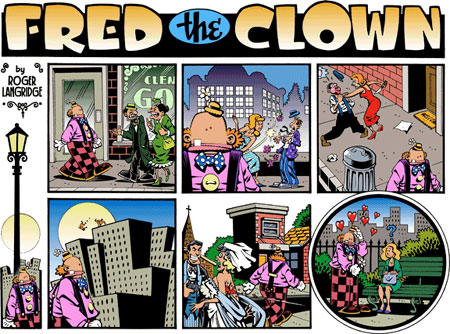
Roger Langridge is a British (New Zealand born) comics and webcomics creator whose mind and pen… well, wander a bit, and delightfully so. He is best know for his whacked-out character Fred the Clown and his webcomic Hotel Fred, both of which are more a playground for Langridge’s fertile imaginings than a coherent story in the usual sense.Langridge has a style that seems “cartoony” on the surface, but is in fact quite sophisticated. His strong clean lines and carefully chosen color (sometimes bright, sometimes in subtle monochromatic palettes) are at once graphically strong and charmingly whimsical; and his drawings are just a treat for anyone who enjoys good comics and cartoon art. His work looks great in black an white too, handled with deft use of patterns and hatchings that show a fine command of the textural language of pen and ink drawing.
Langridge’s comics reveal a genuine fondness for (and knowledge of) the great comics artists of the past. Nowhere is this more evident than in FRED THE CLOWN – An Illustrated History, Langridge’s hilarious and dead-on send-up of every “History of Comic Strips” book or article you’ve every read. The “history” features a pastiche of Fred strips as if done by RF Outcault, Winsor McCay, Max Fleischer, George Herriman and Robert Crumb, among others! His work reveals influences from a host of cartooning and comics greats: E.C. Segar, Cliff Sterrett, Will Elder, Wally Wood, B. Kliban…, the list goes on.
In his affection for the great newspaper strips and comic books of the past, and in his exploration of the paneled language of comics as elements of graphic design, Langridge treads some of the same ground as Chris Ware, but with a decidedly different bent (and bent is the operative word). My mental thesaurus is coughing up words like “zany”, “wacky”, “loopy” and “off the wall” in an ineffectual attempt to describe his excursions into comics’ loonier territory.
The front of Langridge’s web site is a blog. Look to the right for links to comics, and other info, including an interview and bio/checklist.
The Comics page of his site features links to the Fred weekly comics, an archive of his attempt at a daily comic and PDF Minicomics that you can download free. For some of the best stuff, though, pick up on the terrific print versions of his comics, including Fred the Clown, his anthology of stuff from Zoot and The Collected Knuckles the Malevolent Nun. Yowzza!
Categories:
-
Matt Dixon
 I first came across Matt Dixon’s work on the CGSociety site, where he has been a participant in several of their “Challenges“, contests in which computer graphics artists create works that are a response to a particular theme.
The great thing about the Challenges is the the artists document their work at numerous stages during the creation process, effectively creating a sort of tutorial for each work. Here is the finish page for the sequence devoted to the image at left, Dixon’s entry for the “Master and Servant” challenge, for which he took second place for 2-D works after Linda Bergkvist’s elegant entry. (See my previous post about Linda Bergkvist.)
The Challenge feature page for each work is a bit like a blog, with “posts” arranged in reverse chronological sequence. Go to the second page and scroll to the bottom to go through Dixon’s creative process from the initial concept sketch to finished digital painting.
You can also see his digital painting process for The Old Man of the Woods, his entry for the more recent “Spectacular” Challenge theme.
The Challenge features are particularly nice in the case of artists like Dixon, whose own site has galleries of his work and a little bit of background info, but virtually nothing about his working methods.
Grounded in traditional drawing and painting techniques, Dixon now prefers to work entirely digitally. Professionally he does concept art for the gaming industry. There is a list of some of the games he has contributed to on the MobyGames site.
The March 2006 issue of Heavy Metal magazine features gallery of Dixon’s work. He is also a contributor to the Event Horizon 2 anthology from MamTor Publishing.
Categories:
-
Michael Skrepnick
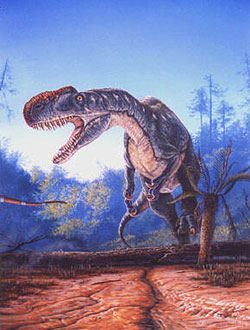 Michael Skrepnick gets to draw and paint fantastic animals that are as wild and bizarre as anything done by any fantasy or science fiction artist, except that the animals he portrays are real, or at least based on the best information we have about real animals that once walked the Earth.
Paleo artists like Skrepnick work with paleontologists to create images of animals long extinct by extrapolating their appearance from the fossil record and from a knowledge of modern animals that share physiological characteristics with the extinct ones. In the case of dinosaurs, this means birds and members of the crocodile family.
Good paleo artists and paleontologists are painstaking in their efforts to recreate these animals faithfully. The fossils give good information about skeletal structure, from which things like muscle mass, size and weight of an animal can be deduced. There is also some information about skin textures. (For color, however, fossils don’t give a clue.) The closer we get to the reality of what dinosaurs actually looked like, the more one thing becomes clear: these were some weird puppies.
Working in graphite or pen and ink for monochromatic works and in acrylic for paintings, Skrepnick portrays prehistoric animals with a clear, sharp and detailed style that reinforces their connection with the real world and recognizable environments and makes their strangeness even more palpable. His dinosaurs are bathed in sunlight, strongly modeled and connected to the ground and the world around them.
His images have appeared in many museums and scientific institutions and in books from a variety of publishers.
There are two galleries in the site, but the images are frustratingly small – not large enough to get a real feeling for the quality and drama of Skrepnick’s work. Try looking for some of the books he has illustrated.
Some titles are: Great Dinosaur Expeditions and Discoveries: Adventures With the Fossil Hunters (Dinosaur Library) (Thom Holmes, Laurie Holmes), Armored, Plated, and Bone-Headed Dinosaurs: The Ankylosaurs, Stegosaurs, and Pachycephalosaurs (The Dinosaur Library) (Thom Holmes, Laurie Holmes), Triceratops: Mighty Three-Horned Dinosaur (I Like Dinosaurs!) (Enslow Publishers), Sinosauropteryx-Mysterious Feathered Dinosaur (I Like Dinosaurs!) (Michael William Skrepnick), and Mesozoic Vertebrate Life: (Indiana University Press), for which the image of Monolophosaurus jiangi, shown here, is the cover.
Categories:
-
Michelangelo’s Drawings
 This sheet of drawings, Michelangelo’s studies for the Libyan Sibyl, perhaps the most beautiful of the figures on the Sistine Chapel ceiling, has always impressed me as a self-contained master course in drawing.
It’s loose, expressive and supremely confident. The draughtsmanship is precise and elegant. The figure is modeled in detail but there is still an economy of line. The tone work is subtle and strong and defines the forms with unquestionable fidelity. The line itself is firm and definite, but almost disappears in places. You can see the remnants of light construction lines where Michelangelo is searching out the form, but when he finds it, he nails it. No question.
The drawing is exquisitely beautiful, and of all of the master drawings I’ve seen in my life it remains one of my absolute favorites, yet it was never meant to be a work of art.
For Michelangelo Buonerroti, as with most artists before the Baroque period, drawing was a tool, a step in the preparation of a final work, whether a painting, sculpture or other work, and not an art form in itself. Drawings were made into woodblocks, engravings or etchings for display as artworks, but the original drawings were seldom considered works in themselves. (Michelangelo burned many of his drawings before his death!)
Michelangelo considered himself a sculptor and not a painter or a draughtsman, yet his drawings are among the most brilliant in the history of art. (Hey, that’s why they call these guys “masters”.)
I’ve had the opportunity to see this drawing in person twice, once in Philadelphia and once in New York, and I was entranced by it both times, coming back to it again and again. Like all works on paper, it can’t be on permanent display and is only shown as part of a temporary exhibition. The original is in the collection of the Metropolitan Museum in NY. You can view it in detail with the zooming feature on their site.
There is a major exhibit titled Michelangelo Drawings: closer to the master at the British Museum in London (this drawing is not part of it) opening this Thursday, March 23rd and running to June 25th, 2006. The exhibit draws on the collections of The Ashmolean and the Teyler Museum in Haarlem as well as the British Museum’s own collection.
There is a gallery connected with the exhibition page, and you can find other selections from their collection including another study for the Sistine ceiling.
You can find some other selections from the exhibit here, some other Michelangelo drawings on the Web Gallery of Art, Casa Buonarroti, and excerpts here from a book published by Yale University Press: Michelangelo Drawings : Closer to the Master (Hugo Chapman).
Categories:



Charley’s Picks
Bookshop.org
(Bookshop.org affilliate links; sales benefit independent bookshop owners; I get a small percentage to help support my work on Lines and Colors)
Carlson’s Guide to Landscape Painting
Drawing and Sketching in Pencil
Bridgman’s Complete Guide to Drawing from Life
Charley’s Picks
Amazon
(Amazon.com affiliate links; sales go to a larger yacht for Jeff Bezos; but I get a small percentage to help support my work on Lines and Colors)
Carlson’s Guide to Landscape Painting
Drawing and Sketching in Pencil
Bridgman’s Complete Guide to Drawing from Life