


Categories
- 3d CGI
- Amusements
- Animation
- Anime & Manga
- Art Materials
- Art Videos
- Blogroll
- Cartoons
- Color
- Comics
- Concept & Visual Dev.
- Creativity
- Digital Art
- Digital Painting
- Displaying Art on the Web
- Drawing
- Eye Candy for Today
- Gallery and Museum Art
- High-res Art Images
- Illustration
- Motion Graphics & Flash
- Museums
- Online Museums
- Outsider Art
- Painting
- Painting a Day
- Paleo Art
- Pastel, Conté & Chalk
- Pen & Ink
- Prints and Printmaking
- Reviews
- Sc-fi and Fantasy
- Sculpture & Dimensional
- Site Comments
- Sketching
- Storyboards
- Tools and Techniques
- Uncategorized
- Vector Art
- Videos & Podcasts
- Vision and Optics
- Watercolor and Gouache
- Webcomics
Archives
- May 2026
- April 2026
- March 2026
- February 2026
- January 2026
- December 2025
- November 2025
- October 2025
- September 2025
- August 2025
- July 2025
- June 2025
- May 2025
- January 2025
- December 2024
- November 2024
- October 2024
- September 2024
- August 2024
- June 2024
- April 2024
- March 2024
- February 2024
- January 2024
- December 2023
- November 2023
- October 2023
- September 2023
- August 2023
- July 2023
- May 2023
- April 2023
- March 2023
- February 2023
- January 2023
- December 2022
- November 2022
- September 2022
- August 2022
- July 2022
- June 2022
- May 2022
- April 2022
- March 2022
- February 2022
- January 2022
- December 2021
- November 2021
- October 2021
- September 2021
- August 2021
- July 2021
- June 2021
- May 2021
- April 2021
- March 2021
- February 2021
- January 2021
- December 2020
- November 2020
- October 2020
- September 2020
- August 2020
- July 2020
- June 2020
- May 2020
- April 2020
- March 2020
- February 2020
- January 2020
- December 2019
- November 2019
- October 2019
- September 2019
- August 2019
- July 2019
- June 2019
- May 2019
- April 2019
- March 2019
- February 2019
- January 2019
- December 2018
- November 2018
- October 2018
- September 2018
- August 2018
- July 2018
- June 2018
- May 2018
- April 2018
- March 2018
- February 2018
- January 2018
- December 2017
- November 2017
- October 2017
- September 2017
- August 2017
- July 2017
- June 2017
- May 2017
- April 2017
- March 2017
- February 2017
- January 2017
- December 2016
- November 2016
- October 2016
- September 2016
- August 2016
- July 2016
- June 2016
- May 2016
- April 2016
- March 2016
- February 2016
- January 2016
- December 2015
- November 2015
- October 2015
- September 2015
- August 2015
- July 2015
- June 2015
- May 2015
- April 2015
- March 2015
- February 2015
- January 2015
- December 2014
- November 2014
- October 2014
- September 2014
- August 2014
- July 2014
- June 2014
- May 2014
- April 2014
- March 2014
- February 2014
- January 2014
- December 2013
- November 2013
- October 2013
- September 2013
- August 2013
- July 2013
- June 2013
- May 2013
- April 2013
- March 2013
- February 2013
- January 2013
- December 2012
- November 2012
- October 2012
- September 2012
- August 2012
- July 2012
- June 2012
- May 2012
- April 2012
- March 2012
- February 2012
- January 2012
- December 2011
- November 2011
- October 2011
- September 2011
- August 2011
- July 2011
- June 2011
- May 2011
- April 2011
- March 2011
- February 2011
- January 2011
- December 2010
- November 2010
- October 2010
- September 2010
- August 2010
- July 2010
- June 2010
- May 2010
- April 2010
- March 2010
- February 2010
- January 2010
- December 2009
- November 2009
- October 2009
- September 2009
- August 2009
- July 2009
- June 2009
- May 2009
- April 2009
- March 2009
- February 2009
- January 2009
- December 2008
- November 2008
- October 2008
- September 2008
- August 2008
- July 2008
- June 2008
- May 2008
- April 2008
- March 2008
- February 2008
- January 2008
- December 2007
- November 2007
- October 2007
- September 2007
- August 2007
- July 2007
- June 2007
- May 2007
- April 2007
- March 2007
- February 2007
- January 2007
- December 2006
- November 2006
- October 2006
- September 2006
- August 2006
- July 2006
- June 2006
- May 2006
- April 2006
- March 2006
- February 2006
- January 2006
- December 2005
- November 2005
- October 2005
- September 2005
- August 2005
Relevant Blogs
Art, Painting & Sketch
- Gurney Journey
- Underpaintings
- Art and Influence
- Painting Perceptions
- Oil Painters of America
- Vasari Paint POV
- Flying Fox
- Urban Sketchers
- Bento (Smithsonian)
- Art Inconnu
- The Hidden Place
- Still Life
- Making a Mark
- The Art of the Landscape
- Exploring Color & Creativity
- Art Contrarian
- Artist A Day
- beinArt Surreal Art Collective
- Eye Level
- David Dunlop
- p.i.g.m.e.n.t.i.u.m
- CultureGrrl
- Joaquín Sorolla blog
- Artists in Pastel
“Painting a Day”
- A Painting a Day (Keiser)
- On Painting (Keiser)
- Julian Merrow-Smith
- Karen Jurick
- Jeffrey Hayes
- Carol Marine
- Abbey Ryan
- Daily Paintworks
Other Painting Blogs
- Virtual Gouache Land
- Neil Hollingsworth
- Marc Hanson
- Kevin Menck
- Marc Dalessio
- Larry Seiler
- Stapleton Kearns
- Colin Page
- Roos Schuring
- Hans Versfelt
- Titus Meeuws
- Régis Pettinari
- René Plein Air
- Belinda Del Pesco
- Robin Weiss
- Nathan Fowkes (Land Sketch)
- William Wray
- Frank Serrano
- Stephen Magsig
- Michael Chesley Johnson
- Twice a Week
- Sarah Wimperis
- Rob Adams
- Michael Cole Manley
- The Dirty Palette Club
- Mike Manley’s Draw!
Gallery Art & Illustration mix
Illustration
- Howard Pyle
- 100 Years of Illustration
- BibliOdyssey
- Illustration Art
- Today’s Inspiration
- Illustration Mundo
- Little Chimp Society
- Danny Gregory
- R D (John Martz
- Illustration Friday blog
- Monster Brains
- Illustrators & Illustrations (RU)
- Elwood H. Smith
- DaniDraws.com
- Designers Who Blog
- iSpot Blog
Sci-Fi & Fantasy
Illustration & Comics
Comics & Cartoons
- Comics Beat
- Robot 6
- Newsarama Blog
- Comic Vine
- Comics Alliance
- Forbidden Planet Int.
- Paolo Rivera
- Bolt City
- Flight
- Scott McCloud
- The Comics Journal
- Comixpedia
- Funnybook Babylon
- James Baker
- Middleton’s Sketchbook
- Boneville
- The Hotel Fred
- Paul Rivoche
- Daily Cartoonist
- Mad About Cartoons (William Wray)
- Digital Strips
Illustration & Concept
Animation & Concept
- Cartoon Brew
- Animation Blog
- Cold Hard Flash
- Concept Art World
- The CAB
- FY Concept Art
- Concept Ships
- Concept Robots
- John Nevarez
- Armand Serrano
- Marcos Mateu-Mestre
- all kinds of stuff (Kricfalusi)
- Yacin the faun (Man Arenas)
- Kelsey Mann
- Cre8tivemarks Blog
- Ice-Cream Monster Toon Cafe
- AAU Character & Creature Design
- AAU Animation Notes
- Articles and Texticles
Paleo & Scientific
Tools & Techniques
Other
Lists of Art Blogs
Art Image Resource Links
Historic Art Images
- Wikimedia Commons: Paintings
- Wikimedia Commons: Drawings
- The Athenaeum
- WikiArt (WikiPaintings)
- Google Art Project: Artists
- Google Art Project: Collections (Museums)
- ArtCyclopedia
- Web Gallery of Art
- Art Renewal Center
- Web Gallery of Impressionism
Auction Consolidation sites
Auction sites
- Sotheby’s
- Bonham’s
- Christies
- Heritage Auctions: Fine Art
- Heritage Auctions: Illustration
- Freeman’s Auctions
- Bukowskis
- Shannon’s
Image Search
Reverse Image Search (search by image)
- Tin Eye
- RevImg
- Google Image Search (camera icon)
- Bing Image Search (camera icon)
Promoting some friends and some clients of my website design business
- Twin Willows T’ai Chi studio in Wilmington DE. Taiji classes with Bryan Davis.
- Ray Hayward, Inspired Teacher of T’ai Chi ( Taiji ) in Minneapolis, Founder of Mindful Motion Tai Chi Academy
- OldHead Tattoo studio and Art Gallery in Wilmington DE. Tattoos and paintings by Bruce Gulick
- Sharon Domenico Art, pet portrait oil paintings
- Platinum Paperhanging, wallpaper hanging, Main Line and Philadelphia, PA
- Lisa Stone Design, interior designer, Main Line and Philadelphia, PA
- Studio12KPT, original art, prints, calendars and other custom printed items by Van Sickle & Rolleri
-
Jon Sullivan

I know little about illustrator Jon Sullivan, except that he has done numerous science fiction and fantasy themed illustrations and covers for companies like TSR and Tor.His scenes of dragons, aliens, warriors, beasts and the landscapes of strange worlds are ablaze with fiery electric color, brilliant lights, arcs of electricity and the neon glow of futuristic technology.
Sullivan uses lots of contrasting complimentary colors to punch up the intensity of his hues, along with juxtapositions of sharp value contrasts. In some images he also utilizes a limited palette with the attention drawn to limited passages of one or two high chroma colors.
Everything is in the service of drama and the suggestion of epic struggles, which is part fo the great fun in this kind of fantasy illustration.
The galleries on his site are unfortunately a bit awkward to navigate. There are several galleries of thumbnails that can be clicked on for larger images. Some of them reward subsequent clicks with larger images or detail crops, while others return you to the thumbnails, and some of them return you to a different thumbnail page than the one from which you first accessed the image, making it difficult to systematically look through the images.
There is also a Flickr set of his illustrations, and a smaller gallery accompanying an article on io9.
Categories:
-
Armand S. Baltazar

Armand Baltazar is a concept artist, illustrator and gallery artist based in California.Originally from Chicago, he studied at the Art Institute of Chicago, Northern Illinois University and after a time working in advertising, went on to to earn a second BFA in illustration from the Art Center College of Design in Pasadena.
His animation concept art credits include Prince of Egypt, The Road to Eldorado, Sinbad, Shark Tale and Flushed Away.
His online portfolio is divided into sections for animation, illustration and fine art. In the latter two you will find examples of a rough textured painterly stye that is a wonderful counterpoint to his more refined concept and illustration pieces.
His gallery paintings include figure painting and drawings as well as subjects like farm machinery and trains.
Categories:
-
Joseph Kleitsch

Like many of the painters associated with “California Impressionism” in the early part of the 20th Century, Joseph Kleitsch came from outside California, in his case originally form Hungary.Kleitsch came to the U.S. in 1901, settled in Ohio and eventually Kansas, Mexico City and Chicago before finding his way to Laguna Beach California in 1920. Along the way he became a well established portrait painter, and received high praise for his portraits and interior scenes.
During his time in California he developed a bright, high-chroma style rich with painterly flourish and broken color. In the mid-1920s, Kleitsch traveled to Europe for two years, on his return bringing expressionist colors and distortions into his work.
Categories:
-
Sistine Chapel Panorama

When I was in Rome a few years ago two things were at the top of my “must see” list. One was the Galleria Borghese and its wonderful collection (see my posts on Titian and Bernini), the other was the Vatican Museum and, in particular, the Sistine Chapel and Michelangelo’s stunning frescos.Following the advice of a guidebook we arrived at the Vatican early and worked through the museum quickly, not pausing to linger over the other works (not easy to do), and got to the chapel before it filled up with its usual shoulder to shoulder carpet of bent neck tourists. By being among the first to arrive in the chapel we were able to walk around the space freely, viewing perhaps the most astonishingly adorned interior space in the world at our leisure.
(We then got back in line and went through the museum again, a process with which my companions were less than pleased. The museum is arranged in a kind of single file, one way march through the rooms, almost like a Disney attraction, and is not conducive to wandering freely.)
Even viewing the Sistine Chapel without the crowds has its limitations, though; the bent-neck viewing angle is only comfortable for a short time, and management doesn’t encourage you to bring in chaise lounges and binoculars.
For the next best thing to that experience, you can visit the Vatican’s “Virtual Visit of the Sistine Chapel“, a VR interactive that drops you into the middle of the chapel (empty of visitors), and allows you to pan around, and of course up, thorugh the entire space, and zoom in on any section.
While this may not be the best way to view individual elements (for that, visit the Web Gallery of Art, and their section on the ceiling frescoes), it’s a fascinating way to get a feeling for the space and the relative size of the images on the ceiling and walls.
As I did when actually there, I focused on the prophets and sibyls, which I think are some of the most beautiful of Michelangelo’s painted figures; in particular the Libyan Sibyl, above, for which his preparatory drawings are absolutely beautiful, and among my favorites in the history of art.
When viewing the panorama (which is in Flash), you may find it helpful to try the two different modes of motion provided by the “Change Mouse Mode” Button (the “M” next to the plus and minus at lower left).
Unfortunately, I found the rest of the Sistine Chapel section of the Vatican Museum’s online collections less rewarding, and difficult to navigate (despite the hand of God pointing to the top level navigation elements).
[Via Jason Kottke]
Categories:
-
Michele Harvey
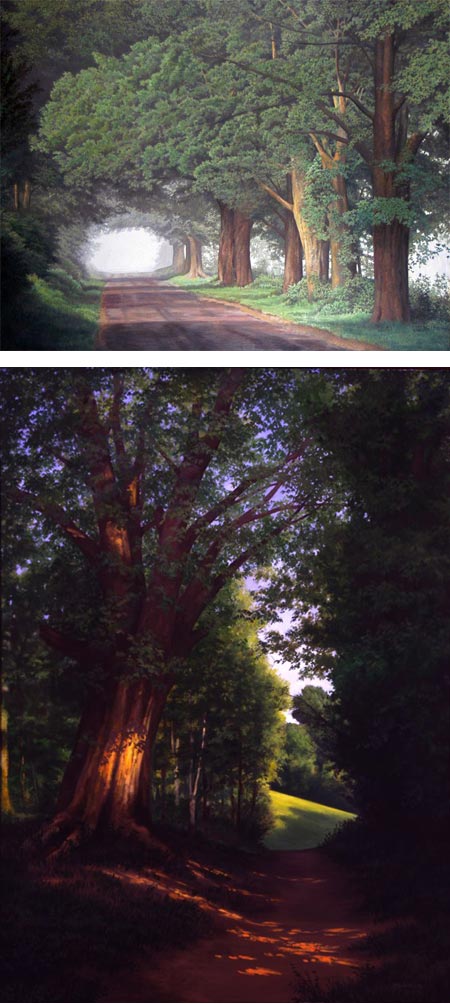
Michele Harvey is a painter who spends at least part of her time in a studio in upstate New York.Her paintings of the area are large in scale, rich in detail and texture and often have an air of quiet mystery. Trunks or crowns of trees, sharply focused in the foreground, frequently are set against backgrounds in which more distant parts of the landscape gradually dissolve into mist or fog, inviting the viewer to step forward into the image in search of more visual treasures to be revealed.
In some ways the two images I’ve chosen to show here are atypical, but I happened to find them particularly compelling.
Harvey also does severely horizontal landscapes with broader views, as well as a series of triptychs. The latter sometimes are of three directly related images, but often have a central image flanked by two images closely related to each other, but different in composition and tone from the central image. In those there is still a relationship between the center and side images, perhaps suggesting that they are different views from the same spot, or just scenes from the same area on the same day.
The fact that they prompt questions is part of the appeal of Harvey’s paintings. Even in those in which the focus is sharp and the color brighter, there are suggestions of questions to be answered and mysteries to be explored, if only one could step into the painting and walk down the offered path.
Harvey’s work is currently on exhibit in the area where may of her pieces are set, near Cooperstown, New York.
The Fenimore Art Museum in Cooperstown is showing Watermark: Michelle Harvey & Glimmerglass from now until December 31, 2010.
Glimmerglass is a state park in the area, and is on the banks of Ostego Lake, which was the “Glimmerglass” in James Fenimore Cooper’s series of novels, Leatherstocking Tales.
Categories:
-
Taylor Jones

Taylor Jones is a caricaturist, illustrator and political cartoonist who is a regular contributor to EL Nuevo Dia, a newspaper based in Guaynbo, Puerto Rico.He has adopted a nicely traditional cross-hatch pen and ink drawing style (like David Levine, looking back to the pen and ink illustrators of the late 19th Century) that he wields with aplomb while portraying and often skewering popular political and entertainment figures of the day.
He often produces color versions of his drawings which he accents with judicious touches of watercolor, enough to enliven the image while still leaving the appealing characteristics of the pen and ink drawing.
Jones’ web site has a modest gallery of his work, as well as a home page image that is replaced, according to him, “…daily, weekly, or whenever I feel like it”. You can find more of his work on Daryl Cagle’s Political Cartoonists Index (see my post on Daryl Cagle’s Professional Cartoonist Index). It’s not as obvious as it should be, but down amid the icons and stuff under the image are arrows for browsing through recent cartoons, as well as a drop-down menu for selecting a particular date.
In addition there is a selection of his illustrations on the Cagle.com site.
You can also go to the “Search For a Cartoon” page and search for Taylor Jones, for access to dozens of his cartoons (offered in both color and black and white versions).
Jones maintains his blog on the Cagle.com site. The blog covers a variety of topics, and the posts are always accompanied by one or more of his cartoon illustrations.
Categories:




Charley’s Picks
Bookshop.org
(Bookshop.org affilliate links; sales benefit independent bookshop owners; I get a small percentage to help support my work on Lines and Colors)

John Singer Sargent: Watercolors


Urban Sketching: Understanding Perspective


Charley’s Picks
Amazon
(Amazon.com affiliate links; sales go to a larger yacht for Jeff Bezos; but I get a small percentage to help support my work on Lines and Colors)
John Singer Sargent: Watercolors
Urban Sketching: Understanding Perspective