


Categories
- 3d CGI
- Amusements
- Animation
- Anime & Manga
- Art Materials
- Art Videos
- Blogroll
- Cartoons
- Color
- Comics
- Concept & Visual Dev.
- Creativity
- Digital Art
- Digital Painting
- Displaying Art on the Web
- Drawing
- Eye Candy for Today
- Gallery and Museum Art
- High-res Art Images
- Illustration
- Motion Graphics & Flash
- Museums
- Online Museums
- Outsider Art
- Painting
- Painting a Day
- Paleo Art
- Pastel, Conté & Chalk
- Pen & Ink
- Prints and Printmaking
- Reviews
- Sc-fi and Fantasy
- Sculpture & Dimensional
- Site Comments
- Sketching
- Storyboards
- Tools and Techniques
- Uncategorized
- Vector Art
- Videos & Podcasts
- Vision and Optics
- Watercolor and Gouache
- Webcomics
Archives
- May 2026
- April 2026
- March 2026
- February 2026
- January 2026
- December 2025
- November 2025
- October 2025
- September 2025
- August 2025
- July 2025
- June 2025
- May 2025
- January 2025
- December 2024
- November 2024
- October 2024
- September 2024
- August 2024
- June 2024
- April 2024
- March 2024
- February 2024
- January 2024
- December 2023
- November 2023
- October 2023
- September 2023
- August 2023
- July 2023
- May 2023
- April 2023
- March 2023
- February 2023
- January 2023
- December 2022
- November 2022
- September 2022
- August 2022
- July 2022
- June 2022
- May 2022
- April 2022
- March 2022
- February 2022
- January 2022
- December 2021
- November 2021
- October 2021
- September 2021
- August 2021
- July 2021
- June 2021
- May 2021
- April 2021
- March 2021
- February 2021
- January 2021
- December 2020
- November 2020
- October 2020
- September 2020
- August 2020
- July 2020
- June 2020
- May 2020
- April 2020
- March 2020
- February 2020
- January 2020
- December 2019
- November 2019
- October 2019
- September 2019
- August 2019
- July 2019
- June 2019
- May 2019
- April 2019
- March 2019
- February 2019
- January 2019
- December 2018
- November 2018
- October 2018
- September 2018
- August 2018
- July 2018
- June 2018
- May 2018
- April 2018
- March 2018
- February 2018
- January 2018
- December 2017
- November 2017
- October 2017
- September 2017
- August 2017
- July 2017
- June 2017
- May 2017
- April 2017
- March 2017
- February 2017
- January 2017
- December 2016
- November 2016
- October 2016
- September 2016
- August 2016
- July 2016
- June 2016
- May 2016
- April 2016
- March 2016
- February 2016
- January 2016
- December 2015
- November 2015
- October 2015
- September 2015
- August 2015
- July 2015
- June 2015
- May 2015
- April 2015
- March 2015
- February 2015
- January 2015
- December 2014
- November 2014
- October 2014
- September 2014
- August 2014
- July 2014
- June 2014
- May 2014
- April 2014
- March 2014
- February 2014
- January 2014
- December 2013
- November 2013
- October 2013
- September 2013
- August 2013
- July 2013
- June 2013
- May 2013
- April 2013
- March 2013
- February 2013
- January 2013
- December 2012
- November 2012
- October 2012
- September 2012
- August 2012
- July 2012
- June 2012
- May 2012
- April 2012
- March 2012
- February 2012
- January 2012
- December 2011
- November 2011
- October 2011
- September 2011
- August 2011
- July 2011
- June 2011
- May 2011
- April 2011
- March 2011
- February 2011
- January 2011
- December 2010
- November 2010
- October 2010
- September 2010
- August 2010
- July 2010
- June 2010
- May 2010
- April 2010
- March 2010
- February 2010
- January 2010
- December 2009
- November 2009
- October 2009
- September 2009
- August 2009
- July 2009
- June 2009
- May 2009
- April 2009
- March 2009
- February 2009
- January 2009
- December 2008
- November 2008
- October 2008
- September 2008
- August 2008
- July 2008
- June 2008
- May 2008
- April 2008
- March 2008
- February 2008
- January 2008
- December 2007
- November 2007
- October 2007
- September 2007
- August 2007
- July 2007
- June 2007
- May 2007
- April 2007
- March 2007
- February 2007
- January 2007
- December 2006
- November 2006
- October 2006
- September 2006
- August 2006
- July 2006
- June 2006
- May 2006
- April 2006
- March 2006
- February 2006
- January 2006
- December 2005
- November 2005
- October 2005
- September 2005
- August 2005
Relevant Blogs
Art, Painting & Sketch
- Gurney Journey
- Underpaintings
- Art and Influence
- Painting Perceptions
- Oil Painters of America
- Vasari Paint POV
- Flying Fox
- Urban Sketchers
- Bento (Smithsonian)
- Art Inconnu
- The Hidden Place
- Still Life
- Making a Mark
- The Art of the Landscape
- Exploring Color & Creativity
- Art Contrarian
- Artist A Day
- beinArt Surreal Art Collective
- Eye Level
- David Dunlop
- p.i.g.m.e.n.t.i.u.m
- CultureGrrl
- Joaquín Sorolla blog
- Artists in Pastel
“Painting a Day”
- A Painting a Day (Keiser)
- On Painting (Keiser)
- Julian Merrow-Smith
- Karen Jurick
- Jeffrey Hayes
- Carol Marine
- Abbey Ryan
- Daily Paintworks
Other Painting Blogs
- Virtual Gouache Land
- Neil Hollingsworth
- Marc Hanson
- Kevin Menck
- Marc Dalessio
- Larry Seiler
- Stapleton Kearns
- Colin Page
- Roos Schuring
- Hans Versfelt
- Titus Meeuws
- Régis Pettinari
- René Plein Air
- Belinda Del Pesco
- Robin Weiss
- Nathan Fowkes (Land Sketch)
- William Wray
- Frank Serrano
- Stephen Magsig
- Michael Chesley Johnson
- Twice a Week
- Sarah Wimperis
- Rob Adams
- Michael Cole Manley
- The Dirty Palette Club
- Mike Manley’s Draw!
Gallery Art & Illustration mix
Illustration
- Howard Pyle
- 100 Years of Illustration
- BibliOdyssey
- Illustration Art
- Today’s Inspiration
- Illustration Mundo
- Little Chimp Society
- Danny Gregory
- R D (John Martz
- Illustration Friday blog
- Monster Brains
- Illustrators & Illustrations (RU)
- Elwood H. Smith
- DaniDraws.com
- Designers Who Blog
- iSpot Blog
Sci-Fi & Fantasy
Illustration & Comics
Comics & Cartoons
- Comics Beat
- Robot 6
- Newsarama Blog
- Comic Vine
- Comics Alliance
- Forbidden Planet Int.
- Paolo Rivera
- Bolt City
- Flight
- Scott McCloud
- The Comics Journal
- Comixpedia
- Funnybook Babylon
- James Baker
- Middleton’s Sketchbook
- Boneville
- The Hotel Fred
- Paul Rivoche
- Daily Cartoonist
- Mad About Cartoons (William Wray)
- Digital Strips
Illustration & Concept
Animation & Concept
- Cartoon Brew
- Animation Blog
- Cold Hard Flash
- Concept Art World
- The CAB
- FY Concept Art
- Concept Ships
- Concept Robots
- John Nevarez
- Armand Serrano
- Marcos Mateu-Mestre
- all kinds of stuff (Kricfalusi)
- Yacin the faun (Man Arenas)
- Kelsey Mann
- Cre8tivemarks Blog
- Ice-Cream Monster Toon Cafe
- AAU Character & Creature Design
- AAU Animation Notes
- Articles and Texticles
Paleo & Scientific
Tools & Techniques
Other
Lists of Art Blogs
Art Image Resource Links
Historic Art Images
- Wikimedia Commons: Paintings
- Wikimedia Commons: Drawings
- The Athenaeum
- WikiArt (WikiPaintings)
- Google Art Project: Artists
- Google Art Project: Collections (Museums)
- ArtCyclopedia
- Web Gallery of Art
- Art Renewal Center
- Web Gallery of Impressionism
Auction Consolidation sites
Auction sites
- Sotheby’s
- Bonham’s
- Christies
- Heritage Auctions: Fine Art
- Heritage Auctions: Illustration
- Freeman’s Auctions
- Bukowskis
- Shannon’s
Image Search
Reverse Image Search (search by image)
- Tin Eye
- RevImg
- Google Image Search (camera icon)
- Bing Image Search (camera icon)
Promoting some friends and some clients of my website design business
- Twin Willows T’ai Chi studio in Wilmington DE. Taiji classes with Bryan Davis.
- Ray Hayward, Inspired Teacher of T’ai Chi ( Taiji ) in Minneapolis, Founder of Mindful Motion Tai Chi Academy
- OldHead Tattoo studio and Art Gallery in Wilmington DE. Tattoos and paintings by Bruce Gulick
- Sharon Domenico Art, pet portrait oil paintings
- Platinum Paperhanging, wallpaper hanging, Main Line and Philadelphia, PA
- Lisa Stone Design, interior designer, Main Line and Philadelphia, PA
- Studio12KPT, original art, prints, calendars and other custom printed items by Van Sickle & Rolleri
-
Steven Assael

Steven Assael is a New York artist who paints and draws figurative works that feel simultaneously sharply focused and viscerally textured.Assael also looks for texture of another sort, in the vivid personalities of his subjects, often drawn from the enthusiasts in the body art subculture and carrying their own secondary visual texture in the form of tattoos, interesting piercings and a bit of costume.
He also takes on more mundane subjects, but sets them off in thought provoking compositions, like his dreamily posed Bride I (above, with detail) in which the bride seems to float, as if buoyed by an invisible, curved body of water.
Asael works from life, eschewing photographic reference for the experience of painting from life, and the more direct and acute observation it affords.
His subjects can also be straightforward portrait or figure paintings in addition to his more formally arranged compositions, but there is always a feeling of a pause, a contemplative suspension of time, in his portrayals.
Of particular interest to me are his drawings, both life studies and portraits, with their subtle line, carefully observed tone and an ability to capture a feeling of the sitter’s character.
Asrael studied at Pratt Institute, including independent study in Europe on a Pratt Scholarship, and currently teaches at both Pratt and the School of Visual Art in New York.
There is currently a show of his work at the Forum Gallery in New York that runs until May 2, 2009.
There is a book of his drawings, a collection of paintings, and an earlier collection of both paintings and drawings; all out of print, I think, but sometimes available through Amazon and other book search services.
[Via Art Knowledge News]
Note: Some of the images in the sites linked below should be considered NSFW.
Categories:
-
Wall Art Acura TV Spot
 Working with lead artists David Whittle and Sainty (Henry St. Leger), who are known as street artists, directors Ben Foley and Chris Hopewell created a 30 second television commercial for Acura called Wall Art in which the car is shown in an animated environment.
What you might assume at first to be CGI, compositing the car image into cartoon drawings done on paper or in a computer graphics program and composited together in the usual computer special effects suites, is instead a completely different approach, in which the images themselves are drawn, life size, on huge 60′ x 40′ (18m x 12m) canvases.
The canvases were drawn, painted over and redrawn, as if they were enormous animation cell backgrounds, and other elements were drawn on the floor and even on the car itself, animating a life-size driver and the images of birds as seen from above against the car.
Even the apparent turn of a corner that goes by at one point is hand drawn animation. All of the apparent motion is in the drawn animations and the position of the camera. The car never moves.
(It brings to mind the remarkable MUTO wall animation I wrote about in March.)
The Acura Wall Art shoot took 17 painters and 240 hours of shooting over ten days. There is a “making of” video on the t5m.com site, that includes the final 30 second spot at the end.
Categories:
-
Theft of the Mona Lisa

In 1911, Leonardo da Vinci’s portrait of a noblewoman, titled Portrait of Lisa Gherardini, wife of Francesco del Giocondo, sometimes titled La Gioconda, and known popularly as the Mona Lisa, was stolen from its place in the Louvre in Paris.The event caused an enormous stir, eclipsing for a time talk of an impending war, and was the focus of much attention worldwide; until the crime was apparently solved 28 months later with the apprehension of the thief and the return of the famous painting to its former space.
When I say “apparently solved”, I don’t mean to imply that the painting returned was not the original, that was established without doubt; but Dorothy and Thomas Hoobler, in their book The Crimes of Paris: A True Story of Murder, Theft, and Detection, suggest that there was more to the theft than was apparent, and that the true crime went unsolved.
Stealing Mona Lisa is excerpted on the Vanity Fair site and makes for an interesting read.
If it’s true, I only have this to say about the real “victims” of the crime — it couldn’t have happened to a more appropriate bunch of selfish creeps.
[Via Kottke.org]
Categories:
-
Carter Hodgkin
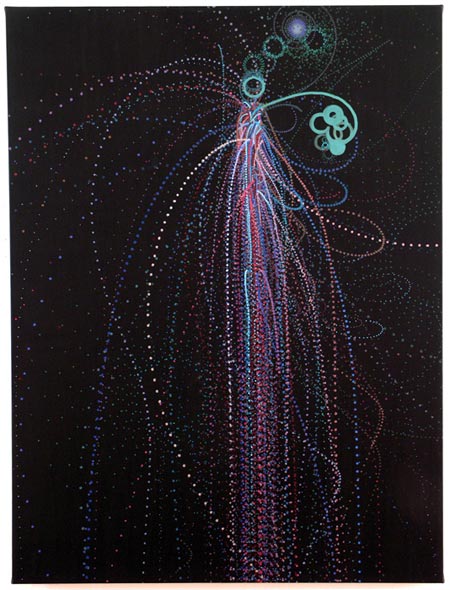
From a comment on my previous post about Fractal Images (thanks, Cedra), I learned of Carter Hodgkin, an artist working on one of those wonderfully fuzzy borders between art and science.Hodgkin’s paintings, drawings and prints are inspired by the tracings of “exotic” particles, strange bits of matter born in the miniature cataclysms created in the bubble chambers (or “cloud chambers”, I love that phrase) in the heart of the great atom smashers like the Tevatron at Fermilab or the Large Hadron Collider.
These particles, the examination of which is one of the gateways to our understanding of the fundamental nature of space/time, exist for only the briefest blips of time, increments so small they defy understanding.
The tracks that trace their fleeting expression in this world are the paths they take out of the collision, usually in graceful spirals and curves with their own strange beauty (you can see a couple of actual images here and here).
Taking these spirals, curves and lines as a starting point, Hodgkin creates images that are partly digital, then inkjet printed at a fairly large scale and painted into with oil enamel or watercolor.
The resultant images carry some of the mathematical geometry of the original cloud chamber inspiration, imbued with the artist’s range of color and value choices, and are somewhere in between representational and non-representational, as well as in between art an science, and in between nature and imagination.
Categories:
-
60 Fractal Images

I just love fractal generated images. These computer based images, crafted out of mathematical formulae, carry with them some of the visual characteristics of both natural forms and of abstract mathematical beauty. At their best, they resonate with a brain-tingling hint of infinity.Dainis Graveris has collected 60 prime examples, in this case all generated using a freeeware flame fractal program called Apophysis (Windows only, unfortunately), and posted them on the 1stWebdesigner blog. The article is listed as “Part 1”, with the rest presumably to follow soon.
Many of the images are linked to larger versions, frequently on deviantART, that show some of their intricately recursive worlds-within-worlds details (see the detail of the last image, above).
Credits, in this case, are often just screen names. (Images above, Gibson125, babymilk and parablev.)
For more on fractal images, see my previous posts listed below, particularly my article on Benoit Mandelbrot.
Update Part 2 has been posted and is a list of links to 33 Apophysis tutorials.
Categories:
-
George Loftus Noyes

George Loftus Noyes was an American painter, born in Canada of American parents, who started painting at an early age, and became a noted landscape painter in the Boston area just after the turn of the 20th Century.Noyes studied with English artist George Bartlett in Boston, and later studied in Paris at the ateliers of Gustave Courtois, Joseph-Paul Blanc and Paul-Louis Delance. It was there that he joined in the new enthusiasm among French painters for painting “en plein air“, and was undoubtedly influenced by the French Impressionist works making headlines at the time.
Noyes was able to exhibit successfully at the Paris Salon, and on his return to Boston, established himself as a landscape painter, painting many coastal paintings. Noyes was one of the first painters to paint Cape Cod. He also painted in the mountains of New Hampshire and Vermont.
Noyes is generally mentioned in association the the Boston School, though I can’t find any indication if he was in direct contact with artists of “The Ten American Painters” like Tarbell or Twatchman, of if he was in contact with the Cos Cob or Old Lyme art colonies.
He did travel and and paint with Frederic Edwin Chruch, including a painting trip to Mexico.
Noyes was also a teacher, whose Summer class students included Henry Peck, Clifford Warren Ashley and N.C. Wyeth.
Tragically, much of his work was lost in a barn fire. I’ve found a few reproductions showing a bit of variety in his approach over time. In the image above, The Gorge, which I assume is of the mountains in New England, he reminds me a bit of Daniel Garber’s paintings of the Pennsylvania countryside.
Categories:




Charley’s Picks
Bookshop.org
(Bookshop.org affilliate links; sales benefit independent bookshop owners; I get a small percentage to help support my work on Lines and Colors)

John Singer Sargent: Watercolors


Urban Sketching: Understanding Perspective


Charley’s Picks
Amazon
(Amazon.com affiliate links; sales go to a larger yacht for Jeff Bezos; but I get a small percentage to help support my work on Lines and Colors)
John Singer Sargent: Watercolors
Urban Sketching: Understanding Perspective