


Categories
- 3d CGI
- Amusements
- Animation
- Anime & Manga
- Art Materials
- Art Videos
- Blogroll
- Cartoons
- Color
- Comics
- Concept & Visual Dev.
- Creativity
- Digital Art
- Digital Painting
- Displaying Art on the Web
- Drawing
- Eye Candy for Today
- Gallery and Museum Art
- High-res Art Images
- Illustration
- Motion Graphics & Flash
- Museums
- Online Museums
- Outsider Art
- Painting
- Painting a Day
- Paleo Art
- Pastel, Conté & Chalk
- Pen & Ink
- Prints and Printmaking
- Reviews
- Sc-fi and Fantasy
- Sculpture & Dimensional
- Site Comments
- Sketching
- Storyboards
- Tools and Techniques
- Uncategorized
- Vector Art
- Videos & Podcasts
- Vision and Optics
- Watercolor and Gouache
- Webcomics
Archives
- May 2026
- April 2026
- March 2026
- February 2026
- January 2026
- December 2025
- November 2025
- October 2025
- September 2025
- August 2025
- July 2025
- June 2025
- May 2025
- January 2025
- December 2024
- November 2024
- October 2024
- September 2024
- August 2024
- June 2024
- April 2024
- March 2024
- February 2024
- January 2024
- December 2023
- November 2023
- October 2023
- September 2023
- August 2023
- July 2023
- May 2023
- April 2023
- March 2023
- February 2023
- January 2023
- December 2022
- November 2022
- September 2022
- August 2022
- July 2022
- June 2022
- May 2022
- April 2022
- March 2022
- February 2022
- January 2022
- December 2021
- November 2021
- October 2021
- September 2021
- August 2021
- July 2021
- June 2021
- May 2021
- April 2021
- March 2021
- February 2021
- January 2021
- December 2020
- November 2020
- October 2020
- September 2020
- August 2020
- July 2020
- June 2020
- May 2020
- April 2020
- March 2020
- February 2020
- January 2020
- December 2019
- November 2019
- October 2019
- September 2019
- August 2019
- July 2019
- June 2019
- May 2019
- April 2019
- March 2019
- February 2019
- January 2019
- December 2018
- November 2018
- October 2018
- September 2018
- August 2018
- July 2018
- June 2018
- May 2018
- April 2018
- March 2018
- February 2018
- January 2018
- December 2017
- November 2017
- October 2017
- September 2017
- August 2017
- July 2017
- June 2017
- May 2017
- April 2017
- March 2017
- February 2017
- January 2017
- December 2016
- November 2016
- October 2016
- September 2016
- August 2016
- July 2016
- June 2016
- May 2016
- April 2016
- March 2016
- February 2016
- January 2016
- December 2015
- November 2015
- October 2015
- September 2015
- August 2015
- July 2015
- June 2015
- May 2015
- April 2015
- March 2015
- February 2015
- January 2015
- December 2014
- November 2014
- October 2014
- September 2014
- August 2014
- July 2014
- June 2014
- May 2014
- April 2014
- March 2014
- February 2014
- January 2014
- December 2013
- November 2013
- October 2013
- September 2013
- August 2013
- July 2013
- June 2013
- May 2013
- April 2013
- March 2013
- February 2013
- January 2013
- December 2012
- November 2012
- October 2012
- September 2012
- August 2012
- July 2012
- June 2012
- May 2012
- April 2012
- March 2012
- February 2012
- January 2012
- December 2011
- November 2011
- October 2011
- September 2011
- August 2011
- July 2011
- June 2011
- May 2011
- April 2011
- March 2011
- February 2011
- January 2011
- December 2010
- November 2010
- October 2010
- September 2010
- August 2010
- July 2010
- June 2010
- May 2010
- April 2010
- March 2010
- February 2010
- January 2010
- December 2009
- November 2009
- October 2009
- September 2009
- August 2009
- July 2009
- June 2009
- May 2009
- April 2009
- March 2009
- February 2009
- January 2009
- December 2008
- November 2008
- October 2008
- September 2008
- August 2008
- July 2008
- June 2008
- May 2008
- April 2008
- March 2008
- February 2008
- January 2008
- December 2007
- November 2007
- October 2007
- September 2007
- August 2007
- July 2007
- June 2007
- May 2007
- April 2007
- March 2007
- February 2007
- January 2007
- December 2006
- November 2006
- October 2006
- September 2006
- August 2006
- July 2006
- June 2006
- May 2006
- April 2006
- March 2006
- February 2006
- January 2006
- December 2005
- November 2005
- October 2005
- September 2005
- August 2005
Relevant Blogs
Art, Painting & Sketch
- Gurney Journey
- Underpaintings
- Art and Influence
- Painting Perceptions
- Oil Painters of America
- Vasari Paint POV
- Flying Fox
- Urban Sketchers
- Bento (Smithsonian)
- Art Inconnu
- The Hidden Place
- Still Life
- Making a Mark
- The Art of the Landscape
- Exploring Color & Creativity
- Art Contrarian
- Artist A Day
- beinArt Surreal Art Collective
- Eye Level
- David Dunlop
- p.i.g.m.e.n.t.i.u.m
- CultureGrrl
- Joaquín Sorolla blog
- Artists in Pastel
“Painting a Day”
- A Painting a Day (Keiser)
- On Painting (Keiser)
- Julian Merrow-Smith
- Karen Jurick
- Jeffrey Hayes
- Carol Marine
- Abbey Ryan
- Daily Paintworks
Other Painting Blogs
- Virtual Gouache Land
- Neil Hollingsworth
- Marc Hanson
- Kevin Menck
- Marc Dalessio
- Larry Seiler
- Stapleton Kearns
- Colin Page
- Roos Schuring
- Hans Versfelt
- Titus Meeuws
- Régis Pettinari
- René Plein Air
- Belinda Del Pesco
- Robin Weiss
- Nathan Fowkes (Land Sketch)
- William Wray
- Frank Serrano
- Stephen Magsig
- Michael Chesley Johnson
- Twice a Week
- Sarah Wimperis
- Rob Adams
- Michael Cole Manley
- The Dirty Palette Club
- Mike Manley’s Draw!
Gallery Art & Illustration mix
Illustration
- Howard Pyle
- 100 Years of Illustration
- BibliOdyssey
- Illustration Art
- Today’s Inspiration
- Illustration Mundo
- Little Chimp Society
- Danny Gregory
- R D (John Martz
- Illustration Friday blog
- Monster Brains
- Illustrators & Illustrations (RU)
- Elwood H. Smith
- DaniDraws.com
- Designers Who Blog
- iSpot Blog
Sci-Fi & Fantasy
Illustration & Comics
Comics & Cartoons
- Comics Beat
- Robot 6
- Newsarama Blog
- Comic Vine
- Comics Alliance
- Forbidden Planet Int.
- Paolo Rivera
- Bolt City
- Flight
- Scott McCloud
- The Comics Journal
- Comixpedia
- Funnybook Babylon
- James Baker
- Middleton’s Sketchbook
- Boneville
- The Hotel Fred
- Paul Rivoche
- Daily Cartoonist
- Mad About Cartoons (William Wray)
- Digital Strips
Illustration & Concept
Animation & Concept
- Cartoon Brew
- Animation Blog
- Cold Hard Flash
- Concept Art World
- The CAB
- FY Concept Art
- Concept Ships
- Concept Robots
- John Nevarez
- Armand Serrano
- Marcos Mateu-Mestre
- all kinds of stuff (Kricfalusi)
- Yacin the faun (Man Arenas)
- Kelsey Mann
- Cre8tivemarks Blog
- Ice-Cream Monster Toon Cafe
- AAU Character & Creature Design
- AAU Animation Notes
- Articles and Texticles
Paleo & Scientific
Tools & Techniques
Other
Lists of Art Blogs
Art Image Resource Links
Historic Art Images
- Wikimedia Commons: Paintings
- Wikimedia Commons: Drawings
- The Athenaeum
- WikiArt (WikiPaintings)
- Google Art Project: Artists
- Google Art Project: Collections (Museums)
- ArtCyclopedia
- Web Gallery of Art
- Art Renewal Center
- Web Gallery of Impressionism
Auction Consolidation sites
Auction sites
- Sotheby’s
- Bonham’s
- Christies
- Heritage Auctions: Fine Art
- Heritage Auctions: Illustration
- Freeman’s Auctions
- Bukowskis
- Shannon’s
Image Search
Reverse Image Search (search by image)
- Tin Eye
- RevImg
- Google Image Search (camera icon)
- Bing Image Search (camera icon)
Promoting some friends and some clients of my website design business
- Twin Willows T’ai Chi studio in Wilmington DE. Taiji classes with Bryan Davis.
- Ray Hayward, Inspired Teacher of T’ai Chi ( Taiji ) in Minneapolis, Founder of Mindful Motion Tai Chi Academy
- OldHead Tattoo studio and Art Gallery in Wilmington DE. Tattoos and paintings by Bruce Gulick
- Sharon Domenico Art, pet portrait oil paintings
- Platinum Paperhanging, wallpaper hanging, Main Line and Philadelphia, PA
- Lisa Stone Design, interior designer, Main Line and Philadelphia, PA
- Studio12KPT, original art, prints, calendars and other custom printed items by Van Sickle & Rolleri
-
Liz Lomax
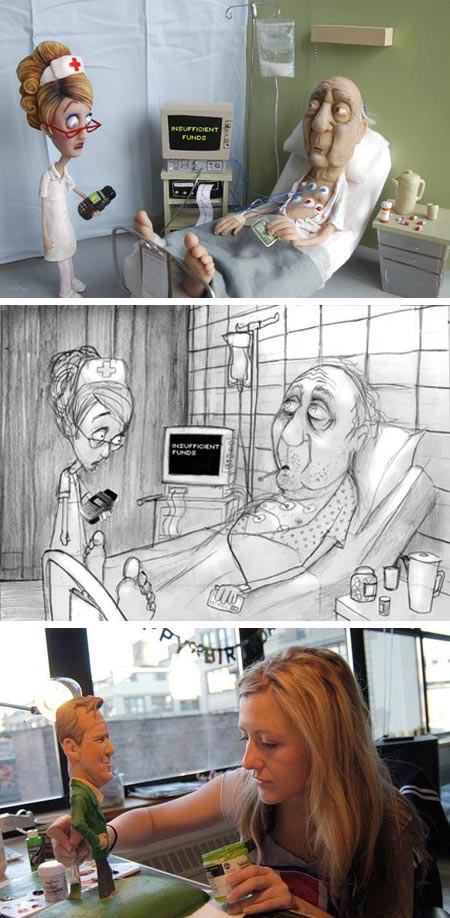
Liz Lomax describes herself as a “three dimensional illustrator”. Before assuming that means illustration created in a 3-D CGI application, step back and think in more immediate, real-world terms.Lomax creates her stylized, whimsically exaggerated images as small scale sculptures, which she then places in environments that she also hand crafts, and photographs the result to achieve her illustration image.
Much of her work is based on likenesses, or more accurately, caricatures, of well known individuals, including pop music stars like Sting, Amy Winehouse, Michael Jackson and the Rolling Stones, movie personalities, political candidates and various other newsmakers.
She also does theme based editorial illustration, with conceptual interpretive images much in the vein of many contemporary illustrators, but realized in her hand-sculpted models and environments.
Lomax starts with a sketch, and her sketches have a nice feeling to them that would suit being followed up as a finished illustration in traditional media; but she then takes them to the third dimension, modeling the figure, tweaking the likeness (which must work from several angles), then painting, finishing and arranging the sculpted figures in 3-D environments, much like dioramas, for the final photograph.
Her client list includes major publications like The Boston Globe, Advertising Age, Newsweek, MAD, The new York Times, Rolling Stone, The Wall Street Journal and many others, as well as a number of advertising agencies and commercial accounts.
There are a variety of her works on her web site in various categories, including some done just for fun.
The Telegraph site has a slide show of her work and some of her working models. There is a video of her working process for a sculpture of Noel Gallagher, and her blog shows work in progress, discusses her working methods and has photos that show the sculptures to scale as she works on them.
Categories:
-
Shakespeare’s Portrait?
 There have traditionally been only two images accepted as true portraits of the man who is generally acknowledged as the greatest writer in the English language, William Shakespeare.
One is his monument bust in the Holy Trinity Church in Statford-upon-Avon (left, 4th down), and the other is the famous engraving by Martin Droeshout (left, bottom) that was used as the cover piece of the First Folio of Shakespeare’s work (and has been repurposed in a gigazillion ways since). Both of them were done after his death in 1616.
On Monday, the chairman of the Shakespeare Birthplace Trust, Stanley Wells, unveiled a painting that has been in the house of the Cobbe family outside of Dublin for centuries, that is now suggested to be the only image of the bard painted from life (image at left, top).
This status was previously held, but always in question, for the painting called the Chandos Portrait, attributed to artist John Taylor (left, third down), but that claim has been discredited to a large extent.
The painting from the Cobbe family shows an energetic and bright eyed man, younger than the portrayals we commonly see, most of which have been based on Droeshout’s engraving.
In this portrait, Shakespeare would have been 46 at the time, six years before his death.
The painting bears a resemblance to a painting once thought to be of Shakespeare and attributed to Flemish painter Charles Janssen, that is in the National Gallery in London (left, second down).
Though this painting has been established to have been of another person, and to have been altered sometime before 1770 to make it resemble Shakespeare, it is what prompted the Alec Cobbe to begin inquires among Shakespeare scholars and art experts to see if his family’s painting was, indeed, of the great playwright.
Though the jury is not in, sophisticated dating techniques and the opinions of the experts in both camps suggest that this may, in fact, be the only portrait we have of Shakespeare painted during his lifetime.
Unfortunately, in all of the media attention the painting has received, I can find no mention of an attribution, or even a suggestion of a probable artist’s name. I suppose that may remain a mystery, like much about the bard himself.
Though out of context (and though by “paintings”, Hamlet is referring to Opheila’s makeup), the issue of identifying portraits brings to mind:
“I have heard of your paintings too, well enough; God has given you one face and you make yourselves another,…”
[Thanks to Larry Roibal]
Categories:
-
99 Paintings of Beer on the Wall (Cat Scott)

In a painting blog variation that combines her interest in both beer and painting, Cat Scott has chosen as her subject a variety of beer bottles. Their different shapes, colors and label designs give a seemingly limited subject more diversity than one might think.She also employs a variety of media in the works she post on her aptly named blog, 99 Paintings of Beer on the Wall, from pen and gouache or pen and highlighter on bristol or in sketchbooks to acrylic and oil on canvas.
Scott is a graphic designer full time and paints when she can, and maintains another, more general, sketchblog, as well as an illustration portfolio (images above, bottom row). She is also a participant in the Girls Who Draw group sketchblog.
Her portfolio site includes portfolios for illustration and design, as well as a sketchbook section. There is also a profile with some additional images on Imagekind.
Though most of her “99 paintings of Beer on the Wall” are sold or not for sale at the moment, in addition to offering prints, she does apparently put many of them up for sale; in case you’re inclined to take one down, and perhaps, pass it around.
Categories:
-
World Builder (Bruce Branit)
 I will sometimes gripe about manufactured culture to the point where it may seem I don’t like certain genres at all, when in fact I do (e.g. CGI animated movies and superhero comic books).
After griping about Hollywood CGI animated features in the course of raving about Sita Sings the Blues recently, I’ll point out that I really do like Computer Generated Imaging when it’s used with intelligence, wit and imagination (The Incredibles is one of my favorite movies); as opposed to being put into service for super-slick formulaic features in which name voice talent is seen as a prerequisite but actual stories are in short supply.
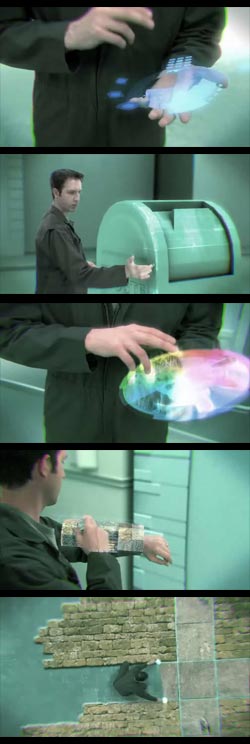
As a case in point, I’ll recommend a wonderful short film by Bruce Branit called World Builder, in which a man builds a holographic 3-D environment for the woman he loves. The live action part of the film was shot in a single day, the CGI post production was done over the course of two years.
The film makes good use of CGI, which, in a way, is part of the subject, and anyone who has worked in CGI applications, even consumer level “world builders” like Bryce or Vue d’Esprit, and users of Google Sketchup in particular, will find entertaining nods to the way these things work.
The real point, though, is that the film is a story, and a touching one at that; and the effects are in the end only tools to enable the telling of the story; something that Big Entertainment tends to forget in the midst of their calculations about box office receipts and visions of sugarplum merchandising returns.
Branit directs Branit/VFX in Kansas City. You can find other films by Branit there and on Vimeo.
[Via Kottke]
Categories:
-
Margaret Morrison
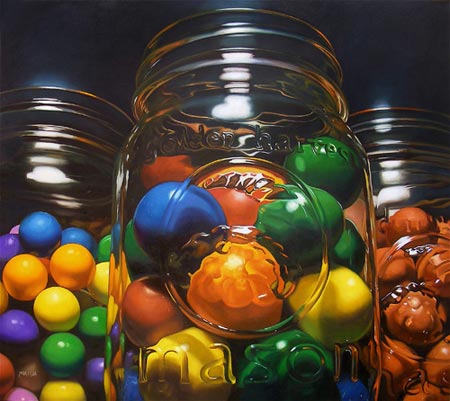
Margaret Morrison’s recent works are yummy, both in terms of their frequent subject matter of sweets and candies, and the sumptuous color with which she portrays those treats.Morrison’s canvases are relatively large, often 4’x4′ (122x122cm) or larger, and put their small scale subjects into large scale relief, sometimes at eye level or above, giving our a glimpse of them a delicious feeling or intimacy.
She takes delight in the surfaces of gummy candies, smooth chocolates and shiny hard candies. The objects themselves are often strongly lit, adding to the impact of their color and the dimensionality of their forms.
Along with the candies, cupcakes and brightly colored Pez dispensers, you’ll find florals, colorful arrangements of fruit and other foods, and, if you go back far enough, a range of figurative work in a more muted palette and with a very different emotional tone.
Morrison has a solo show at the Woodward Gallery in New York that runs from March 7 to May 6th, 2009. There is a selection of her work on the gallery’s site.
There also also a portfolio of her work on the site of the Lamar Dodd School of Art, where Morrison is a Senior Lecturer.
[Via Art Knowledge News]
Categories:
-
Sita Sings the Blues (Nina Paley)
 Sita Sings the Blues is an award winning independent feature length animation by Nina Paley.
The film combines an adaptation of the epic Indian story of Ramayana with a personal story from Paley herself. The film won the Best Feature award at the 32nd Annecy Animated Film Festival (see my post on student films at Annecy 2008, and Cartoon Brew on Annecy 2008), and has been receiving rave word of mouth around the net.
Sita Sings the Blues gets its TV debut tonight on WNET (Channel 13, New York), and may be on other PBS stations as well (though not here in Philadelphia).
After struggling with copyright issues which prohibited release of the film for a time, in which there was an unexpected claim to copyright on 1920’s jazz vocals by Annete Hanshaw, Paley has generously released the film through a Creative Commons Attribution-Share Alike license; so for those of us who can’t catch it on TV or in a theater, it is available in its entirety online.
You can view it on the WNET site, or on the Internet Archive, where you can also download it in a variety of formats and sizes ( and where I watched it and will eventually download a high resolution copy), or through other mirrors or BitTorrent Downloads (see the SitaSites page on the Sita Sings the Blues site).
If you like it, and want to show your support, you can donate to the artist in the kind of voluntary purchase that the internet makes possible.
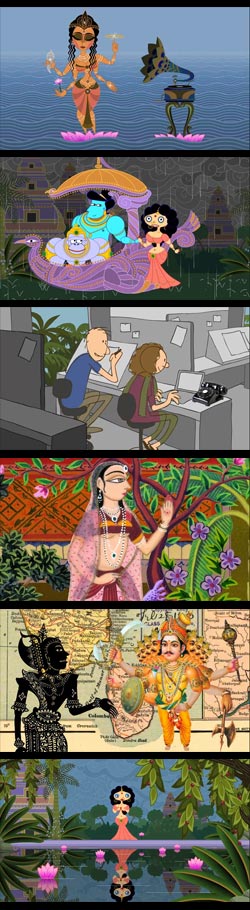
The film, which Paley made primarily in Flash, with help for a specialized fight scene from Jake Friedman, is a triumph of imagination and writing over fancy technology.
It is a visual delight, with a variety of animation and drawing approaches, from direct sketchy drawing to vector patterns to shadow puppets to scanned and composited photographs, like a combination of Yellow Submarine, Terry Gilliam’s Monty Python “cartoons” and the kind of wiggly line sketchiness (“Squigglevision”) often associated with hand drawn independent animated films.
Sita Sings the Blues is awash with colors, both visual and emotional, and bursting with clever ideas and entertaining notions about how to present various subjects, but always in the service of the story, not for the gratuitous display of technique.
Unlike so many of the formulaic, manufactured CGI films that the big studios crank out to meet their accounting schedules, Paley actually has a story to tell, two of them in fact.
Categories:




Charley’s Picks
Bookshop.org
(Bookshop.org affilliate links; sales benefit independent bookshop owners; I get a small percentage to help support my work on Lines and Colors)

John Singer Sargent: Watercolors


Urban Sketching: Understanding Perspective


Charley’s Picks
Amazon
(Amazon.com affiliate links; sales go to a larger yacht for Jeff Bezos; but I get a small percentage to help support my work on Lines and Colors)
John Singer Sargent: Watercolors
Urban Sketching: Understanding Perspective