


Categories
- 3d CGI
- Amusements
- Animation
- Anime & Manga
- Art Materials
- Art Videos
- Blogroll
- Cartoons
- Color
- Comics
- Concept & Visual Dev.
- Creativity
- Digital Art
- Digital Painting
- Displaying Art on the Web
- Drawing
- Eye Candy for Today
- Gallery and Museum Art
- High-res Art Images
- Illustration
- Motion Graphics & Flash
- Museums
- Online Museums
- Outsider Art
- Painting
- Painting a Day
- Paleo Art
- Pastel, Conté & Chalk
- Pen & Ink
- Prints and Printmaking
- Reviews
- Sc-fi and Fantasy
- Sculpture & Dimensional
- Site Comments
- Sketching
- Storyboards
- Tools and Techniques
- Uncategorized
- Vector Art
- Videos & Podcasts
- Vision and Optics
- Watercolor and Gouache
- Webcomics
Archives
- May 2026
- April 2026
- March 2026
- February 2026
- January 2026
- December 2025
- November 2025
- October 2025
- September 2025
- August 2025
- July 2025
- June 2025
- May 2025
- January 2025
- December 2024
- November 2024
- October 2024
- September 2024
- August 2024
- June 2024
- April 2024
- March 2024
- February 2024
- January 2024
- December 2023
- November 2023
- October 2023
- September 2023
- August 2023
- July 2023
- May 2023
- April 2023
- March 2023
- February 2023
- January 2023
- December 2022
- November 2022
- September 2022
- August 2022
- July 2022
- June 2022
- May 2022
- April 2022
- March 2022
- February 2022
- January 2022
- December 2021
- November 2021
- October 2021
- September 2021
- August 2021
- July 2021
- June 2021
- May 2021
- April 2021
- March 2021
- February 2021
- January 2021
- December 2020
- November 2020
- October 2020
- September 2020
- August 2020
- July 2020
- June 2020
- May 2020
- April 2020
- March 2020
- February 2020
- January 2020
- December 2019
- November 2019
- October 2019
- September 2019
- August 2019
- July 2019
- June 2019
- May 2019
- April 2019
- March 2019
- February 2019
- January 2019
- December 2018
- November 2018
- October 2018
- September 2018
- August 2018
- July 2018
- June 2018
- May 2018
- April 2018
- March 2018
- February 2018
- January 2018
- December 2017
- November 2017
- October 2017
- September 2017
- August 2017
- July 2017
- June 2017
- May 2017
- April 2017
- March 2017
- February 2017
- January 2017
- December 2016
- November 2016
- October 2016
- September 2016
- August 2016
- July 2016
- June 2016
- May 2016
- April 2016
- March 2016
- February 2016
- January 2016
- December 2015
- November 2015
- October 2015
- September 2015
- August 2015
- July 2015
- June 2015
- May 2015
- April 2015
- March 2015
- February 2015
- January 2015
- December 2014
- November 2014
- October 2014
- September 2014
- August 2014
- July 2014
- June 2014
- May 2014
- April 2014
- March 2014
- February 2014
- January 2014
- December 2013
- November 2013
- October 2013
- September 2013
- August 2013
- July 2013
- June 2013
- May 2013
- April 2013
- March 2013
- February 2013
- January 2013
- December 2012
- November 2012
- October 2012
- September 2012
- August 2012
- July 2012
- June 2012
- May 2012
- April 2012
- March 2012
- February 2012
- January 2012
- December 2011
- November 2011
- October 2011
- September 2011
- August 2011
- July 2011
- June 2011
- May 2011
- April 2011
- March 2011
- February 2011
- January 2011
- December 2010
- November 2010
- October 2010
- September 2010
- August 2010
- July 2010
- June 2010
- May 2010
- April 2010
- March 2010
- February 2010
- January 2010
- December 2009
- November 2009
- October 2009
- September 2009
- August 2009
- July 2009
- June 2009
- May 2009
- April 2009
- March 2009
- February 2009
- January 2009
- December 2008
- November 2008
- October 2008
- September 2008
- August 2008
- July 2008
- June 2008
- May 2008
- April 2008
- March 2008
- February 2008
- January 2008
- December 2007
- November 2007
- October 2007
- September 2007
- August 2007
- July 2007
- June 2007
- May 2007
- April 2007
- March 2007
- February 2007
- January 2007
- December 2006
- November 2006
- October 2006
- September 2006
- August 2006
- July 2006
- June 2006
- May 2006
- April 2006
- March 2006
- February 2006
- January 2006
- December 2005
- November 2005
- October 2005
- September 2005
- August 2005
Relevant Blogs
Art, Painting & Sketch
- Gurney Journey
- Underpaintings
- Art and Influence
- Painting Perceptions
- Oil Painters of America
- Vasari Paint POV
- Flying Fox
- Urban Sketchers
- Bento (Smithsonian)
- Art Inconnu
- The Hidden Place
- Still Life
- Making a Mark
- The Art of the Landscape
- Exploring Color & Creativity
- Art Contrarian
- Artist A Day
- beinArt Surreal Art Collective
- Eye Level
- David Dunlop
- p.i.g.m.e.n.t.i.u.m
- CultureGrrl
- Joaquín Sorolla blog
- Artists in Pastel
“Painting a Day”
- A Painting a Day (Keiser)
- On Painting (Keiser)
- Julian Merrow-Smith
- Karen Jurick
- Jeffrey Hayes
- Carol Marine
- Abbey Ryan
- Daily Paintworks
Other Painting Blogs
- Virtual Gouache Land
- Neil Hollingsworth
- Marc Hanson
- Kevin Menck
- Marc Dalessio
- Larry Seiler
- Stapleton Kearns
- Colin Page
- Roos Schuring
- Hans Versfelt
- Titus Meeuws
- Régis Pettinari
- René Plein Air
- Belinda Del Pesco
- Robin Weiss
- Nathan Fowkes (Land Sketch)
- William Wray
- Frank Serrano
- Stephen Magsig
- Michael Chesley Johnson
- Twice a Week
- Sarah Wimperis
- Rob Adams
- Michael Cole Manley
- The Dirty Palette Club
- Mike Manley’s Draw!
Gallery Art & Illustration mix
Illustration
- Howard Pyle
- 100 Years of Illustration
- BibliOdyssey
- Illustration Art
- Today’s Inspiration
- Illustration Mundo
- Little Chimp Society
- Danny Gregory
- R D (John Martz
- Illustration Friday blog
- Monster Brains
- Illustrators & Illustrations (RU)
- Elwood H. Smith
- DaniDraws.com
- Designers Who Blog
- iSpot Blog
Sci-Fi & Fantasy
Illustration & Comics
Comics & Cartoons
- Comics Beat
- Robot 6
- Newsarama Blog
- Comic Vine
- Comics Alliance
- Forbidden Planet Int.
- Paolo Rivera
- Bolt City
- Flight
- Scott McCloud
- The Comics Journal
- Comixpedia
- Funnybook Babylon
- James Baker
- Middleton’s Sketchbook
- Boneville
- The Hotel Fred
- Paul Rivoche
- Daily Cartoonist
- Mad About Cartoons (William Wray)
- Digital Strips
Illustration & Concept
Animation & Concept
- Cartoon Brew
- Animation Blog
- Cold Hard Flash
- Concept Art World
- The CAB
- FY Concept Art
- Concept Ships
- Concept Robots
- John Nevarez
- Armand Serrano
- Marcos Mateu-Mestre
- all kinds of stuff (Kricfalusi)
- Yacin the faun (Man Arenas)
- Kelsey Mann
- Cre8tivemarks Blog
- Ice-Cream Monster Toon Cafe
- AAU Character & Creature Design
- AAU Animation Notes
- Articles and Texticles
Paleo & Scientific
Tools & Techniques
Other
Lists of Art Blogs
Art Image Resource Links
Historic Art Images
- Wikimedia Commons: Paintings
- Wikimedia Commons: Drawings
- The Athenaeum
- WikiArt (WikiPaintings)
- Google Art Project: Artists
- Google Art Project: Collections (Museums)
- ArtCyclopedia
- Web Gallery of Art
- Art Renewal Center
- Web Gallery of Impressionism
Auction Consolidation sites
Auction sites
- Sotheby’s
- Bonham’s
- Christies
- Heritage Auctions: Fine Art
- Heritage Auctions: Illustration
- Freeman’s Auctions
- Bukowskis
- Shannon’s
Image Search
Reverse Image Search (search by image)
- Tin Eye
- RevImg
- Google Image Search (camera icon)
- Bing Image Search (camera icon)
Promoting some friends and some clients of my website design business
- Twin Willows T’ai Chi studio in Wilmington DE. Taiji classes with Bryan Davis.
- Ray Hayward, Inspired Teacher of T’ai Chi ( Taiji ) in Minneapolis, Founder of Mindful Motion Tai Chi Academy
- OldHead Tattoo studio and Art Gallery in Wilmington DE. Tattoos and paintings by Bruce Gulick
- Sharon Domenico Art, pet portrait oil paintings
- Platinum Paperhanging, wallpaper hanging, Main Line and Philadelphia, PA
- Lisa Stone Design, interior designer, Main Line and Philadelphia, PA
- Studio12KPT, original art, prints, calendars and other custom printed items by Van Sickle & Rolleri
-
Todd Ford

Todd Ford is a painter and art teacher living and working in Texas.Ford paints in a deftly rendered realist style that pays particular attention to smooth surfaces and sharp contrasts in sometimes closely related colors (greens and blues, oranges and yellows).
He has some frequent subjects, including a series of paintings of plastic toys (which I didn’t particularly respond to) and a more recent series of liquids and immersed objects in jars, and another of cloth partially inserted into jars (both of which I like very much), as well as the apparent beginnings of two newer series of reflective globes and drapery, and close ups of reflective spoons containing pools or drops of colored liquids (which I’m looking forward to seeing more of).
There is also a slightly older series of close ups of the details of old farm trucks, that I find fascinating for the juxtaposition of the weathered surfaces of painted metal with the smooth, shiny surfaces of glass headlights and chrome bezels.
Ford has both a blog and a web site that feature his paintings.
He takes several interesting tacks at his still life subjects. He has several paintings of broken glass, with close ups of bottle necks and the remains of the bases of broken bottles, rendered with an attention to color and transparency, rendering and finish that might be given to portraits of museum quality glassware.
My favorites are his compositions combining the transparency, color shading and tonal drama of colored glassware and drapery, usually in the form of cloth partially in and partially out of colored jars or bottles. There is also a related series of objects like spoons or brushes partially immersed in liquid in similar jars, that explores some of the same visual territory of transparency, translucency, reflection and refraction.
Ford also has a few paintings with light bulbs, broken, whole and even submerged in liquid in jars, the delve into the same challenges.
I’m particularly fond of some of the recent posts on his blog in which the paintings are photographed in place on the easel, giving you a sense of scale usually missing from photographed works.
[Link via Art & Critique]
Categories:
-
My Father’s Hand (Samuel Wray)

My Father’s Hand is a tribute blog, created by designer Amanda Wray to showcase the drawings of her father, Samuel Wray.Samuel Wray was a commercial artist in some capacity, though I know little about his commercial work other than that he did some inking and lettering projects for comics, notably for a Robinson Crusoe comic.
The drawings that his daughter has posted are personal, drawings of figures and faces, sketches and self portraits. The postings started in 2006 and are sometimes accompanied by descriptive passages.
Along the way, we get glimpses of the man and his sometimes distant relationship with his daughter, her fascination with his process of drawing and her thoughts on the drawings themselves.
Wray’s drawings are often confident, with solid draftsmanship and a loose, informal line quality. Most are in pencil. He sometimes draws in ink, with tones in wash, and his ink line can be alternately definite or searching. In some of his pencil drawings, as well, he can have a more tentative line, with a delicate quality, seemingly contemplative.
My understanding is that Wray was suffering in his later years from the beginnings of Alzheimer’s, and was in struck by a car a few years before his death. His daughter started the blog about a year before he died, and was offering reproductions of the drawings, the proceeds of which originally went to him and now go to his widow. There is no formal offering of particular reproductions, simply a contact email link.
I assume the ability to purchase reproductions is still in place, as the blog is still on the web, even though Amanda’s posts stop a few days after her father’s passing in 2007.
[Link via Neil Hollingsworth]
Categories:
-
Gary Kelley

Gary Kelley is a well-known American Illustrator with a long list of impressive clients, including Time, Newsweek, Rolling Stone, The New Yorker, Atlantic Monthly, The Los Angeles Times, The Boston Globe, and numerous agencies and design firms.He has received 27 gold or silver medals from the Society of Illustrators in New York, and was inducted into the Society of Illustrators Hall of Fame in 2007.
He created the two 70-foot murals for the dramatic Barnes and Noble bookstore at 5th Avenue and 48th Street in New York, has lectured at numerous art schools across the U.S. and is joining the faculty of the Hartford Illustration MFA program.
Kelley has illustrated several picture books, including classics like The Legend of Sleepy Hollow, Rip Van Winkle, and Poe’s Tales of Mystery.
Kelley does not maintain his own web site as far as I can tell, but he has a portfolio on the Richard Solomon site. Unfortunately, the new Solomon site is designed in a way that doesn’t permit the bookmarking of individual artist’s sections (What were they thinking?), so I have to direct you to the home page, and tell you to click on “Illustrators” link at top left, that just looks like a heading (What were they thinking?) and pop out the hidden menu (What were they thinking?) and find him in the list to see his portfolio (What? Were they thinking?).
There is a sort of pop-up menu of thumbnails at the bottom that you have to do some mouse gymnastics to get out of your way so you can see the whole picture. There are links at the top to a bio and case study.
Kelley has a strong geometric style, obviously informed by an admiration for Cubism in general and Picasso in particular. He has a remarkable ability to handle complex scenes with multiple figures and faces; and not only fill them with expressive human qualities, but focus your eye unerringly to the particular face or faces that he wants you to see. He does this without overt tricks of lighting, or blatant splashes of color; but instead using subtle control of value, color and composition, all within his intricate grid of geometrically defined shapes.
His palette varies from muted to bright, depending on the demands of the subject, and his colors are augmented with the deft application of texture, both in subjects and backgrounds. He also has a great knack for creating portraits that are stylized without being caricatures.
The Illustration Academy has a page devoted to Kelly, with a short bio, some (unfortunately small) images, and two interesting slide shows of demos he gave at the Academy, one in colored pencil, the other in pastel.
Categories:
-
Draw!

Though its title might suggest a more general interest magazine devoted to drawing, Draw! magazine is focused on topics of relevance to comic book art, animation and related varieties of illustration.Each issue features how-to articles and tutorials from industry professionals, profiles of artists working in those fields and in-depth interviews.
Draw! is edited by Mike Manley, long time comics veteran who has worked on titles like Batman, Shazam, Darkhawk and numerous other titles for DC, Marvel and Dark Horse, as well as being a storyboard artist and background designer for Walt Disney, MTV, Warner Brothers and the Cartoon Network.
Manley, who is an extreme multi-tasker, is currently back in school going for a degree in painting at the Pennsylvania Academy of the Fine Arts, and also teaches drawing and animation related subjects at the Delaware College of Art and Design (where I teach a class in Adobe Flash). I’ve had the pleasure of knowing Mike for a number of years and he’s also an all-around nice guy (but don’t tell him I said so…). I’ll cover more on Mike’s other accomplishments in a future post.
In recent years Manley has been focusing much of his attention on Draw!, working to make it a focal point for those interested in the skills involved in creating comic book art and animation. He has gotten a long list of industry pros to contribute, and has also formed a core group of regular contributors who give the magazine a solid foundation, including Bret Blevins, Paule Rivoche and Alberto Ruiz.
Draw! is an 80 page magazine, mixing black and white and color pages, and sells for $6.95 U.S. Manley packs it tight with how-to insights and artist profiles from cover to cover. Draw! is published by TwoMorrows publishing, which also publishes other comics related titles like Rough Stuff, Write Now!, Alter Ego and The Jack Kirby Collector.
You can often find Draw! in comic book specialty shops, and larger bookstores. (If your local comics shop or bookstore doesn’t carry it, you might be able to convince them to do so.)
You can also order individual issues and subscriptions from the Draw! website. Unfortunately, the official Draw! web site isn’t well designed or maintained, and does a poor job of showcasing the magazine. (I don’t think Manley has control over the site, I think TwoMorrows is responsible for it, as the TwoMorrows site is poorly designed and arranged as well.) You may get more of a picture of the magazine’s contents from other sources, like Manley’s interview with Alex Horley as reprinted on Newsarama.
The most recent issue of Draw! that I have (#15, Spring, 2008), is a bit of a departure from the usual format. It’s called the “Back to School Issue” and features an overview and in-depth look at the major art and specialty schools in the U.S. that are now offering dedicated courses of study in comics and related arts, including The Joe Kubert School of Cartooning and Graphic Art, The Center for Cartoon Studies, The Minneapolis College of Art and Design, the School of Visual Arts, and the Savannah College of Art and Design.
I think the new issue (#16) is due out soon, but you can still order #15 through the site (even though they mislabel it as “Winter 2008” instead of “Spring 2008”). You can also order downloadable PDF versions of recent issues for $2.95, several collections of the Best of Draw! and Manley’s How to Create Comics From Script to Print in both trade paperback and DVD versions.
Categories:
-
75 Artists You Must Know and Where to Find Them, from DaniDraws.com

Dani Jones, the illustrator behind the long-running and very informative art blog, DaniDraws.com, has posted a list of 75 artists, including illustrators and cartoonists, that are suggested as “must know”, along with a good shot of 6 or 8 links to resources for each one.There isn’t much in the way of description, just a quick phrase or sentence, but the artists are arranged by category.
You’ll find many artists here that I’ve featured over time on lines and colors, along with many I haven’t gotten to yet, but are on my list.
Whether it’s a definitive list is, of course, a matter of debate, and part of the fun. Jones invites comments about additions and suggestions for artists that others feel may have been left out.
Definitive or not, it’s a terrific list (and could be a major time sink, of course, so be prepared to spend some time being dazzled by great stuff).
Categories:
-
J. Alden Weir
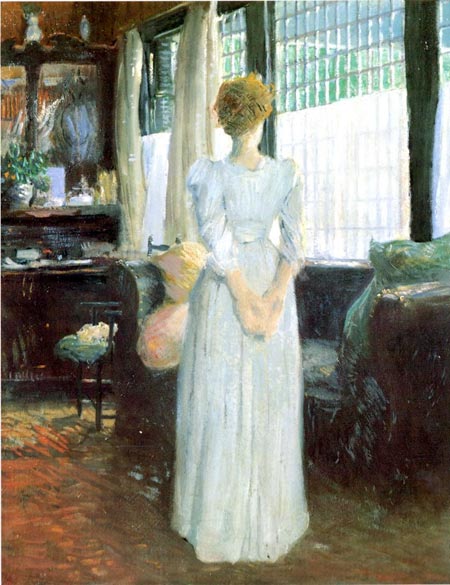
Julian Alden Weir, more commonly called J. Alden Weir, was one of the wonderfully diverse group of artists that get lumped together under the catch-all heading of “American Impressionists”.Weir was a member of The Ten American Painters, a loosely tied group of painters in New York and Boston who broke away from the Society of American Artists, which was itself a splinter group from the National Academy of Design. His compatriots in the Ten included Childe Hassam, Robert Reid, Willard Metcalf, Frank Benson, Edmund Tarbell, Thomas Wilmer Dewing, and eventually, William Merrit Chase.
Most important among them for Weir was John Henry Twatchman, with whom Weir formed a long lasting friendship. The two artists painted together, often exhibited together, and were both teachers at the Art Students League in New York. Weir also taught at, and was a member of, the Cos Cob Art Colony, an artists community that sprang up around Twatchman’s home in Greenwich, CT, along with Hassam, Theodore Robinson and Robert Reid.
Members of the Cos Cob Colony were involved with the staging of the 1913 Armory Show, famous now for introducing European modernist art to America; over which Weir resigned from his presidency of the Association of Painters and Sculptors.
As a student, Weir trained at the National Academy of Design, and then in Paris at the École des Beaux-Arts, where he studied with Jean-Léon Gérôme and was friends with Jules Bastien-Lepage, who became something of a mentor.
When he returned form Europe Weir intended to make his living painting portraits, but was unsuccessful in obtaining portrait commissions for some time, so many of his portrait works from the time are of family and friends.
Weir’s style and approach changed dramatically over the course of his career, from traditional landscapes that have a feeling of Corot and Courbet and portraits influenced by Manet, to later works in which he came to adopt some of the stylistic characteristics of French Impressionism (which he at first despised), and a continuing influence from his fondness for Japanese prints.
He was also influenced by Twatchman’s tonalist aproach, possibly also the result of meeting Whistler in London before returning to the U.S. after his time in France. There was also the tonalist influence of his friendship with Albert Pinkham Ryder. Weir’s older brother, John Ferguson Weir, who I can find little info on, was also a painter, working somewhat in the tradition of the Barbizon School.
J. Alden Weir’s intimate interior scenes often put me in mind of those of Edmund Tarbell and Childe Hassam, with their muted light and tactile feeling for wood and cloth.
In his later career, Weir didn’t share his friends’ enthusiasm for traveling to paint in various locations, preferring to remain on his Connecticut farm, which is now a National Historic Site.
In his Impressionist influenced works, Weir sometimes breaks up his canvas into the short strokes of brilliant color associated with the style of Monet, Sisley and Pissarro, but just as often uses rough scumbling to achieve his broken color, giving his canvasses a fascinating textural quality.
Like a number of the other painters labeled American Impressionists, Weir didn’t feel the need to follow the lead of his French counterparts in throwing out the academic traditions of drawing and solidity of form; and his style is often a delightful blend of the two seemingly contrary artistic factions, which is one of the reasons I find Weir and the other American painters of his circle so appealing.
Categories:




Charley’s Picks
Bookshop.org
(Bookshop.org affilliate links; sales benefit independent bookshop owners; I get a small percentage to help support my work on Lines and Colors)

John Singer Sargent: Watercolors


Urban Sketching: Understanding Perspective


Charley’s Picks
Amazon
(Amazon.com affiliate links; sales go to a larger yacht for Jeff Bezos; but I get a small percentage to help support my work on Lines and Colors)
John Singer Sargent: Watercolors
Urban Sketching: Understanding Perspective