


Categories
- 3d CGI
- Amusements
- Animation
- Anime & Manga
- Art Materials
- Art Videos
- Blogroll
- Cartoons
- Color
- Comics
- Concept & Visual Dev.
- Creativity
- Digital Art
- Digital Painting
- Displaying Art on the Web
- Drawing
- Eye Candy for Today
- Gallery and Museum Art
- High-res Art Images
- Illustration
- Motion Graphics & Flash
- Museums
- Online Museums
- Outsider Art
- Painting
- Painting a Day
- Paleo Art
- Pastel, Conté & Chalk
- Pen & Ink
- Prints and Printmaking
- Reviews
- Sc-fi and Fantasy
- Sculpture & Dimensional
- Site Comments
- Sketching
- Storyboards
- Tools and Techniques
- Uncategorized
- Vector Art
- Videos & Podcasts
- Vision and Optics
- Watercolor and Gouache
- Webcomics
Archives
- June 2026
- May 2026
- April 2026
- March 2026
- February 2026
- January 2026
- December 2025
- November 2025
- October 2025
- September 2025
- August 2025
- July 2025
- June 2025
- May 2025
- January 2025
- December 2024
- November 2024
- October 2024
- September 2024
- August 2024
- June 2024
- April 2024
- March 2024
- February 2024
- January 2024
- December 2023
- November 2023
- October 2023
- September 2023
- August 2023
- July 2023
- May 2023
- April 2023
- March 2023
- February 2023
- January 2023
- December 2022
- November 2022
- September 2022
- August 2022
- July 2022
- June 2022
- May 2022
- April 2022
- March 2022
- February 2022
- January 2022
- December 2021
- November 2021
- October 2021
- September 2021
- August 2021
- July 2021
- June 2021
- May 2021
- April 2021
- March 2021
- February 2021
- January 2021
- December 2020
- November 2020
- October 2020
- September 2020
- August 2020
- July 2020
- June 2020
- May 2020
- April 2020
- March 2020
- February 2020
- January 2020
- December 2019
- November 2019
- October 2019
- September 2019
- August 2019
- July 2019
- June 2019
- May 2019
- April 2019
- March 2019
- February 2019
- January 2019
- December 2018
- November 2018
- October 2018
- September 2018
- August 2018
- July 2018
- June 2018
- May 2018
- April 2018
- March 2018
- February 2018
- January 2018
- December 2017
- November 2017
- October 2017
- September 2017
- August 2017
- July 2017
- June 2017
- May 2017
- April 2017
- March 2017
- February 2017
- January 2017
- December 2016
- November 2016
- October 2016
- September 2016
- August 2016
- July 2016
- June 2016
- May 2016
- April 2016
- March 2016
- February 2016
- January 2016
- December 2015
- November 2015
- October 2015
- September 2015
- August 2015
- July 2015
- June 2015
- May 2015
- April 2015
- March 2015
- February 2015
- January 2015
- December 2014
- November 2014
- October 2014
- September 2014
- August 2014
- July 2014
- June 2014
- May 2014
- April 2014
- March 2014
- February 2014
- January 2014
- December 2013
- November 2013
- October 2013
- September 2013
- August 2013
- July 2013
- June 2013
- May 2013
- April 2013
- March 2013
- February 2013
- January 2013
- December 2012
- November 2012
- October 2012
- September 2012
- August 2012
- July 2012
- June 2012
- May 2012
- April 2012
- March 2012
- February 2012
- January 2012
- December 2011
- November 2011
- October 2011
- September 2011
- August 2011
- July 2011
- June 2011
- May 2011
- April 2011
- March 2011
- February 2011
- January 2011
- December 2010
- November 2010
- October 2010
- September 2010
- August 2010
- July 2010
- June 2010
- May 2010
- April 2010
- March 2010
- February 2010
- January 2010
- December 2009
- November 2009
- October 2009
- September 2009
- August 2009
- July 2009
- June 2009
- May 2009
- April 2009
- March 2009
- February 2009
- January 2009
- December 2008
- November 2008
- October 2008
- September 2008
- August 2008
- July 2008
- June 2008
- May 2008
- April 2008
- March 2008
- February 2008
- January 2008
- December 2007
- November 2007
- October 2007
- September 2007
- August 2007
- July 2007
- June 2007
- May 2007
- April 2007
- March 2007
- February 2007
- January 2007
- December 2006
- November 2006
- October 2006
- September 2006
- August 2006
- July 2006
- June 2006
- May 2006
- April 2006
- March 2006
- February 2006
- January 2006
- December 2005
- November 2005
- October 2005
- September 2005
- August 2005
Relevant Blogs
Art, Painting & Sketch
- Gurney Journey
- Underpaintings
- Art and Influence
- Painting Perceptions
- Oil Painters of America
- Vasari Paint POV
- Flying Fox
- Urban Sketchers
- Bento (Smithsonian)
- Art Inconnu
- The Hidden Place
- Still Life
- Making a Mark
- The Art of the Landscape
- Exploring Color & Creativity
- Art Contrarian
- Artist A Day
- beinArt Surreal Art Collective
- Eye Level
- David Dunlop
- p.i.g.m.e.n.t.i.u.m
- CultureGrrl
- Joaquín Sorolla blog
- Artists in Pastel
“Painting a Day”
- A Painting a Day (Keiser)
- On Painting (Keiser)
- Julian Merrow-Smith
- Karen Jurick
- Jeffrey Hayes
- Carol Marine
- Abbey Ryan
- Daily Paintworks
Other Painting Blogs
- Virtual Gouache Land
- Neil Hollingsworth
- Marc Hanson
- Kevin Menck
- Marc Dalessio
- Larry Seiler
- Stapleton Kearns
- Colin Page
- Roos Schuring
- Hans Versfelt
- Titus Meeuws
- Régis Pettinari
- René Plein Air
- Belinda Del Pesco
- Robin Weiss
- Nathan Fowkes (Land Sketch)
- William Wray
- Frank Serrano
- Stephen Magsig
- Michael Chesley Johnson
- Twice a Week
- Sarah Wimperis
- Rob Adams
- Michael Cole Manley
- The Dirty Palette Club
- Mike Manley’s Draw!
Gallery Art & Illustration mix
Illustration
- Howard Pyle
- 100 Years of Illustration
- BibliOdyssey
- Illustration Art
- Today’s Inspiration
- Illustration Mundo
- Little Chimp Society
- Danny Gregory
- R D (John Martz
- Illustration Friday blog
- Monster Brains
- Illustrators & Illustrations (RU)
- Elwood H. Smith
- DaniDraws.com
- Designers Who Blog
- iSpot Blog
Sci-Fi & Fantasy
Illustration & Comics
Comics & Cartoons
- Comics Beat
- Robot 6
- Newsarama Blog
- Comic Vine
- Comics Alliance
- Forbidden Planet Int.
- Paolo Rivera
- Bolt City
- Flight
- Scott McCloud
- The Comics Journal
- Comixpedia
- Funnybook Babylon
- James Baker
- Middleton’s Sketchbook
- Boneville
- The Hotel Fred
- Paul Rivoche
- Daily Cartoonist
- Mad About Cartoons (William Wray)
- Digital Strips
Illustration & Concept
Animation & Concept
- Cartoon Brew
- Animation Blog
- Cold Hard Flash
- Concept Art World
- The CAB
- FY Concept Art
- Concept Ships
- Concept Robots
- John Nevarez
- Armand Serrano
- Marcos Mateu-Mestre
- all kinds of stuff (Kricfalusi)
- Yacin the faun (Man Arenas)
- Kelsey Mann
- Cre8tivemarks Blog
- Ice-Cream Monster Toon Cafe
- AAU Character & Creature Design
- AAU Animation Notes
- Articles and Texticles
Paleo & Scientific
Tools & Techniques
Other
Lists of Art Blogs
Art Image Resource Links
Historic Art Images
- Wikimedia Commons: Paintings
- Wikimedia Commons: Drawings
- The Athenaeum
- WikiArt (WikiPaintings)
- Google Art Project: Artists
- Google Art Project: Collections (Museums)
- ArtCyclopedia
- Web Gallery of Art
- Art Renewal Center
- Web Gallery of Impressionism
Auction Consolidation sites
Auction sites
- Sotheby’s
- Bonham’s
- Christies
- Heritage Auctions: Fine Art
- Heritage Auctions: Illustration
- Freeman’s Auctions
- Bukowskis
- Shannon’s
Image Search
Reverse Image Search (search by image)
- Tin Eye
- RevImg
- Google Image Search (camera icon)
- Bing Image Search (camera icon)
Promoting some friends and some clients of my website design business
- Twin Willows T’ai Chi studio in Wilmington DE. Taiji classes with Bryan Davis.
- Ray Hayward, Inspired Teacher of T’ai Chi ( Taiji ) in Minneapolis, Founder of Mindful Motion Tai Chi Academy
- OldHead Tattoo studio and Art Gallery in Wilmington DE. Tattoos and paintings by Bruce Gulick
- Sharon Domenico Art, pet portrait oil paintings
- Platinum Paperhanging, wallpaper hanging, Main Line and Philadelphia, PA
- Lisa Stone Design, interior designer, Main Line and Philadelphia, PA
- Studio12KPT, original art, prints, calendars and other custom printed items by Van Sickle & Rolleri
-
Chris Beck

Wisconsin artist Chris Beck went from the fine art program at the University of Wisconsin-Madison to a career as a graphic designer and then found her way back to painting.Her bright, high-chroma watercolors have been featured in magazines like Watercolor Artist and The Artist’s Magazine and she has been the recipient of a number of awards from juried shows and exhibitions.
In addition to still life subjects and florals, both in still life and in gardens, Beck finds inspiration in the colorful painted metal surfaces of tin toys, which she also calls “Vintage Critters“.
Her painting “Snail Mail” (image above, bottom) has been chosen to share the cover of the upcoming book from Kennedy Publishing, Best of America, Watermedia II (more info here).
Beck maintains two blogs, a personal one called I’m painting as fast as I can… and a more general blog, aimed at the appreciation and spotlighting of various watercolor artists, titled Brush – Paper – Water.
Categories:
-
Wei Te – Mu di (The Cowherd’s Flute) by Te Wei

Wei Te – Mu di, or The Cowherd’s Flute, is a beautiful short animated film by Te Wei (Sheng Tewei) a master Chinese animator who died this month at the age of 95.Te Wei was a print cartoonist who was asked by the Chinese Ministry of Culture to establish an animation studio in 1949. He is best known for his 1950’s film The Conceited General.
In the 1960’s he began to create the equivalent of animated ink paintings, the design of which were most influenced by painter Qi Baishi.
During the Cultural Revolution from 1966 to 1976, he was not permitted to create animation, but returned to in in the late 1970’s, continuing in the style of animated ink paintings.
The Cowherd’s Flute, from 1963, is perhaps the best example of this style. I don’t know of a translation of The Conecited General, but The Cowherd’s Flute is wordless, just image and music, almost like a Chinese version of one of the interpretations of musical pieces in Disney’s Fantasia.
It’s absolutely beautiful.
[Via Cartoon Brew]
Categories:
-
Vintage German Illustration

Susan Lenox has posted a collection of vintage German posters, illustration and advertising art (mostly late 19th and early 20th Century) to a Flickr set.There are travel posters, ads for beer, bicycles, theatre and pens, and a variety of artists and styles. Many of the images are linked to larger versions, but unfortunately not much larger.
You can still enjoy the images though, and the interesting out-of-context subjects that can leave you wondering what some of them are about.
As in any collection of material like this, some are more interesting than others and you have to do a little digging for the best ones.
[Via MetaFilter]
Categories:
-
Jean-Sébastien Rossbach

Jean-Sébastien Rossbach is a French freelance illustrator and concept artist based in Paris. He has done work in publishing, video games, board and role playing games, movies, the recording industry and advertising.Rossbach gives his fantasy themed illustrations an extra element of decorative surface, incorporating patterns and deign elements into his images. Very often he uses suggestions of patterns, with just enough detail for your eye to fill in a richer surface than he has actually rendered.
Rossback paints digitally in Painter and Photoshop, but uses the textural characteristics of the digital brushes to produce a painterly appearance, particularly in his loose, gestural backgrounds.
His web site includes a blog and galleries of illustrations, covers and sketches. When viewing work in his portfolio, be aware that the arrows lead to subsequent pages of thumbnails, and there is a text link for “Zoom” under the thumbnails that links to high resolution versions of the images.
Rossback collaborated with illustrator Aleksi Briclot and writer Jean-Luc Istin on Merlin, an art book re-exploration of the Authurian Merlin legend,. The text is in French, but the book is largely illustrations.
You can download a PDF preview of the book from the publisher’s site (link that says “Découvrez quelques pages de cet ouvrage”).
Categories:
-
Philip Geiger

Phillip Geiger says that he does not intend for his paintings to carry a narrative, but a narrative element is often implied by the posed subjects that inhabit his room interiors.His interiors are at once quiet and lively, calm and energetic. It is in his treatment of light and painterly handling that Geiger conveys energy. The confident application of paint and contrasts of tone and color, along with the play of light, bring almost every surface alive in his otherwise subdued domestic scenes.
The people seem almost like still life elements at times, appreciated for their form, texture and color rather than for their personality, and are often shown from behind or in other positions where viewer interaction with them is de-emphasized and replaced with the viewer as observer.
Though the interiors are of modest houses, they are older and often provide rich contrasts of color and tone in the woodwork of door and window framing, variations in the color of painted walls and degrees of lighting from room to room and frequently direct patches of sunlight across wood floors or illumination from lamps within the scene.
I’ve seen Geiger compared with intimists like Vuillard and Fairfiled Porter, and he lists his own influences as Vermeer, Degas, Corot and Hopper; but the painter that springs to mind for me is Edmund Tarbell, whose quiet interiors were also alive with rich colors, lively paint textures and the suggestion of narrative within the calm posing of figures.
In Tarbell’s case, the figures were members of his family, Geiger uses paid models to populate his interiors.
Geiger is a member of the faculty of the Studio Art Department of the University of Virginia, where he teaches drawing and painting. I can’t find a dedicated site for him, but he is represented by the Tibor DeNagy Gallery in New York and the Renyolds Gallery in Richmond.
Unfortunately, the Tibor DeNagy gallery is frames, apparently to defeat any chance of people letting each other know about a particular artist by linking directly to them (what are the designers and clients who make these decisions thinking?), so I can’t give you a direct link. The Renyolds fares better, but the images are frustratingly small and few.
I’ve found a few other resources, notably on Painting Perceptions and Indiana University School of Fine Arts (click for larger versions).
Categories:
-
Jason Seiler
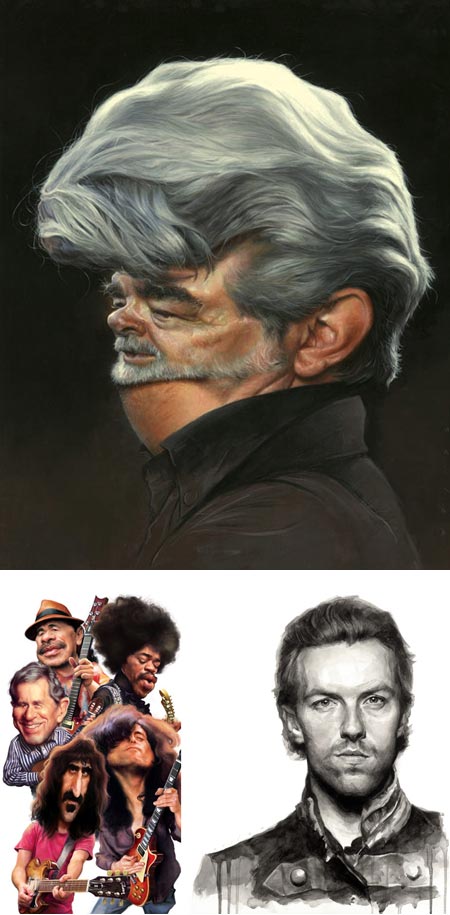
Jason Seiler is a caricaturist, character designer and illustrator whose clients include The New York Times, Time Magazine, The Weekly Standard, Business Week, MAD Magazine and many others.As a caricaturist, Seiler often pushes his exaggerated portraits to extremes, to the point where they have a fun-house mirror feeling. He can then turn around and deliver a straightforward portrait, though he obviously enjoys the freedom that caricature allows.
His web site has sections devoted to entertainment and political figures, but don’t miss the sketches, in which displays a nice quality of line and hatching in the process of building up his monochromatic tones.
If I’m not mistaken, he works both digitally in Photoshop and in traditional media, using strongly modeled rendering to give his exaggerated faces a solid three dimensional feel.
Seiler also maintains a blog, in which he discusses work in progress, often with preliminary images and process sequences.
He has recently done his first character design for feature film, working on the Bandersnatch for Tim Burton’s Alice in Wonderland.
Seiler is also an instructor with the Schoolism online school, along with Bobby Chiu and Ryan Wood.
Jason Seiler is the son of painter Larry Seiler, who I profiled yesterday.
Categories:




Charley’s Picks
Bookshop.org
(Bookshop.org affilliate links; sales benefit independent bookshop owners; I get a small percentage to help support my work on Lines and Colors)

John Singer Sargent: Watercolors


Urban Sketching: Understanding Perspective


Charley’s Picks
Amazon
(Amazon.com affiliate links; sales go to a larger yacht for Jeff Bezos; but I get a small percentage to help support my work on Lines and Colors)
John Singer Sargent: Watercolors
Urban Sketching: Understanding Perspective