


Categories
- 3d CGI
- Amusements
- Animation
- Anime & Manga
- Art Materials
- Art Videos
- Blogroll
- Cartoons
- Color
- Comics
- Concept & Visual Dev.
- Creativity
- Digital Art
- Digital Painting
- Displaying Art on the Web
- Drawing
- Eye Candy for Today
- Gallery and Museum Art
- High-res Art Images
- Illustration
- Motion Graphics & Flash
- Museums
- Online Museums
- Outsider Art
- Painting
- Painting a Day
- Paleo Art
- Pastel, Conté & Chalk
- Pen & Ink
- Prints and Printmaking
- Reviews
- Sc-fi and Fantasy
- Sculpture & Dimensional
- Site Comments
- Sketching
- Storyboards
- Tools and Techniques
- Uncategorized
- Vector Art
- Videos & Podcasts
- Vision and Optics
- Watercolor and Gouache
- Webcomics
Archives
- May 2026
- April 2026
- March 2026
- February 2026
- January 2026
- December 2025
- November 2025
- October 2025
- September 2025
- August 2025
- July 2025
- June 2025
- May 2025
- January 2025
- December 2024
- November 2024
- October 2024
- September 2024
- August 2024
- June 2024
- April 2024
- March 2024
- February 2024
- January 2024
- December 2023
- November 2023
- October 2023
- September 2023
- August 2023
- July 2023
- May 2023
- April 2023
- March 2023
- February 2023
- January 2023
- December 2022
- November 2022
- September 2022
- August 2022
- July 2022
- June 2022
- May 2022
- April 2022
- March 2022
- February 2022
- January 2022
- December 2021
- November 2021
- October 2021
- September 2021
- August 2021
- July 2021
- June 2021
- May 2021
- April 2021
- March 2021
- February 2021
- January 2021
- December 2020
- November 2020
- October 2020
- September 2020
- August 2020
- July 2020
- June 2020
- May 2020
- April 2020
- March 2020
- February 2020
- January 2020
- December 2019
- November 2019
- October 2019
- September 2019
- August 2019
- July 2019
- June 2019
- May 2019
- April 2019
- March 2019
- February 2019
- January 2019
- December 2018
- November 2018
- October 2018
- September 2018
- August 2018
- July 2018
- June 2018
- May 2018
- April 2018
- March 2018
- February 2018
- January 2018
- December 2017
- November 2017
- October 2017
- September 2017
- August 2017
- July 2017
- June 2017
- May 2017
- April 2017
- March 2017
- February 2017
- January 2017
- December 2016
- November 2016
- October 2016
- September 2016
- August 2016
- July 2016
- June 2016
- May 2016
- April 2016
- March 2016
- February 2016
- January 2016
- December 2015
- November 2015
- October 2015
- September 2015
- August 2015
- July 2015
- June 2015
- May 2015
- April 2015
- March 2015
- February 2015
- January 2015
- December 2014
- November 2014
- October 2014
- September 2014
- August 2014
- July 2014
- June 2014
- May 2014
- April 2014
- March 2014
- February 2014
- January 2014
- December 2013
- November 2013
- October 2013
- September 2013
- August 2013
- July 2013
- June 2013
- May 2013
- April 2013
- March 2013
- February 2013
- January 2013
- December 2012
- November 2012
- October 2012
- September 2012
- August 2012
- July 2012
- June 2012
- May 2012
- April 2012
- March 2012
- February 2012
- January 2012
- December 2011
- November 2011
- October 2011
- September 2011
- August 2011
- July 2011
- June 2011
- May 2011
- April 2011
- March 2011
- February 2011
- January 2011
- December 2010
- November 2010
- October 2010
- September 2010
- August 2010
- July 2010
- June 2010
- May 2010
- April 2010
- March 2010
- February 2010
- January 2010
- December 2009
- November 2009
- October 2009
- September 2009
- August 2009
- July 2009
- June 2009
- May 2009
- April 2009
- March 2009
- February 2009
- January 2009
- December 2008
- November 2008
- October 2008
- September 2008
- August 2008
- July 2008
- June 2008
- May 2008
- April 2008
- March 2008
- February 2008
- January 2008
- December 2007
- November 2007
- October 2007
- September 2007
- August 2007
- July 2007
- June 2007
- May 2007
- April 2007
- March 2007
- February 2007
- January 2007
- December 2006
- November 2006
- October 2006
- September 2006
- August 2006
- July 2006
- June 2006
- May 2006
- April 2006
- March 2006
- February 2006
- January 2006
- December 2005
- November 2005
- October 2005
- September 2005
- August 2005
Relevant Blogs
Art, Painting & Sketch
- Gurney Journey
- Underpaintings
- Art and Influence
- Painting Perceptions
- Oil Painters of America
- Vasari Paint POV
- Flying Fox
- Urban Sketchers
- Bento (Smithsonian)
- Art Inconnu
- The Hidden Place
- Still Life
- Making a Mark
- The Art of the Landscape
- Exploring Color & Creativity
- Art Contrarian
- Artist A Day
- beinArt Surreal Art Collective
- Eye Level
- David Dunlop
- p.i.g.m.e.n.t.i.u.m
- CultureGrrl
- Joaquín Sorolla blog
- Artists in Pastel
“Painting a Day”
- A Painting a Day (Keiser)
- On Painting (Keiser)
- Julian Merrow-Smith
- Karen Jurick
- Jeffrey Hayes
- Carol Marine
- Abbey Ryan
- Daily Paintworks
Other Painting Blogs
- Virtual Gouache Land
- Neil Hollingsworth
- Marc Hanson
- Kevin Menck
- Marc Dalessio
- Larry Seiler
- Stapleton Kearns
- Colin Page
- Roos Schuring
- Hans Versfelt
- Titus Meeuws
- Régis Pettinari
- René Plein Air
- Belinda Del Pesco
- Robin Weiss
- Nathan Fowkes (Land Sketch)
- William Wray
- Frank Serrano
- Stephen Magsig
- Michael Chesley Johnson
- Twice a Week
- Sarah Wimperis
- Rob Adams
- Michael Cole Manley
- The Dirty Palette Club
- Mike Manley’s Draw!
Gallery Art & Illustration mix
Illustration
- Howard Pyle
- 100 Years of Illustration
- BibliOdyssey
- Illustration Art
- Today’s Inspiration
- Illustration Mundo
- Little Chimp Society
- Danny Gregory
- R D (John Martz
- Illustration Friday blog
- Monster Brains
- Illustrators & Illustrations (RU)
- Elwood H. Smith
- DaniDraws.com
- Designers Who Blog
- iSpot Blog
Sci-Fi & Fantasy
Illustration & Comics
Comics & Cartoons
- Comics Beat
- Robot 6
- Newsarama Blog
- Comic Vine
- Comics Alliance
- Forbidden Planet Int.
- Paolo Rivera
- Bolt City
- Flight
- Scott McCloud
- The Comics Journal
- Comixpedia
- Funnybook Babylon
- James Baker
- Middleton’s Sketchbook
- Boneville
- The Hotel Fred
- Paul Rivoche
- Daily Cartoonist
- Mad About Cartoons (William Wray)
- Digital Strips
Illustration & Concept
Animation & Concept
- Cartoon Brew
- Animation Blog
- Cold Hard Flash
- Concept Art World
- The CAB
- FY Concept Art
- Concept Ships
- Concept Robots
- John Nevarez
- Armand Serrano
- Marcos Mateu-Mestre
- all kinds of stuff (Kricfalusi)
- Yacin the faun (Man Arenas)
- Kelsey Mann
- Cre8tivemarks Blog
- Ice-Cream Monster Toon Cafe
- AAU Character & Creature Design
- AAU Animation Notes
- Articles and Texticles
Paleo & Scientific
Tools & Techniques
Other
Lists of Art Blogs
Art Image Resource Links
Historic Art Images
- Wikimedia Commons: Paintings
- Wikimedia Commons: Drawings
- The Athenaeum
- WikiArt (WikiPaintings)
- Google Art Project: Artists
- Google Art Project: Collections (Museums)
- ArtCyclopedia
- Web Gallery of Art
- Art Renewal Center
- Web Gallery of Impressionism
Auction Consolidation sites
Auction sites
- Sotheby’s
- Bonham’s
- Christies
- Heritage Auctions: Fine Art
- Heritage Auctions: Illustration
- Freeman’s Auctions
- Bukowskis
- Shannon’s
Image Search
Reverse Image Search (search by image)
- Tin Eye
- RevImg
- Google Image Search (camera icon)
- Bing Image Search (camera icon)
Promoting some friends and some clients of my website design business
- Twin Willows T’ai Chi studio in Wilmington DE. Taiji classes with Bryan Davis.
- Ray Hayward, Inspired Teacher of T’ai Chi ( Taiji ) in Minneapolis, Founder of Mindful Motion Tai Chi Academy
- OldHead Tattoo studio and Art Gallery in Wilmington DE. Tattoos and paintings by Bruce Gulick
- Sharon Domenico Art, pet portrait oil paintings
- Platinum Paperhanging, wallpaper hanging, Main Line and Philadelphia, PA
- Lisa Stone Design, interior designer, Main Line and Philadelphia, PA
- Studio12KPT, original art, prints, calendars and other custom printed items by Van Sickle & Rolleri
-
Eye Candy for Today: Inness On the Delaware

On the Delaware River, George Inness.On Google Art Project, click in lower right of image for zoom controls.
Original is in the Brooklyn Museum.
Even in his earlier, more realist works, a master of suggestion.
See my previous post on George Inness.
Categories:
-
The New Drawing on the Right Side of the Brain, 4th Edition
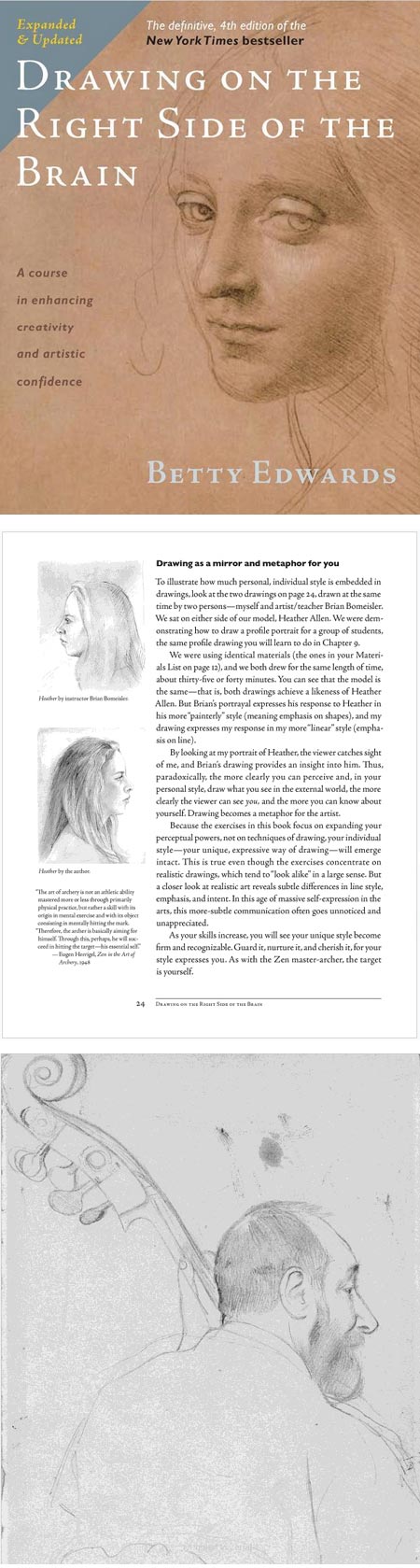
Like the 1930’s Hollywood cliché of the civilized explorers wowing the backward and worshipful natives with the “magic” of a cigarette lighter held aloft at a dramatic moment, there has long been an assignment of magic to the ability to draw and paint realistically in our culture.This comes from the notion that the ability to draw, and the other artistic skills that are built on that foundation, is reserved for those who have somehow been endowed at birth with “talent”, a magical cigarette lighter if ever there was one.
While not wanting to take away the special reverence that those who can draw or paint sometimes receive from the majority who “can’t draw a straight line” (since I’ve found that personally enjoyable at various points in my life, particularly as a teenager), I’m a firm believer that “talent” is a tarnished concept, and drawing is a skill, like playing a musical instrument, skiing, archery, flying a plane or performing surgery, that is acquired through hard work and diligent practice.
In fact, talent, that knack that makes acquiring a particular skill appear to come more easily, can be a hinderance as much as a help. After the initial boost, it can convince those that have it to be complacent and lazy, leaving them in a turtle and hare situation in which their hardworking counterparts quickly surpass them.
Drawing on the Right Side of the Brain is book by Betty Edwards that embodies the idea of drawing as a teachable skill. It focuses in particular on the most fundamental problem facing adults who are learning to draw — learning to see; specifically learning to see what is actually in front of them, as opposed to what their brain is telling them they recognize and should in essence draw a symbol for, e.g. an almond shape to represent an eye, which actually has a much more complex and interesting shape.
Edward’s book has been something of a phenomenon since its release in 1979. It became a bestseller and is one of the most popular drawing instruction books of all time. In it she puts forth a course of study based on exercises that encourage a shift in perception.
She bases her rationale on the assumption that there are two fundamental modes of human perception, that one of them is much better for drawing and related tasks than the other (which is better at the kind of rational linear thinking more valued in our culture), and that these modes are physically based in the two halves of our interestingly bisected brains.
Edwards puts a lot of effort into establishing the science for this, particularly in the subsequent revised editions of the book. I think the science for this idea is in question. However, the assignment of these states to physical parts of the brain, while central to her title, is to my mind unimportant to the underlying premise — that culturing a particular mode of thinking and perception is key to acquiring the skill of drawing.
Her course utilizes a series of exercises that encourage that shift, confusing the usually dominant “left brain” or rational/linear mode into submission and allowing the “right brain” to come out and play, pencil in hand.
Many of the exercises in her course were based on long proven drawing instruction techniques, such as pure contour drawing, sighting, the use of a viewfinder and drawing negative spaces instead of positive shapes; others were novel, like drawing from upside-down images; but the book as a whole was different from other drawing instruction books when it debuted in that it was obviously and overtly aimed at those are were in the “99%”, those without the magic of “talent”.
As such, I have long recommended Drawing on the Right Side of the Brain to anyone who says “I wish I could draw.”, as well as to artists who feel they need to rekindle their drawing fire, as the exercises can be particularly revealing to those who haven’t been in a dedicated course of study for some time.
Edwards has revised the book over several editions, including a fairly major revision titled The New Drawing on the Right Side of the Brain, the latest version of which is the recently released 4th edition.
In this revision she has to some extent addressed my major criticism of the book, that it stops short at teaching seeing/drawing, and misses the other half of drawing — the nuances of line, tone, rendering, edges, value and other elements that elevate drawing to an art. It’s as if you found a remarkable course on how to speak a language, but that course stops short with forming coherent phrases and neglects how to speak in a natural or convincing way.
The before and after instruction drawings of students of her course, which have always been striking and a compelling argument for the strength of the book, also have a kind of flat and bland appearance, lacking those elements that we associate with sophisticated drawing.
 She has added additional master drawings to this edition of the book, and places more emphasis on qualities of rendering than in previous editions, but I still recommend supplementing the use of the book with a “phase II” study of more advanced drawing concepts and more traditional drawing texts.
In the revised edition she also reorganizes the material a bit and attempts to codify the seeing/drawing shift into more a more specific subset of concepts.
She also places more emphasis on the perceptual shift involved in drawing as a key to creativity enhancement. This is actually her central theme; the book is subtitled “A course in enhancing creativity and artistic confidence”, but I find this aspect less compelling than the more specifically drawing related content. Your milage may vary.
There is a website for the book and related materials. Unfortunately it has not seen a major update in years, has a kind of stuck in the 90’s look to it, is poorly organized and does a terrible job, if at all, of explaining the book or the concepts it embodies. The site seems focused on convincing those who have already purchased the book to buy Edward’s other titles, workbooks, workshops and a pointless “portfolio” of prepackaged drawing supplies.
There is a sample chapter, but you would do better to look at the Amazon.com “Look Inside” feature for various editions (some of which have a more extensive preview than others).
Unfortunately, I am reviewing from a pre-publication uncorrected proof, and I don’t know how well it represents the final edition of the book. If the printing is the same, I have to say that the publisher has followed the recent self-destructive tendencies of the U.S. publishing industry as a whole and gone with cheaper, thinner paper and a poorer overall production quality to squeeze a few more pennies out of each copy (other reviews I’ve seen back this up).
Regardless of the sad state of American publishing, this remains a valuable book, in several of its editions, for both non-artists and artists alike — codifying the drawing-as-seeing skills that are so fundamental, and easily overlooked, in our pursuit of the magic of drawing.
For more, see my previous post on Drawing on the Right Side of the Brain
Categories:
-
Eye Candy for Today: Young Woman Drawing

Young Woman Drawing by Marie-Denise Villers.In the Metropolitan Museum of Art. Click “Fullscreen” under the image and use zoom or download arrow.
See my previous post on Marie-Denise Villers, and here.
Categories:
-
Patrick Faulwetter digital plein air painting

Long before the relatively recent advent of the iPad and the digital painting apps for it that have ushered in a new wave of “digital plein air painting”, some artists, myself included, were painting digitally from life using laptop computers and pressure sensitive tablets.Most of these artists had backgrounds in other types of digital art — digital comics creation in my case, but for the majority of those of which I was aware, concept art, for which digital painting has become the standard medium. Examples would include, Nicholas “sparth” Bouvier, Robh Ruppel and Nick Pugh. (Many artists work on both digital platforms, and/or also work in plein air with traditional media, such as Erik Tiemens.)
Even now, despite the prevalence of ever more sophisticated iPad painting apps and styli (Apple’s insistence on showing artists doing iPad painting with their fingers is just marketing BS, it’s possible, but pointless), there are still many advantages to working on laptop with a tablet, as clunky as the setup may seem compared to the sleeker, lighter, all-in-one device.
For one thing the digital painting software for laptop and desktop computers is much more advanced than any iPad app, having had over 15 years to mature into professional level tools.
For another, the use of pressure sensitive tablets is a distinct advantage both in terms of the more natural drawing and painting application they provide and a degree of accuracy beyond that of the relatively clunky finger-sized iPad styli. (Whether the recent introduction of the Jot Touch pressure sensitive iPad stylus will change that remains to be seen.)
Another, often overlooked advantage is the two handed approach to digital painting and drawing available on a laptop — in which the non-drawing hand is free to simultaneously work modifier keys to switch tools, make adjustments, zoom and of course, undo, all of which requires stopping and tapping on the tablet.
It’s a matter of trade-offs then, lightness and ease of portability of the tablet vs. the stronger set of tools available for the laptop/pressure sensitive tablet combination.
A case in point for the latter is the personal work of concept artist Patrick Faulwetter, who I profiled in his professional capacity yesterday, and whose set of digital plein air paintings, done on an Apple laptop with a Wacom Bamboo pressure sensitive tablet, left me impressed enough to make them the subject of a separate post.
In addition to doing digital paintings on location in various places around his home in California, Faulwetter takes his digital painting tools on his travels to places like China, Istanbul and Greece, as well as other areas of the U.S.
His digital location sketches are striking in their handling of color, value and atmosphere. He also takes superb advantage of one of the strengths of digital location painting — the ability to work on location in low light conditions or at night, in situations that would be prohibitively awkward with traditional painting media, capturing nuances of twilight and nighttime color and light effects that a camera would easily miss.
Faulwetter also has a wonderful eye for the value and colors contrasts of dappled sunlight and the horizontal light of early morning or late afternoon.
Among his subjects, Faulwetter demonstrates the fondness for cars, ships, planes and related tech that was part of what drew him to concept art originally. In these, as well as his portrayals of city streets, highways overpasses, rock formations, parks and harbor scenes, you can see his economy of rendering, due in part to the speed of rendering made possible by the digital tools (one of which is a palette that never runs dry and always contains every color you’ve used in your current piece in the form of the eyedropper tool).
You can see a photo of Faulwetter sketching with his laptop and Bamboo tablet in a photo from his blog (image above, bottom).
Unfortunately, his blog is in one of those widgety Blogger templates that can be viewed in half a dozen ways, all of which, though graphically nice looking, are usability disasters. I found it easiest to use the “Classic” view, even though it’s one of those script driven arrangements that keeps loading more content in one long continous scroll, within which it is impossible to bookmark and return to a specific place (does anybody actually think these are a good idea?). Anyway, the interface issues are well worth dealing with for the delightful range and variety of Faulwetter’s sketches.
Those who are less familiar with digital painting may be tempted to think there is some digital “magic” that makes digital painting easier, but other than some of the advantages I’ve mentioned (for which there are also tradeoffs such as the lack of tactile feedback, etc.), I think you’ll find that most digital painters work in an approach similar to the preferred medium of many concept artists and illustrators prior to digital tools — gouache.
Categories:
-
Patrick Faulwetter

Originally from Germany, Patrick Faulwetter is a concept artist who started with an interest in architecture that then then shifted into automotive design and led him to work with the Volkswagen and Audi Design Center in California.He later moved into concept design for the entertainment industry, and his film credits include Priest, GI Joe 2: Retaliation and Bryan Singer’s Jack and the Giant Killer and his clients include Blizzard, Electronic Arts, Rythm and Hues and Imagi.
His website showcases his professional work and is divided into sections for Design, Environments, Concept and design challenges. The Environments section is the one in which you will find the most images (note the small link below the thumbnails to the second page).
Faulwetter has a wonderful faculty for conveying scale and atmospheric perspective, as well as superb control of limited palettes and dramatic lighting.
Faulwetter also maintains a blog called Sketchpat, on which he has posted some concept sketches, but his most recent posts, and the majority of the images on the blog, are digital location paintings, painted en plein on a laptop computer with a small pressure sensitive tablet.
I was going to include someof his digital location sketches here, but I was so impressed with them that I decided to make them the subject of a separate post.
Categories:
-
David Roberts

19th Scottish century painter and printmaker David Roberts was known primarily as an orientalist, producing richly detailed paintings and a large number of finely executed lithographs of Egypt andt the near east, using as reference sketches made during several extended trips to the region.Roberts began his career as a designer and painter of stage scenery. For a time he pursued his gallery art on the side. Reportedly, J.M.W. Turner convinced Roberts to devote himself to gallery painting full time and Roberts eventually was much in demand for his exotic subjects and fine renderings, and was elected to the Royal Academy.
In particular, Roberts excelled in capturing the imposing scale, detailed surfaces and dramatic grandeur of the monuments and architectural wonders that were the subject of most of his works.
If there are contemporary concept artists who are not aware of his work, I think they would find it a compelling study of striking environments.
Roberts also painted landmark views of his native Scotland, as well as key locations in Italy.
Categories:




Charley’s Picks
Bookshop.org
(Bookshop.org affilliate links; sales benefit independent bookshop owners; I get a small percentage to help support my work on Lines and Colors)

John Singer Sargent: Watercolors


Urban Sketching: Understanding Perspective


Charley’s Picks
Amazon
(Amazon.com affiliate links; sales go to a larger yacht for Jeff Bezos; but I get a small percentage to help support my work on Lines and Colors)
John Singer Sargent: Watercolors
Urban Sketching: Understanding Perspective