


Categories
- 3d CGI
- Amusements
- Animation
- Anime & Manga
- Art Materials
- Art Videos
- Blogroll
- Cartoons
- Color
- Comics
- Concept & Visual Dev.
- Creativity
- Digital Art
- Digital Painting
- Displaying Art on the Web
- Drawing
- Eye Candy for Today
- Gallery and Museum Art
- High-res Art Images
- Illustration
- Motion Graphics & Flash
- Museums
- Online Museums
- Outsider Art
- Painting
- Painting a Day
- Paleo Art
- Pastel, Conté & Chalk
- Pen & Ink
- Prints and Printmaking
- Reviews
- Sc-fi and Fantasy
- Sculpture & Dimensional
- Site Comments
- Sketching
- Storyboards
- Tools and Techniques
- Uncategorized
- Vector Art
- Videos & Podcasts
- Vision and Optics
- Watercolor and Gouache
- Webcomics
Archives
- May 2026
- April 2026
- March 2026
- February 2026
- January 2026
- December 2025
- November 2025
- October 2025
- September 2025
- August 2025
- July 2025
- June 2025
- May 2025
- January 2025
- December 2024
- November 2024
- October 2024
- September 2024
- August 2024
- June 2024
- April 2024
- March 2024
- February 2024
- January 2024
- December 2023
- November 2023
- October 2023
- September 2023
- August 2023
- July 2023
- May 2023
- April 2023
- March 2023
- February 2023
- January 2023
- December 2022
- November 2022
- September 2022
- August 2022
- July 2022
- June 2022
- May 2022
- April 2022
- March 2022
- February 2022
- January 2022
- December 2021
- November 2021
- October 2021
- September 2021
- August 2021
- July 2021
- June 2021
- May 2021
- April 2021
- March 2021
- February 2021
- January 2021
- December 2020
- November 2020
- October 2020
- September 2020
- August 2020
- July 2020
- June 2020
- May 2020
- April 2020
- March 2020
- February 2020
- January 2020
- December 2019
- November 2019
- October 2019
- September 2019
- August 2019
- July 2019
- June 2019
- May 2019
- April 2019
- March 2019
- February 2019
- January 2019
- December 2018
- November 2018
- October 2018
- September 2018
- August 2018
- July 2018
- June 2018
- May 2018
- April 2018
- March 2018
- February 2018
- January 2018
- December 2017
- November 2017
- October 2017
- September 2017
- August 2017
- July 2017
- June 2017
- May 2017
- April 2017
- March 2017
- February 2017
- January 2017
- December 2016
- November 2016
- October 2016
- September 2016
- August 2016
- July 2016
- June 2016
- May 2016
- April 2016
- March 2016
- February 2016
- January 2016
- December 2015
- November 2015
- October 2015
- September 2015
- August 2015
- July 2015
- June 2015
- May 2015
- April 2015
- March 2015
- February 2015
- January 2015
- December 2014
- November 2014
- October 2014
- September 2014
- August 2014
- July 2014
- June 2014
- May 2014
- April 2014
- March 2014
- February 2014
- January 2014
- December 2013
- November 2013
- October 2013
- September 2013
- August 2013
- July 2013
- June 2013
- May 2013
- April 2013
- March 2013
- February 2013
- January 2013
- December 2012
- November 2012
- October 2012
- September 2012
- August 2012
- July 2012
- June 2012
- May 2012
- April 2012
- March 2012
- February 2012
- January 2012
- December 2011
- November 2011
- October 2011
- September 2011
- August 2011
- July 2011
- June 2011
- May 2011
- April 2011
- March 2011
- February 2011
- January 2011
- December 2010
- November 2010
- October 2010
- September 2010
- August 2010
- July 2010
- June 2010
- May 2010
- April 2010
- March 2010
- February 2010
- January 2010
- December 2009
- November 2009
- October 2009
- September 2009
- August 2009
- July 2009
- June 2009
- May 2009
- April 2009
- March 2009
- February 2009
- January 2009
- December 2008
- November 2008
- October 2008
- September 2008
- August 2008
- July 2008
- June 2008
- May 2008
- April 2008
- March 2008
- February 2008
- January 2008
- December 2007
- November 2007
- October 2007
- September 2007
- August 2007
- July 2007
- June 2007
- May 2007
- April 2007
- March 2007
- February 2007
- January 2007
- December 2006
- November 2006
- October 2006
- September 2006
- August 2006
- July 2006
- June 2006
- May 2006
- April 2006
- March 2006
- February 2006
- January 2006
- December 2005
- November 2005
- October 2005
- September 2005
- August 2005
Relevant Blogs
Art, Painting & Sketch
- Gurney Journey
- Underpaintings
- Art and Influence
- Painting Perceptions
- Oil Painters of America
- Vasari Paint POV
- Flying Fox
- Urban Sketchers
- Bento (Smithsonian)
- Art Inconnu
- The Hidden Place
- Still Life
- Making a Mark
- The Art of the Landscape
- Exploring Color & Creativity
- Art Contrarian
- Artist A Day
- beinArt Surreal Art Collective
- Eye Level
- David Dunlop
- p.i.g.m.e.n.t.i.u.m
- CultureGrrl
- Joaquín Sorolla blog
- Artists in Pastel
“Painting a Day”
- A Painting a Day (Keiser)
- On Painting (Keiser)
- Julian Merrow-Smith
- Karen Jurick
- Jeffrey Hayes
- Carol Marine
- Abbey Ryan
- Daily Paintworks
Other Painting Blogs
- Virtual Gouache Land
- Neil Hollingsworth
- Marc Hanson
- Kevin Menck
- Marc Dalessio
- Larry Seiler
- Stapleton Kearns
- Colin Page
- Roos Schuring
- Hans Versfelt
- Titus Meeuws
- Régis Pettinari
- René Plein Air
- Belinda Del Pesco
- Robin Weiss
- Nathan Fowkes (Land Sketch)
- William Wray
- Frank Serrano
- Stephen Magsig
- Michael Chesley Johnson
- Twice a Week
- Sarah Wimperis
- Rob Adams
- Michael Cole Manley
- The Dirty Palette Club
- Mike Manley’s Draw!
Gallery Art & Illustration mix
Illustration
- Howard Pyle
- 100 Years of Illustration
- BibliOdyssey
- Illustration Art
- Today’s Inspiration
- Illustration Mundo
- Little Chimp Society
- Danny Gregory
- R D (John Martz
- Illustration Friday blog
- Monster Brains
- Illustrators & Illustrations (RU)
- Elwood H. Smith
- DaniDraws.com
- Designers Who Blog
- iSpot Blog
Sci-Fi & Fantasy
Illustration & Comics
Comics & Cartoons
- Comics Beat
- Robot 6
- Newsarama Blog
- Comic Vine
- Comics Alliance
- Forbidden Planet Int.
- Paolo Rivera
- Bolt City
- Flight
- Scott McCloud
- The Comics Journal
- Comixpedia
- Funnybook Babylon
- James Baker
- Middleton’s Sketchbook
- Boneville
- The Hotel Fred
- Paul Rivoche
- Daily Cartoonist
- Mad About Cartoons (William Wray)
- Digital Strips
Illustration & Concept
Animation & Concept
- Cartoon Brew
- Animation Blog
- Cold Hard Flash
- Concept Art World
- The CAB
- FY Concept Art
- Concept Ships
- Concept Robots
- John Nevarez
- Armand Serrano
- Marcos Mateu-Mestre
- all kinds of stuff (Kricfalusi)
- Yacin the faun (Man Arenas)
- Kelsey Mann
- Cre8tivemarks Blog
- Ice-Cream Monster Toon Cafe
- AAU Character & Creature Design
- AAU Animation Notes
- Articles and Texticles
Paleo & Scientific
Tools & Techniques
Other
Lists of Art Blogs
Art Image Resource Links
Historic Art Images
- Wikimedia Commons: Paintings
- Wikimedia Commons: Drawings
- The Athenaeum
- WikiArt (WikiPaintings)
- Google Art Project: Artists
- Google Art Project: Collections (Museums)
- ArtCyclopedia
- Web Gallery of Art
- Art Renewal Center
- Web Gallery of Impressionism
Auction Consolidation sites
Auction sites
- Sotheby’s
- Bonham’s
- Christies
- Heritage Auctions: Fine Art
- Heritage Auctions: Illustration
- Freeman’s Auctions
- Bukowskis
- Shannon’s
Image Search
Reverse Image Search (search by image)
- Tin Eye
- RevImg
- Google Image Search (camera icon)
- Bing Image Search (camera icon)
Promoting some friends and some clients of my website design business
- Twin Willows T’ai Chi studio in Wilmington DE. Taiji classes with Bryan Davis.
- Ray Hayward, Inspired Teacher of T’ai Chi ( Taiji ) in Minneapolis, Founder of Mindful Motion Tai Chi Academy
- OldHead Tattoo studio and Art Gallery in Wilmington DE. Tattoos and paintings by Bruce Gulick
- Sharon Domenico Art, pet portrait oil paintings
- Platinum Paperhanging, wallpaper hanging, Main Line and Philadelphia, PA
- Lisa Stone Design, interior designer, Main Line and Philadelphia, PA
- Studio12KPT, original art, prints, calendars and other custom printed items by Van Sickle & Rolleri
-
Realism from the USA & Canada at Peter Walker Fine Art

Despite the cross-pollination of images facilitated by the internet, the actual opportunities for art lovers on one continent to see work by contemporary artists from another are not as frequent as one might like.Peter Walker Fine Art, a gallery in South Australia, is featuring an exhibit of realist painters from the US and Canada that showcases several artists I’ve featured here on Lines and Colors, and several more of interest.
The exhibition will be on display until 17 March, 2012.
(Images above: Jeff Gola, Joshua Suda, Sadie J. Valeri, Stephen Magsig, Jennifer Nehrbass, Jonathan Koch, Marina Dieul.
Categories:
-
Inspirations
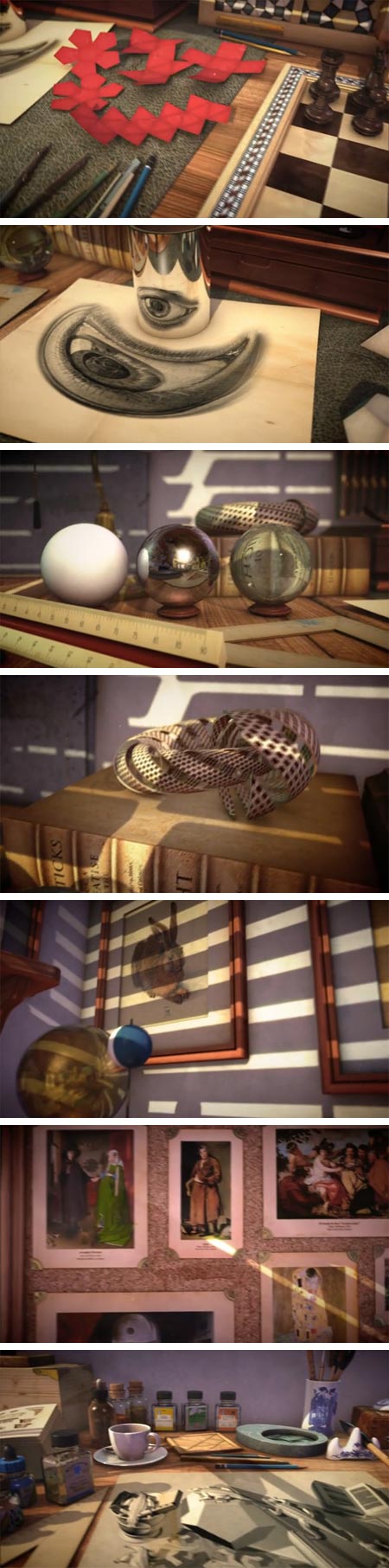
Inspirations is a beautifully realized and wonderfully conceived short CGI animated film by Cristóbal Vila.It is a homage to the works of artist M.C. Escher, conceived as Vila’s fanciful imagining of the artist’s workspace, filled with objects that refer to aspects of Escher’s work
On his website, Etérea Studios, Vila provides information about the short, including stills and annotation about the sources of objects and concepts used in the film, and a page about the referenced artworks by other masters.
I particularly enjoy the highpoint of the piece, in which one of Escher’s images that suggests three dimensionality emerging from a flat surface, itself emerges from a flat surface.
Vila also created the beautiful short, Nature by Numbers, which I wrote about here.
[Via io9]
Categories:
-
Tran Nguyen

Born in Vietnam and raised in the US, Georgia based artist Tran Nguyen studied illustration at the Savannah College of Art and Design (if I’m interpreting the info page of her website correctly, her name is pronounced “tron wen”).Nguyen’s illustrations combine elements of realism, magic realism, art nouveau and perhaps symbolism, and frequently include geometric patterns.
Often employing muted, carefully controlled palettes and subtle textures, she creates works that invite contemplation, seeming to reveal emotional content in layers.
She frequently works “out of the box”, playfully extending parts of her images beyond the apparent bounds of their background, as well as suggesting dimensional qualities of her geometric elements as though some of them floated above the surface of the picture.
Nguyen is represented by Richard Solomon, Artist’s Representative in New York. Their website includes a brief description and step-through of her working process, which involves colored pencil and delicate glazes of transparent acrylics.
[Addendum 2016: Her student website is no longer active. Her new website is here: www.mynameistran.com ]
Categories:
-
Closer to Van Eyck

Closer to Van Eyck: Rediscovering the Ghent Altarpiece is an online presentation of the results of a research project that examined the artist’s extraordinary masterwork in extreme detail, both to assess and record its condition for conservation.The site opens up with a full image of the panels of the altarpiece; from there you can drill down into individual panels to levels of wonderful detail. You can also bring up images from the various panels in split screen view for as many as four at once and zoom in simultaneously.
The images include not only macrophotography, but infrared macrophotography, infrared reflectography and X-radiography, which reveal the master’s underlying layers and aspects of his working process.
See my previous post on Jan van Eyck.
[Via peacay, by way of MetaFilter]
Categories:
-
Simon Dominic

Simon Dominic (who you will sometimes see referred to as Simon Dominic Brewer) is an English illustrator and concept artist.Like many contemporary concept artists and illustrators working in the science fiction and fantasy vein, Simon works digitally, painting his compositions in Corel Painter and Art Rage Studio Pro (see my 2011 review of Art Rage 3 Studio Pro).
He makes a point of using the “natural media” characteristics of those tools (which emulate the effects of traditional media like oil, gouache, watercolor, etc.) to give his work a more painterly feel.
Dominic has a wonderfully eccentric imagination, with creatures and characters that step outside of the expected stereotypes. He often works with constrained color palettes and sharp value contrasts to give his compositions visual drama, and also makes excellent use of texture and atmospheric perspective.
Dominic’s work has been featured in a number of collections of digital and fantasy art, such as the Exposé series, the Fantasy Art Now books and Digital Art Masters.
As a promotion for Volume 5 of Digital Art Masters, the publishers extracted a chapter showcasing Dominic’s how-to for one of his digital paintings and made it available as a PDF so potential readers could sample the book. As of this writing, it’s still available here (click on the “Free Chapter!” banner at the bottom of the main image).
There is a 2011 interview with Dominic on Inside the Artist’s Studio.
[Via Concept Art World]
Categories:
-
The Public Domain Review

I’d like to talk (well OK, rant) for a minute about copyright and the principle of public domain.
“Public domain” is a term referring to works that have passed out of copyright, or have been deliberately assigned to the public domain on creation (for example when created for the U.S. government), and therefore now belong to the public, i.e. all of us.
This is an excellent idea and has been part of US copyright law from the beginning. Copyright laws vary, sometimes confusingly, by country, but I think most or all allow for works to pass into public ownership over time.
As a creator and copyright holder myself, I will be the first to say that copyright is basically a Good Thing, allowing legal protection for the creator of a work from unauthorized use and distribution of their creation for their lifetime — and some years beyond. However, the U.S. Founding Fathers viewed ownership of intellectual property as a kind of monopoly, and felt that it should be limited for the good of the public.
The basic idea is that once the creator of a copyrighted work has died, and his or her heirs (who did not actually create the work) have had a sufficient time to profit off of their relative’s efforts, the work passes into the public domain and belongs to all of us — to copy, rework, disseminate and create variations of to our hearts content, and much to the enrichment of the culture.
Some public domain characters, for example, would include Robin Hood, King Arthur, The Three Musketeers, Snow White, Jack and the Beanstalk, Alice in Wonderland, and so on. Think of all of the inventive variations and stories we have from just those few examples.
Most artwork from history is in the public domain (though photographs of the artwork can be copyrighted by the photographers who took them or institutions to whom copyright for photographs has been assigned).
The copyright/public domain balance is a pretty good arrangement — the creator is protected for their lifetime, the relatives get to ride their coattails for a while, and then we all benefit from a richer public culture when ownership eventually passes to us.
Unfortunately, copyright laws that were originally meant to protect creators can be twisted into tools for advancing corporate power and greed, and the legislators who create and revise our laws seem easily manipulated by those with money and influence.
The large international media conglomerates (the same ones who have been trying to push the U.S. congress into ceding control of the internet to them with travesties of legislation like PIPA and SOPA), are also doing their best to defeat the original intention of the copyright laws, and keep pressuring legislators into extending the “sufficient time” that copyright extends past the creator’s death, to protect and advance their corporate profits.
Originally “life of the author plus 50 years”, the provision was extended to “life of the author plus 70” years by the 1998 Copyright Extension Act, not coincidentally just before the copyright for Disney’s Mickey Mouse was due to move into the public domain. Many referred to it as the “Mickey Mouse Protection Act”.
Those who are cynical about this process, myself included, assume that the time that copyright extends past the creator’s death will be extended again, not coincidentally before the profit making power of Mickey Mouse can be threatened with passing into public domain under the 70 year limit, with pressure applied to legislators by the same monied interests that extended it the first time (and it’s not just Disney that wants this, it’s all the big media conglomerates).
This would effectively mean that nothing that is not deliberately put into the public domain by its creator will ever again pass into ownership of the public, and that the principle of public domain as envisioned by the framers of the U.S. system of government has effectively been defeated.
There have even been a number of attempts by media corporations to claim ownership of public domain material, effectively stealing from us.
The history of the publishing, recording and other media industries is littered with cases of big companies stealing copyrights or copyrighted material from the original creators, or forcing them to give up their rights in order to be paid.
It’s another shameful example of wealth and power trumping the public good, and something that should always keep us wary of the intentions of these corporations (particularly when they’re promoting legislation to “protect creators” — cough cough).
That said, we still have an extensive backlog of material already in the public domain that we can share and enjoy; which, having had my little rant, brings me to the actual subject of the post, The Public Domain Review.
The internet (at least for the time being) is a cornucopia of public domain material; sites like Wikipedia, Wikimedia Commons, The Internet Archive, Project Gutenberg and hundreds of others offer a bounty of public domain material.
The Public Domain Review seeks to be a kind of curated guide to some of this material; its contributors offer articles on interesting finds and good sources of material. There is a page on the site about The Public Domain Review, that also talks about the principle of public domain.
There are sections for collections of topics, one of which is images. Though not yet extensive, as the site as just one year old, the collection is promising and will likely continue to grow. The selections are already nicely eclectic, as the examples above demonstrate.
(Images above: Giovanni Paolo Pannini, Eugène von Guérard, Rick Guidice (NASA), image from book by Frederik Ruysch (uncertain of the artist), Limbourg brothers (for Très Riches Heures), Arnoldus Montanus, Harry Clarke)
[Link via MetaFilter]
Categories:




Charley’s Picks
Bookshop.org
(Bookshop.org affilliate links; sales benefit independent bookshop owners; I get a small percentage to help support my work on Lines and Colors)

John Singer Sargent: Watercolors


Urban Sketching: Understanding Perspective


Charley’s Picks
Amazon
(Amazon.com affiliate links; sales go to a larger yacht for Jeff Bezos; but I get a small percentage to help support my work on Lines and Colors)
John Singer Sargent: Watercolors
Urban Sketching: Understanding Perspective