


Categories
- 3d CGI
- Amusements
- Animation
- Anime & Manga
- Art Materials
- Art Videos
- Blogroll
- Cartoons
- Color
- Comics
- Concept & Visual Dev.
- Creativity
- Digital Art
- Digital Painting
- Displaying Art on the Web
- Drawing
- Eye Candy for Today
- Gallery and Museum Art
- High-res Art Images
- Illustration
- Motion Graphics & Flash
- Museums
- Online Museums
- Outsider Art
- Painting
- Painting a Day
- Paleo Art
- Pastel, Conté & Chalk
- Pen & Ink
- Prints and Printmaking
- Reviews
- Sc-fi and Fantasy
- Sculpture & Dimensional
- Site Comments
- Sketching
- Storyboards
- Tools and Techniques
- Uncategorized
- Vector Art
- Videos & Podcasts
- Vision and Optics
- Watercolor and Gouache
- Webcomics
Archives
- April 2026
- March 2026
- February 2026
- January 2026
- December 2025
- November 2025
- October 2025
- September 2025
- August 2025
- July 2025
- June 2025
- May 2025
- January 2025
- December 2024
- November 2024
- October 2024
- September 2024
- August 2024
- June 2024
- April 2024
- March 2024
- February 2024
- January 2024
- December 2023
- November 2023
- October 2023
- September 2023
- August 2023
- July 2023
- May 2023
- April 2023
- March 2023
- February 2023
- January 2023
- December 2022
- November 2022
- September 2022
- August 2022
- July 2022
- June 2022
- May 2022
- April 2022
- March 2022
- February 2022
- January 2022
- December 2021
- November 2021
- October 2021
- September 2021
- August 2021
- July 2021
- June 2021
- May 2021
- April 2021
- March 2021
- February 2021
- January 2021
- December 2020
- November 2020
- October 2020
- September 2020
- August 2020
- July 2020
- June 2020
- May 2020
- April 2020
- March 2020
- February 2020
- January 2020
- December 2019
- November 2019
- October 2019
- September 2019
- August 2019
- July 2019
- June 2019
- May 2019
- April 2019
- March 2019
- February 2019
- January 2019
- December 2018
- November 2018
- October 2018
- September 2018
- August 2018
- July 2018
- June 2018
- May 2018
- April 2018
- March 2018
- February 2018
- January 2018
- December 2017
- November 2017
- October 2017
- September 2017
- August 2017
- July 2017
- June 2017
- May 2017
- April 2017
- March 2017
- February 2017
- January 2017
- December 2016
- November 2016
- October 2016
- September 2016
- August 2016
- July 2016
- June 2016
- May 2016
- April 2016
- March 2016
- February 2016
- January 2016
- December 2015
- November 2015
- October 2015
- September 2015
- August 2015
- July 2015
- June 2015
- May 2015
- April 2015
- March 2015
- February 2015
- January 2015
- December 2014
- November 2014
- October 2014
- September 2014
- August 2014
- July 2014
- June 2014
- May 2014
- April 2014
- March 2014
- February 2014
- January 2014
- December 2013
- November 2013
- October 2013
- September 2013
- August 2013
- July 2013
- June 2013
- May 2013
- April 2013
- March 2013
- February 2013
- January 2013
- December 2012
- November 2012
- October 2012
- September 2012
- August 2012
- July 2012
- June 2012
- May 2012
- April 2012
- March 2012
- February 2012
- January 2012
- December 2011
- November 2011
- October 2011
- September 2011
- August 2011
- July 2011
- June 2011
- May 2011
- April 2011
- March 2011
- February 2011
- January 2011
- December 2010
- November 2010
- October 2010
- September 2010
- August 2010
- July 2010
- June 2010
- May 2010
- April 2010
- March 2010
- February 2010
- January 2010
- December 2009
- November 2009
- October 2009
- September 2009
- August 2009
- July 2009
- June 2009
- May 2009
- April 2009
- March 2009
- February 2009
- January 2009
- December 2008
- November 2008
- October 2008
- September 2008
- August 2008
- July 2008
- June 2008
- May 2008
- April 2008
- March 2008
- February 2008
- January 2008
- December 2007
- November 2007
- October 2007
- September 2007
- August 2007
- July 2007
- June 2007
- May 2007
- April 2007
- March 2007
- February 2007
- January 2007
- December 2006
- November 2006
- October 2006
- September 2006
- August 2006
- July 2006
- June 2006
- May 2006
- April 2006
- March 2006
- February 2006
- January 2006
- December 2005
- November 2005
- October 2005
- September 2005
- August 2005
Relevant Blogs
Art, Painting & Sketch
- Gurney Journey
- Underpaintings
- Art and Influence
- Painting Perceptions
- Oil Painters of America
- Vasari Paint POV
- Flying Fox
- Urban Sketchers
- Bento (Smithsonian)
- Art Inconnu
- The Hidden Place
- Still Life
- Making a Mark
- The Art of the Landscape
- Exploring Color & Creativity
- Art Contrarian
- Artist A Day
- beinArt Surreal Art Collective
- Eye Level
- David Dunlop
- p.i.g.m.e.n.t.i.u.m
- CultureGrrl
- Joaquín Sorolla blog
- Artists in Pastel
“Painting a Day”
- A Painting a Day (Keiser)
- On Painting (Keiser)
- Julian Merrow-Smith
- Karen Jurick
- Jeffrey Hayes
- Carol Marine
- Abbey Ryan
- Daily Paintworks
Other Painting Blogs
- Virtual Gouache Land
- Neil Hollingsworth
- Marc Hanson
- Kevin Menck
- Marc Dalessio
- Larry Seiler
- Stapleton Kearns
- Colin Page
- Roos Schuring
- Hans Versfelt
- Titus Meeuws
- Régis Pettinari
- René Plein Air
- Belinda Del Pesco
- Robin Weiss
- Nathan Fowkes (Land Sketch)
- William Wray
- Frank Serrano
- Stephen Magsig
- Michael Chesley Johnson
- Twice a Week
- Sarah Wimperis
- Rob Adams
- Michael Cole Manley
- The Dirty Palette Club
- Mike Manley’s Draw!
Gallery Art & Illustration mix
Illustration
- Howard Pyle
- 100 Years of Illustration
- BibliOdyssey
- Illustration Art
- Today’s Inspiration
- Illustration Mundo
- Little Chimp Society
- Danny Gregory
- R D (John Martz
- Illustration Friday blog
- Monster Brains
- Illustrators & Illustrations (RU)
- Elwood H. Smith
- DaniDraws.com
- Designers Who Blog
- iSpot Blog
Sci-Fi & Fantasy
Illustration & Comics
Comics & Cartoons
- Comics Beat
- Robot 6
- Newsarama Blog
- Comic Vine
- Comics Alliance
- Forbidden Planet Int.
- Paolo Rivera
- Bolt City
- Flight
- Scott McCloud
- The Comics Journal
- Comixpedia
- Funnybook Babylon
- James Baker
- Middleton’s Sketchbook
- Boneville
- The Hotel Fred
- Paul Rivoche
- Daily Cartoonist
- Mad About Cartoons (William Wray)
- Digital Strips
Illustration & Concept
Animation & Concept
- Cartoon Brew
- Animation Blog
- Cold Hard Flash
- Concept Art World
- The CAB
- FY Concept Art
- Concept Ships
- Concept Robots
- John Nevarez
- Armand Serrano
- Marcos Mateu-Mestre
- all kinds of stuff (Kricfalusi)
- Yacin the faun (Man Arenas)
- Kelsey Mann
- Cre8tivemarks Blog
- Ice-Cream Monster Toon Cafe
- AAU Character & Creature Design
- AAU Animation Notes
- Articles and Texticles
Paleo & Scientific
Tools & Techniques
Other
Lists of Art Blogs
Art Image Resource Links
Historic Art Images
- Wikimedia Commons: Paintings
- Wikimedia Commons: Drawings
- The Athenaeum
- WikiArt (WikiPaintings)
- Google Art Project: Artists
- Google Art Project: Collections (Museums)
- ArtCyclopedia
- Web Gallery of Art
- Art Renewal Center
- Web Gallery of Impressionism
Auction Consolidation sites
Auction sites
- Sotheby’s
- Bonham’s
- Christies
- Heritage Auctions: Fine Art
- Heritage Auctions: Illustration
- Freeman’s Auctions
- Bukowskis
- Shannon’s
Image Search
Reverse Image Search (search by image)
- Tin Eye
- RevImg
- Google Image Search (camera icon)
- Bing Image Search (camera icon)
Promoting some friends and some clients of my website design business
- Twin Willows T’ai Chi studio in Wilmington DE. Taiji classes with Bryan Davis.
- Ray Hayward, Inspired Teacher of T’ai Chi ( Taiji ) in Minneapolis, Founder of Mindful Motion Tai Chi Academy
- OldHead Tattoo studio and Art Gallery in Wilmington DE. Tattoos and paintings by Bruce Gulick
- Sharon Domenico Art, pet portrait oil paintings
- Platinum Paperhanging, wallpaper hanging, Main Line and Philadelphia, PA
- Lisa Stone Design, interior designer, Main Line and Philadelphia, PA
- Studio12KPT, original art, prints, calendars and other custom printed items by Van Sickle & Rolleri
-
Mike Hernandez

I’ll start with a slight disclaimer, in that Gallery Nucleus, which is currently having a solo exhibition of Mike Hernandez’ work, is also currently an advertiser on Lines and Colors.That being said, when I check in on Gallery Nucleus, it often turns out that they have something on exhibit that is interesting to the point where I want to tell you about it, and I’m trying to do that while the show is current and those in the area can still catch it.
Mike Hernandez is a concept artist and art director at Dreamworks Animation. He has worked on projects like Shreck, Sinbad and Bee Movie. You can see some concept art for Sinbad and Bee Movie on his blog.
Most of the artwork on his blog, though, is his personal work — beautiful small landscapes in gouache, a few somewhat larger ones in oil, charcoal drawings, and marker and ink drawings, often with versions colored after the fact in Photoshop.
Hernandez apparently paints and sketches either on the way to and from work, or perhaps on his lunch hour, as many of the small landscapes are of the area around or even on the Dreamworks campus. They range from traditional landscapes in parks and wooded areas to urban scenes and compositions of industrial buildings, which he renders as miniature marvels of geometric color and light.
Hernandez’ ink sketches, frequently done with a Sharpie, are loose and gestural, but nicely evocative of the California countryside and urban alleyways.
His gouache paintings and sketches are splashed with color and texture, and often have a nice quality of brushstrokes that feel a bit like scribble lines.
Unfortunately, you can’t just click an “Older posts” link to dig back through his blog, as it’s one of those Blogger arrangements where you have to go to particular months on the sidebar; but digging will be rewarded — with life sketches, wonderful charcoal drawings of dogs, photoshop renderings of imaginary scenes and lots of landscape paintings and drawings.
Gallery Nucleus has an online gallery of some of the work that will be offered during the show, though the images on the page are incomplete. (The prices, even given the small scale of the paintings, seem low.)
The Mike Hernandez Solo Exhibition at Gallery Nucleus in Alhambra, CA runs from now until Jaunary 11, 2009. There is a reception tonight, January 3, 2009 from 7-11PM.
Categories:
-
Alexandre Cabanel
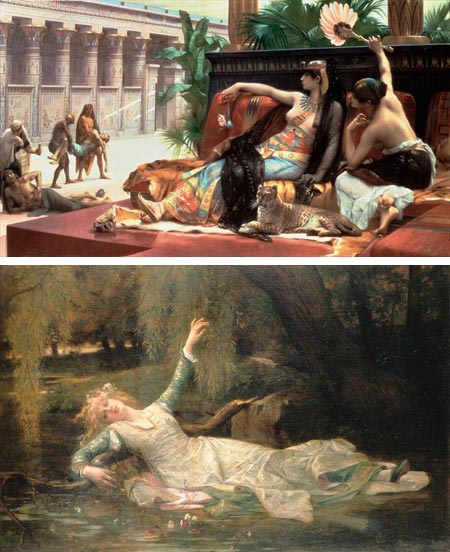
Alexandre Cabanel was a French Academic classical painter who showed notable skill at drawing at the age of 11 and entered the École des Beaux-Arts at 17. He quickly began exhibiting at the Paris Salon.He was renowned as a portrait painter as well as a painter of historic, religious and classical subjects, and eventually became an influential teacher at the École des Beaux-Arts (at the same time that Jean-Léon Gérôme was appointed there) and a juror at the Salon.
He counted among his students numerous painters of note, including Jules Bastien-Lepage, himself tremendously influential, and Daniel Ridgeway Knight (less well-known, but a personal favorite about whom I’ll write more in a future post).
He indulged his audience a bit, with historic or mythological subjects that allowed him to paint beautiful, languorous nudes, as in his Birth of Venus (also here), which was bought by Napoleon III at the 1863 Salon, and Cleopatra trying out poisons on her lovers (above, top, also known as “Cleopatra testing poisons on condemned men”).
With his precise draftsmanship and superb command of painting technique, he was something of an exemplar of an academic painter, and like many of his compatriots, his reputation fell after his death and remained suppressed during the anti-Academic wave of the 20th Century Modernist art establishment.
It’s interesting to compare Cabanel’s vision of Shakespeare’s Ophelia (image above, bottom, also here) with that of Victorian and Pre-Raphaelite painters like John William Waterhouse (images here, here and here) and John Everett Millais.
Categories:
-
Happy Leyendecker Baby New Year 2009!

Another post of New Year’s babies from the illustrator who originated the concept of representing the new year as a baby, J.C. Leyendecker; and some of his numerous Saturday Evening Post covers which captured the essence of the year into the theme surrounding the baby.There is (finally!) a new book of Leyendecker’s work, J.C. Leyendecker by Laurence S. Cutler and Judy Goffman Cutler. Though I haven’t gotten my copy of it yet, reviews are good.
Have a great new year, and may it be filled with lots of great art!
-Charley
Categories:
-
Guy Rose (update)
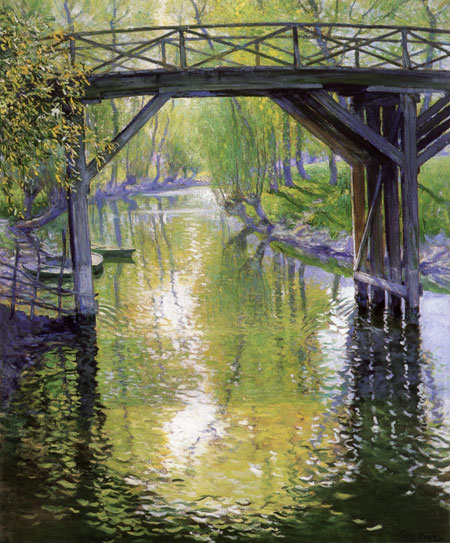
When I wrote about Guy Rose back in 2007 there were only a few resources online, since then, however, much to my delight, The Athenaeum has posted has posted over 120 good-sized images of his beautiful paintings.Guy Orlando Rose is considered one of the foremost of the painters known as “California Impressionists”. I put that term in quotes because, like the “Pennsylvania Impressionists” and “American Impressionists” in general, I think the term has been applied after the fact, and I doubt the painters ever referred to themselves that way.
The images posted on The Athenaeum are from the painter’s time in Giverny, where he learned about French Impressionism firsthand, as well as from California and its striking coastline.
The more I see of Rose’s work, the higher my opinion of him.
Categories:
-
William Laskin
Inlay is a decorative process in which small pieces of material with differing colors are laid into carved channels in the surface of an object to create a pattern or image.Inlays are often applied to decorative boxes or other small objects using wood veneer. It is also a common practice to use other materials, notably shells, particularly when inlay is applied to wooden musical instruments.
Inlays are often applied in to small areas of the fingerboards of guitars, giving them that extra appeal of decoration and craftsmanship.
William Laskin is a Canadian luthier (maker of stringed instruments), specializing in guitars, who goes well beyond the typical small decorative patterns normally applied to guitars several ways.
One is in the composition of his materials, which range into 9 different species of shell, 15 varieties of stone, 4 kinds of ivory and bone, and 3 types of metal.
Another is the location and extent of his inlays. While it is not uncommon for inlays to appear on the rosette surrounding the sound hole, or on the headstock, the shaped block at the top of a guitar’s neck which holds the tuning nuts, those applications are normally small, with headstock decoration usually consisting of the maker’s logo.
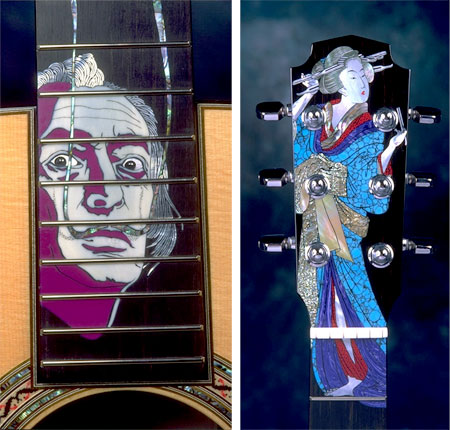
Laskin, on the other hand frequently takes the entire headstock or large portions of the fingerboard as his canvas, and the fact that he treats it as a canvas is the most unusual and interesting aspect of his inlay work.
Using a process called engraved inlay, Laskin hand cuts shaped channels into the ebony fingerboard or ebony headstock veneer that he uses on his guitars, and applies his carefully chosen inlay materials to create what he terms “narrative” inlay, essentially realistic pictures.
The result is a series of striking images, created with the different colors and surface characteristics of the inlay materials as his palette.
Laskin often sketches his subjects from live models, and does extensive research and preliminary drawings before beginning the intense, extremely time consuming process of engraving the design and forming and setting the inlay pieces.
There is a gallery of inlays on his site (click on the thumbnails for larger images), with a description of the process. There is a video on his site called The Guitar is My Canvas, but I was unable to see it as it requires RealPlayer.
Laskin resists the temptation to repeat a successful design, and each inlay image is unique. His range of subjects includes musicians, animals, film noir scenes and artists, like the portrait of Dalí above, as well as references to art styles like the design inspired by Japanese woodblock prints, also shown above.
Makes me wish I played seriously enough to afford one.
Categories:
-
The 2009 Eustace Tilley Contest

As I promised in my post about The Many Faces of Eustace Tilley last January, I’m letting you know about the 2009 Eustace Tilley Contest in time to participate if you’re inclined.Eustace Tilley is the name given to the foppish character drawn by art director Rea Irvin for the first cover of The New Yorker in 1925 (image above, top left). The character has returned for a reprise on the anniversary issue each year and has essentially become the magazine’s mascot.
Last year The New Yorker began a contest in which entrants create their own version of an alternate or updated Eustace, and the winners are featured in a slide show on the magazine’s web site (some of last year’s entries shown above as well as in my previous post). Last year they were also featured in the print version of the magazine, but they don’t mention that on this year’s page about the contest, so I think it’s just online this time.
The contest is only open to residents of the US and Canada (with the exception of Quebec). To enter, you sign up, confirm your registration and then upload your image(s) as a jpg, png or non-animated gif file, ideally 465×633 (must be in vertical orientation).
You can submit multiple entries (up to three, I think). The entries must be received by midnight Eastern Time on January 15, 2009, and the winners will be announced on February 2, 2009.
There’s no particular prize other than inclusion in the slide show of the 12 winners, which will be chosen by the New Yorker’s art editor, François Mouly; and, of course, the fun of creating your own variation of the character.
You can see the submissions to date for the 2009 contest here, the winners of the 2008 contest here, and a Flickr gallery of all 170 entries from the 2008 contest here.
You can also see a gallery of some of the variations on Tilley that the magazine has commissioned as covers from various artists, including Art Spiegelman, Chris Ware, Charles Burns, Roz Chast, Robert Crumb, Anita Kunz, Carter Goodrich and others; and an article about the history of the character by Louis Menand, Mystery Man: The many faces of Eustace Tilley.
I’ll write another article when the contest results are posted in February and we can all see the new round of thoroughly modern Tilleys.
[Via Kottke]
Categories:




Charley’s Picks
Bookshop.org
(Bookshop.org affilliate links; sales benefit independent bookshop owners; I get a small percentage to help support my work on Lines and Colors)

John Singer Sargent: Watercolors


Urban Sketching: Understanding Perspective


Charley’s Picks
Amazon
(Amazon.com affiliate links; sales go to a larger yacht for Jeff Bezos; but I get a small percentage to help support my work on Lines and Colors)
John Singer Sargent: Watercolors
Urban Sketching: Understanding Perspective