


Categories
- 3d CGI
- Amusements
- Animation
- Anime & Manga
- Art Materials
- Art Videos
- Blogroll
- Cartoons
- Color
- Comics
- Concept & Visual Dev.
- Creativity
- Digital Art
- Digital Painting
- Displaying Art on the Web
- Drawing
- Eye Candy for Today
- Gallery and Museum Art
- High-res Art Images
- Illustration
- Motion Graphics & Flash
- Museums
- Online Museums
- Outsider Art
- Painting
- Painting a Day
- Paleo Art
- Pastel, Conté & Chalk
- Pen & Ink
- Prints and Printmaking
- Reviews
- Sc-fi and Fantasy
- Sculpture & Dimensional
- Site Comments
- Sketching
- Storyboards
- Tools and Techniques
- Uncategorized
- Vector Art
- Videos & Podcasts
- Vision and Optics
- Watercolor and Gouache
- Webcomics
Archives
- April 2026
- March 2026
- February 2026
- January 2026
- December 2025
- November 2025
- October 2025
- September 2025
- August 2025
- July 2025
- June 2025
- May 2025
- January 2025
- December 2024
- November 2024
- October 2024
- September 2024
- August 2024
- June 2024
- April 2024
- March 2024
- February 2024
- January 2024
- December 2023
- November 2023
- October 2023
- September 2023
- August 2023
- July 2023
- May 2023
- April 2023
- March 2023
- February 2023
- January 2023
- December 2022
- November 2022
- September 2022
- August 2022
- July 2022
- June 2022
- May 2022
- April 2022
- March 2022
- February 2022
- January 2022
- December 2021
- November 2021
- October 2021
- September 2021
- August 2021
- July 2021
- June 2021
- May 2021
- April 2021
- March 2021
- February 2021
- January 2021
- December 2020
- November 2020
- October 2020
- September 2020
- August 2020
- July 2020
- June 2020
- May 2020
- April 2020
- March 2020
- February 2020
- January 2020
- December 2019
- November 2019
- October 2019
- September 2019
- August 2019
- July 2019
- June 2019
- May 2019
- April 2019
- March 2019
- February 2019
- January 2019
- December 2018
- November 2018
- October 2018
- September 2018
- August 2018
- July 2018
- June 2018
- May 2018
- April 2018
- March 2018
- February 2018
- January 2018
- December 2017
- November 2017
- October 2017
- September 2017
- August 2017
- July 2017
- June 2017
- May 2017
- April 2017
- March 2017
- February 2017
- January 2017
- December 2016
- November 2016
- October 2016
- September 2016
- August 2016
- July 2016
- June 2016
- May 2016
- April 2016
- March 2016
- February 2016
- January 2016
- December 2015
- November 2015
- October 2015
- September 2015
- August 2015
- July 2015
- June 2015
- May 2015
- April 2015
- March 2015
- February 2015
- January 2015
- December 2014
- November 2014
- October 2014
- September 2014
- August 2014
- July 2014
- June 2014
- May 2014
- April 2014
- March 2014
- February 2014
- January 2014
- December 2013
- November 2013
- October 2013
- September 2013
- August 2013
- July 2013
- June 2013
- May 2013
- April 2013
- March 2013
- February 2013
- January 2013
- December 2012
- November 2012
- October 2012
- September 2012
- August 2012
- July 2012
- June 2012
- May 2012
- April 2012
- March 2012
- February 2012
- January 2012
- December 2011
- November 2011
- October 2011
- September 2011
- August 2011
- July 2011
- June 2011
- May 2011
- April 2011
- March 2011
- February 2011
- January 2011
- December 2010
- November 2010
- October 2010
- September 2010
- August 2010
- July 2010
- June 2010
- May 2010
- April 2010
- March 2010
- February 2010
- January 2010
- December 2009
- November 2009
- October 2009
- September 2009
- August 2009
- July 2009
- June 2009
- May 2009
- April 2009
- March 2009
- February 2009
- January 2009
- December 2008
- November 2008
- October 2008
- September 2008
- August 2008
- July 2008
- June 2008
- May 2008
- April 2008
- March 2008
- February 2008
- January 2008
- December 2007
- November 2007
- October 2007
- September 2007
- August 2007
- July 2007
- June 2007
- May 2007
- April 2007
- March 2007
- February 2007
- January 2007
- December 2006
- November 2006
- October 2006
- September 2006
- August 2006
- July 2006
- June 2006
- May 2006
- April 2006
- March 2006
- February 2006
- January 2006
- December 2005
- November 2005
- October 2005
- September 2005
- August 2005
Relevant Blogs
Art, Painting & Sketch
- Gurney Journey
- Underpaintings
- Art and Influence
- Painting Perceptions
- Oil Painters of America
- Vasari Paint POV
- Flying Fox
- Urban Sketchers
- Bento (Smithsonian)
- Art Inconnu
- The Hidden Place
- Still Life
- Making a Mark
- The Art of the Landscape
- Exploring Color & Creativity
- Art Contrarian
- Artist A Day
- beinArt Surreal Art Collective
- Eye Level
- David Dunlop
- p.i.g.m.e.n.t.i.u.m
- CultureGrrl
- Joaquín Sorolla blog
- Artists in Pastel
“Painting a Day”
- A Painting a Day (Keiser)
- On Painting (Keiser)
- Julian Merrow-Smith
- Karen Jurick
- Jeffrey Hayes
- Carol Marine
- Abbey Ryan
- Daily Paintworks
Other Painting Blogs
- Virtual Gouache Land
- Neil Hollingsworth
- Marc Hanson
- Kevin Menck
- Marc Dalessio
- Larry Seiler
- Stapleton Kearns
- Colin Page
- Roos Schuring
- Hans Versfelt
- Titus Meeuws
- Régis Pettinari
- René Plein Air
- Belinda Del Pesco
- Robin Weiss
- Nathan Fowkes (Land Sketch)
- William Wray
- Frank Serrano
- Stephen Magsig
- Michael Chesley Johnson
- Twice a Week
- Sarah Wimperis
- Rob Adams
- Michael Cole Manley
- The Dirty Palette Club
- Mike Manley’s Draw!
Gallery Art & Illustration mix
Illustration
- Howard Pyle
- 100 Years of Illustration
- BibliOdyssey
- Illustration Art
- Today’s Inspiration
- Illustration Mundo
- Little Chimp Society
- Danny Gregory
- R D (John Martz
- Illustration Friday blog
- Monster Brains
- Illustrators & Illustrations (RU)
- Elwood H. Smith
- DaniDraws.com
- Designers Who Blog
- iSpot Blog
Sci-Fi & Fantasy
Illustration & Comics
Comics & Cartoons
- Comics Beat
- Robot 6
- Newsarama Blog
- Comic Vine
- Comics Alliance
- Forbidden Planet Int.
- Paolo Rivera
- Bolt City
- Flight
- Scott McCloud
- The Comics Journal
- Comixpedia
- Funnybook Babylon
- James Baker
- Middleton’s Sketchbook
- Boneville
- The Hotel Fred
- Paul Rivoche
- Daily Cartoonist
- Mad About Cartoons (William Wray)
- Digital Strips
Illustration & Concept
Animation & Concept
- Cartoon Brew
- Animation Blog
- Cold Hard Flash
- Concept Art World
- The CAB
- FY Concept Art
- Concept Ships
- Concept Robots
- John Nevarez
- Armand Serrano
- Marcos Mateu-Mestre
- all kinds of stuff (Kricfalusi)
- Yacin the faun (Man Arenas)
- Kelsey Mann
- Cre8tivemarks Blog
- Ice-Cream Monster Toon Cafe
- AAU Character & Creature Design
- AAU Animation Notes
- Articles and Texticles
Paleo & Scientific
Tools & Techniques
Other
Lists of Art Blogs
Art Image Resource Links
Historic Art Images
- Wikimedia Commons: Paintings
- Wikimedia Commons: Drawings
- The Athenaeum
- WikiArt (WikiPaintings)
- Google Art Project: Artists
- Google Art Project: Collections (Museums)
- ArtCyclopedia
- Web Gallery of Art
- Art Renewal Center
- Web Gallery of Impressionism
Auction Consolidation sites
Auction sites
- Sotheby’s
- Bonham’s
- Christies
- Heritage Auctions: Fine Art
- Heritage Auctions: Illustration
- Freeman’s Auctions
- Bukowskis
- Shannon’s
Image Search
Reverse Image Search (search by image)
- Tin Eye
- RevImg
- Google Image Search (camera icon)
- Bing Image Search (camera icon)
Promoting some friends and some clients of my website design business
- Twin Willows T’ai Chi studio in Wilmington DE. Taiji classes with Bryan Davis.
- Ray Hayward, Inspired Teacher of T’ai Chi ( Taiji ) in Minneapolis, Founder of Mindful Motion Tai Chi Academy
- OldHead Tattoo studio and Art Gallery in Wilmington DE. Tattoos and paintings by Bruce Gulick
- Sharon Domenico Art, pet portrait oil paintings
- Platinum Paperhanging, wallpaper hanging, Main Line and Philadelphia, PA
- Lisa Stone Design, interior designer, Main Line and Philadelphia, PA
- Studio12KPT, original art, prints, calendars and other custom printed items by Van Sickle & Rolleri
-
Alan Pollack

After studying as several colleges, including the School of Visual Arts and the New York Academy of Figurative Art, fantasy artist Alan Pollack decided to focus on illustrations for role playing game companies.He worked for a while for TSR, the company responsible for Dungeons and Dragons, and has since gone freelance, adding companies like Del-Rey, ROC, Tor Books and Wizards of the Coast to his client list, book covers to his ouevre and science fiction subjects to his subject matter.
His web site galleries include role playing game art, collectable card game art, unpublished art, book covers and available originals. Though he applies his detailed realist style to each genre with equal aplomb, it is the book cover art I find most appealing, particularly in cases where he plays with areas of color as compositional elements, as in the image above, Memory of Fire.
Most of his paintings are in oil on illustration board and are sometimes done at a fairly large size (30″x40″, 76x100cm).
Pollack seems to have a fun sense of the lineage of classic science fiction and fantasy illustration that developed out of pulp illustration of the early to mid 20th Century, and cites his early fascination with somewhat more modern influences such as Frazetta, Boris, the Hildebrandt Brothers and Michael Whelan, and the later discovery of artists like Brom, Keith Parkinson, Robh Ruppel and Donato Giancola.
For me, one of the most appealing factors in Pollack’s work is his sense of fun. You get the impression he is having a blast painting the kind of subjects he grew up fascinated with, and that enthusiasm comes through in the finished paintings.
Categories:
-
Mouse Guard (David Peterson)
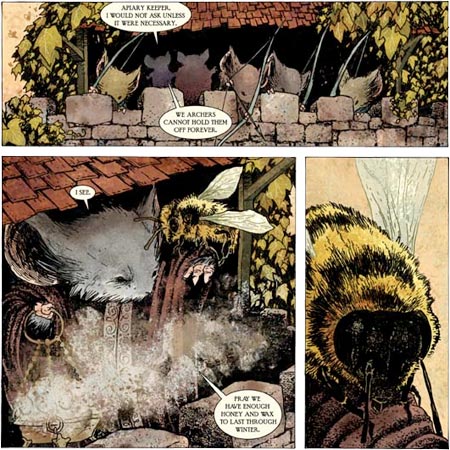
Mouse Guard is a comics series (graphic story) about medieval knights, life in medieval villages and communities, territorial differences, commerce, war, and the harsh conditions that marked life in Europe in the middle of the 12th Century; except that the story is about communities of mice, told almost in parallel, as though this were a history of what was occurring beneath the feet and notice of the actual medieval humans at the time.The stories are named for the times, Mouse Guard: Fall 1152, and Mouse Guard: Winter 1152, the current series. The Fall series ran six issues and was collected into a hardcover edition, Mouse Guard Volume 1: Fall 1152, and later released as a trade paperback.
Drawn in an illustrative style that would be suitable for children’s books, the stories appeal to adults and are charming and direct in a way that would appeal to children of a certain age (though there is some actual violence, so parents should read through before getting younger kids interested).
The illustration style stands out from most other comics, bearing more relation to pen and ink illustration from earlier times and carrying a nice flavor for the setting and story. Author/artist David Peterson draws the art in traditional ink on bristol board; the coloring looks like watercolor, though I don’t know if it is applied to stats manually or, like most modern comics, applied digitally once the drawings have been digitized.
Peterson also bucked the current market trends with another choice, making his books a different size from traditional American comics (8″ x 8″ instead of 6½” x 10″), which can make it more difficult to get past the mainstream mindset of many comic shop owners (as I know from the personal experience of publishing the print version of my own webcomic in a horizontal format).
Those comic shop owners who do opt to carry the title, though, are finding that they have a comic they can recommend to people new to comics, female as well as male, and of varying ages; something not nearly common enough as the American comic book market struggles to break out if its superhero ghetto.
Peterson’s stories would appeal to the broad audience that responded to the Lord of the Rings movies, with many similar themes and a similar (though more modest) approach to world building, creating a detailed setting in which to unfold his tales.
In addition to stories in keeping with the medieval sword and castle milieu, the mice protagonists face challenges familiar to real mice (owls, scarcity of food), but resolve them in distinctly anthropomorphic ways (swords and slings, negotiation and cooperation between disparate communities).
I find it particularly interesting in the current series that their greatest enemy doesn’t seem to be an evil warlord or ravaging beast, but the Winter itself, very much in keeping with the realities of Medieval life.
Peterson earned a degree in Fine Arts from Michigan University and has a personal web site that includes illustrations, many of which are for children’s books or in a similar style.
Unfortunately, like so many sites for comics and web comics in particular, the official Mouse Guard site seems skewed toward those who are already familiar with the series, and doesn’t do the best job of introducing a new reader to the material. You can actually get a better introduction and overview on the extensive Wikipedia entry devoted to the title.
There is also brief description and several preview excerpts on the Archaia Studios Press site, a nice 5-page excerpt from Mouse Guard: Fall 1152 on the New York Magazine site, and an interview with Peterson on the Silver Bullet Comics site.
The official site does have an introduction to the characters, but in hunting for artwork, you may be misled into thinking there is not much available. There is no “Gallery” section; the Downloads section features small Avatars, but larger Wallpapers are promised as “Coming Soon”.
The For Sale section yields paydirt in the form of pages of original art for sale. Clicking on the thumbnails produces large versions of the original pages. These are presented in the increasingly popular Lightbox JavaScript pop-up, that I find mildly annoying for it’s tendency to make you wait while it resizes the window, but that’s a minor quibble. The Lightbox pop-up does provide the ability to click through the images in sequence (hidden control to the right an left of the image).
As nice as it is to see the original pen and ink pages, this is only part of the art, missing Peterson’s nicely emotive color.
What is not made obvious (and really should be) is that there is a series of terrific 8-page previews linked to the small cover thumbnails on the “Books” page. There are many pages of art here from the sequence of issues that can give you a real feeling for the nature of this original and fascinating series.
[Suggestion courtesy of James Gurney]
Categories:
-
Utagawa: Masters of the Japanese Print, 1770-1900 at the Brooklyn Museum

We tend to think of Japanese prints as depicting serene, contemplative scenes of mountains and gardens; and characterize them as the work of Zen-like removal from the bustle of everyday life.On hearing that the term Ukiyo-e, the name for one of the most prominent genres of Japanese prints, refers to “pictures of the floating world”, we might assume, as I first did, that the intention is metaphysical.
In fact, the “floating world” is a term derived from a reference to a very much here-and-now (at the time) subculture that revolved around pleasure centers of major cities like Kyoto, Osaka and Edo (now Tokyo), in which food, drink, theatre, sex and other amusements offered their earthly allure.
Many of the prints that belong to that genre were of popular subjects like famous actors, sumo wrestlers, warriors, beautiful courtesans, interiors of theaters and scenes of frivolity and celebration like fireworks displays (image above: Fireworks at Ryogoku Bridge by Utagawa Toyokuni). These prints could be produced in great enough numbers that a wide audience, for whom original paintings were out of reach, could afford them. In effect, they were the visual pop culture of the time.
In fact, the government often cracked down on the artists for pandering to the public with base and popular subjects and tried to forbid the sale of pictures of famous actors, beautiful women and overtly erotic subject matter. It was later, perhaps because of the crackdowns, that many of the same artists moved into landscape for their primary subjects.
The Brooklyn Museum in New York has mounted a show of more than 70 prints, both from the Chazen Museum of Art, University of Wisconsin, and their own extensive collection of Japanese prints, called Utagawa: Masters of the Japanese Print, 1770-1900 that brings this character of the Ukiyo-e prints into high relief.
The Utagowa School, founded by Utagowa Toyoharu, was the major force in the Japanese print market in the 19th Century. It encompassed many of the of the finest artists working in woodblock prints at the time, including Utagawa Hiroshige (also known as Ando Hiroshige).
The Brooklyn Museum owns a complete set of Hirosage’s famous 100 Views of Edo, one of the most revered series of works in Japanese Art.
Utagawa: Masters of the Japanese Print, 1770-1900 is at the Brooklyn Museum from now through June 15, 2008.
If you happen to travel to brooklyn for the exhibit, don’t miss the fact that the Brooklyn Botanic Garden has a beautiful Japanese Hill and Pond Garden that should be showing signs of first blossoms about now; in which you can walk through the kind of serene and contemplative landscape we normally associate with Japanese prints.
For an experience more in keeping with the popular early prints of the Utagawa School, you might try Times Square.
Addendum: The Brooklyn Botanical Garden is offering a Utagwa woodprinting class inspired by the museum’s exhibit. From the Garden’s description of the class: “The Brooklyn Museum’s exhibit of Utagawa woodblock prints will inspire us to make wood and/or linoleum block prints of BBG sites. Two or three sets of numbered prints will be the class goal. Previous experience with linoleum and/or wood block printing is necessary. To register, call 718-623-7220. 6 Thursdays: May 1 to June 5 | 10:30 a.m.–1:30 p.m. $174 member, $189 nonmember (Fee includes $25 lab fee.)”
Categories:
-
Rogier ven der Wyden’s Miraflores Altarpiece

It’s interesting that in the great body of art throughout history that has been inspired by Christianity, or commissioned directly by the various expressions of the Christian church, the resurrection of Christ, the event that is the basis of the important observance of Easter, doesn’t seem to be one of the more common subjects for paintings.While it understandably doesn’t embody the drama or emotional impact of the crucifixion, it seems less frequently depicted than many less important or dramatic events from the Bible that are often the subject of paintings, statuary or altarpieces.
I’m not certain why; there are some depictions of the resurrection that have plenty of visual impact, like Albrecht Altdorfer’s stormy scene and Matthias Grünewald’s stunningly intense vision in his Isenheim Alterpiece.
Perhaps it’s just my perception. I haven’t attempted an actual count, and there is a pretty long list of resurrection artwork on this site. It may just be that those paintings are not the ones most noticed or remembered.
Here is one to add to the list, though, a fascinating painting by an early master of technique of oil painting, Rogier van der Weyden. It is the right panel of his Miraflores Altarpiece (image above with detail, right and bottom).
This is an extraordinarily elaborate and detailed work, in which Van der Weyden is taking advantage of the ability of oil painting to execute intricate details and carry color in layers of translucent glazes.
This is actually a double scene, depicting two separate events in one image. Our eye moves from the decorative elements on the trompe l’oeil arches into the interior scene, painstakingly constructed in linear perspective, with Christ having arisen and gone immediately to his mother.
From there we move into the background of the painting, and also travel into the immediate past, to the scene of the resurrection, rendered with carefully painted atmospheric perspective. (It’s interesting to note that in work by the early masters of oil painting, there is an understanding of the color shifts and value changes in atmospheric perspective, but distant background elements are often rendered with the same fanatical detail as foreground elements.) The two scenes, and two events in time, are connected by a winding path in the middle ground.
Like Antonello da Messina’s remarkable St. Jerome in his Study, we are invited to journey into and through the painting, and in this case, through time as well.
Categories:
-
Todd Ford

Todd Ford is a painter and art teacher living and working in Texas.Ford paints in a deftly rendered realist style that pays particular attention to smooth surfaces and sharp contrasts in sometimes closely related colors (greens and blues, oranges and yellows).
He has some frequent subjects, including a series of paintings of plastic toys (which I didn’t particularly respond to) and a more recent series of liquids and immersed objects in jars, and another of cloth partially inserted into jars (both of which I like very much), as well as the apparent beginnings of two newer series of reflective globes and drapery, and close ups of reflective spoons containing pools or drops of colored liquids (which I’m looking forward to seeing more of).
There is also a slightly older series of close ups of the details of old farm trucks, that I find fascinating for the juxtaposition of the weathered surfaces of painted metal with the smooth, shiny surfaces of glass headlights and chrome bezels.
Ford has both a blog and a web site that feature his paintings.
He takes several interesting tacks at his still life subjects. He has several paintings of broken glass, with close ups of bottle necks and the remains of the bases of broken bottles, rendered with an attention to color and transparency, rendering and finish that might be given to portraits of museum quality glassware.
My favorites are his compositions combining the transparency, color shading and tonal drama of colored glassware and drapery, usually in the form of cloth partially in and partially out of colored jars or bottles. There is also a related series of objects like spoons or brushes partially immersed in liquid in similar jars, that explores some of the same visual territory of transparency, translucency, reflection and refraction.
Ford also has a few paintings with light bulbs, broken, whole and even submerged in liquid in jars, the delve into the same challenges.
I’m particularly fond of some of the recent posts on his blog in which the paintings are photographed in place on the easel, giving you a sense of scale usually missing from photographed works.
[Link via Art & Critique]
Categories:
-
My Father’s Hand (Samuel Wray)

My Father’s Hand is a tribute blog, created by designer Amanda Wray to showcase the drawings of her father, Samuel Wray.Samuel Wray was a commercial artist in some capacity, though I know little about his commercial work other than that he did some inking and lettering projects for comics, notably for a Robinson Crusoe comic.
The drawings that his daughter has posted are personal, drawings of figures and faces, sketches and self portraits. The postings started in 2006 and are sometimes accompanied by descriptive passages.
Along the way, we get glimpses of the man and his sometimes distant relationship with his daughter, her fascination with his process of drawing and her thoughts on the drawings themselves.
Wray’s drawings are often confident, with solid draftsmanship and a loose, informal line quality. Most are in pencil. He sometimes draws in ink, with tones in wash, and his ink line can be alternately definite or searching. In some of his pencil drawings, as well, he can have a more tentative line, with a delicate quality, seemingly contemplative.
My understanding is that Wray was suffering in his later years from the beginnings of Alzheimer’s, and was in struck by a car a few years before his death. His daughter started the blog about a year before he died, and was offering reproductions of the drawings, the proceeds of which originally went to him and now go to his widow. There is no formal offering of particular reproductions, simply a contact email link.
I assume the ability to purchase reproductions is still in place, as the blog is still on the web, even though Amanda’s posts stop a few days after her father’s passing in 2007.
[Link via Neil Hollingsworth]
Categories:




Charley’s Picks
Bookshop.org
(Bookshop.org affilliate links; sales benefit independent bookshop owners; I get a small percentage to help support my work on Lines and Colors)

John Singer Sargent: Watercolors


Urban Sketching: Understanding Perspective


Charley’s Picks
Amazon
(Amazon.com affiliate links; sales go to a larger yacht for Jeff Bezos; but I get a small percentage to help support my work on Lines and Colors)
John Singer Sargent: Watercolors
Urban Sketching: Understanding Perspective