


Categories
- 3d CGI
- Amusements
- Animation
- Anime & Manga
- Art Materials
- Art Videos
- Blogroll
- Cartoons
- Color
- Comics
- Concept & Visual Dev.
- Creativity
- Digital Art
- Digital Painting
- Displaying Art on the Web
- Drawing
- Eye Candy for Today
- Gallery and Museum Art
- High-res Art Images
- Illustration
- Motion Graphics & Flash
- Museums
- Online Museums
- Outsider Art
- Painting
- Painting a Day
- Paleo Art
- Pastel, Conté & Chalk
- Pen & Ink
- Prints and Printmaking
- Reviews
- Sc-fi and Fantasy
- Sculpture & Dimensional
- Site Comments
- Sketching
- Storyboards
- Tools and Techniques
- Uncategorized
- Vector Art
- Videos & Podcasts
- Vision and Optics
- Watercolor and Gouache
- Webcomics
Archives
- April 2026
- March 2026
- February 2026
- January 2026
- December 2025
- November 2025
- October 2025
- September 2025
- August 2025
- July 2025
- June 2025
- May 2025
- January 2025
- December 2024
- November 2024
- October 2024
- September 2024
- August 2024
- June 2024
- April 2024
- March 2024
- February 2024
- January 2024
- December 2023
- November 2023
- October 2023
- September 2023
- August 2023
- July 2023
- May 2023
- April 2023
- March 2023
- February 2023
- January 2023
- December 2022
- November 2022
- September 2022
- August 2022
- July 2022
- June 2022
- May 2022
- April 2022
- March 2022
- February 2022
- January 2022
- December 2021
- November 2021
- October 2021
- September 2021
- August 2021
- July 2021
- June 2021
- May 2021
- April 2021
- March 2021
- February 2021
- January 2021
- December 2020
- November 2020
- October 2020
- September 2020
- August 2020
- July 2020
- June 2020
- May 2020
- April 2020
- March 2020
- February 2020
- January 2020
- December 2019
- November 2019
- October 2019
- September 2019
- August 2019
- July 2019
- June 2019
- May 2019
- April 2019
- March 2019
- February 2019
- January 2019
- December 2018
- November 2018
- October 2018
- September 2018
- August 2018
- July 2018
- June 2018
- May 2018
- April 2018
- March 2018
- February 2018
- January 2018
- December 2017
- November 2017
- October 2017
- September 2017
- August 2017
- July 2017
- June 2017
- May 2017
- April 2017
- March 2017
- February 2017
- January 2017
- December 2016
- November 2016
- October 2016
- September 2016
- August 2016
- July 2016
- June 2016
- May 2016
- April 2016
- March 2016
- February 2016
- January 2016
- December 2015
- November 2015
- October 2015
- September 2015
- August 2015
- July 2015
- June 2015
- May 2015
- April 2015
- March 2015
- February 2015
- January 2015
- December 2014
- November 2014
- October 2014
- September 2014
- August 2014
- July 2014
- June 2014
- May 2014
- April 2014
- March 2014
- February 2014
- January 2014
- December 2013
- November 2013
- October 2013
- September 2013
- August 2013
- July 2013
- June 2013
- May 2013
- April 2013
- March 2013
- February 2013
- January 2013
- December 2012
- November 2012
- October 2012
- September 2012
- August 2012
- July 2012
- June 2012
- May 2012
- April 2012
- March 2012
- February 2012
- January 2012
- December 2011
- November 2011
- October 2011
- September 2011
- August 2011
- July 2011
- June 2011
- May 2011
- April 2011
- March 2011
- February 2011
- January 2011
- December 2010
- November 2010
- October 2010
- September 2010
- August 2010
- July 2010
- June 2010
- May 2010
- April 2010
- March 2010
- February 2010
- January 2010
- December 2009
- November 2009
- October 2009
- September 2009
- August 2009
- July 2009
- June 2009
- May 2009
- April 2009
- March 2009
- February 2009
- January 2009
- December 2008
- November 2008
- October 2008
- September 2008
- August 2008
- July 2008
- June 2008
- May 2008
- April 2008
- March 2008
- February 2008
- January 2008
- December 2007
- November 2007
- October 2007
- September 2007
- August 2007
- July 2007
- June 2007
- May 2007
- April 2007
- March 2007
- February 2007
- January 2007
- December 2006
- November 2006
- October 2006
- September 2006
- August 2006
- July 2006
- June 2006
- May 2006
- April 2006
- March 2006
- February 2006
- January 2006
- December 2005
- November 2005
- October 2005
- September 2005
- August 2005
Relevant Blogs
Art, Painting & Sketch
- Gurney Journey
- Underpaintings
- Art and Influence
- Painting Perceptions
- Oil Painters of America
- Vasari Paint POV
- Flying Fox
- Urban Sketchers
- Bento (Smithsonian)
- Art Inconnu
- The Hidden Place
- Still Life
- Making a Mark
- The Art of the Landscape
- Exploring Color & Creativity
- Art Contrarian
- Artist A Day
- beinArt Surreal Art Collective
- Eye Level
- David Dunlop
- p.i.g.m.e.n.t.i.u.m
- CultureGrrl
- Joaquín Sorolla blog
- Artists in Pastel
“Painting a Day”
- A Painting a Day (Keiser)
- On Painting (Keiser)
- Julian Merrow-Smith
- Karen Jurick
- Jeffrey Hayes
- Carol Marine
- Abbey Ryan
- Daily Paintworks
Other Painting Blogs
- Virtual Gouache Land
- Neil Hollingsworth
- Marc Hanson
- Kevin Menck
- Marc Dalessio
- Larry Seiler
- Stapleton Kearns
- Colin Page
- Roos Schuring
- Hans Versfelt
- Titus Meeuws
- Régis Pettinari
- René Plein Air
- Belinda Del Pesco
- Robin Weiss
- Nathan Fowkes (Land Sketch)
- William Wray
- Frank Serrano
- Stephen Magsig
- Michael Chesley Johnson
- Twice a Week
- Sarah Wimperis
- Rob Adams
- Michael Cole Manley
- The Dirty Palette Club
- Mike Manley’s Draw!
Gallery Art & Illustration mix
Illustration
- Howard Pyle
- 100 Years of Illustration
- BibliOdyssey
- Illustration Art
- Today’s Inspiration
- Illustration Mundo
- Little Chimp Society
- Danny Gregory
- R D (John Martz
- Illustration Friday blog
- Monster Brains
- Illustrators & Illustrations (RU)
- Elwood H. Smith
- DaniDraws.com
- Designers Who Blog
- iSpot Blog
Sci-Fi & Fantasy
Illustration & Comics
Comics & Cartoons
- Comics Beat
- Robot 6
- Newsarama Blog
- Comic Vine
- Comics Alliance
- Forbidden Planet Int.
- Paolo Rivera
- Bolt City
- Flight
- Scott McCloud
- The Comics Journal
- Comixpedia
- Funnybook Babylon
- James Baker
- Middleton’s Sketchbook
- Boneville
- The Hotel Fred
- Paul Rivoche
- Daily Cartoonist
- Mad About Cartoons (William Wray)
- Digital Strips
Illustration & Concept
Animation & Concept
- Cartoon Brew
- Animation Blog
- Cold Hard Flash
- Concept Art World
- The CAB
- FY Concept Art
- Concept Ships
- Concept Robots
- John Nevarez
- Armand Serrano
- Marcos Mateu-Mestre
- all kinds of stuff (Kricfalusi)
- Yacin the faun (Man Arenas)
- Kelsey Mann
- Cre8tivemarks Blog
- Ice-Cream Monster Toon Cafe
- AAU Character & Creature Design
- AAU Animation Notes
- Articles and Texticles
Paleo & Scientific
Tools & Techniques
Other
Lists of Art Blogs
Art Image Resource Links
Historic Art Images
- Wikimedia Commons: Paintings
- Wikimedia Commons: Drawings
- The Athenaeum
- WikiArt (WikiPaintings)
- Google Art Project: Artists
- Google Art Project: Collections (Museums)
- ArtCyclopedia
- Web Gallery of Art
- Art Renewal Center
- Web Gallery of Impressionism
Auction Consolidation sites
Auction sites
- Sotheby’s
- Bonham’s
- Christies
- Heritage Auctions: Fine Art
- Heritage Auctions: Illustration
- Freeman’s Auctions
- Bukowskis
- Shannon’s
Image Search
Reverse Image Search (search by image)
- Tin Eye
- RevImg
- Google Image Search (camera icon)
- Bing Image Search (camera icon)
Promoting some friends and some clients of my website design business
- Twin Willows T’ai Chi studio in Wilmington DE. Taiji classes with Bryan Davis.
- Ray Hayward, Inspired Teacher of T’ai Chi ( Taiji ) in Minneapolis, Founder of Mindful Motion Tai Chi Academy
- OldHead Tattoo studio and Art Gallery in Wilmington DE. Tattoos and paintings by Bruce Gulick
- Sharon Domenico Art, pet portrait oil paintings
- Platinum Paperhanging, wallpaper hanging, Main Line and Philadelphia, PA
- Lisa Stone Design, interior designer, Main Line and Philadelphia, PA
- Studio12KPT, original art, prints, calendars and other custom printed items by Van Sickle & Rolleri
-
Eakins’ The Gross Clinic – held for ransom?
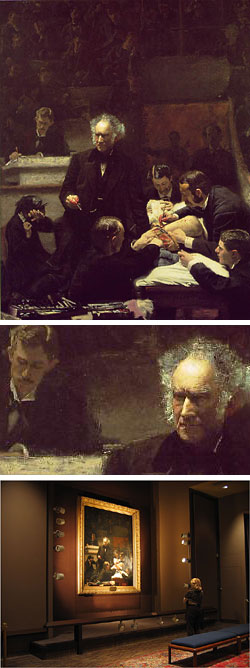 Philadelphia, like many great cities, is intimately associated particular artists. Perhaps foremost among them is Thomas Eakins, undisputedly one of America’s greatest painters. (See my previous post on Eakins.)
Eakin’s acknowledged masterpiece is a painting titled The Gross Clinic (Wikipedia article and image), it depicts one of the pioneering surgeons at the city’s venerable medical school, Thomas Jefferson University, directing and performing an advanced operation in a teaching amphitheater full of medical students at the university’s associated hospital, at the time and to this day one of the nation’s great teaching hospitals.
The painting exemplifies in many ways the fundamental dual roles of Jefferson as a university/hospital and Eakins’ own fascination with human anatomy, the practice of of surgery, which he saw in some ways as an analog of painting, and the triumph of rationality in the advancement of medicine and science.
Sadly, rationality does not always have staying power, and even the finest institutions can find themselves at the mercy of an incomprehensibly short-sighted and insufferably arrogant band of fools who happen to sit on the board of directors at a particular point in time.
This seems to be the fate of Jefferson, whose board recently surprised the city with the announcement of a clandestine agreement to sell The Gross Clinic, a significant part of the heritage of both the school and the city, to Wal-Mart heiress Alice L. Walton for her Crystal Bridges Museum Of American Art in Bentonville, Arkansas for $68 million, aided and abetted, in a shameful exercise in mis-judgement, by The National Gallery.
The painting was originally not actually purchased by Jefferson, but by Jefferson alumni. They bought the work (which was not well-received at the time, largely because of its strikingly graphic depiction of the surgery) for $200, and donated the dramatic image of one of their great professors to the university. The painting was hung in the College Building, where it stayed until the 1980’s, when it was moved to a gallery in Jefferson Alumni Hall (image at left bottom).
Perhaps because art at the time was viewed more as art and less as a commodity, and probably because they didn’t dream the need would arise, the alumni did not legally bind the university to keep their gift in place, either within the university’s campus or within the city of Philadelphia. Yes the university, like many, is financially pressed, but other options were not discussed and the whole deal was kept secret until done. The current alumni are not pleased. Neither are many others in Philadelphia, including your writer, who have some sense of the value of art other than dollar value.
In a creepy parallel to the way that Wal-Mart “creates jobs” by undercutting and destroying the long-standing local businesses in a community and hiring their former employes back at sub-standard wages and benefits, Wal-Mart heiress Alice L. Walton is attempting to “create culture” in building her new museum in Arkansas; not through years of careful collecting (which requires skill, knowledge and patience), but by raiding the treasures of other cities, finding financial weaknesses in institutions that can be exploited to separate communities from their treasured works with the brute force application of the billions her daddy left her to play with.
Her last conquest was to relieve the New York Public Library of the burden of caring for Asher B. Durand’s Kindred Spirits (NYT article), by way of sealed bid auction.
Jefferson’s board, perhaps daunted by the public outcry, the questionable legality of the transaction and attempts to invoke the city’s laws about “treasured objects”, has agreed to hold the transaction for 45 days, leaving the city and its cultural institutions to come up with an offer to match Walton’s $68 million, effectively holding the painting for ransom.
The Philadelphia Museum of Art, (which sits, incidentally, on the Eakins Oval at the end of the Benjamin Franklin Parkway), and The Pennsylvania Academy of the Fine Arts, itself home to a great Museum of American Art, have created a fund to attempt to keep Eakins’ great work here in Philadelphia. (Eakins studied and later taught at the Academy and took classes in anatomy at Jefferson.) The fund in itself won’t create the necessary $68 million, but it may attract the notice of donors who will.
While I object to this in a way, because it legitimizes the Jefferson board’s draconian ransom scheme, I have to reluctantly support it; if only because I can’t bear the thought of the painting winding up in the hands of a spoiled and privileged heiress who thinks that she can buy culture like jewelry, and whose money is stained with the sweat of underpaid workers and chalked with the dust of community businesses that have been crushed under the Wal-Mart steam roller.
Why must art always be subjugated to the whims of the artless?
You’re getting to see my snarky side here, because I’m already pissed off about the way art is treated as a commodity, and this deal just seems particularly onerous and close to home.
I should mention in the context of my ranting that I have a great deal of respect and a certain emotional attachment for Thomas Jefferson University Hospital. I consider it one of the finest in the country and I was always glad that my kidney transplant (14 years!) was performed there. I am also an alumni of The Pennsylvania Academy of the Fine Arts, one of the institutions sponsoring the fund to keep the painting in the city.
Categories:
-
Scott McCloud Making Comics Fifty State Tour

In spite of a personal schedule that I thought would prevent it, I managed to catch Scott McCloud’s lecture at Drexel University here in Philadelphia last night.McCloud, for those of you not familiar with him, is a popular comics creator and writer, who is best known as a writer about comics, not in the sense of a reviewer, but in the overarching sense of one who tackles the philosophical questions of what comics actually are, what they can do and how they work as an art form and means of visual communication.
He’s also a comics creator, see my previous post about the online version of his long running character Zot!. You can also find some of his comics stories and experiments on his site.
This year McCloud released the third of his major books about the comics form. The first one, Understanding Comics, is a classic on the nature of comics as a medium and art form, and I can’t recommend it highly enough (certainly not in this short space). The second was Reinventing Comics, about the new forms comics are taking, particularly in electronic media, (in which he mentions my own webcomic, Argon Zark!). The new book is Making Comics, his foray into the art and craft of comics, about which I will write a more detailed post in the near future.
In support of the new book McCloud and his family have embarked on a 50 state lecture tour, with speaking engagements at universities, comics conventions, large comics shops and other venues across the country. Interestingly, in an interview on Marty Moss-Coane’s Radio Times yesterday on the local NPR affiliate WHYY (Real Audio file available by searching for Nov 30, 2006 on this page), McCloud says that when he is booked by a university, he’s never sure what department will be hosting him. It could be the art department, communications or technology. His lectures and writings are of interest to all of them.
I’ve had the pleasure of meeting Scott before, so I knew he was well spoken and articulate, but I was pleased to find that he is also a very good public speaker. His presentation was lively, witty, accompanied by well thought out and arranged graphics (as you might imagine), and in retrospect, covered a remarkable amount of ground in under an hour. He also tackled some fairly advanced concepts and made them seem simple and understandable with his usual aplomb, bringing to bear his uncanny understanding of the relationship between words and pictures in sequence (comics), and the power of that form to not only tell stories, but convey information, even complex information.
In all, this is a very worthwhile experience for anyone interested in visual art or communications of any sort, and if you are in the path of his lecture tour, I highly recommend that you try to catch his presentation. As far as I know the lectures are usually free and open to the public, particularly when sponsored by universities.
You can find the schedule on the Tour section of his site, as well as “along the way” details on a blog devoted to the tour, which also include tibits like “Winterviews“, videos in which McCloud’s young daughter interviews comics creators they encounter in their travels.
McCloud has also recently posted an online supplement to one of the chapters of the new book, called “Chapter 5½“, in which he adds to the “Tools, Techniques and Technology” chapter with information on computer technology displayed in its natural environment.
Categories:
-
Alex Gross

Alex Gross is an illustrator and gallery artist whose work is a fascinating amalgam of images and influences, rendered in a highly crafted and meticulous style that gives his compositions an uncanny feeling of authority.He creates large scale and sometimes highly detailed paintings that are filled with iconic images that may or may not be allegorical. Snakes, birds and butterflies are placed in odd contexts. Faces are often dour or troubled in a manner somewhat reminiscent of George Tooker’s monuments to isolation. Clouds take unusual forms, sometimes as patterns, occasionally as actual objects like falling airplanes, a repeated theme in several images.
There is a kind of delicate and careful eerieness to his more recent gallery paintings, which feel like allegorical portraits, contrasted with a more energetic play of imagery in his older paintings (which I have to say I prefer).
Gross’s canvasses can have a certain Gothic formality about them, as if time has been conveniently stopped and elements of reality carefully mixed and arranged in some kind of cosmic diorama before being carefully recorded by the artist.
There is a feeling of graphic nostalgia in almost all of his work, recalling early poster art, mixed with elements of pop surrealism, bits of American and Japanese pop culture and dotted with the iconic butterflies and other weird symbolism — a sort of retro-future nostalgic pop-classical synthesis. (Sorry, I couldn’t resist.)
Gross studied at the Art Center College of Design in Pasadena and in 2000 travelled in Japan for two months on an artistic scholarship, collecting examples of Japanese gallery art and commercial art. Part of the collection was published by Taschen as Japanese Beauties (Icons). There is also a beautiful new hardcover collection of Gross’s own work, The Art of Alex Gross: Paintings and Other Works from Chronicle Books.
Suggestion courtesy of Jack Harris.
Categories:
-
Jean-Baptiste-Siméon Chardin
 If I were to say “Think of a great landscape painter.” or ” Think of a great portrait artist.”, you would probably have a few names spring immediately to mind. If I were to say “Think of a great still life painter.”, chances are better that you might draw a blank, or at least have to think for a bit to come up with a name.
Still life, though a respected form of painting, just isn’t very glamorous. It’s been a staple subject of artists for centuries and many artists today are doing wonderful work in the area; but historically, artists who paint still life and something else are usually remembered for the something else. Well, here’s a name for your list, even if it is a long hyphenated one: Jean-Baptiste-Siméon Chardin. (I think the French just loved long hyphenated names so they could outdo the British at something else.)
Chardin was one of the great painters of the 18th Century. His unsentimental portrayals of his subjects, strongly influenced by the Dutch masters, were in sharp contrast to the opulently decorative and playfully erotic canvasses of other Rococo masters like Boucher and Fragonard. He was renowned for his portraits and genre paintings (pictures of everyday life), but in his case it is the still life subjects that get the attention.
Though the subjects are humble, often pots, ladles, jars and simple kitchen utensils, Chardin paints them with a richness and tactile vibrancy that is outstanding among all still life painters. He was particularly a master of texture, whether of beaten and polished metal, scuffed wood or the rough surfaces of walls and tables. You can feel the objects in his paintings, pick them and hold them in your mind, even though the way he represents them is painterly and not photorealistic. He often laid in parts of his paintings with rough chunks of color, smudges and and scumbling, letting the surface of the paint itself provide some of the texture.
If you have the opportunity to look at a Chardin painting in a local museum (see the listing on Artcyclopedia), you may find that you’ve unknowingly walked by it several times. Like most still life paintings, Chardin’s don’t scream for attention, but they do reward it. Contemplation of a Chardin still life can be an almost Zen-like exercise in the appreciation of the humble and immediate as sublime.
Don’t ignore his portraits or domestic scenes, he was a superb painter in all areas, but it’s his magically tactile still life subjects that are most memorable. You may come away with at least one name for your mental list of great still life painters.
Categories:
-
Joshua Middleton

Joshua Middleton is a comics artist who works in mainstream American comics, but whose work feels outside of that world in many ways.Middleton draws in an open lined style, with few spotted blacks, that feels to me like it carries more influence from Japanese and European comics than major American comics. Nonetheless, after a stint on Crossgen’s Meridian and a short run on his own creator owned project, Sky between Branches (image above), he went to work for Marvel Comics, creating covers and sometimes interior art for titles like NYX, New Mutants and X-Men Unlimited. He did a bit of work for Udon and Dark Horse and then Moved to DC, where he has done a number of covers and the full mini-series Superman/Shazam: First Thunder (with writer Judd Winick). Middleton seems to have settled in there as a cover artist for Vertigo titles like American Virgin.
Middleton’s site features galleries of his work from various projects, arranged by covers, comics pages and sketches & character designs, including some concept designs for Serenity’s “Inara”. He started a blog this fall in which he posts unpublished work, sketches, news, notices of originals that are up for auction and sometimes some YouTube style vids of images as he works on them.
Middleton often does the complete artwork for the pieces he works on, pencils, inks and colors, again more in keeping with European and independent comics than the normal approach of major American comics companies, which is based on a team model (or assembly line if you want to be cynical).
His ink rendering style utilizes a fine outline, with little variation in line weight, also like the European ligne claire comics style or like inks for animation. His color feels almost like cartoon cell painting, with broad areas of relatively flat color laid against one another with few gradients or painted effects except in backgrounds.
He works with lots of subdued, neutralized colors, particularly blues that are pushed almost to gray. It’s an unusual approach for mainstream comics coloring, although it has some characteristics in common with coloring for some American comics that are very manga influenced. The difference is that Middleton does it with more aplomb and a firmer knowledge of anatomy and geometric form than the color artists for many of those titles.
Overall, though, Middleton’s aim seems always to be in service of the emotion of the story, whether in characters faces or the emotional effect of color and tone on the scene as a whole. I hope his success as a cover artist doesn’t keep him from applying that approach more sequential work; telling stories, after all, is what comics do best.
Categories:
-
John Howe

Fantasy artist John Howe is best known for his illustrations of J. R. R. Tolkien’s works, creating illustrations for editions of The Lord of the Rings trilogy, The Hobbit and related calendars in the early 90’s. Peter Jackson tapped him, along with Alan Lee, to be lead artists on his large scale movie adaptation.Howe also worked on the film The Lion the Witch and the Wardrobe, and is presumably involved in other movie projects. Howe was born in Canada, studied in France and is now living in Switzerland. He has illustrated numerous other books in several countries, primarily but not always in the fantasy and medieval genres.
Despite having a bio page, his site doesn’t have much in the way of a quick introduction, instead it seems to assume that you’re already aware of his work and are back for more news. Someone with more time/patience than I could probably find more background info by digging through the pages devoted to news, travels, FAQ and fan forums.
There are plenty of images, though. They are pulled from a database, so you can view them by various categories, like topic, most viewed, highest rated, newest, etc. Some, like “Elves & Dragons” (image above), have links to very large versions and even preliminary sketches.
There is a supplementary site here, apparently for an exhibition of his work in conjunction with a cultural event of some kind in 2007. (I haven’t had time to try to translate this for more details.)
Addendum: The site for this event, Saint-Ursanne, La Fantastique, has been updated and is now available in English, as well as French and German. The event takes place in a medieval city that was the inspiration for many of Howe’s paintings for The Lord of the Rings. A description for the site reads: an exclusive exhibition of John Howe paintings in the cloisters and cellar gallery, fantastical installations all around the city, classical and Celtic concerts, medieval festivities, encounters around J. R. R. Tolkien’s novels, documentaries and evening cinema in the reconverted factory “Fours à Chauxâ€.
Categories:




Charley’s Picks
Bookshop.org
(Bookshop.org affilliate links; sales benefit independent bookshop owners; I get a small percentage to help support my work on Lines and Colors)

John Singer Sargent: Watercolors


Urban Sketching: Understanding Perspective


Charley’s Picks
Amazon
(Amazon.com affiliate links; sales go to a larger yacht for Jeff Bezos; but I get a small percentage to help support my work on Lines and Colors)
John Singer Sargent: Watercolors
Urban Sketching: Understanding Perspective