


Categories
- 3d CGI
- Amusements
- Animation
- Anime & Manga
- Art Materials
- Art Videos
- Blogroll
- Cartoons
- Color
- Comics
- Concept & Visual Dev.
- Creativity
- Digital Art
- Digital Painting
- Displaying Art on the Web
- Drawing
- Eye Candy for Today
- Gallery and Museum Art
- High-res Art Images
- Illustration
- Motion Graphics & Flash
- Museums
- Online Museums
- Outsider Art
- Painting
- Painting a Day
- Paleo Art
- Pastel, Conté & Chalk
- Pen & Ink
- Prints and Printmaking
- Reviews
- Sc-fi and Fantasy
- Sculpture & Dimensional
- Site Comments
- Sketching
- Storyboards
- Tools and Techniques
- Uncategorized
- Vector Art
- Videos & Podcasts
- Vision and Optics
- Watercolor and Gouache
- Webcomics
Archives
- May 2026
- April 2026
- March 2026
- February 2026
- January 2026
- December 2025
- November 2025
- October 2025
- September 2025
- August 2025
- July 2025
- June 2025
- May 2025
- January 2025
- December 2024
- November 2024
- October 2024
- September 2024
- August 2024
- June 2024
- April 2024
- March 2024
- February 2024
- January 2024
- December 2023
- November 2023
- October 2023
- September 2023
- August 2023
- July 2023
- May 2023
- April 2023
- March 2023
- February 2023
- January 2023
- December 2022
- November 2022
- September 2022
- August 2022
- July 2022
- June 2022
- May 2022
- April 2022
- March 2022
- February 2022
- January 2022
- December 2021
- November 2021
- October 2021
- September 2021
- August 2021
- July 2021
- June 2021
- May 2021
- April 2021
- March 2021
- February 2021
- January 2021
- December 2020
- November 2020
- October 2020
- September 2020
- August 2020
- July 2020
- June 2020
- May 2020
- April 2020
- March 2020
- February 2020
- January 2020
- December 2019
- November 2019
- October 2019
- September 2019
- August 2019
- July 2019
- June 2019
- May 2019
- April 2019
- March 2019
- February 2019
- January 2019
- December 2018
- November 2018
- October 2018
- September 2018
- August 2018
- July 2018
- June 2018
- May 2018
- April 2018
- March 2018
- February 2018
- January 2018
- December 2017
- November 2017
- October 2017
- September 2017
- August 2017
- July 2017
- June 2017
- May 2017
- April 2017
- March 2017
- February 2017
- January 2017
- December 2016
- November 2016
- October 2016
- September 2016
- August 2016
- July 2016
- June 2016
- May 2016
- April 2016
- March 2016
- February 2016
- January 2016
- December 2015
- November 2015
- October 2015
- September 2015
- August 2015
- July 2015
- June 2015
- May 2015
- April 2015
- March 2015
- February 2015
- January 2015
- December 2014
- November 2014
- October 2014
- September 2014
- August 2014
- July 2014
- June 2014
- May 2014
- April 2014
- March 2014
- February 2014
- January 2014
- December 2013
- November 2013
- October 2013
- September 2013
- August 2013
- July 2013
- June 2013
- May 2013
- April 2013
- March 2013
- February 2013
- January 2013
- December 2012
- November 2012
- October 2012
- September 2012
- August 2012
- July 2012
- June 2012
- May 2012
- April 2012
- March 2012
- February 2012
- January 2012
- December 2011
- November 2011
- October 2011
- September 2011
- August 2011
- July 2011
- June 2011
- May 2011
- April 2011
- March 2011
- February 2011
- January 2011
- December 2010
- November 2010
- October 2010
- September 2010
- August 2010
- July 2010
- June 2010
- May 2010
- April 2010
- March 2010
- February 2010
- January 2010
- December 2009
- November 2009
- October 2009
- September 2009
- August 2009
- July 2009
- June 2009
- May 2009
- April 2009
- March 2009
- February 2009
- January 2009
- December 2008
- November 2008
- October 2008
- September 2008
- August 2008
- July 2008
- June 2008
- May 2008
- April 2008
- March 2008
- February 2008
- January 2008
- December 2007
- November 2007
- October 2007
- September 2007
- August 2007
- July 2007
- June 2007
- May 2007
- April 2007
- March 2007
- February 2007
- January 2007
- December 2006
- November 2006
- October 2006
- September 2006
- August 2006
- July 2006
- June 2006
- May 2006
- April 2006
- March 2006
- February 2006
- January 2006
- December 2005
- November 2005
- October 2005
- September 2005
- August 2005
Relevant Blogs
Art, Painting & Sketch
- Gurney Journey
- Underpaintings
- Art and Influence
- Painting Perceptions
- Oil Painters of America
- Vasari Paint POV
- Flying Fox
- Urban Sketchers
- Bento (Smithsonian)
- Art Inconnu
- The Hidden Place
- Still Life
- Making a Mark
- The Art of the Landscape
- Exploring Color & Creativity
- Art Contrarian
- Artist A Day
- beinArt Surreal Art Collective
- Eye Level
- David Dunlop
- p.i.g.m.e.n.t.i.u.m
- CultureGrrl
- Joaquín Sorolla blog
- Artists in Pastel
“Painting a Day”
- A Painting a Day (Keiser)
- On Painting (Keiser)
- Julian Merrow-Smith
- Karen Jurick
- Jeffrey Hayes
- Carol Marine
- Abbey Ryan
- Daily Paintworks
Other Painting Blogs
- Virtual Gouache Land
- Neil Hollingsworth
- Marc Hanson
- Kevin Menck
- Marc Dalessio
- Larry Seiler
- Stapleton Kearns
- Colin Page
- Roos Schuring
- Hans Versfelt
- Titus Meeuws
- Régis Pettinari
- René Plein Air
- Belinda Del Pesco
- Robin Weiss
- Nathan Fowkes (Land Sketch)
- William Wray
- Frank Serrano
- Stephen Magsig
- Michael Chesley Johnson
- Twice a Week
- Sarah Wimperis
- Rob Adams
- Michael Cole Manley
- The Dirty Palette Club
- Mike Manley’s Draw!
Gallery Art & Illustration mix
Illustration
- Howard Pyle
- 100 Years of Illustration
- BibliOdyssey
- Illustration Art
- Today’s Inspiration
- Illustration Mundo
- Little Chimp Society
- Danny Gregory
- R D (John Martz
- Illustration Friday blog
- Monster Brains
- Illustrators & Illustrations (RU)
- Elwood H. Smith
- DaniDraws.com
- Designers Who Blog
- iSpot Blog
Sci-Fi & Fantasy
Illustration & Comics
Comics & Cartoons
- Comics Beat
- Robot 6
- Newsarama Blog
- Comic Vine
- Comics Alliance
- Forbidden Planet Int.
- Paolo Rivera
- Bolt City
- Flight
- Scott McCloud
- The Comics Journal
- Comixpedia
- Funnybook Babylon
- James Baker
- Middleton’s Sketchbook
- Boneville
- The Hotel Fred
- Paul Rivoche
- Daily Cartoonist
- Mad About Cartoons (William Wray)
- Digital Strips
Illustration & Concept
Animation & Concept
- Cartoon Brew
- Animation Blog
- Cold Hard Flash
- Concept Art World
- The CAB
- FY Concept Art
- Concept Ships
- Concept Robots
- John Nevarez
- Armand Serrano
- Marcos Mateu-Mestre
- all kinds of stuff (Kricfalusi)
- Yacin the faun (Man Arenas)
- Kelsey Mann
- Cre8tivemarks Blog
- Ice-Cream Monster Toon Cafe
- AAU Character & Creature Design
- AAU Animation Notes
- Articles and Texticles
Paleo & Scientific
Tools & Techniques
Other
Lists of Art Blogs
Art Image Resource Links
Historic Art Images
- Wikimedia Commons: Paintings
- Wikimedia Commons: Drawings
- The Athenaeum
- WikiArt (WikiPaintings)
- Google Art Project: Artists
- Google Art Project: Collections (Museums)
- ArtCyclopedia
- Web Gallery of Art
- Art Renewal Center
- Web Gallery of Impressionism
Auction Consolidation sites
Auction sites
- Sotheby’s
- Bonham’s
- Christies
- Heritage Auctions: Fine Art
- Heritage Auctions: Illustration
- Freeman’s Auctions
- Bukowskis
- Shannon’s
Image Search
Reverse Image Search (search by image)
- Tin Eye
- RevImg
- Google Image Search (camera icon)
- Bing Image Search (camera icon)
Promoting some friends and some clients of my website design business
- Twin Willows T’ai Chi studio in Wilmington DE. Taiji classes with Bryan Davis.
- Ray Hayward, Inspired Teacher of T’ai Chi ( Taiji ) in Minneapolis, Founder of Mindful Motion Tai Chi Academy
- OldHead Tattoo studio and Art Gallery in Wilmington DE. Tattoos and paintings by Bruce Gulick
- Sharon Domenico Art, pet portrait oil paintings
- Platinum Paperhanging, wallpaper hanging, Main Line and Philadelphia, PA
- Lisa Stone Design, interior designer, Main Line and Philadelphia, PA
- Studio12KPT, original art, prints, calendars and other custom printed items by Van Sickle & Rolleri
-
Noli Novak

In drawing, particularly pen and ink drawing, stipple refers to the painstaking technique of creating tones by laying down areas of dots, the density of which creates areas of varying tone. It’s almost a handmade analog to the pre-printing screening of photographs, though the technique long preceded photography.Stipple was important to classic illustrators, such as Dorothy Lathrop, and is associated in particular with noted pulp science fiction illustrator Virgil Finlay. The technique went through something of a revival in the 1960’s, both among science fiction illustrators who carried on Finlay’s tradition, like Robert Walters, and among underground cartoonists, notably Fred Schrier and Dave Sheridan.
In general, however, the technique doesn’t have many adherents due to the work intensive, patience demanding nature of the process. I’ve done some stipple illustrations myself, and I can testify to the demanding nature of laying down hundreds, if not thousands, of dots to create smooth tones.
Contrary to what you might think if you haven’t tried it, you cannot apply stipple mindlessly; the dots must be laid down carefully, with attention to the spacing between them. Get two dots too close to each other and you have a glaring error, dark enough to stand out in your otherwise smooth tone.
Given the difficulty of the technique, it’s a delight to have a bastion of modern stipple illustration in the form of the “hedcuts” (“headline cuts”) that have graced the pages of the Wall Street Journal since 1979, when the style was codified by Kevin Sprouls. The WSJ hedcut style, in which stipple is used in conjunction with engraving-like cross hatching, is employed for small portraits of well known figures, and has become an identifying characteristic of the paper.
Noli Novak is one of the few people who does these illustrations professionally. Her clear, crisp application of the process produces portraits with some of the feeling of traditional engravings, but with a fresh, modern edge.
Novak and her colleagues work from photographs licensed by the Journal, meticulously hand drawing the illustrations that are often so true to the appearance of the subject that many people misinterpret the technique as some kind of sophisticated Photoshop filtering process. While there are some filters that work in that direction, attempting to apply screen-like effects that mimic engravings or stipple, I’ve never seen any of them come anywhere close to the drawings of a talented hedcut artist like Novak.
There is a visual charm to these drawings that, despite their echos of engraving and other graphics, is unique and particularly pleasing to the eye (in a way analogous to the unique visual charm of scratchboard).
Novak has been producing some of the best of the WSJ’s Hedcut portraits since 1987. Her website includes galleries of her drawings of celebrities, corporate and public figures, along with categories like Men, Women, Bald, Headgear and Bearded (the latter hilariously including a teddy bear).
Just so you don’t think that each category only contains 2 pieces, take note of the inexplicably small arrow to the lower right of the drawings, which leads to subsequent pages.
Novak also has a blog, titled, appropriately enough, Hedcuts, in which she discusses her work; including cases in which her work has been “borrowed” by other artists.
Her website also includes examples of her collage works, in which she often uses bits of newspaper as elements.
Novak was featured in the National Portrait Gallery’s exhibition Picturing Business in America.
Categories:
-
Vintage National Parks Posters
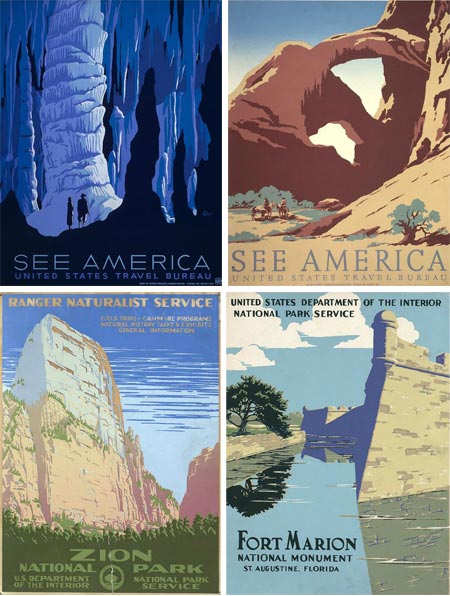
National Geographic has posted a selection of WPA sponsored Great Depression era posters created as promotions for the nation’s national parks.There are no artist credits, and the selection is small, but the posters are graphically beautiful.
You can see more of these, though reproduced much smaller, on the Ranger Doug’s site, where they are offered as modern posters.
[Via BoingBoing]
Categories:
-
Justin Clayton

I first encountered painter Justin Clayton when I included him in one of my early posts about Painting a Day blogs (and a subsequent post). Clayton has since moved away from the painting a day convention, but still posts small still life, landscape and figurative paintings to his blog on a frequent basis.Clayton’s approach is direct and painterly, often with roughly textured backgrounds in his still life compositions, in which he also shows his fascination with the play of light and shadow.
Clayton studied at BYU, the Los Angeles Academy of Figurative Art and the California Arts Institute; and cites as inspiration painters like William Nicholson, John Singer Sargent and James Abbott McNeill Whistler.
In addition to his blog, Clayton has a website on which his paintings are arranged in thumbnail galleries by date or subject. You can also start with the latest work and click through them in sequence.
He also maintains a secondary blog devoted to his Beach Paintings, in which he continues to post paintings and photographs from a 2007 trip down the California coast, and additional work of a related nature since then.
He is also a member of the Daily Paintworks group of painters, who display their latest work together on a joint page. In addition there are three of Clayton’s process videos available on Vimeo.
Categories:
-
Outwin Boochever Portrait Competition 2009

The Outwin Boochever Portrait Competition 2009 at the Smithsonian National Portrait Gallery was, as the name implies, held in 2009, but the exhibition of 49 works selected from the 3,300 entries is on display until September 6, 2010.The museum has posted the finalists on this page, click on the thumbnails for larger versions.
The portraits encompass a range of styles and media, and the competition is meant to demonstrate the widening definition of portraiture and the role of portraits in art.
The website also has a Portrait of an Artist feature, in which several of the participating artists are highlighted and clicking through takes you to a statement by the artist and often additional images.
(Images at left: Phillip Schirmer, Chuck Close, Margaret Bowland, Jen Bandini)
Categories:
-
Reverse Perspective Animation

Linear perspective is an attempt to codify the way that we perceive the relationships between the size of objects, and the shapes of objects, based on their relationship to us in three dimensional space and convey that perception on a two dimensional surface.The most important rules of linear perspective are that objects appear smaller in the distance, and parallel lines converge on a hypothetical distant vanishing point.
In true reverse (or inverse) perspective, these rules are reversed, in that objects are larger in the distance and parallel lines converge in the direction of the observer’s position.
Reverse perspective is sometimes called Byzantine perspective because of its use in icon paintings, in which objects like thrones or platforms are depicted as wider on the portion farther from the observer. The notions that have been applied for explanation are that the important point of view is that of God, not of the human observer. Whether this is the actual intent is unknown, but it’s worth remembering that the invention of linear perspective postdates the Byzantine, so they could not have been using the reverse of codified rules they presumably didn’t have.
For those of us who have been exposed to linear perspective in images for all of our lives, the idea of reverse perspective is hard to visualize, but Jeremy Mooney-Somers has used 3-D graphics software (a modified version of Art of Illusion) to make an animated visualization of True Reverse Perspective.
I have to emphasize that the images above do not convey the idea. You must see the animated version to get the effect.
(It’s interesting to contrast this with with the Reverspective of Patrick Hughes; though not actually true reverse perspective, it’s an interesting variation on the way we perceive three dimensional relationships.)
[Via BoingBoing]
Categories:
-
Al Williamson 1931-2010
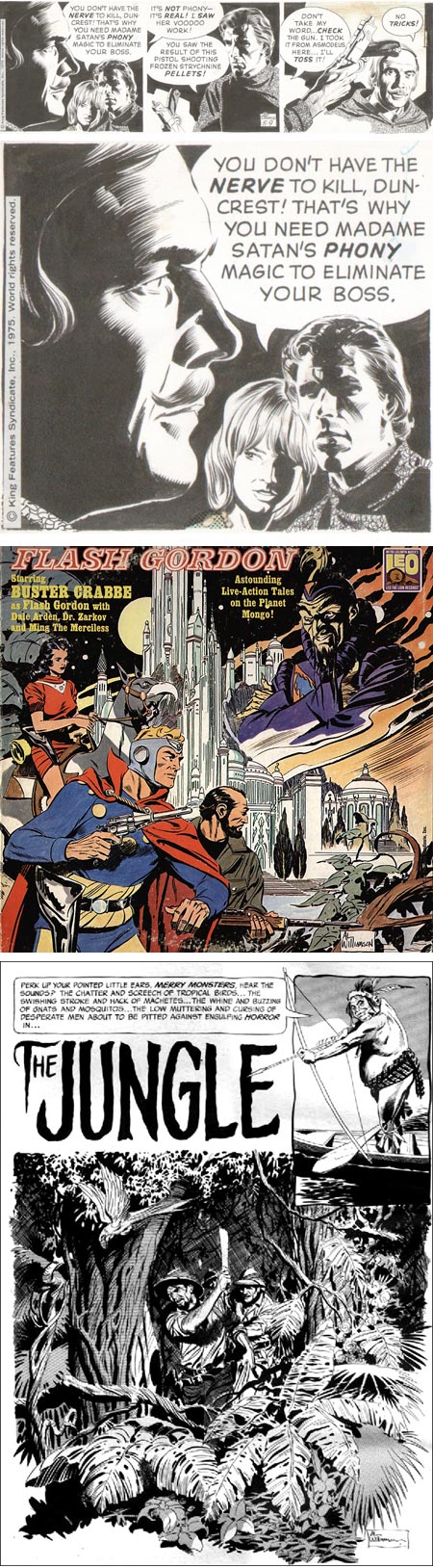
I’m sorry to report that Al Williamson, one of the greats of 20th Century comics art and a personal favorite of mine, died on Sunday at the age of 79.For more see my posts on Al Williamson and Al Williamson’s Flash Gordon: A Lifelong Vision of the Heroic.
Categories:




Charley’s Picks
Bookshop.org
(Bookshop.org affilliate links; sales benefit independent bookshop owners; I get a small percentage to help support my work on Lines and Colors)

John Singer Sargent: Watercolors


Urban Sketching: Understanding Perspective


Charley’s Picks
Amazon
(Amazon.com affiliate links; sales go to a larger yacht for Jeff Bezos; but I get a small percentage to help support my work on Lines and Colors)
John Singer Sargent: Watercolors
Urban Sketching: Understanding Perspective