


Categories
- 3d CGI
- Amusements
- Animation
- Anime & Manga
- Art Materials
- Art Videos
- Blogroll
- Cartoons
- Color
- Comics
- Concept & Visual Dev.
- Creativity
- Digital Art
- Digital Painting
- Displaying Art on the Web
- Drawing
- Eye Candy for Today
- Gallery and Museum Art
- High-res Art Images
- Illustration
- Motion Graphics & Flash
- Museums
- Online Museums
- Outsider Art
- Painting
- Painting a Day
- Paleo Art
- Pastel, Conté & Chalk
- Pen & Ink
- Prints and Printmaking
- Reviews
- Sc-fi and Fantasy
- Sculpture & Dimensional
- Site Comments
- Sketching
- Storyboards
- Tools and Techniques
- Uncategorized
- Vector Art
- Videos & Podcasts
- Vision and Optics
- Watercolor and Gouache
- Webcomics
Archives
- May 2026
- April 2026
- March 2026
- February 2026
- January 2026
- December 2025
- November 2025
- October 2025
- September 2025
- August 2025
- July 2025
- June 2025
- May 2025
- January 2025
- December 2024
- November 2024
- October 2024
- September 2024
- August 2024
- June 2024
- April 2024
- March 2024
- February 2024
- January 2024
- December 2023
- November 2023
- October 2023
- September 2023
- August 2023
- July 2023
- May 2023
- April 2023
- March 2023
- February 2023
- January 2023
- December 2022
- November 2022
- September 2022
- August 2022
- July 2022
- June 2022
- May 2022
- April 2022
- March 2022
- February 2022
- January 2022
- December 2021
- November 2021
- October 2021
- September 2021
- August 2021
- July 2021
- June 2021
- May 2021
- April 2021
- March 2021
- February 2021
- January 2021
- December 2020
- November 2020
- October 2020
- September 2020
- August 2020
- July 2020
- June 2020
- May 2020
- April 2020
- March 2020
- February 2020
- January 2020
- December 2019
- November 2019
- October 2019
- September 2019
- August 2019
- July 2019
- June 2019
- May 2019
- April 2019
- March 2019
- February 2019
- January 2019
- December 2018
- November 2018
- October 2018
- September 2018
- August 2018
- July 2018
- June 2018
- May 2018
- April 2018
- March 2018
- February 2018
- January 2018
- December 2017
- November 2017
- October 2017
- September 2017
- August 2017
- July 2017
- June 2017
- May 2017
- April 2017
- March 2017
- February 2017
- January 2017
- December 2016
- November 2016
- October 2016
- September 2016
- August 2016
- July 2016
- June 2016
- May 2016
- April 2016
- March 2016
- February 2016
- January 2016
- December 2015
- November 2015
- October 2015
- September 2015
- August 2015
- July 2015
- June 2015
- May 2015
- April 2015
- March 2015
- February 2015
- January 2015
- December 2014
- November 2014
- October 2014
- September 2014
- August 2014
- July 2014
- June 2014
- May 2014
- April 2014
- March 2014
- February 2014
- January 2014
- December 2013
- November 2013
- October 2013
- September 2013
- August 2013
- July 2013
- June 2013
- May 2013
- April 2013
- March 2013
- February 2013
- January 2013
- December 2012
- November 2012
- October 2012
- September 2012
- August 2012
- July 2012
- June 2012
- May 2012
- April 2012
- March 2012
- February 2012
- January 2012
- December 2011
- November 2011
- October 2011
- September 2011
- August 2011
- July 2011
- June 2011
- May 2011
- April 2011
- March 2011
- February 2011
- January 2011
- December 2010
- November 2010
- October 2010
- September 2010
- August 2010
- July 2010
- June 2010
- May 2010
- April 2010
- March 2010
- February 2010
- January 2010
- December 2009
- November 2009
- October 2009
- September 2009
- August 2009
- July 2009
- June 2009
- May 2009
- April 2009
- March 2009
- February 2009
- January 2009
- December 2008
- November 2008
- October 2008
- September 2008
- August 2008
- July 2008
- June 2008
- May 2008
- April 2008
- March 2008
- February 2008
- January 2008
- December 2007
- November 2007
- October 2007
- September 2007
- August 2007
- July 2007
- June 2007
- May 2007
- April 2007
- March 2007
- February 2007
- January 2007
- December 2006
- November 2006
- October 2006
- September 2006
- August 2006
- July 2006
- June 2006
- May 2006
- April 2006
- March 2006
- February 2006
- January 2006
- December 2005
- November 2005
- October 2005
- September 2005
- August 2005
Relevant Blogs
Art, Painting & Sketch
- Gurney Journey
- Underpaintings
- Art and Influence
- Painting Perceptions
- Oil Painters of America
- Vasari Paint POV
- Flying Fox
- Urban Sketchers
- Bento (Smithsonian)
- Art Inconnu
- The Hidden Place
- Still Life
- Making a Mark
- The Art of the Landscape
- Exploring Color & Creativity
- Art Contrarian
- Artist A Day
- beinArt Surreal Art Collective
- Eye Level
- David Dunlop
- p.i.g.m.e.n.t.i.u.m
- CultureGrrl
- Joaquín Sorolla blog
- Artists in Pastel
“Painting a Day”
- A Painting a Day (Keiser)
- On Painting (Keiser)
- Julian Merrow-Smith
- Karen Jurick
- Jeffrey Hayes
- Carol Marine
- Abbey Ryan
- Daily Paintworks
Other Painting Blogs
- Virtual Gouache Land
- Neil Hollingsworth
- Marc Hanson
- Kevin Menck
- Marc Dalessio
- Larry Seiler
- Stapleton Kearns
- Colin Page
- Roos Schuring
- Hans Versfelt
- Titus Meeuws
- Régis Pettinari
- René Plein Air
- Belinda Del Pesco
- Robin Weiss
- Nathan Fowkes (Land Sketch)
- William Wray
- Frank Serrano
- Stephen Magsig
- Michael Chesley Johnson
- Twice a Week
- Sarah Wimperis
- Rob Adams
- Michael Cole Manley
- The Dirty Palette Club
- Mike Manley’s Draw!
Gallery Art & Illustration mix
Illustration
- Howard Pyle
- 100 Years of Illustration
- BibliOdyssey
- Illustration Art
- Today’s Inspiration
- Illustration Mundo
- Little Chimp Society
- Danny Gregory
- R D (John Martz
- Illustration Friday blog
- Monster Brains
- Illustrators & Illustrations (RU)
- Elwood H. Smith
- DaniDraws.com
- Designers Who Blog
- iSpot Blog
Sci-Fi & Fantasy
Illustration & Comics
Comics & Cartoons
- Comics Beat
- Robot 6
- Newsarama Blog
- Comic Vine
- Comics Alliance
- Forbidden Planet Int.
- Paolo Rivera
- Bolt City
- Flight
- Scott McCloud
- The Comics Journal
- Comixpedia
- Funnybook Babylon
- James Baker
- Middleton’s Sketchbook
- Boneville
- The Hotel Fred
- Paul Rivoche
- Daily Cartoonist
- Mad About Cartoons (William Wray)
- Digital Strips
Illustration & Concept
Animation & Concept
- Cartoon Brew
- Animation Blog
- Cold Hard Flash
- Concept Art World
- The CAB
- FY Concept Art
- Concept Ships
- Concept Robots
- John Nevarez
- Armand Serrano
- Marcos Mateu-Mestre
- all kinds of stuff (Kricfalusi)
- Yacin the faun (Man Arenas)
- Kelsey Mann
- Cre8tivemarks Blog
- Ice-Cream Monster Toon Cafe
- AAU Character & Creature Design
- AAU Animation Notes
- Articles and Texticles
Paleo & Scientific
Tools & Techniques
Other
Lists of Art Blogs
Art Image Resource Links
Historic Art Images
- Wikimedia Commons: Paintings
- Wikimedia Commons: Drawings
- The Athenaeum
- WikiArt (WikiPaintings)
- Google Art Project: Artists
- Google Art Project: Collections (Museums)
- ArtCyclopedia
- Web Gallery of Art
- Art Renewal Center
- Web Gallery of Impressionism
Auction Consolidation sites
Auction sites
- Sotheby’s
- Bonham’s
- Christies
- Heritage Auctions: Fine Art
- Heritage Auctions: Illustration
- Freeman’s Auctions
- Bukowskis
- Shannon’s
Image Search
Reverse Image Search (search by image)
- Tin Eye
- RevImg
- Google Image Search (camera icon)
- Bing Image Search (camera icon)
Promoting some friends and some clients of my website design business
- Twin Willows T’ai Chi studio in Wilmington DE. Taiji classes with Bryan Davis.
- Ray Hayward, Inspired Teacher of T’ai Chi ( Taiji ) in Minneapolis, Founder of Mindful Motion Tai Chi Academy
- OldHead Tattoo studio and Art Gallery in Wilmington DE. Tattoos and paintings by Bruce Gulick
- Sharon Domenico Art, pet portrait oil paintings
- Platinum Paperhanging, wallpaper hanging, Main Line and Philadelphia, PA
- Lisa Stone Design, interior designer, Main Line and Philadelphia, PA
- Studio12KPT, original art, prints, calendars and other custom printed items by Van Sickle & Rolleri
-
COLOURlovers

COLOURlovers is a community site devited to the exchange of colors and information about color and color trends.Aimed primarily at designers, the heart of the site is the posting of various color palettes created by members.
Of more interest to artists, however, is the COLOURlovers Color + Design Blog, which I mentioned in my post on The History of the Color Wheel.
The blog features articles on color, color trends and various potential sources of color inspiration. The latter can include images, and color palletes extracted from them, from such varied sources as plants, animals, buildings, clothing, flowers, rust, fireworks, paper, sailboats, crayons, cartoon characters, comic book costumes, anime, tattoos, graffiti, churches and temples, video games, bicycles, currency, furniture, crustaceans, insects, birds, chameleons, clouds, skies, vegetables and, presumably, the kitchen sink.
You can sort the blog posts by Articles, News, Trends, Interviews and Most Popular.
Of particular interest to me are the occasional articles they will do in which they extract simple color palettes from paintings by various artists. They’ve featured Surrealists like Yves Tanguy and Giorgio de Chirico (see my posts on Yves Tanguy and Giorgio de Chirico), modernists like Joseph Albers and Mark Rothko, old masters like Da Vinci and Impressionists like Armand Guillaumin and Claude Monet (see my post on Armand Guillaumin).
I find it particularly interesting to see the four or five dominant colors in a painting extracted and displayed as a simple palette.
Categories:
-
Creativity in Action

I enjoyed this short video essay by New York Times writer Roberta Smith, in which she muses about a painting in the Metropolitan Museum of Art in New York that she had passed often without really stopping to look.After realizing that what she thought was a picture of women socializing was actually a studio visit with an artist, her model and another woman who is presumably a patron or friend of the artist, she got thinking about several other paintings in the museum which portray artists in the studio or at work.
Here are links to the Met’s pages for the works she mentions and shows in the essay:
In the Studio by Alfred Stevens (image above)
The American School by Matthew Pratt
Woman Seated at an Easel by Georges Braque
Chance Encounter at 3AM by Red Grooms
Self-Portrait With a Friend by Edward Vuillard is not in the Met’s collection, it was in a special exhibit Smith was on her way to view when the idea occurred to her. I haven’t been able to locate it with a quick search, but there are lots of Vuillard images here and resources here.
Though, of all of the paintings on view at the Met of artists working (or not), I’m surprised Smith didn’t include a painting that immediately springs to my mind when I think of artists engaged in drawing or painting, Young Woman Drawing, by Marie-Denise Villers, which I wrote about here.
[Link via Art Notes]
Categories:
-
More Photoshop Tutorials
 I wrote back in February about a listing of 100 Photoshop Tutorials, many of which applied to digital painting.
Here are some more Photoshop tutorial resources I’ve come across. Though fewer of them are directly related to digital painting, they may be of interest to digital artists as well as those involved in design and photo manipulation.
The first is a listing of 50 Lighting Effects Photoshop Tutorials on The Photoshop Roadmap, in which various techniques and effects using blending modes, masking, compositing and filters are are outlined for lighting enhancement and special effects (first two images at left).
The next is Top 10 Photoshop Tutorial Websites, on Outlaw Design Blog, which is a list of lists; or more accurately a list of sites on which you will find extensive resources for Photoshop tutorials in many aspects of digital image creation and modification.
Another individual link is specific to digital painting. Though it is titled Learn How to Paint Digitally Albert Einstein, it isn’t actually a tutorial (it goes by too fast for that), but a potentially instructive time-lapse video of the progress of a digital painting of the famous theoretical physicist (left, bottom two images). Starting cleverly with cartoon-like sketch based on his famous formula for the relation of mass to energy, it progresses through various stages to a finished likeness. The little flashes are control panels being brought up and used, most likely to change blending modes on a layer. Unfortunately, they go by too quickly to be instructive, so you may have to fill in the blanks yourself (or see if you can stop the video on those frames). The video is posted on the 5min Life Videopedia.
Just for fun, throw in Worth 1000, which I wrote about in 2006, in which the venerable image editor is put to good use in the service of abject silliness. Though not tutorials, the image manipulation “Challenges” are a humorous tour through some of the compositing and touch up techniques possible in Photoshop. In my post at the time I complained about their terrible interface. They have since cleaned up their act with a new, much clearer and easy to navigate site design. Go to “Ended Advanced Photoshop Contests”.
Even the propaganda department of the only remaining member of the “Axis of Evil” (who thinks up these things?) is trying to close the “Photoshop Gap” these days. Iran is apparently in possession of Photoshop (a weapon of mass distortion?) and not afraid to use it; as evidenced by their enhancement of a photo they released, proclaiming the apparent success of a chest-thumping missile launch, with a cloned-in extra missile.
I just love this stuff!
[Some links via Digg]
Categories:
-
John Sloan
 Let’s see if I can get the math right on this, let alone the connections.
John Sloan, William Glackens, George Luks and Everett Shinn, who are sometimes referred to as the “Philadelphia Four”, were central to the group of upstart artists who critics in the early part of the 20th Century would mockingly dub “The Ashcan School”.
The four had common backgrounds as illustrators for The Philadelphia Inquirer and the The Philadelphia Press and attended classes at The Pennsylvania Academy of the Fine Arts.
Sloan went to high school at Central High in Philadelphia, along with Glackens and Albert C. Barnes, who would later establish the Barnes Foundation. Sloan and Glackens went on to study at the Academy. Among their instructors was Thomas Anshutz, who, as the leading student of Thomas Eakins, inherited Eakins’ mantle when the latter was forced from the school.
Sloan eventually met another influential student of Anshutz, Robert Henri, a strong willed and charismatic artist who preached rebellion from the constraints of academic art.
Henri encouraged the four to pursue careers as gallery artists, paint honestly what they saw in life, particularly contemporary urban life, and suggested they study European artists like Frans Hals, Goya, Valázquez, and Manet.
The five painters eventually relocated, one by one, to New York. In 1908 the five artists from Philadelphia mounted a joint exhibition with three other artists, Authur B. Davies, Maurice Prendergast and Ernest Lawson. The exhibition was in part a protest against their rejection by art critics of the time. Though they only exhibited as a group one time, it earned them the title of “The Eight”.
The label of “Ashcan School” was applied to the five painters from Philadelphia for their portrayal of gritty scenes of urban life, tenement houses, the poor and lower working class, which were considered unfit subjects for paintings by the art establishment.
The “Ashcan School” (a term used more in retrospect than at the time, and never by the artists to refer to themselves), was in part a rebellion against academic art and in part a refutation of the other upstart movement in American art, American Impressionism.
The Ashcan artists adopted a darker palette and rejected the more genteel subject matter of the Impressionist influenced painters. The latter style (or group of styles) also had a focus in Philadelphia at the Pennsylvania Academy of the Fine Arts in the form of New Hope artists (see my posts on Daniel Garber and Fern Coppedge), and in New York and Boston in the form of “The Ten” (see my posts on Childe Hassam, Edmund Tarbell, J. Alden Weir and John Henry Twatchman).
Even though, like those painters, Sloan and his compatriots painted traditional landscape subjects, portraits and figurative work, they are mostly noted for their images of the rough unpolished textures of city life, rooftops, side streets, alleyways, elevated trains, clotheslines, tenement stoops, back yards, bars and brothels.
Sloan is sometimes thought of as a socially oriented painter, and for a time was involved in Socialist groups, but he said he disliked “propaganda” in paintings and that his scenes were done with “sympathy, but no social consciousness”.
Unlike many of his associates, and perhaps most of the American Impressionist painters, Sloan was not a facile painter. He painted slowly and methodically, and was more likely to finish his paintings in the studio from location sketches and notes than to paint them “en plein air”. Sloan shared Hopper’s technique of painting out of windows, sometimes using the window as a framing device.
Still his paintings carry an uncanny feeling of place and atmosphere, particularly in catching subdued light and subtle color shifts of rain and fog, or the colors of night in the city.
Sloan was also prolific as an etcher; and I think his etchings, and the graphic elements in his paintings, in which he often flattened forms with almost solid areas of color, had a distinct impact on mid-20th Century illustration, as well as other painters of his time and after.
Sloan taught at the Art Students League for over ten years, and for a short time at the George Luks Art School. His students included Alexander Calder, Reginald Marsh, Peggy Bacon, and Barnett Newman.
Though his paintings bring high prices at auction today, he sold few during his lifetime and reportedly told his students, “I have nothing to teach you that will help you to make a living”.
The Delaware Art Museum, a gem of a small museum that I’ve mentioned before in my posts on Howard Pyle and the Pre-Raphaelites, has a terrific collection of Sloan and his contemporaries, largely due to a bequest from Helen Farr Sloan, the artist’s second wife.
The museum has organized a traveling exhibition, Seeing the City: Sloan’s New York that is currently at the Smart Museum of Art at the University of Chicago until September 14, 2008, and will then travel to the Renolda House Museum of American Art in North Carolina from October 4, 2008 to January 4, 2009.
The exhibit has a dedicated web site, which features an extensive gallery of Sloan’s work, extensive biographical information, resources and other features, like Sloan’s new York Then and Now, that lets you compare his paintings, or period photographs of where he lived and painted, with modern photographs of the same scenes.
There is also a book published to accompany the exhibit, John Sloan’s New York. Sloan published a book of his teaching called Gist of Art, which I believe has been republished recently as John Sloan on Drawing and Painting.
One of the best online sources for Sloan’s work is The Athenaeum, which has a nice selection of 41 works, reproduced larger than elsewhere and with a good color balance. Click on the thumbnail for a dedicated page, then again for the larger image.
Sloan, whether as a member of the Philadelphia Four (or Five), or of The Eight, was one of a small number of artists who helped define a new way of seeing and painting.
Categories:
-
Robin Eley

Robin Eley is an Australian illustrator based in Adelaide. Eley was born in the UK, raised in Australia and trained in the U.S. at Westmont College and the Illustration Academy.Eley paints in acrylic and oil, in a kind of interpretive realism that combines direct representational and stylized images. This is particularly evident in his portraits, which can range from straightforward to caricature, but have a strong definition through his control of value and color.
His clients include Time, The Village Voice, The Wall Street Journal, Vibe, Hyperion/Disney and Houghton Mifflin.
Eley’s subjects always seem to “pop”, with little doubt where your eye is intended to focus. He will often soften his backgrounds, or control them with color contrasts, to make the subject snap into high relief.
He also has a nice feeling for the naturalistic representation of materials, giving even his most exaggerated subjects a firm grounding in the real world.
His editorial work, and his portraits in particular, often have a nice “bite” to them, pointing out the foibles of his subject with the precise stab of a brush.
You will find a range of his work on his web site, arranged into sections for portraits, book illustration, conceptual (editorial) and advertising. You can also find images of his work, sometimes reproduced a bit larger, on his Levy Creative Management portfolio page. His own site also includes some of his work reproduced nice and large and offered as wallpapers. (I can’t give you direct links because the site is in frames.)
Eley also maintains a blog, on which he posts and talks about his professional work as well as personal pieces.
Categories:
-
Jeff Smith: Bone and Beyond
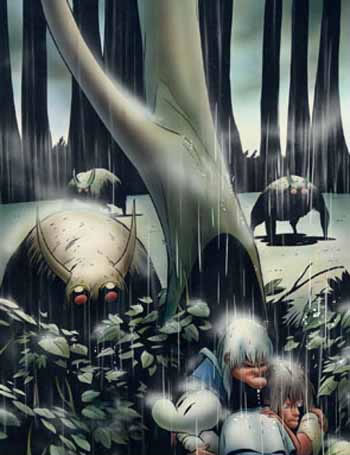
I’m always particularly pleased when the art establishment of museums and traditional galleries shakes itself out of its self-imposed blindness and recognizes comics (“graphic narrative”) as the art form it is; so I was pleased to learn that the work of comics artist Jeff Smith, creator of the highly regarded series Bone, is featured in a new exhibit at the Wexner Center for the Arts in Columbus Ohio, Jeff Smith: Bone and Beyond.I’ve written about Jeff Smith and Bone before (and here).
The exhibit features 80 of of Smith’s pen and ink pages from Bone, several color covers as well as some of his work on projects since wrapping up the thousand-plus page series, including his Shazam series for DC Comics and his new ongoing series Rasl.
Bone (Amazon link) was published as black and white trade paperbacks, then collected in a 1,300 page graphic novel (in the true sense of that term, not the way it’s misused by the comics industry as a catchall for squarebound comics), and then rereleased as a series of color trade paperbacks, with coloring by Steve Hamaker.
The exhibit at the Wexner Center also includes a selection of classic comics art from artists that Smith considers direct influences on his work and style, including original pages and panels from Walt Kelly’s Pogo, Will Eisner’s The Spirit, Carl Barks’s Uncle Scrooge, Garry Trudeau’s Doonesbury, and E. C. Segar’s Thimble Theatre.
There is a catalog created to accompany the exhibit, which also includes the work of the other artists. There is a five minute video on the Wexner site with an interview with Smith.
The exhibit at the Wexner Center runs until August 3, 2008.
A related exhibit, Jeff Smith: Before Bone is running concurrently at the nearby Cartoon Research Library of Ohio State University. It features his work on Thorn, Smith’s strip for the campus newspaper, The Lantern. There is also a catalog to accompany this exhibit.
You can always catch up on the latest news about Jeff Smith and his work on his Boneville blog. You can also order Bone, Rasl and related items directly from Smith’s online Shop.
[Exhibition link via Art Knowledge News]
Categories:




Charley’s Picks
Bookshop.org
(Bookshop.org affilliate links; sales benefit independent bookshop owners; I get a small percentage to help support my work on Lines and Colors)

John Singer Sargent: Watercolors


Urban Sketching: Understanding Perspective


Charley’s Picks
Amazon
(Amazon.com affiliate links; sales go to a larger yacht for Jeff Bezos; but I get a small percentage to help support my work on Lines and Colors)
John Singer Sargent: Watercolors
Urban Sketching: Understanding Perspective