


Categories
- 3d CGI
- Amusements
- Animation
- Anime & Manga
- Art Materials
- Art Videos
- Blogroll
- Cartoons
- Color
- Comics
- Concept & Visual Dev.
- Creativity
- Digital Art
- Digital Painting
- Displaying Art on the Web
- Drawing
- Eye Candy for Today
- Gallery and Museum Art
- High-res Art Images
- Illustration
- Motion Graphics & Flash
- Museums
- Online Museums
- Outsider Art
- Painting
- Painting a Day
- Paleo Art
- Pastel, Conté & Chalk
- Pen & Ink
- Prints and Printmaking
- Reviews
- Sc-fi and Fantasy
- Sculpture & Dimensional
- Site Comments
- Sketching
- Storyboards
- Tools and Techniques
- Uncategorized
- Vector Art
- Videos & Podcasts
- Vision and Optics
- Watercolor and Gouache
- Webcomics
Archives
- May 2026
- April 2026
- March 2026
- February 2026
- January 2026
- December 2025
- November 2025
- October 2025
- September 2025
- August 2025
- July 2025
- June 2025
- May 2025
- January 2025
- December 2024
- November 2024
- October 2024
- September 2024
- August 2024
- June 2024
- April 2024
- March 2024
- February 2024
- January 2024
- December 2023
- November 2023
- October 2023
- September 2023
- August 2023
- July 2023
- May 2023
- April 2023
- March 2023
- February 2023
- January 2023
- December 2022
- November 2022
- September 2022
- August 2022
- July 2022
- June 2022
- May 2022
- April 2022
- March 2022
- February 2022
- January 2022
- December 2021
- November 2021
- October 2021
- September 2021
- August 2021
- July 2021
- June 2021
- May 2021
- April 2021
- March 2021
- February 2021
- January 2021
- December 2020
- November 2020
- October 2020
- September 2020
- August 2020
- July 2020
- June 2020
- May 2020
- April 2020
- March 2020
- February 2020
- January 2020
- December 2019
- November 2019
- October 2019
- September 2019
- August 2019
- July 2019
- June 2019
- May 2019
- April 2019
- March 2019
- February 2019
- January 2019
- December 2018
- November 2018
- October 2018
- September 2018
- August 2018
- July 2018
- June 2018
- May 2018
- April 2018
- March 2018
- February 2018
- January 2018
- December 2017
- November 2017
- October 2017
- September 2017
- August 2017
- July 2017
- June 2017
- May 2017
- April 2017
- March 2017
- February 2017
- January 2017
- December 2016
- November 2016
- October 2016
- September 2016
- August 2016
- July 2016
- June 2016
- May 2016
- April 2016
- March 2016
- February 2016
- January 2016
- December 2015
- November 2015
- October 2015
- September 2015
- August 2015
- July 2015
- June 2015
- May 2015
- April 2015
- March 2015
- February 2015
- January 2015
- December 2014
- November 2014
- October 2014
- September 2014
- August 2014
- July 2014
- June 2014
- May 2014
- April 2014
- March 2014
- February 2014
- January 2014
- December 2013
- November 2013
- October 2013
- September 2013
- August 2013
- July 2013
- June 2013
- May 2013
- April 2013
- March 2013
- February 2013
- January 2013
- December 2012
- November 2012
- October 2012
- September 2012
- August 2012
- July 2012
- June 2012
- May 2012
- April 2012
- March 2012
- February 2012
- January 2012
- December 2011
- November 2011
- October 2011
- September 2011
- August 2011
- July 2011
- June 2011
- May 2011
- April 2011
- March 2011
- February 2011
- January 2011
- December 2010
- November 2010
- October 2010
- September 2010
- August 2010
- July 2010
- June 2010
- May 2010
- April 2010
- March 2010
- February 2010
- January 2010
- December 2009
- November 2009
- October 2009
- September 2009
- August 2009
- July 2009
- June 2009
- May 2009
- April 2009
- March 2009
- February 2009
- January 2009
- December 2008
- November 2008
- October 2008
- September 2008
- August 2008
- July 2008
- June 2008
- May 2008
- April 2008
- March 2008
- February 2008
- January 2008
- December 2007
- November 2007
- October 2007
- September 2007
- August 2007
- July 2007
- June 2007
- May 2007
- April 2007
- March 2007
- February 2007
- January 2007
- December 2006
- November 2006
- October 2006
- September 2006
- August 2006
- July 2006
- June 2006
- May 2006
- April 2006
- March 2006
- February 2006
- January 2006
- December 2005
- November 2005
- October 2005
- September 2005
- August 2005
Relevant Blogs
Art, Painting & Sketch
- Gurney Journey
- Underpaintings
- Art and Influence
- Painting Perceptions
- Oil Painters of America
- Vasari Paint POV
- Flying Fox
- Urban Sketchers
- Bento (Smithsonian)
- Art Inconnu
- The Hidden Place
- Still Life
- Making a Mark
- The Art of the Landscape
- Exploring Color & Creativity
- Art Contrarian
- Artist A Day
- beinArt Surreal Art Collective
- Eye Level
- David Dunlop
- p.i.g.m.e.n.t.i.u.m
- CultureGrrl
- Joaquín Sorolla blog
- Artists in Pastel
“Painting a Day”
- A Painting a Day (Keiser)
- On Painting (Keiser)
- Julian Merrow-Smith
- Karen Jurick
- Jeffrey Hayes
- Carol Marine
- Abbey Ryan
- Daily Paintworks
Other Painting Blogs
- Virtual Gouache Land
- Neil Hollingsworth
- Marc Hanson
- Kevin Menck
- Marc Dalessio
- Larry Seiler
- Stapleton Kearns
- Colin Page
- Roos Schuring
- Hans Versfelt
- Titus Meeuws
- Régis Pettinari
- René Plein Air
- Belinda Del Pesco
- Robin Weiss
- Nathan Fowkes (Land Sketch)
- William Wray
- Frank Serrano
- Stephen Magsig
- Michael Chesley Johnson
- Twice a Week
- Sarah Wimperis
- Rob Adams
- Michael Cole Manley
- The Dirty Palette Club
- Mike Manley’s Draw!
Gallery Art & Illustration mix
Illustration
- Howard Pyle
- 100 Years of Illustration
- BibliOdyssey
- Illustration Art
- Today’s Inspiration
- Illustration Mundo
- Little Chimp Society
- Danny Gregory
- R D (John Martz
- Illustration Friday blog
- Monster Brains
- Illustrators & Illustrations (RU)
- Elwood H. Smith
- DaniDraws.com
- Designers Who Blog
- iSpot Blog
Sci-Fi & Fantasy
Illustration & Comics
Comics & Cartoons
- Comics Beat
- Robot 6
- Newsarama Blog
- Comic Vine
- Comics Alliance
- Forbidden Planet Int.
- Paolo Rivera
- Bolt City
- Flight
- Scott McCloud
- The Comics Journal
- Comixpedia
- Funnybook Babylon
- James Baker
- Middleton’s Sketchbook
- Boneville
- The Hotel Fred
- Paul Rivoche
- Daily Cartoonist
- Mad About Cartoons (William Wray)
- Digital Strips
Illustration & Concept
Animation & Concept
- Cartoon Brew
- Animation Blog
- Cold Hard Flash
- Concept Art World
- The CAB
- FY Concept Art
- Concept Ships
- Concept Robots
- John Nevarez
- Armand Serrano
- Marcos Mateu-Mestre
- all kinds of stuff (Kricfalusi)
- Yacin the faun (Man Arenas)
- Kelsey Mann
- Cre8tivemarks Blog
- Ice-Cream Monster Toon Cafe
- AAU Character & Creature Design
- AAU Animation Notes
- Articles and Texticles
Paleo & Scientific
Tools & Techniques
Other
Lists of Art Blogs
Art Image Resource Links
Historic Art Images
- Wikimedia Commons: Paintings
- Wikimedia Commons: Drawings
- The Athenaeum
- WikiArt (WikiPaintings)
- Google Art Project: Artists
- Google Art Project: Collections (Museums)
- ArtCyclopedia
- Web Gallery of Art
- Art Renewal Center
- Web Gallery of Impressionism
Auction Consolidation sites
Auction sites
- Sotheby’s
- Bonham’s
- Christies
- Heritage Auctions: Fine Art
- Heritage Auctions: Illustration
- Freeman’s Auctions
- Bukowskis
- Shannon’s
Image Search
Reverse Image Search (search by image)
- Tin Eye
- RevImg
- Google Image Search (camera icon)
- Bing Image Search (camera icon)
Promoting some friends and some clients of my website design business
- Twin Willows T’ai Chi studio in Wilmington DE. Taiji classes with Bryan Davis.
- Ray Hayward, Inspired Teacher of T’ai Chi ( Taiji ) in Minneapolis, Founder of Mindful Motion Tai Chi Academy
- OldHead Tattoo studio and Art Gallery in Wilmington DE. Tattoos and paintings by Bruce Gulick
- Sharon Domenico Art, pet portrait oil paintings
- Platinum Paperhanging, wallpaper hanging, Main Line and Philadelphia, PA
- Lisa Stone Design, interior designer, Main Line and Philadelphia, PA
- Studio12KPT, original art, prints, calendars and other custom printed items by Van Sickle & Rolleri
-
Bernard Völlmy


Bernard Völlmy is a Swiss painter, now based in France, who works primarily in watercolor, but also in monochromatic and color watercolors combined with graphite.
His watercolor themes often include subjects with water — creeks and streams, small runs or even reflective puddles. These are approached with an eye to texture and interesting value contrasts.
Völlmy’s website is in French, but is relatively easily navigable by non-French speakers. The link I’ve posted takes you directly to his watercolor on paper gallery. You can find other galleries of images under the “Bernard Völlmy” menu tab. Among them is a section for his sketchbooks.
Categories:
-
Eye Candy for Today: John Sell Cotman graphite and wash drawing


East End of Saint Jacques at Dieppe, Normandy; John Sell Cotman; graphite and brown wash; roughly 12 x 9 inches (29 x 22 cm). LInk is to zoomable version on Google Art Project, downloadable file on Wikimedia Commons, original is in the Yale Center for British Art.
English painter, printmaker and illustrator John Sell Cotman, who was active in the late 18th and early 19th centuries, was prolific and left a trove of drawings in addition to his paintings and graphics. Here, he confidently delineates the intricately decorative structure of a large Renaissance church with graphite, augmented with subtle washes.
The drawing exhibits both the substantial accuracy of a careful architectural drawing, and the liveliness of a more casual sketch.
In part, this is likely due to the loosely free rendering of the roof of the lower structure, but I think it’s also due to an approach I have also noticed in the wonderful architectural drawings of Canaletto.
In both cases, lines that over their course are ruler straight, are along the way wavering and often lightly broken. It’s a wonderful technique.
Categories:
-
Jennifer McChristian (update)


Originally from Montreal and now based in California, Jennifer McChristian is a painter I first featured back in 2007.
Working primarily in oil, and secondarily in gouache and watercolor, McChristian paints both plein air and in the studio. While she sometimes paints the natural landscape, her preference is to find subjects in the built environment, often taking obvious delight in the geometry of buildings, highways, streets, and bridges, and the shapes of shadow and light they produce.
She also finds inspiration in nocturnes, working with the contrasts of darkness and artificial light in a way that strikes me as appealingly playful. McChristian also studies people, placing her figures and portraits within their environment.
Her approach is quite interesting; she apparently works with a bright, high chroma imprimatura, reddish or almost magenta, that she allows to freely come through in areas of her brusquely textural paint application.
I find the textural, painterly nature of her brush marks particularly appealing. Unfortunately, this character of her pantings doesn’t come through well when reproduced at the size of my example images (I’ve included one detail crop to demonstrate). Fortunately, if you click through the thumbnails on her website to the full size images, most of them are just large enough to see and appreciate this aspect of her work.
Her website is divided into galleries for landscape, figures, drawings and an archive of older work. Her blog also serves as an archive of sorts; though no longer active, it still includes additional examples of her work as well as photos of her conducting workshops and classes.
McChristian’s work is featured on the cover and in the lead article of the current April/May 2021 issue of PleinAir Magazine.
Categories:
-
Eye Candy for Today: M.C. Escher lithograph: Reptiles


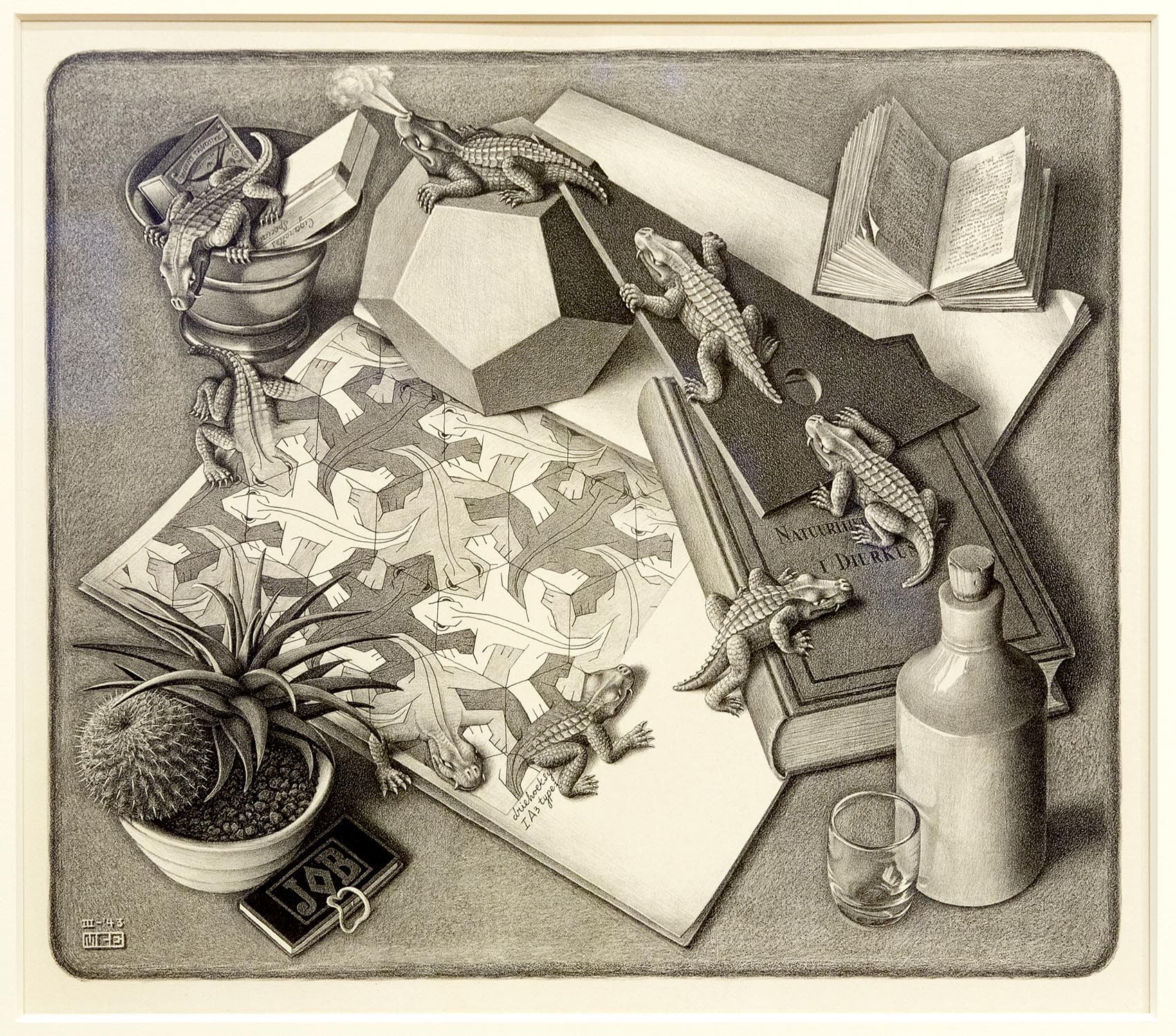
Reptiles, Maurits Cornelis Escher, lithograph, roughly 13 x 15 inches (33 × 38 cm)
Link is to an image sourced from this article on the website of WBUR radio, reviewing a 2018 Escher exhibition at the Museum of Fine Arts Boston.
Here, we find the ingenious Dutch printmaker M.C. Escher indulging in a number of his favored themes: tessellated patterns, the relationship between the a two dimensional surface and three dimensional space, a shift between the graphic and the “real”, circular visual logic, geometric solids, and keenly observed still life subjects that may hold symbolic meaning.
This is one of my favorite Escher compositions; it plays with the very nature of illusionistic art — the representation of a three dimensional world on a two dimensional surface.
I see a potential play on words in the title, Reptiles. (Whether this translates into Dutch, or whether Escher spoke English, I don’t know.) The reptiles are represented as elements in a tessellation — as flat, interlocking patterns on the drawing surface. The repeated elements in a tessellated surface are called “tiles”. If you want to carry it further, “Rep” can be short for “repeated”. But then, I’m just projecting into Escher’s work, as its enigmatic nature makes it fun to do.
Also, I love the snort of smoke from the lizard on top of the dodecahedron.
For more, see my previous posts on M.C. Escher.
Categories:
-
Alexander Rothaug
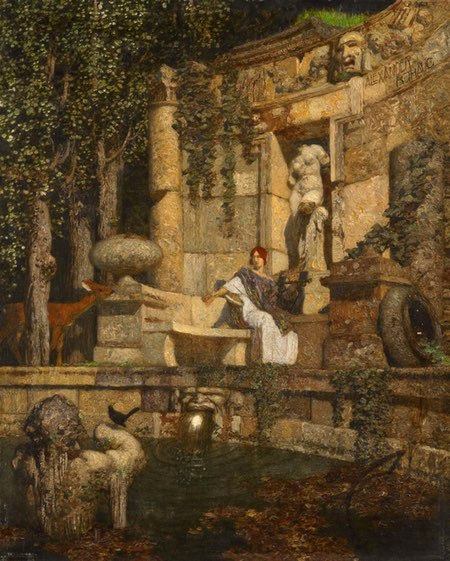

Alexander Rothaug was an Austrian painter and illustrator active in the late 19th and early 20th centuries. I assume he might be categorized as a Symbolist, which in itself is a loose classification as art styles go.
Rothaug seems particularly inspired by dramatic scenes from myths and legends, often populated with stylized, exaggeratedly muscular figures and rough, visceral textures.
It’s his use of texture that grabs my attention, particularly in the representation of rocks and stone.
Be aware that a number of the works you will find contain nudity, even if highly stylized, and might be considered mildly NSFW.
Categories:
-
Same Energy – image similarity search with Deep Learning

In my previous post on Bing image search vs. Google, Yahoo & Tin Eye, I mentioned the “visual search” or “search by image” features of the major search engines, in which a reference image is the basis of the search rather than text.
Bing and Google will search first for additional copies of the same image, and when past those, will show “similar images” or “related images”. This can be an interesting way to discover new art and artists.
In comments on that post, a reader was kind enough to inform me of a new and fascinating entry into the field of image based search: Same Energy.
Same Energy is based on deep learning, a subset of machine learning, which is a form of computer process that is sometimes over generously called “artificial intelligence” or “AI”.
Although I’m sure Microsoft and Google are incorporating elements of machine learning into their image search algorithms, I believe they still rely heavily on associated text, tags and meta information. Same Energy appears to rely entirely on deep learning.
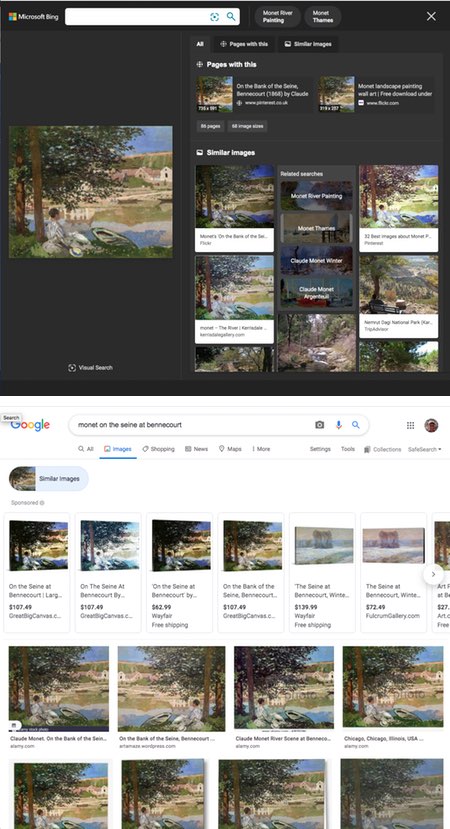
I fed a source image of Monet’s On the Seine at Bennecourt to Bing, Google and Same Energy. The regular search engines returned many sources of copies of the same image, and then started to suggest “similar” images (images above).
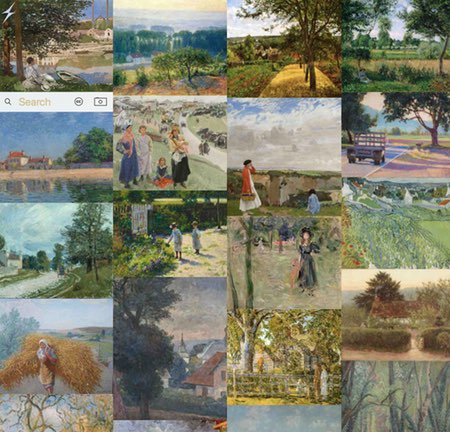
Same Energy, while often finding a few copies of the same image, would much more readily start showing a range of similar images, often with more varied results than the big two (image above). I found its results were pretty good in terms of similarity, but often ranged wider and led to interesting discoveries.
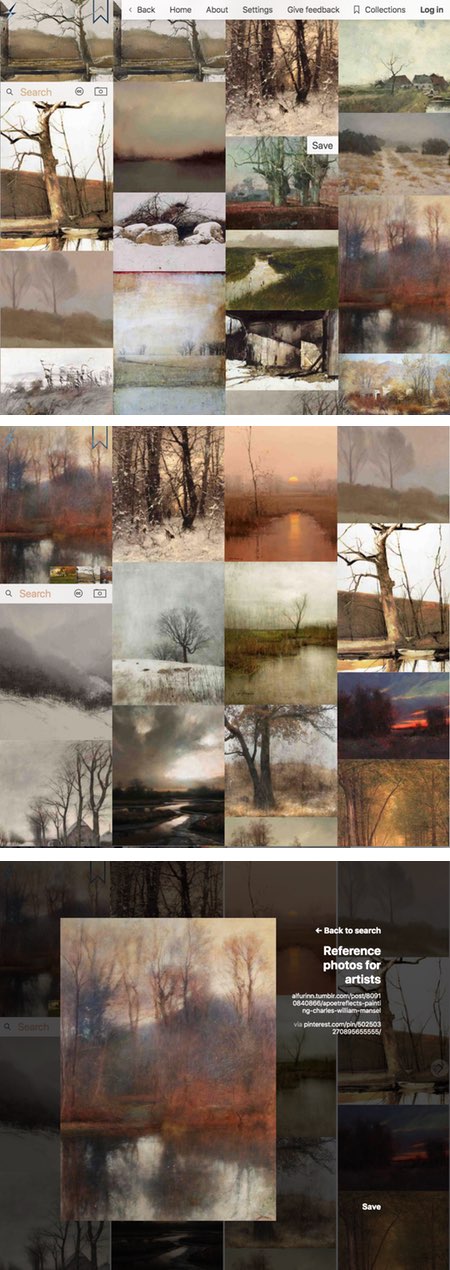
When you upload an image (most easily by dragging one from your desktop, there is no provision for entering a URL for an image on the web), Same Energy immediately displays a tight grid, arranged mosaic style, of numerous images (you can modify the grid under “Settings”). The image being referred to is displayed at the upper left.
Clicking on one of the similar images places that image in the upper left, and shifts the response and field of images to similarity to that image. It also allows you to click on that new reference image and see more detail, including a link to the page from which the image was sourced (images above).

While Same Energy seemed to have a broader interpretation of “similar” than the major search engines, it was quite good at recognizing the nature of the image and the quality of the art. I deliberately tried to get it to mistake very realistic paintings for photographs, but it almost never did. It also did not readily mix in amateurish low quality paintings with high quality work by more accomplished painters. Both of these can be unfortunate tendencies in the big search engines’ image similarity searches.
The combination of the quick, densely displayed returns and the level of quality makes searching for similar images more engaging with Same Energy than with Bing or Google. I found myself fascinated, dragging images of widely varied styles into the interface, and often tracking down images that came up that were new to me, and bookmarking often. If you sign up for an account, the option is offered to save images and create Collections.
Searching for images with nudity, as in figure drawing models, returns blurred images. You must click through on an image and check your acceptance to see images that contain nudity, or have been tagged NSFW, etc. Be aware that the results (many sourced from Reddit) are then pretty much unfiltered.
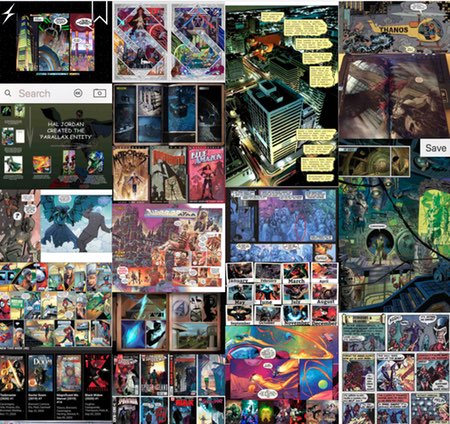
I tried uploading an image from my own webcomic, Argon Zark!, and I found the returns actually gave me some insight into how others (or at least a deep learning algorithm) might perceive my style (image above).You can also enter text searches, but I found this feature weak at this point in the system’s development. I tried the names of several artists, and many weren’t recognized as viable search terms. There is no provision yet for setting image size, or other refinements that might possibly be added in the future. Also, I noticed the same images coming up fairly often in my searches for a given genre, for instance landscape painting.
Same Energy is young, still in Beta, and likely has a much smaller database of indexed material at this point than the big players, who have been at it for years and with significantly greater resources.
Jacob Jackson, the developer, indicates that Same Energy is an ongoing project and will continue to be refined and improved, even while its reach increases.
I, for one, will be stopping back frequently to indulge.

The upshot is, if you’re looking for alternate sizes or additional information on a given image, use Bing or Google. If you are more interested in exploring, discovering and just having fun searching through art images (or any kind of images), give Same Energy a try.
[Timesink Warning!]
Categories:




Charley’s Picks
Bookshop.org
(Bookshop.org affilliate links; sales benefit independent bookshop owners; I get a small percentage to help support my work on Lines and Colors)

John Singer Sargent: Watercolors


Urban Sketching: Understanding Perspective


Charley’s Picks
Amazon
(Amazon.com affiliate links; sales go to a larger yacht for Jeff Bezos; but I get a small percentage to help support my work on Lines and Colors)
John Singer Sargent: Watercolors
Urban Sketching: Understanding Perspective