


Categories
- 3d CGI
- Amusements
- Animation
- Anime & Manga
- Art Materials
- Art Videos
- Blogroll
- Cartoons
- Color
- Comics
- Concept & Visual Dev.
- Creativity
- Digital Art
- Digital Painting
- Displaying Art on the Web
- Drawing
- Eye Candy for Today
- Gallery and Museum Art
- High-res Art Images
- Illustration
- Motion Graphics & Flash
- Museums
- Online Museums
- Outsider Art
- Painting
- Painting a Day
- Paleo Art
- Pastel, Conté & Chalk
- Pen & Ink
- Prints and Printmaking
- Reviews
- Sc-fi and Fantasy
- Sculpture & Dimensional
- Site Comments
- Sketching
- Storyboards
- Tools and Techniques
- Uncategorized
- Vector Art
- Videos & Podcasts
- Vision and Optics
- Watercolor and Gouache
- Webcomics
Archives
- September 2026
- August 2026
- July 2026
- June 2026
- May 2026
- April 2026
- March 2026
- February 2026
- January 2026
- December 2025
- November 2025
- October 2025
- September 2025
- August 2025
- July 2025
- June 2025
- May 2025
- January 2025
- December 2024
- November 2024
- October 2024
- September 2024
- August 2024
- June 2024
- April 2024
- March 2024
- February 2024
- January 2024
- December 2023
- November 2023
- October 2023
- September 2023
- August 2023
- July 2023
- May 2023
- April 2023
- March 2023
- February 2023
- January 2023
- December 2022
- November 2022
- September 2022
- August 2022
- July 2022
- June 2022
- May 2022
- April 2022
- March 2022
- February 2022
- January 2022
- December 2021
- November 2021
- October 2021
- September 2021
- August 2021
- July 2021
- June 2021
- May 2021
- April 2021
- March 2021
- February 2021
- January 2021
- December 2020
- November 2020
- October 2020
- September 2020
- August 2020
- July 2020
- June 2020
- May 2020
- April 2020
- March 2020
- February 2020
- January 2020
- December 2019
- November 2019
- October 2019
- September 2019
- August 2019
- July 2019
- June 2019
- May 2019
- April 2019
- March 2019
- February 2019
- January 2019
- December 2018
- November 2018
- October 2018
- September 2018
- August 2018
- July 2018
- June 2018
- May 2018
- April 2018
- March 2018
- February 2018
- January 2018
- December 2017
- November 2017
- October 2017
- September 2017
- August 2017
- July 2017
- June 2017
- May 2017
- April 2017
- March 2017
- February 2017
- January 2017
- December 2016
- November 2016
- October 2016
- September 2016
- August 2016
- July 2016
- June 2016
- May 2016
- April 2016
- March 2016
- February 2016
- January 2016
- December 2015
- November 2015
- October 2015
- September 2015
- August 2015
- July 2015
- June 2015
- May 2015
- April 2015
- March 2015
- February 2015
- January 2015
- December 2014
- November 2014
- October 2014
- September 2014
- August 2014
- July 2014
- June 2014
- May 2014
- April 2014
- March 2014
- February 2014
- January 2014
- December 2013
- November 2013
- October 2013
- September 2013
- August 2013
- July 2013
- June 2013
- May 2013
- April 2013
- March 2013
- February 2013
- January 2013
- December 2012
- November 2012
- October 2012
- September 2012
- August 2012
- July 2012
- June 2012
- May 2012
- April 2012
- March 2012
- February 2012
- January 2012
- December 2011
- November 2011
- October 2011
- September 2011
- August 2011
- July 2011
- June 2011
- May 2011
- April 2011
- March 2011
- February 2011
- January 2011
- December 2010
- November 2010
- October 2010
- September 2010
- August 2010
- July 2010
- June 2010
- May 2010
- April 2010
- March 2010
- February 2010
- January 2010
- December 2009
- November 2009
- October 2009
- September 2009
- August 2009
- July 2009
- June 2009
- May 2009
- April 2009
- March 2009
- February 2009
- January 2009
- December 2008
- November 2008
- October 2008
- September 2008
- August 2008
- July 2008
- June 2008
- May 2008
- April 2008
- March 2008
- February 2008
- January 2008
- December 2007
- November 2007
- October 2007
- September 2007
- August 2007
- July 2007
- June 2007
- May 2007
- April 2007
- March 2007
- February 2007
- January 2007
- December 2006
- November 2006
- October 2006
- September 2006
- August 2006
- July 2006
- June 2006
- May 2006
- April 2006
- March 2006
- February 2006
- January 2006
- December 2005
- November 2005
- October 2005
- September 2005
- August 2005
Relevant Blogs
Art, Painting & Sketch
- Gurney Journey
- Underpaintings
- Art and Influence
- Painting Perceptions
- Oil Painters of America
- Vasari Paint POV
- Flying Fox
- Urban Sketchers
- Bento (Smithsonian)
- Art Inconnu
- The Hidden Place
- Still Life
- Making a Mark
- The Art of the Landscape
- Exploring Color & Creativity
- Art Contrarian
- Artist A Day
- beinArt Surreal Art Collective
- Eye Level
- David Dunlop
- p.i.g.m.e.n.t.i.u.m
- CultureGrrl
- Joaquín Sorolla blog
- Artists in Pastel
“Painting a Day”
- A Painting a Day (Keiser)
- On Painting (Keiser)
- Julian Merrow-Smith
- Karen Jurick
- Jeffrey Hayes
- Carol Marine
- Abbey Ryan
- Daily Paintworks
Other Painting Blogs
- Virtual Gouache Land
- Neil Hollingsworth
- Marc Hanson
- Kevin Menck
- Marc Dalessio
- Larry Seiler
- Stapleton Kearns
- Colin Page
- Roos Schuring
- Hans Versfelt
- Titus Meeuws
- Régis Pettinari
- René Plein Air
- Belinda Del Pesco
- Robin Weiss
- Nathan Fowkes (Land Sketch)
- William Wray
- Frank Serrano
- Stephen Magsig
- Michael Chesley Johnson
- Twice a Week
- Sarah Wimperis
- Rob Adams
- Michael Cole Manley
- The Dirty Palette Club
- Mike Manley’s Draw!
Gallery Art & Illustration mix
Illustration
- Howard Pyle
- 100 Years of Illustration
- BibliOdyssey
- Illustration Art
- Today’s Inspiration
- Illustration Mundo
- Little Chimp Society
- Danny Gregory
- R D (John Martz
- Illustration Friday blog
- Monster Brains
- Illustrators & Illustrations (RU)
- Elwood H. Smith
- DaniDraws.com
- Designers Who Blog
- iSpot Blog
Sci-Fi & Fantasy
Illustration & Comics
Comics & Cartoons
- Comics Beat
- Robot 6
- Newsarama Blog
- Comic Vine
- Comics Alliance
- Forbidden Planet Int.
- Paolo Rivera
- Bolt City
- Flight
- Scott McCloud
- The Comics Journal
- Comixpedia
- Funnybook Babylon
- James Baker
- Middleton’s Sketchbook
- Boneville
- The Hotel Fred
- Paul Rivoche
- Daily Cartoonist
- Mad About Cartoons (William Wray)
- Digital Strips
Illustration & Concept
Animation & Concept
- Cartoon Brew
- Animation Blog
- Cold Hard Flash
- Concept Art World
- The CAB
- FY Concept Art
- Concept Ships
- Concept Robots
- John Nevarez
- Armand Serrano
- Marcos Mateu-Mestre
- all kinds of stuff (Kricfalusi)
- Yacin the faun (Man Arenas)
- Kelsey Mann
- Cre8tivemarks Blog
- Ice-Cream Monster Toon Cafe
- AAU Character & Creature Design
- AAU Animation Notes
- Articles and Texticles
Paleo & Scientific
Tools & Techniques
Other
Lists of Art Blogs
Art Image Resource Links
Historic Art Images
- Wikimedia Commons: Paintings
- Wikimedia Commons: Drawings
- The Athenaeum
- WikiArt (WikiPaintings)
- Google Art Project: Artists
- Google Art Project: Collections (Museums)
- ArtCyclopedia
- Web Gallery of Art
- Art Renewal Center
- Web Gallery of Impressionism
Auction Consolidation sites
Auction sites
- Sotheby’s
- Bonham’s
- Christies
- Heritage Auctions: Fine Art
- Heritage Auctions: Illustration
- Freeman’s Auctions
- Bukowskis
- Shannon’s
Image Search
Reverse Image Search (search by image)
- Tin Eye
- RevImg
- Google Image Search (camera icon)
- Bing Image Search (camera icon)
Promoting some friends and some clients of my website design business
- Twin Willows T’ai Chi studio in Wilmington DE. Taiji classes with Bryan Davis.
- Ray Hayward, Inspired Teacher of T’ai Chi ( Taiji ) in Minneapolis, Founder of Mindful Motion Tai Chi Academy
- OldHead Tattoo studio and Art Gallery in Wilmington DE. Tattoos and paintings by Bruce Gulick
- Sharon Domenico Art, pet portrait oil paintings
- Platinum Paperhanging, wallpaper hanging, Main Line and Philadelphia, PA
- Lisa Stone Design, interior designer, Main Line and Philadelphia, PA
- Studio12KPT, original art, prints, calendars and other custom printed items by Van Sickle & Rolleri
-
Don Gray
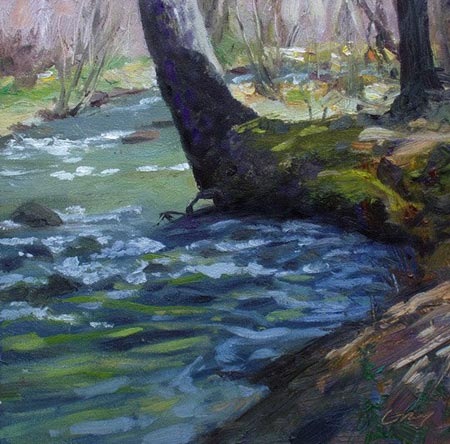
I initially came cross Oregon born, California based painter Don Gray by way of his daily painting blog Daily Art West, in which he posts his small paintings of varied subjects, sometimes following the model of small indoor still life subjects common to the “painting a day” practice, but more often of outdoor scenes, frequently painted en plein air.Following links from the blog, I found some of his more finished gallery work and discovered that he is a muralist.
Gray paints his small paintings in both oil and watercolor. His 30 years of painting have taken him through much of the Pacific Northwest; and he has applied his direct realist style to a variety of landscapes, both intimate and grand in scale. He has also developed the figurative work that features more prominently in his murals, which most often are of historical subjects.
Gray has in recent years experimented with moving away from realism in his contemporary work.
Perhaps because I don’t have much personal experience with the western mountains, I connect most readily with his smaller scale landscapes of woods, small fields and creeks. In particular his small plein air paintings of these subjects have a feeling of immediacy and deftness of execution that I find particularly appealing.
Looking back through his blog posts, which are plentiful as one would expect from the painting a day regimen, is a fascinating journey through varied countryside, as well as another sort of journey through the artist’s interest in certain subjects. These fascinations often result in small series — of his brushes, of pillows on a love seat, or the current small series of fruit wrapped in clear plastic bags.
His landscapes show a freedom of subject choice that indicates he is not reliant on the “picturesque”. Gray has developed an enviable ability to see painting worthy subjects in almost anything on which his eye alights.
Categories:
-
John Asaro
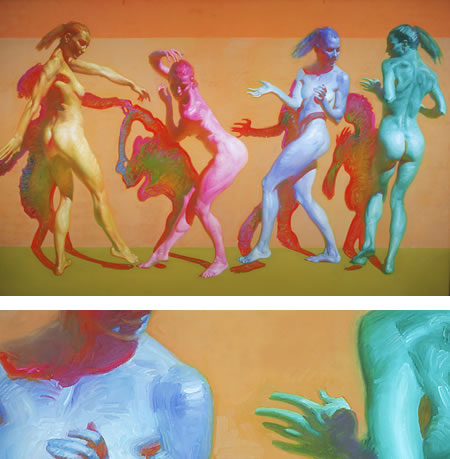
John Asaro’s web site opens with a statement about a change in artistic direction, from a 30 year career as a painter of “genre scenes” to a new commitment to exclusively painting the female figure.The site contains little else in the way of information or background and is simply a gallery of work. The paintings themselves, which Asaro calls “figure portraits in arrangements” are striking. Single or multiple figures are indeed arranged compositionally against intense almost flat color backgrounds, with a singular eye to negative space.
The figures themselves, though sometimes colored naturalistically, are more often rendered in high-chroma colors; giving an impression of being monochromatic, but actually resonating with a rich variety of color.
Asaro paints in oil on canvas, and he lays in his bold colors with equally bold brushstrokes, wrapping them around the figures in a way that both emphasizes the forms and creates a vibrant visual texture.
When you look at the detail images that sometimes accompany the main images on the site, you can come away with the impression that the brushwork is so free that it must have been painted quickly, but I think the accuracy of the drawing indicates a more careful application of paint. I think it is confidence born of many years of painting that gives the impression of loose application.
Though his site is devoted to work in the new direction, you can still see some of Asaro’s previous work, which is in demand as limited edition serigraphs, on other sites.
Asaro is apparently represented by Lela Harty Studio/Gallery and on their site, despite a terrible navigation interface which keeps it all but hidden, you can find a long list of sold paintings linked to images. Asaro’s “genre painting” occasionally consists of straightforward landscapes, but most often is of figures in landscape, in the tradition of Sarolla, Anders Zorn and many of the painters labeled “American Impressionists”.
The Lela Harty site also lists a book, Asaro: A New Romanticism, which is out of print and unfortunately expensive used, and a new video, Asaro: A Retrospective, which is available on DVD.
Note: Some of the images in the sites linked here might be considered NSFW.
[Suggestion courtesy of Belinda Del Pesco (see my previous post on Belinda Del Pesco)]
Categories:
-
Barbara (Briggs) Bradley

Barbara Bradley’s brush was stilled on Friday when she was killed in a car accident at the age of 81.Bradley, née Barbara Briggs, was a member of the Charles E. Cooper Studio, a highly influential commercial art and illustration studio prominent in the mid 20th Century.
The illustrators that Cooper attracted were among the best of the best; and in an era when the printing of color photographs had become inexpensive enough to be commonplace, used their clear, sharp, modern styles to entertain the the eye in a way photographs can’t.
Bradley was a shining example of this, applying her refined drawing style and keen color sense to delightfully fresh and lively illustrations for a variety of editorial and commercial accounts.
Bradley studied at the University of California at Berkeley and at Art Center before embarking on her career with Cooper in new York. She later returned to California and established herself as a freelancer.
She became an instructor, and eventually Director of illustration, at the Academy of Art University. In that role she became tremendously influential, passing on her extensive knowledge of illustration and technique to a broad cross section of new illustrators.
There is a tribute site, Thank You Barbara Bradley, which has an outline of her career, galleries of her work and a series of comments and tributes form her associates and students.
Leif Peng, who maintains the terrific blog Today’s Inspiration, which focuses on illustration from the period in which Bradley was most active, has written a particularly touching tribute to the influence she had on someone who never even met her in person. Peng also has previous posts on Bradley, Queen of the Perkies and Cutes and The 70’s, the 80’s… and the Academy, in which he posts additional examples of her work.
There was an article on Bradley in issue #21 of Illustration Magazine, part of a continuing series on the artists of the Charles E. Cooper Studio, which showcases some of the best examples I’ve seen of her illustrations.
In addition to her other awards, Bradley received the 2007 Outstanding Educator in the Arts Award from the Society of Illustrators.
A small portion of her teaching legacy was condensed into her book Drawing People: How to Portray the Clothed Figure.
[Thanks to James Gurney for passing on the notice]
Categories:
-
Free Comic Book Day, 2008
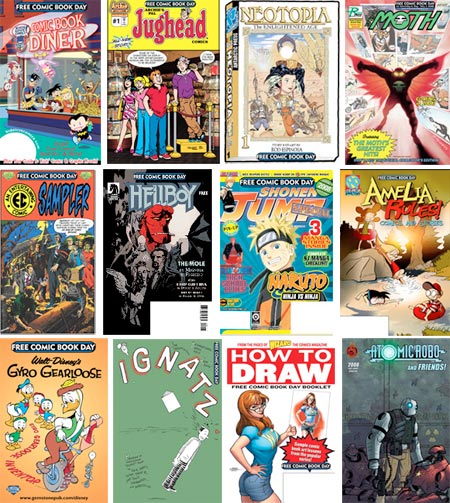
Today is, once again, Free Comic Book Day!Comic book stores around the U.S. are giving away free copies of comics that a variety of publishers have created just for the occasion.
Aside from the obvious pleasure of picking up a free comic (or two, or more, depending on the store), is the nature of the event. This is the day when the normally somewhat insular and geeky world of comic book specialty stores open up their doors extra wide to those not normally exposed to the mysteries and wonders within.
The proprietors comb their hair and put on a tie (figuratively speaking) and are on their best behavior, expecting to greet newcomers to the world of modern comics. Many stores will use the occasion to simultaneously hold sales and events, including hosting guest artists and book signings.
If you’re even remotely curious about the state of modern comic books, a field that is growing and changing rapidly in many respects, but haven’t felt particularly comfortable wandering into a shop (some of which can often feel more like a private club for geeks than a regular bookstore), here’s a chance to wander through one as if it was a sidewalk sale (which it may well be for the occasion).
Chat with the proprietor, ask what’s different and unusual. Tell them what you like and see if they can suggest a comic title (free or otherwise) that’s up your alley.
The free comics themselves always vary in subject, quality and direction of interest. The good news here, and about comics in the U.S. in general, is that it’s not all superheroes. Despite the interest generated by the continuing popularity of the genre in other popular entertainment, as evidenced by the new Iron Man movie, the market for non-superhero material in the the US has increased dramatically with the rise of the new crop of graphic storytellers and independent “graphic novels”.
(Don’t get me wrong. I’ll point out again that I really like superhero comics, I just think it’s unfortunate that they are so predominant that many people think that’s all modern comics have to offer.)
You can see a list of the comics being offered here. There are two lists, which they’re calling Gold Books and Silver Books. The former are more mainstream and are available at most participating shops (while supplies last), the latter are more varied in subject and approach and are more likely to be found at comic book stores that carry more independent, small press and foreign comics to begin with.
These shops are preferable for those interested in the variety that modern comics have to offer. Even if you’ve been to a comic book specialty store before, you may not have seen a good representation of what’s actually available. Some smaller shops only carry the most popular mainstream titles, and are less likely to offer a variety of non-superhero material.
You can find a list of participating comic book specialty stores in your area using the Free Comic Book Day Store Locator. You may find that some stores, like the one I shop at, carry much more than just comics.
For more on Free Comic Book Day, and my introduction to comic book specialty stores, see my posts on Free Comic Book Day 2007 and FCBD 2006.
Note: Once Free Comic Book Day is past, you may still find it continues unofficially for several days or more, as many shops still have some of the free comics on hand; and more importantly, maintain their attitude of wanting to welcome and make comfortable newcomers who are tiptoeing into the unexplored landscape of modern comic books.
Categories:
-
Maurice Braun

Hungarian born painter Maurice Braun came to the US at the age of four, when his parents moved to New York City.He demonstrated an interest in art at an early age and was apprenticed to a jeweler at the age of fourteen. On his own, he began to copy works of art from the Metropolitan Museum of Art. He studied at the Academy of Design, and then studied for a year with William Merritt Chase at the school Chase founded (the Chase School, later called the New York School). Braun later traveled to Europe, studying and painting in Hungary, Austria and Germany.
Returning to New York, Braun established himself as a portrait painter, also painting landscapes in New England. He was attracted to the then flowering art scene in California, and moved there in 1910. He was drawn to San Diego by the promise of fresh landscapes, brilliant light, and the presence of a branch of the Theosophical Society, whose tenants were informed by the search for commonality in the spiritual traditions of multiple religions. Braun’s work was informed by his philosophical convictions, and in a way somewhat similar to George Inness, his landscape paintings were intended to be more than a superficial representation of the visual world.
Though Braun would continue to travel and paint in many places, he settled in San Diego and is included in the list of painters from the time who are classified as “California Impressionists”. His academic training was melded with the influence of Chase and the European Impressionists, leading to another of those wonderful blendings of academic art and impressionistic freedom that characterize many of the painters considered “American Impressionists”. (Like most of the painters classified that way, I doubt Braun ever considered or called himself an “Impressionist”.)
Braun founded the San Diego Academy of Art and served as its director for many years, but continued to travel to the east coast and exhibit there, establishing studios in New York and Connecticut and traveling back and forth at different times of the year.
Though Braun was a dedicated plein air painter, he did his finished works in the studio, and did not believe in limiting himself to a literal representation of the landscape. He welded intense study of the individual characteristics of the San Diego countryside with his own feeling for composition, form and color and produced an interpretation based on those factors and his philosophical convictions.
Braun’s painting technique varied over time as he continued to experiment, but he developed a bright palette, with clear unfussed-with colors and free brushwork.
Categories:
-
Mati Klarwein

In 1938, while researching derivatives of the fungus ergot in search of pharmaceutical applications in the treatment of migraines, Swiss scientist Dr. Albert Hoffman synthesized a chemical called lysergic acid diethylamide-25, which came into common parlance, and common use, in the early and mid-1960’s as LSD. It was a few years later before Hoffman, reportedly accidentally, discovered that the chemical had remarkable psychoactive properties.Hoffman died on Thursday, at the age of 102, and though his legacy includes a number of other useful pharmaceuticals, it is the synthesis of LSD, and it’s impact on the culture, for which he will be remembered.
There is no doubt that the explosion of frenetic creative activity in music and the visual arts that occurred in the 1960’s owes much of its impetus, directly or indirectly, to the influence of LSD and related psychotropic compounds on the artists and musicians active at the time; an influence that continues to this day and has been absorbed into the fabric of mainstream art and entertainment.
There are a number of artists who are associated with the array of visual art styles that came to be called “psychedelic art”; for some examples, see my articles on Rick Griffin, Robert Venosa, Martina Hoffmann, Alex Grey, Andrew Gonzales and Peter Max. (For a clearer perspective on the influence of consciousness altering chemicals on artistic pursuits, separate from both the overreaching hype and anti-drug hysteria that ensued, see Aldous Huxley’s The Doors of Perception.)
Though he stated that it was not his primary source of inspiration, one of the prominent artists most often associated with the visionary and spiritual aspects of that style is the German painter Mati Klarwein.
Klarwein had been established as a gallery artist for some time, but he entered the popular consciousness when several of his hallucinatory paintings graced the covers of popular progressive rock and jazz albums in the mid-60’s. His painting Annunciation, reproduced on the cover of Santana’s Abraxas LP, and his commissioned cover for Miles Davis’ Bitches Brew became cultural icons of the time.
Born Matias Klarwein, and reportedly named for German Renaissance painter Matthias Grünewald, himself something of a visionary painter, Klarwein studied with Fernand Leger and attended the Ecole des Beaux-Arts in Paris, before encountering the influential fantastic realist painter Ernst Fuchs, who would have a dramatic impact on his path as an artist.
Klarwein’s paintings also show the influence of the Surrealists, notably Salvador Dali, with whom he studied at one time, and share the ability to reinforce fantastic visions with startlingly precise realist painting technique.
His sometimes complex panoramas of bizarre imagery, reinforced with patterns of intense colors (often juxtaposing high-chroma colors with their compliments for the added intensity produced by optical effect), are rich with intricate detail, often carried to extreme levels. His circular composition Grain of Sand is particularly striking in that respect.
Less well known are his sometimes straightforward landscapes and still life paintings.
There are several collections of his work, some of them out of print but often available used, God Jokes: The Art of Abdul Mati Klarwein, Inscapes Real-Estate Paintings by Mati Klarwein, Milk n’ Honey, and a very nice volume that I particularly like, Mati Klarwein: Collected Works 1959-1975.
[Note: the sites linked here contain images that should be considered NSFW.]
Categories:




Charley’s Picks
Bookshop.org
(Bookshop.org affilliate links; sales benefit independent bookshop owners; I get a small percentage to help support my work on Lines and Colors)
Carlson’s Guide to Landscape Painting
Drawing and Sketching in Pencil

Bridgman’s Complete Guide to Drawing from Life
Charley’s Picks
Amazon
(Amazon.com affiliate links; sales go to a larger yacht for Jeff Bezos; but I get a small percentage to help support my work on Lines and Colors)
Carlson’s Guide to Landscape Painting
Drawing and Sketching in Pencil
Bridgman’s Complete Guide to Drawing from Life