


Categories
- 3d CGI
- Amusements
- Animation
- Anime & Manga
- Art Materials
- Art Videos
- Blogroll
- Cartoons
- Color
- Comics
- Concept & Visual Dev.
- Creativity
- Digital Art
- Digital Painting
- Displaying Art on the Web
- Drawing
- Eye Candy for Today
- Gallery and Museum Art
- High-res Art Images
- Illustration
- Motion Graphics & Flash
- Museums
- Online Museums
- Outsider Art
- Painting
- Painting a Day
- Paleo Art
- Pastel, Conté & Chalk
- Pen & Ink
- Prints and Printmaking
- Reviews
- Sc-fi and Fantasy
- Sculpture & Dimensional
- Site Comments
- Sketching
- Storyboards
- Tools and Techniques
- Uncategorized
- Vector Art
- Videos & Podcasts
- Vision and Optics
- Watercolor and Gouache
- Webcomics
Archives
- July 2026
- June 2026
- May 2026
- April 2026
- March 2026
- February 2026
- January 2026
- December 2025
- November 2025
- October 2025
- September 2025
- August 2025
- July 2025
- June 2025
- May 2025
- January 2025
- December 2024
- November 2024
- October 2024
- September 2024
- August 2024
- June 2024
- April 2024
- March 2024
- February 2024
- January 2024
- December 2023
- November 2023
- October 2023
- September 2023
- August 2023
- July 2023
- May 2023
- April 2023
- March 2023
- February 2023
- January 2023
- December 2022
- November 2022
- September 2022
- August 2022
- July 2022
- June 2022
- May 2022
- April 2022
- March 2022
- February 2022
- January 2022
- December 2021
- November 2021
- October 2021
- September 2021
- August 2021
- July 2021
- June 2021
- May 2021
- April 2021
- March 2021
- February 2021
- January 2021
- December 2020
- November 2020
- October 2020
- September 2020
- August 2020
- July 2020
- June 2020
- May 2020
- April 2020
- March 2020
- February 2020
- January 2020
- December 2019
- November 2019
- October 2019
- September 2019
- August 2019
- July 2019
- June 2019
- May 2019
- April 2019
- March 2019
- February 2019
- January 2019
- December 2018
- November 2018
- October 2018
- September 2018
- August 2018
- July 2018
- June 2018
- May 2018
- April 2018
- March 2018
- February 2018
- January 2018
- December 2017
- November 2017
- October 2017
- September 2017
- August 2017
- July 2017
- June 2017
- May 2017
- April 2017
- March 2017
- February 2017
- January 2017
- December 2016
- November 2016
- October 2016
- September 2016
- August 2016
- July 2016
- June 2016
- May 2016
- April 2016
- March 2016
- February 2016
- January 2016
- December 2015
- November 2015
- October 2015
- September 2015
- August 2015
- July 2015
- June 2015
- May 2015
- April 2015
- March 2015
- February 2015
- January 2015
- December 2014
- November 2014
- October 2014
- September 2014
- August 2014
- July 2014
- June 2014
- May 2014
- April 2014
- March 2014
- February 2014
- January 2014
- December 2013
- November 2013
- October 2013
- September 2013
- August 2013
- July 2013
- June 2013
- May 2013
- April 2013
- March 2013
- February 2013
- January 2013
- December 2012
- November 2012
- October 2012
- September 2012
- August 2012
- July 2012
- June 2012
- May 2012
- April 2012
- March 2012
- February 2012
- January 2012
- December 2011
- November 2011
- October 2011
- September 2011
- August 2011
- July 2011
- June 2011
- May 2011
- April 2011
- March 2011
- February 2011
- January 2011
- December 2010
- November 2010
- October 2010
- September 2010
- August 2010
- July 2010
- June 2010
- May 2010
- April 2010
- March 2010
- February 2010
- January 2010
- December 2009
- November 2009
- October 2009
- September 2009
- August 2009
- July 2009
- June 2009
- May 2009
- April 2009
- March 2009
- February 2009
- January 2009
- December 2008
- November 2008
- October 2008
- September 2008
- August 2008
- July 2008
- June 2008
- May 2008
- April 2008
- March 2008
- February 2008
- January 2008
- December 2007
- November 2007
- October 2007
- September 2007
- August 2007
- July 2007
- June 2007
- May 2007
- April 2007
- March 2007
- February 2007
- January 2007
- December 2006
- November 2006
- October 2006
- September 2006
- August 2006
- July 2006
- June 2006
- May 2006
- April 2006
- March 2006
- February 2006
- January 2006
- December 2005
- November 2005
- October 2005
- September 2005
- August 2005
Relevant Blogs
Art, Painting & Sketch
- Gurney Journey
- Underpaintings
- Art and Influence
- Painting Perceptions
- Oil Painters of America
- Vasari Paint POV
- Flying Fox
- Urban Sketchers
- Bento (Smithsonian)
- Art Inconnu
- The Hidden Place
- Still Life
- Making a Mark
- The Art of the Landscape
- Exploring Color & Creativity
- Art Contrarian
- Artist A Day
- beinArt Surreal Art Collective
- Eye Level
- David Dunlop
- p.i.g.m.e.n.t.i.u.m
- CultureGrrl
- Joaquín Sorolla blog
- Artists in Pastel
“Painting a Day”
- A Painting a Day (Keiser)
- On Painting (Keiser)
- Julian Merrow-Smith
- Karen Jurick
- Jeffrey Hayes
- Carol Marine
- Abbey Ryan
- Daily Paintworks
Other Painting Blogs
- Virtual Gouache Land
- Neil Hollingsworth
- Marc Hanson
- Kevin Menck
- Marc Dalessio
- Larry Seiler
- Stapleton Kearns
- Colin Page
- Roos Schuring
- Hans Versfelt
- Titus Meeuws
- Régis Pettinari
- René Plein Air
- Belinda Del Pesco
- Robin Weiss
- Nathan Fowkes (Land Sketch)
- William Wray
- Frank Serrano
- Stephen Magsig
- Michael Chesley Johnson
- Twice a Week
- Sarah Wimperis
- Rob Adams
- Michael Cole Manley
- The Dirty Palette Club
- Mike Manley’s Draw!
Gallery Art & Illustration mix
Illustration
- Howard Pyle
- 100 Years of Illustration
- BibliOdyssey
- Illustration Art
- Today’s Inspiration
- Illustration Mundo
- Little Chimp Society
- Danny Gregory
- R D (John Martz
- Illustration Friday blog
- Monster Brains
- Illustrators & Illustrations (RU)
- Elwood H. Smith
- DaniDraws.com
- Designers Who Blog
- iSpot Blog
Sci-Fi & Fantasy
Illustration & Comics
Comics & Cartoons
- Comics Beat
- Robot 6
- Newsarama Blog
- Comic Vine
- Comics Alliance
- Forbidden Planet Int.
- Paolo Rivera
- Bolt City
- Flight
- Scott McCloud
- The Comics Journal
- Comixpedia
- Funnybook Babylon
- James Baker
- Middleton’s Sketchbook
- Boneville
- The Hotel Fred
- Paul Rivoche
- Daily Cartoonist
- Mad About Cartoons (William Wray)
- Digital Strips
Illustration & Concept
Animation & Concept
- Cartoon Brew
- Animation Blog
- Cold Hard Flash
- Concept Art World
- The CAB
- FY Concept Art
- Concept Ships
- Concept Robots
- John Nevarez
- Armand Serrano
- Marcos Mateu-Mestre
- all kinds of stuff (Kricfalusi)
- Yacin the faun (Man Arenas)
- Kelsey Mann
- Cre8tivemarks Blog
- Ice-Cream Monster Toon Cafe
- AAU Character & Creature Design
- AAU Animation Notes
- Articles and Texticles
Paleo & Scientific
Tools & Techniques
Other
Lists of Art Blogs
Art Image Resource Links
Historic Art Images
- Wikimedia Commons: Paintings
- Wikimedia Commons: Drawings
- The Athenaeum
- WikiArt (WikiPaintings)
- Google Art Project: Artists
- Google Art Project: Collections (Museums)
- ArtCyclopedia
- Web Gallery of Art
- Art Renewal Center
- Web Gallery of Impressionism
Auction Consolidation sites
Auction sites
- Sotheby’s
- Bonham’s
- Christies
- Heritage Auctions: Fine Art
- Heritage Auctions: Illustration
- Freeman’s Auctions
- Bukowskis
- Shannon’s
Image Search
Reverse Image Search (search by image)
- Tin Eye
- RevImg
- Google Image Search (camera icon)
- Bing Image Search (camera icon)
Promoting some friends and some clients of my website design business
- Twin Willows T’ai Chi studio in Wilmington DE. Taiji classes with Bryan Davis.
- Ray Hayward, Inspired Teacher of T’ai Chi ( Taiji ) in Minneapolis, Founder of Mindful Motion Tai Chi Academy
- OldHead Tattoo studio and Art Gallery in Wilmington DE. Tattoos and paintings by Bruce Gulick
- Sharon Domenico Art, pet portrait oil paintings
- Platinum Paperhanging, wallpaper hanging, Main Line and Philadelphia, PA
- Lisa Stone Design, interior designer, Main Line and Philadelphia, PA
- Studio12KPT, original art, prints, calendars and other custom printed items by Van Sickle & Rolleri
-
Eye Candy for Today: Tenniel’s Cheshire Cat

Cheshire Cat in the Tree Above Alice, illustration for for Alice’s Adventures in Wonderland, John TennielSeveral museums are all atwitter today with images for something called “National Cat Day”, apparently a day when the Ancient Egyptian tradition of cat worship takes over the internet — even more than usual.
As a cat person myself, I sometimes must succumb, and therefore offer an image of John Tenniel’s wonderful illustration of that most famous of cats from Wonderland.
The image is on Wikimedia Commons. I don’t know if the original drawings still exist. Tenniel drew the original guide drawings in ink, sometimes corrected with gouache. These were then traced onto the woodblocks into which the engravings were cut for the prints that accompanied the first editions.
This is just a reproduction of modern reprintings, but there is a Tenniel hand-watercolored version of the image in the Morgan Library, that I featured in a previous Eye Candy post from 2013. See also my 2006 post on Sir John Tenniel.
Categories:
-
An Object at Rest
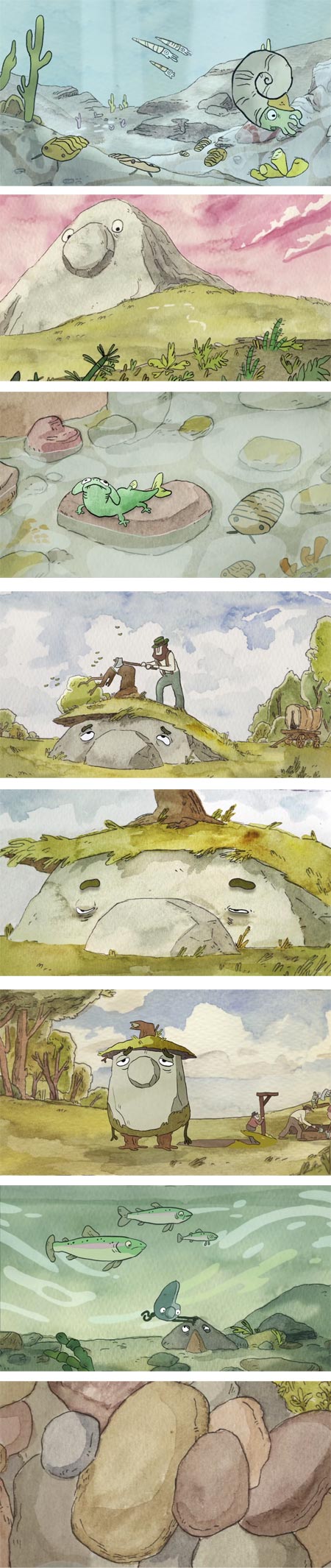
An Object at Rest is an animated short (5 mins) by Seth Boyden that chronicles the eons-long life of a stone as time, and human activity, goes on around it.
In this and some of his other animated shorts, Boyden has combined animation done in the TV Paint application with backgrounds painted in traditional watercolor on paper, giving a charming hand painted feeling well in keeping with his whimsical approach.
[Via Cartoon Brew]
Categories:
-
William Stanley Haseltine

William Stanley Haseltine was a 19th century American painter who studied in the US and Europe.Originally from Philadelphia, where he studied at the University of Pennsylvania and exhibited early in his career at the Pennsylvania Academy of the Fine Arts, he moved to New York, for a time working out of a building that also housed studios for Frederic Edwin Church and Albert Bierstadt.
Haseltine produced studio works from his sketches and watercolors painted on location in Europe, and eventually transitioned to American subjects, particularly of the New England coast.
After the death of his wife, he remarried and moved to Europe, where he would spend his later career based in Rome, but traveling extensively and painting a variety of European subjects.
I particularly like his watercolor and gouache studies — in their more finished form filled with light — and in their more abbreviated form taking on the charming quality of part drawing/part painting — often on toned paper.
Categories:
-
Trove of John Berkey Art

I’ve written previously about John Berkey, the terrific illustrator known primarily for his fantastic visions of space flight, science fiction and future worlds.Most often, when you find references to Berkey’s work, it is to his famous and influential style of space art and science fiction. Most people, even those who are rightly impressed by berkey’s well-known work, aren’t aware of the breadth and stylistic range of his career as an illustrator.
Berkey collector and enthusiast Jim Pinkoski has long maintained a terrific blog devoted to John Berkey’s art, and more specifically, to the art that you rarely see — calendar illustrations, advertisements, posters, magazine covers and interior illustrations covering a wide variety of topics.
Pinkoski has apparently searched through magazines, poster sources, second hand shops, archives, art galleries and a number of other sources to find examples of Berkey’s art that are (unjustifiably) rarely, if ever, seen elsewhere. More importantly, he has had assistance from Demi Berkey, and direct access to John Berkey’s files for many of the pieces.
Pinkoski was the author of an article on John Berkey in issue #36 of Dan Zimmer’s Illustration magazine (long sold out, but maybe you can chance across a copy).
The topics on the blog are arranged in the right column, and the site is extensive, with over 1,700 images. Though most of the images are not large, Pinkoski often posts detail crops, and annotates the images with comments on the piece or general information about the artist’s history.
Berkey remains one of the most influential artists among contemporary illustrators of science fiction, space art and concept art. His range of subjects included history, western scenes, cars, ships, planes, hunting, fishing, nature — even romance novel covers — in addition to art for NASA and magazines like Popular Mechanics, Reader’s Digest and TV Guide.
The John Berkey Art site is a treat, and I look forward to its continued expansion.
(For more, including links to additional sources for images, see my 2010 update post on John Berkey.)
Categories:
-
Drawings and Prints from the permanent collection at the Metropolitan Museum of Art

Drawings and Prints: Selections from the Permanent Collection, Metropolitan Museum of ArtExhibitions subtitled “Selections from the Permanent Collection” never sound dramatic, but shows of master drawings from collections like those of the Met (or the Morgan Library or the National Gallery) are actually rare treasures.
Drawings and prints are considered delicate, subject to light damage and are shown infrequently. Your chances of seeing the same master drawing twice in your lifetime are slim, though it does happen.
The Met and the National Gallery in DC are notable for their efforts to rotate out selections from their superb collections on a regular basis (the Philadelphia Museum of Art was doing this for a while, but sadly seems to have abandoned the practice).
The current selection from the Met will be on display until January 4, 2015, and runs concurrently with About Face: Human Expression on Paper, another exhibition from the permanent collection, that ends on December 13, 2015.
Both have online galleries with links to the individual entries for the works, most of which have download or zoom links to high-res images.
If you have never seen an exhibition of master drawings in person, you should take advantage of the chance if you have it. Drawings and prints, I think, suffer even more in reproduction than paintings, giving up their most sublime characteristics only when confronted in person — not that there isn’t a good deal of enjoyment to be had from web or print images.
(Images above, with details: Paolo Pagani, John Singer Sargent, Denijs Calvaert, Jacques Callot, Pierre Paul Prud’hon, Mariano Fortuny)
Categories:
-
Self-portraits #13

More in my ongoing series of posts about artists’ self-portraits.
I find self-portraits fascinating not just for the range of time periods and styles, but for the interesting variation in the way artists pose themselves.
(Images above, links to my posts: Henri Martin, Marie-Suzanne Roslin, James Tissot, Ernest Meissonier, Peder Severin Kroyer, Giovanni Boldini, Camille Pissarro, Anne-Louis Girodet, Fairfield Porter, Ralph Hedley)
Categories:




Charley’s Picks
Bookshop.org
(Bookshop.org affilliate links; sales benefit independent bookshop owners; I get a small percentage to help support my work on Lines and Colors)

John Singer Sargent: Watercolors


Urban Sketching: Understanding Perspective


Charley’s Picks
Amazon
(Amazon.com affiliate links; sales go to a larger yacht for Jeff Bezos; but I get a small percentage to help support my work on Lines and Colors)
John Singer Sargent: Watercolors
Urban Sketching: Understanding Perspective