


Categories
- 3d CGI
- Amusements
- Animation
- Anime & Manga
- Art Materials
- Art Videos
- Blogroll
- Cartoons
- Color
- Comics
- Concept & Visual Dev.
- Creativity
- Digital Art
- Digital Painting
- Displaying Art on the Web
- Drawing
- Eye Candy for Today
- Gallery and Museum Art
- High-res Art Images
- Illustration
- Motion Graphics & Flash
- Museums
- Online Museums
- Outsider Art
- Painting
- Painting a Day
- Paleo Art
- Pastel, Conté & Chalk
- Pen & Ink
- Prints and Printmaking
- Reviews
- Sc-fi and Fantasy
- Sculpture & Dimensional
- Site Comments
- Sketching
- Storyboards
- Tools and Techniques
- Uncategorized
- Vector Art
- Videos & Podcasts
- Vision and Optics
- Watercolor and Gouache
- Webcomics
Archives
- April 2026
- March 2026
- February 2026
- January 2026
- December 2025
- November 2025
- October 2025
- September 2025
- August 2025
- July 2025
- June 2025
- May 2025
- January 2025
- December 2024
- November 2024
- October 2024
- September 2024
- August 2024
- June 2024
- April 2024
- March 2024
- February 2024
- January 2024
- December 2023
- November 2023
- October 2023
- September 2023
- August 2023
- July 2023
- May 2023
- April 2023
- March 2023
- February 2023
- January 2023
- December 2022
- November 2022
- September 2022
- August 2022
- July 2022
- June 2022
- May 2022
- April 2022
- March 2022
- February 2022
- January 2022
- December 2021
- November 2021
- October 2021
- September 2021
- August 2021
- July 2021
- June 2021
- May 2021
- April 2021
- March 2021
- February 2021
- January 2021
- December 2020
- November 2020
- October 2020
- September 2020
- August 2020
- July 2020
- June 2020
- May 2020
- April 2020
- March 2020
- February 2020
- January 2020
- December 2019
- November 2019
- October 2019
- September 2019
- August 2019
- July 2019
- June 2019
- May 2019
- April 2019
- March 2019
- February 2019
- January 2019
- December 2018
- November 2018
- October 2018
- September 2018
- August 2018
- July 2018
- June 2018
- May 2018
- April 2018
- March 2018
- February 2018
- January 2018
- December 2017
- November 2017
- October 2017
- September 2017
- August 2017
- July 2017
- June 2017
- May 2017
- April 2017
- March 2017
- February 2017
- January 2017
- December 2016
- November 2016
- October 2016
- September 2016
- August 2016
- July 2016
- June 2016
- May 2016
- April 2016
- March 2016
- February 2016
- January 2016
- December 2015
- November 2015
- October 2015
- September 2015
- August 2015
- July 2015
- June 2015
- May 2015
- April 2015
- March 2015
- February 2015
- January 2015
- December 2014
- November 2014
- October 2014
- September 2014
- August 2014
- July 2014
- June 2014
- May 2014
- April 2014
- March 2014
- February 2014
- January 2014
- December 2013
- November 2013
- October 2013
- September 2013
- August 2013
- July 2013
- June 2013
- May 2013
- April 2013
- March 2013
- February 2013
- January 2013
- December 2012
- November 2012
- October 2012
- September 2012
- August 2012
- July 2012
- June 2012
- May 2012
- April 2012
- March 2012
- February 2012
- January 2012
- December 2011
- November 2011
- October 2011
- September 2011
- August 2011
- July 2011
- June 2011
- May 2011
- April 2011
- March 2011
- February 2011
- January 2011
- December 2010
- November 2010
- October 2010
- September 2010
- August 2010
- July 2010
- June 2010
- May 2010
- April 2010
- March 2010
- February 2010
- January 2010
- December 2009
- November 2009
- October 2009
- September 2009
- August 2009
- July 2009
- June 2009
- May 2009
- April 2009
- March 2009
- February 2009
- January 2009
- December 2008
- November 2008
- October 2008
- September 2008
- August 2008
- July 2008
- June 2008
- May 2008
- April 2008
- March 2008
- February 2008
- January 2008
- December 2007
- November 2007
- October 2007
- September 2007
- August 2007
- July 2007
- June 2007
- May 2007
- April 2007
- March 2007
- February 2007
- January 2007
- December 2006
- November 2006
- October 2006
- September 2006
- August 2006
- July 2006
- June 2006
- May 2006
- April 2006
- March 2006
- February 2006
- January 2006
- December 2005
- November 2005
- October 2005
- September 2005
- August 2005
Relevant Blogs
Art, Painting & Sketch
- Gurney Journey
- Underpaintings
- Art and Influence
- Painting Perceptions
- Oil Painters of America
- Vasari Paint POV
- Flying Fox
- Urban Sketchers
- Bento (Smithsonian)
- Art Inconnu
- The Hidden Place
- Still Life
- Making a Mark
- The Art of the Landscape
- Exploring Color & Creativity
- Art Contrarian
- Artist A Day
- beinArt Surreal Art Collective
- Eye Level
- David Dunlop
- p.i.g.m.e.n.t.i.u.m
- CultureGrrl
- Joaquín Sorolla blog
- Artists in Pastel
“Painting a Day”
- A Painting a Day (Keiser)
- On Painting (Keiser)
- Julian Merrow-Smith
- Karen Jurick
- Jeffrey Hayes
- Carol Marine
- Abbey Ryan
- Daily Paintworks
Other Painting Blogs
- Virtual Gouache Land
- Neil Hollingsworth
- Marc Hanson
- Kevin Menck
- Marc Dalessio
- Larry Seiler
- Stapleton Kearns
- Colin Page
- Roos Schuring
- Hans Versfelt
- Titus Meeuws
- Régis Pettinari
- René Plein Air
- Belinda Del Pesco
- Robin Weiss
- Nathan Fowkes (Land Sketch)
- William Wray
- Frank Serrano
- Stephen Magsig
- Michael Chesley Johnson
- Twice a Week
- Sarah Wimperis
- Rob Adams
- Michael Cole Manley
- The Dirty Palette Club
- Mike Manley’s Draw!
Gallery Art & Illustration mix
Illustration
- Howard Pyle
- 100 Years of Illustration
- BibliOdyssey
- Illustration Art
- Today’s Inspiration
- Illustration Mundo
- Little Chimp Society
- Danny Gregory
- R D (John Martz
- Illustration Friday blog
- Monster Brains
- Illustrators & Illustrations (RU)
- Elwood H. Smith
- DaniDraws.com
- Designers Who Blog
- iSpot Blog
Sci-Fi & Fantasy
Illustration & Comics
Comics & Cartoons
- Comics Beat
- Robot 6
- Newsarama Blog
- Comic Vine
- Comics Alliance
- Forbidden Planet Int.
- Paolo Rivera
- Bolt City
- Flight
- Scott McCloud
- The Comics Journal
- Comixpedia
- Funnybook Babylon
- James Baker
- Middleton’s Sketchbook
- Boneville
- The Hotel Fred
- Paul Rivoche
- Daily Cartoonist
- Mad About Cartoons (William Wray)
- Digital Strips
Illustration & Concept
Animation & Concept
- Cartoon Brew
- Animation Blog
- Cold Hard Flash
- Concept Art World
- The CAB
- FY Concept Art
- Concept Ships
- Concept Robots
- John Nevarez
- Armand Serrano
- Marcos Mateu-Mestre
- all kinds of stuff (Kricfalusi)
- Yacin the faun (Man Arenas)
- Kelsey Mann
- Cre8tivemarks Blog
- Ice-Cream Monster Toon Cafe
- AAU Character & Creature Design
- AAU Animation Notes
- Articles and Texticles
Paleo & Scientific
Tools & Techniques
Other
Lists of Art Blogs
Art Image Resource Links
Historic Art Images
- Wikimedia Commons: Paintings
- Wikimedia Commons: Drawings
- The Athenaeum
- WikiArt (WikiPaintings)
- Google Art Project: Artists
- Google Art Project: Collections (Museums)
- ArtCyclopedia
- Web Gallery of Art
- Art Renewal Center
- Web Gallery of Impressionism
Auction Consolidation sites
Auction sites
- Sotheby’s
- Bonham’s
- Christies
- Heritage Auctions: Fine Art
- Heritage Auctions: Illustration
- Freeman’s Auctions
- Bukowskis
- Shannon’s
Image Search
Reverse Image Search (search by image)
- Tin Eye
- RevImg
- Google Image Search (camera icon)
- Bing Image Search (camera icon)
Promoting some friends and some clients of my website design business
- Twin Willows T’ai Chi studio in Wilmington DE. Taiji classes with Bryan Davis.
- Ray Hayward, Inspired Teacher of T’ai Chi ( Taiji ) in Minneapolis, Founder of Mindful Motion Tai Chi Academy
- OldHead Tattoo studio and Art Gallery in Wilmington DE. Tattoos and paintings by Bruce Gulick
- Sharon Domenico Art, pet portrait oil paintings
- Platinum Paperhanging, wallpaper hanging, Main Line and Philadelphia, PA
- Lisa Stone Design, interior designer, Main Line and Philadelphia, PA
- Studio12KPT, original art, prints, calendars and other custom printed items by Van Sickle & Rolleri
-
Zip and L’il Bit: The Captain’s Quest

I was delighted to learn that Zip and L’il Bit, a series of webcomics by Trade Loeffler that I first wrote about in 2006 when I discovered the first story, The Upside-Down Me, and again in 2007 when Loeffler published the second adventure, The Sky Kayak, has returned after a long hiatus in a new story, The Captain’s Quest.Loeffler handles his comics with some of the feeling of an extended children’s book, and a style that seems to harken back to a more genteel time in comics, particularly newspaper comics.
In spite of the apparent simplicity of his drawings, his use of line is sophisticated, and I recommend taking advantage of the zooming feature, which allows you to click on any panel in a given page to enlarge it, and then click through the rest of that page from there.
As of this writing, there are 7 pages in the new story, and a new page is added on Sundays.
[Via Drawn!]
Categories:
-
Velázquez’s Las meninas and Sargent’s Daughters of Edward Darley Boit

Despite the way he has for years been dismissed by critics as a facile but emotionless society painter, I’ve long felt that John Singer Sargent was one of the great painters in the history of Western Art.Though he still doesn’t get the respect I think he deserves, Sargent’s star has risen in recent years. It would have been hard to imagine, say 20 years ago, that the Museo Nacional del Prado would ask the Museum of Fine Arts in Boston to loan Sargent’s masterpiece, The Daughters of Edward Darley Boit, and display it next to the acknowledged masterpiece by the painter many consider the greatest in the history of painting, Diego Velázquez’s The Family of Felipe IV, also known as Las meninas.
The connection, of course, is that Las meninas is the inspiration for Sargent’s painting. Sargent was a great admirer of Velázquez, and painted a smaller scale copy of Velázquez’s most revered work, along with a number of the master’s other paintings, during his trip to Spain in 1879.
The paintings are obviously similar in some ways, they are of figures in a dark interior, each featuring a group of young sisters, and share obvious similarities in value and color. The paint handling is of course different, as is Sargent’s more modern composition; and perhaps most telling, there is an obvious difference in intention. Sargent’s subjects, though of a reasonably well to do family, are far from royalty, and not even posing in their Sunday best, but dressed as though for a normal day.
I would love the opportunity to see these two works together (I had the pleasure of seeing Sargent’s work when it was in New York a few years ago), but unfortunately a trip to Spain is not in the offing.
The Prado has a page about the loan, The work: a reflection of Las meninas, that also features a video.
You can make your own comparison with the zoomable versions of the works on the sites of the Boston Museum of Fine Arts and the Museo Nacional del Prado. They require scrolling in the little zoom boxes, however; so if you just want reasonably large versions of the two works, you can try these for Las meninas and Daughters.
I don’t think that the Prado is putting Sargent on a level with Velázquez, and neither am I, few painters could withstand that comparison; but I believe they are acknowledging that Sargent has a place in the canon of Western art worthy of making a comparison between the two works, certainly more than that of a “facile society painter”.
Categories:
-
Everett Shinn

Pastel artist, oil painter, illustrator and artist/reporter Everett Shinn was the youngest member of the group of turn of the 20th Century American painters known as “Ashcan school”.Shinn was born in New Jersey and attended the Spring Garden Institute in Philadelphia, a technical school with classes in mechanical drawing and architecture, where another artistically inclined student named John Sloan was also a student.
Both would go on to become part of “The Eight”, a group of painters in New York who exhibited together in joint defiance of the artistic conventions of their day. The core group of them were given the name “The Ashcan School” out of derision by critics who deplored their frequent subject matter of rough, lower class people and their surroundings. (For more on The Eight and The Ashcan School, see my post on John Sloan.)
While in Philadelphia, Shinn went to work for The Philadelphia Press as a “visual reporter”, essentially an illustrator who served the role of quick observation and reporting that would soon be superseeded by the burgeoning new medium of photography. At the same time he enrolled in the Pennsylvania Academy of the Fine Arts.
At both the paper and the Academy, he fell in with a group that would later form the core of The Eight — John Sloan, William Glackens and George Luks, sometimes referred to as The Philadelphia Four. All of them came under the influence of Robert Henri, the outspoken artist and advocate of honest and unfanciful realism who was teaching at the Pennsylvania Academy at the time.
Shinn would continue to produce illustrations for various magazines and newspapers when he and his compatriots moved to New York, but only when he wanted to, not on a regular basis.
In his later career, his paintings and pastels of gritty urban life gradually gave way to more genteel subjects, and pastel gave way to oil after a trip to Europe and exposure to a wider circle of painters there.
Admirers of his early work criticized him for betraying his former role in portraying everyday life with social honesty, but, like Sloan, Shinn said it was never a matter of social or political protest, simply artistic observation.
Shinn worked in a variety of media — oil, watercolor, gouache and colored chalks, but is best known for his bold use of pastel and oil pastel. You can see evidence of his training as an observer in many of his works, as well as the influence of Degas in a number of his pastels, particularly those of theatrical subjects.
Categories:
-
Jeu and L’homme sans ombre (Georges Schwizgebel)

Jeu (French for “game”) is an award-winning short (4 minute) animated film by Swiss filmmaker Georges Schwizgebel, by way of the National Film Board of Canada (top two frames above).In the tradition of Disney’s Fantasia, it’s visual interpretation of a piece of music, in this case fairly free-form and constantly changing and morphing.
It gets most interesting about 2 minutes in, when Schwizgebel starts to play games with the structure of architectural interiors and related elements.
Schwizgebel plays some similar games with perspective and “camera angle” in L’homme sans ombre (“The man without a shadow”, bottom two frames above), a longer (10 minute) animated short about a man who makes a Faustian deal to trade his shadow for wealth.
Both films are wordless. The animation throughout has a rough, hand-painted look of gouache or pastel, though it may be oil, in a technique known as “paint-on-glass animation“.
I did not find a dedicated site for Schwizgebel, but you can find more of his films with a Google video search.
Categories:
-
Michael Kutsche

Michael Kutsche is a character designer and concept artist working in the film industry. He was one of the character designers on Tim Burton’s recent film, Alice in Wonderland, and is currently working on the upcoming John Carter of Mars, directed by Andrew Stanton and slated for release in 2012.Originally from Germany, Kutsche is a self-taught artist who credits the internet with establishing his career. Though he works in traditional media like oil and watercolor for his personal and gallery art, his professional work is primarily digital paintings, and it was from a portfolio on CGSociety, a community site devoted to digital art, that he first gained the notice of Sony Pictures Imageworks, a connection that led to his work on Alice.
Kutsche often works with his digital tools in a way that gives a feeling of painterly traditional brushwork. Though his original CGSociety portfolio does not seem to be active, there is a two page interview with him on the site, as well as a walk through of the creation of one of his pieces, The Boxer.
His website has a gallery of work from 2008 and 2009, and he has recently started a blog.
His work is included in the new book, Disney: Alice in Wonderland: A Visual Companion.
Categories:
-
Virginia Frances Sterrett
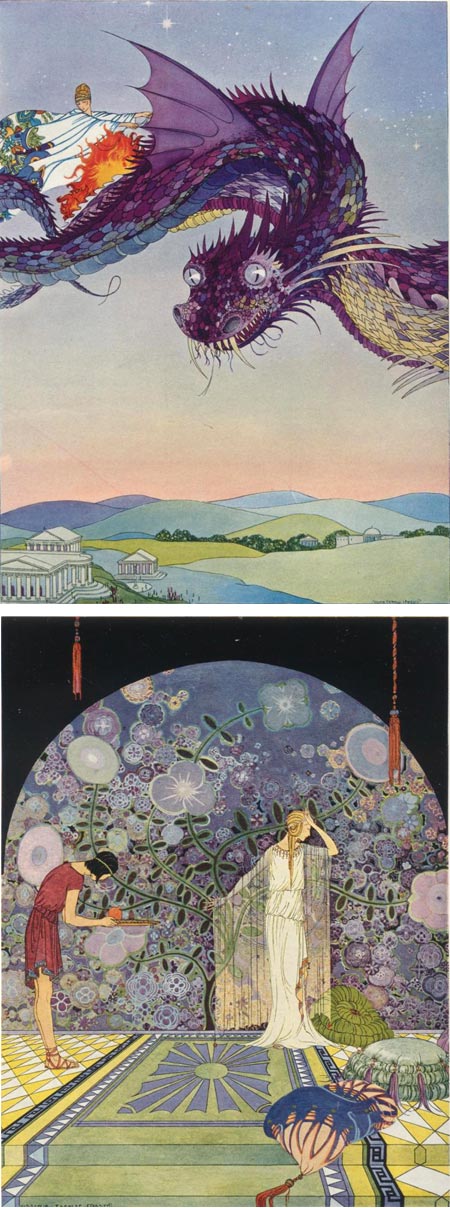
In her unfortunately short life, Virginia Frances Sterrett fought to fulfill her desire to be an illustrator against the ravages of tuberculosis, which she contracted at the age of 19, the same year she received her first commission to illustrate a book, Old French Fairy Tales by Comtesse de Segur.Sterrett was born in Chicago but grew up in Missouri and Kansas. Her father died when she was young. When she was 15 the family moved back to Chicago and, after high school and a stint doing advertising for a department store, she so impressed the Art Institute of Chicago with her abilities that they agreed to admit her and waive her tuition, which she could not have afforded.
Shortly thereafter, her mother became ill and she had to leave the school and work to support her family. It wasn’t long after that her own health began to fail. Though she recovered to a large extent after time in a sanatorium, and had several productive years, her life was cut short by the tuberculosis at the age of 31, just a few illustrations shy of completing Myths and Legends.
Sterrett’s fluid, colorful and elegantly designed compositions, which echo the Art Nouveau inflected illustrations of Golden Age greats like Kay Neilsen and Edmund Dulac, have a beautiful otherworldly quality. One can only imagine or hope that they in some way provided an escape for Sterrett from the harsh realities of her life.
There is a site devoted to her, with a good bio, though it only features illustrations from one book, Arabian Nights.
Art Passions has a relatively complete set from all of her books, Old Book Art has some large images from Tanglewood Tales (click through the linked images twice to get to the largest images).
Since her work was done in the early part of the 20th Century, the books are now in the public domain and you can read complete facsimiles of Tanglewood Tales and Old French Fairy Tales on the Internet Archive.
Amazon lists available paperback copies of Old French Fairy Tales, Volume 1 and Volume 2, but I haven’t seen them and I don’t know anything about the quality of the reproductions.
David Apatoff has an excellent post on Virginia Frances Sterrett on his always enlightening blog Illustration Art.
Categories:




Charley’s Picks
Bookshop.org
(Bookshop.org affilliate links; sales benefit independent bookshop owners; I get a small percentage to help support my work on Lines and Colors)

John Singer Sargent: Watercolors


Urban Sketching: Understanding Perspective


Charley’s Picks
Amazon
(Amazon.com affiliate links; sales go to a larger yacht for Jeff Bezos; but I get a small percentage to help support my work on Lines and Colors)
John Singer Sargent: Watercolors
Urban Sketching: Understanding Perspective