


Categories
- 3d CGI
- Amusements
- Animation
- Anime & Manga
- Art Materials
- Art Videos
- Blogroll
- Cartoons
- Color
- Comics
- Concept & Visual Dev.
- Creativity
- Digital Art
- Digital Painting
- Displaying Art on the Web
- Drawing
- Eye Candy for Today
- Gallery and Museum Art
- High-res Art Images
- Illustration
- Motion Graphics & Flash
- Museums
- Online Museums
- Outsider Art
- Painting
- Painting a Day
- Paleo Art
- Pastel, Conté & Chalk
- Pen & Ink
- Prints and Printmaking
- Reviews
- Sc-fi and Fantasy
- Sculpture & Dimensional
- Site Comments
- Sketching
- Storyboards
- Tools and Techniques
- Uncategorized
- Vector Art
- Videos & Podcasts
- Vision and Optics
- Watercolor and Gouache
- Webcomics
Archives
- April 2026
- March 2026
- February 2026
- January 2026
- December 2025
- November 2025
- October 2025
- September 2025
- August 2025
- July 2025
- June 2025
- May 2025
- January 2025
- December 2024
- November 2024
- October 2024
- September 2024
- August 2024
- June 2024
- April 2024
- March 2024
- February 2024
- January 2024
- December 2023
- November 2023
- October 2023
- September 2023
- August 2023
- July 2023
- May 2023
- April 2023
- March 2023
- February 2023
- January 2023
- December 2022
- November 2022
- September 2022
- August 2022
- July 2022
- June 2022
- May 2022
- April 2022
- March 2022
- February 2022
- January 2022
- December 2021
- November 2021
- October 2021
- September 2021
- August 2021
- July 2021
- June 2021
- May 2021
- April 2021
- March 2021
- February 2021
- January 2021
- December 2020
- November 2020
- October 2020
- September 2020
- August 2020
- July 2020
- June 2020
- May 2020
- April 2020
- March 2020
- February 2020
- January 2020
- December 2019
- November 2019
- October 2019
- September 2019
- August 2019
- July 2019
- June 2019
- May 2019
- April 2019
- March 2019
- February 2019
- January 2019
- December 2018
- November 2018
- October 2018
- September 2018
- August 2018
- July 2018
- June 2018
- May 2018
- April 2018
- March 2018
- February 2018
- January 2018
- December 2017
- November 2017
- October 2017
- September 2017
- August 2017
- July 2017
- June 2017
- May 2017
- April 2017
- March 2017
- February 2017
- January 2017
- December 2016
- November 2016
- October 2016
- September 2016
- August 2016
- July 2016
- June 2016
- May 2016
- April 2016
- March 2016
- February 2016
- January 2016
- December 2015
- November 2015
- October 2015
- September 2015
- August 2015
- July 2015
- June 2015
- May 2015
- April 2015
- March 2015
- February 2015
- January 2015
- December 2014
- November 2014
- October 2014
- September 2014
- August 2014
- July 2014
- June 2014
- May 2014
- April 2014
- March 2014
- February 2014
- January 2014
- December 2013
- November 2013
- October 2013
- September 2013
- August 2013
- July 2013
- June 2013
- May 2013
- April 2013
- March 2013
- February 2013
- January 2013
- December 2012
- November 2012
- October 2012
- September 2012
- August 2012
- July 2012
- June 2012
- May 2012
- April 2012
- March 2012
- February 2012
- January 2012
- December 2011
- November 2011
- October 2011
- September 2011
- August 2011
- July 2011
- June 2011
- May 2011
- April 2011
- March 2011
- February 2011
- January 2011
- December 2010
- November 2010
- October 2010
- September 2010
- August 2010
- July 2010
- June 2010
- May 2010
- April 2010
- March 2010
- February 2010
- January 2010
- December 2009
- November 2009
- October 2009
- September 2009
- August 2009
- July 2009
- June 2009
- May 2009
- April 2009
- March 2009
- February 2009
- January 2009
- December 2008
- November 2008
- October 2008
- September 2008
- August 2008
- July 2008
- June 2008
- May 2008
- April 2008
- March 2008
- February 2008
- January 2008
- December 2007
- November 2007
- October 2007
- September 2007
- August 2007
- July 2007
- June 2007
- May 2007
- April 2007
- March 2007
- February 2007
- January 2007
- December 2006
- November 2006
- October 2006
- September 2006
- August 2006
- July 2006
- June 2006
- May 2006
- April 2006
- March 2006
- February 2006
- January 2006
- December 2005
- November 2005
- October 2005
- September 2005
- August 2005
Relevant Blogs
Art, Painting & Sketch
- Gurney Journey
- Underpaintings
- Art and Influence
- Painting Perceptions
- Oil Painters of America
- Vasari Paint POV
- Flying Fox
- Urban Sketchers
- Bento (Smithsonian)
- Art Inconnu
- The Hidden Place
- Still Life
- Making a Mark
- The Art of the Landscape
- Exploring Color & Creativity
- Art Contrarian
- Artist A Day
- beinArt Surreal Art Collective
- Eye Level
- David Dunlop
- p.i.g.m.e.n.t.i.u.m
- CultureGrrl
- Joaquín Sorolla blog
- Artists in Pastel
“Painting a Day”
- A Painting a Day (Keiser)
- On Painting (Keiser)
- Julian Merrow-Smith
- Karen Jurick
- Jeffrey Hayes
- Carol Marine
- Abbey Ryan
- Daily Paintworks
Other Painting Blogs
- Virtual Gouache Land
- Neil Hollingsworth
- Marc Hanson
- Kevin Menck
- Marc Dalessio
- Larry Seiler
- Stapleton Kearns
- Colin Page
- Roos Schuring
- Hans Versfelt
- Titus Meeuws
- Régis Pettinari
- René Plein Air
- Belinda Del Pesco
- Robin Weiss
- Nathan Fowkes (Land Sketch)
- William Wray
- Frank Serrano
- Stephen Magsig
- Michael Chesley Johnson
- Twice a Week
- Sarah Wimperis
- Rob Adams
- Michael Cole Manley
- The Dirty Palette Club
- Mike Manley’s Draw!
Gallery Art & Illustration mix
Illustration
- Howard Pyle
- 100 Years of Illustration
- BibliOdyssey
- Illustration Art
- Today’s Inspiration
- Illustration Mundo
- Little Chimp Society
- Danny Gregory
- R D (John Martz
- Illustration Friday blog
- Monster Brains
- Illustrators & Illustrations (RU)
- Elwood H. Smith
- DaniDraws.com
- Designers Who Blog
- iSpot Blog
Sci-Fi & Fantasy
Illustration & Comics
Comics & Cartoons
- Comics Beat
- Robot 6
- Newsarama Blog
- Comic Vine
- Comics Alliance
- Forbidden Planet Int.
- Paolo Rivera
- Bolt City
- Flight
- Scott McCloud
- The Comics Journal
- Comixpedia
- Funnybook Babylon
- James Baker
- Middleton’s Sketchbook
- Boneville
- The Hotel Fred
- Paul Rivoche
- Daily Cartoonist
- Mad About Cartoons (William Wray)
- Digital Strips
Illustration & Concept
Animation & Concept
- Cartoon Brew
- Animation Blog
- Cold Hard Flash
- Concept Art World
- The CAB
- FY Concept Art
- Concept Ships
- Concept Robots
- John Nevarez
- Armand Serrano
- Marcos Mateu-Mestre
- all kinds of stuff (Kricfalusi)
- Yacin the faun (Man Arenas)
- Kelsey Mann
- Cre8tivemarks Blog
- Ice-Cream Monster Toon Cafe
- AAU Character & Creature Design
- AAU Animation Notes
- Articles and Texticles
Paleo & Scientific
Tools & Techniques
Other
Lists of Art Blogs
Art Image Resource Links
Historic Art Images
- Wikimedia Commons: Paintings
- Wikimedia Commons: Drawings
- The Athenaeum
- WikiArt (WikiPaintings)
- Google Art Project: Artists
- Google Art Project: Collections (Museums)
- ArtCyclopedia
- Web Gallery of Art
- Art Renewal Center
- Web Gallery of Impressionism
Auction Consolidation sites
Auction sites
- Sotheby’s
- Bonham’s
- Christies
- Heritage Auctions: Fine Art
- Heritage Auctions: Illustration
- Freeman’s Auctions
- Bukowskis
- Shannon’s
Image Search
Reverse Image Search (search by image)
- Tin Eye
- RevImg
- Google Image Search (camera icon)
- Bing Image Search (camera icon)
Promoting some friends and some clients of my website design business
- Twin Willows T’ai Chi studio in Wilmington DE. Taiji classes with Bryan Davis.
- Ray Hayward, Inspired Teacher of T’ai Chi ( Taiji ) in Minneapolis, Founder of Mindful Motion Tai Chi Academy
- OldHead Tattoo studio and Art Gallery in Wilmington DE. Tattoos and paintings by Bruce Gulick
- Sharon Domenico Art, pet portrait oil paintings
- Platinum Paperhanging, wallpaper hanging, Main Line and Philadelphia, PA
- Lisa Stone Design, interior designer, Main Line and Philadelphia, PA
- Studio12KPT, original art, prints, calendars and other custom printed items by Van Sickle & Rolleri
-
New Leonardo Discovered?

You will sometimes hear talk of the “Van Gogh in the attic”; the thought that somewhere are lost artistic gems, set aside, forgotten or misclassified for some reason, waiting for discovery in a dusty attic somewhere in the back streets of Paris or London, perhaps sitting on a shelf in an antique store waiting for you to pick it up for next to nothing.You’ll just as often hear that “it simply doesn’t happen”; but, in fact, new works by the world’s great artists are occasionally uncovered, either by actual discovery of previously unknown works or by changes in attribution of known pieces, like the recent re-attribution of Portrait of a Man to Velázquez.
In another case of re-attribution that is unfolding at the moment, a portrait thought to have been by an unknown German artist from the 19th Century has been identified as a work by Leonardo da Vinci. If true, it is a rare find indeed, the first additional work to be assigned to Leonardo in over 100 years.
The rendering, which has been in the hands of private collectors, is in ink and colored chalks. Though some things can be determined about the work by it’s style, such as the left-handedness of the artist, it was not attributed to Da Vinci, or any of his contemporaries. Because of it’s more modern approach (and despite the Renaissance dress of the subject, a young girl shown in profile) it was thought to fit in with stylistic characteristics of a different time and place.
The attribution is being made on the basis of a fingerprint, found in the upper left edge of the canvas (image above, top right), that has been analyzed and matched to another fingerprint in one of the master’s other works. (Leonardo, like many artists, got his hands into his work and left fingerprints in a number of paintings.)
Though the official jury is still out, art historians are falling into agreement that that work is indeed by Leonardo.
There seem to be many more stories covering the discovery in the UK and European press than here in the States (why am I not surprised?), and I’ll provide some links to some of them below. The first one, from TimesOnline, includes a video that has the best close-ups of the piece that I could find. Hopefully, we’ll see more of it in time.
Though most of the stories emphasize the monetary worth of the piece, like some museum level version of Antiques Road Show, the real value lies in what an additional work can tell us about one of the great masters of Western art.
Categories:
-
Hey Oscar Wilde! It’s Clobberin’ Time!

It’s a common practice among contemporary comics artists to do commissioned sketches or even fully realized drawings for fans and collectors.Often collectors will commission drawings by a number of artists on a single theme, and create over time a collection of themed works by an extensive and diverse list of creators.
Such is the case with the collection displayed on a site titled Hey Oscar Wilde! It’s Clobberin’ Time!, by a collector whose name I don’t know (email address suggests “sgettis”, presumably S. Gettis).
The collection is centered on the theme of asking each artist to portray a favorite literary figure, author or character. This collection has been in progress since 1998, and has been displayed on the web in several forms. I wrote about it in one of its previous incarnations back in 2005 as Artistic interpretations of Literary Figures.
Since then the collection has continued to grow and now includes an impressive list of artists and a fascinatingly diverse list of literary figures. You can browse the collection by either from lists in the right sidebar.
The collection includes a number of comics artists and illustrators I’ve featured previously on Lines and Colors. In the list below, the first link is to the original drawing on the Hey Oscar Wilde! site, second is to my post about the artist.
Images above: Oscar Wilde by Stephen Silver, Alan Moore by Frazer Irving, Captain Nemo by Chris Sprouse, Jim Harrison by Tommy Lee Edwards, Alice in Wonderland by Steve Rude (in Gibson Girl style), Hayao Miyazaki by Kazu Kibuishi (see my post on Hayao Miyazaki), Frankenstein’s Monster by William Stout, Raymond Chandler by Adam Hughes and George Orwell by Kevin Nowlan.
Addendum: the collector’s name is Steven Gettis. [Thanks to Dennis van Zwieten for the tip.]
Categories:
-
Lorenz Stöer
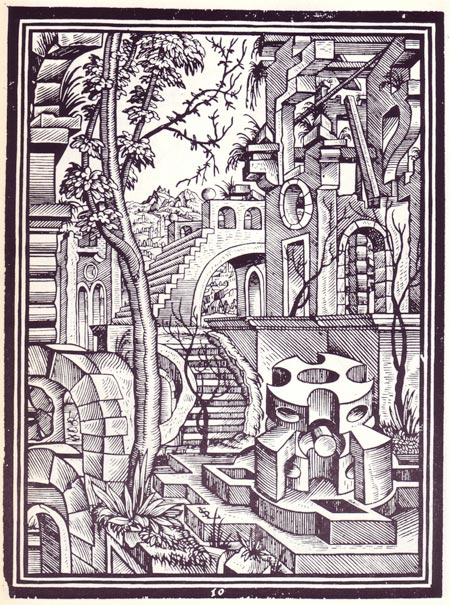
Lorenz Stöer was a German printmaker and painter active in the late 16th Century. His wonderfully idiosyncratic visions of geometric forms in landscapes of imagined architecture have recently been brought to light for us by that master discoverer of the idiosyncratic and arcane, peacay, whose ever-fascinating blog BibliOdyssey is a treasure trove (and dangerously fascinating rabbit-hole) of the strange and wonderful. (See my previous posts on BibliOdyssey here and here.)Stöer seems to be obscure except for a published folio of 11 woodcuts titled Geometria et Perspectiva, of which the image above is an example. But an unpublished portfolio of color drawings discovered at the Munich Library has in recent years been attributed to him.
Peacay has provided not only examples from both on the BibliOdyssey page, but a Flickr set which features the images in high resolution.
There is also a reproduction of the folio here, but peacay’s sets are much better quality. You may want to supplement your enjoyment of the woodcuts with some background about polyhedra here and here (for some reason, I just love this stuff).
Stöer’s fascination with geometric solids was apparently the inspiration for other artists, like the creator of the intricate marquetery on this Collector’s Cabinet from the same time.
I would also have to assume that his polyhedral fantasias, oddly arranged architectural facades and stacked stairways were a direct influence on the fantastic geometry and math inspired works of M.C. Escher.
Categories:
-
Televolution
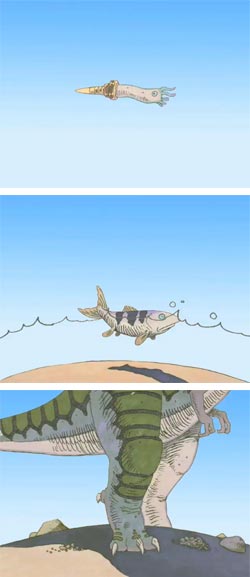 Televolution is an animated short by Malcolm McNeil, who I have written about previously here and here.
Originally shown in Japan in 1990, when some of the the tech he suggests was almost prophetic, the animation is meant to salute the birthday of Charles Darwin (an event that just passed again recently).
McNeill traces the course of evolution in a few whimsical steps, and suggests how things might go from here.
Categories:
-
Van Gogh’s Letters
Anyone who has read Dear Theo, the book of Vincent van Gogh’s letters to his brother, which, in essence, is a kind of autobiography, knows that the popularized image of the artist as an uncouth, irrational, semi-literate wild man, stabbing at the canvas in frantic desperation like a crazed orangutan, couldn’t be further from the truth.Though certainly emotionally troubled, Van Gogh was a thoughtful, well read and articulate individual, whose insights, observations and accounts of his personal journey as an artist are illuminating on many levels.
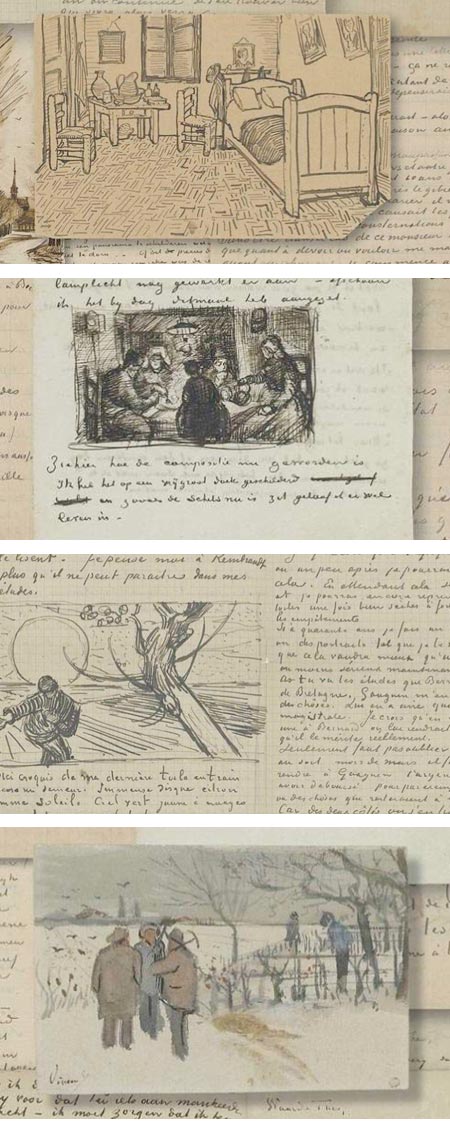
Van Gogh wrote hundreds of letters, a number of which contain sketches, or even well developed drawings, that frequently presage his paintings or refer to the circumstances under which they were painted. Together, they form an account of the artist’s life and work that is unlike anything we have from other major artists.
There are several other collections of Van Gogh’s letters, from those specific to a particular time in the artist’s life, like Vincent Van Gogh – Letters from Provence (The illustrated letters), to more comprehensive collections like Letters of Vincent van Gogh (Touchstone), The Letters of Vincent van Gogh (Penguin Classics) and Complete Letters of Vincent Van Gogh (Bulfinch).
The latest and most deluxe collection, which should soon be available, is Vincent van Gogh — The Letters (Thames & Hudson) (details here), a multi volume set collecting all of his letters with new transcriptions and translations, reproductions of the illustrated letters and reproductions of all of the works that are referred to in the letters. It promises to be a unique study of the artist and his work, told from the artist’s point of view; but at a list price of $600 U.S. ($480 on Amazon), it’s not exactly a mass market collection.
The book set accompanies a new exhibit at the Van Gogh Museum in Amsterdam (choose a language at the upper left), called Van Gogh’s letters: the artist speaks, that showcases many of his letters from the museum’s collection and displays them with related paintings and drawings, forming an exhibition in which the artist, in effect, provides the commentary on his own work.
The exhibition runs until the 3rd of January, 2010, but it is part of a larger project, in which the letters were reexamined and photographed in preparation for both the exhibit and the book; and the museum has mounted excellent web resources that will continue after the exhibition has closed.
There is a web site devoted to the project at www.vangoghletters.org that is essentially a comprehensive, online, databased version of the book project. It can be searched by period, correspondent or place; or filtered for letters with sketches. There are also advanced search capabilities and background features on the artist, his time, the people with whom he was corresponding and more.
The letters are displayed as original text, translated, with notes and facsimile reproductions of the letters themselves, as well as reproductions of artwork (by Van Gogh and other artists) referred to in the letters.
It’s easy to miss the small links at top of the columns to the facsimile versions and artworks, and it’s worth looking through the Quick Guide they have offered to getting the most out of the resource (it pops up by default the first time you access the letters).
As if this wasn’t enough to delight lovers of Van Gogh’s work, the museum is also maintaining a wonderful Van Gogh Blog, in which letters form the artist are posted daily, giving the effect of the artist writing a daily blog post, or corresponding with you personally on a daily basis (whichever appeals to your disposition). The posts are accompanied with drawings and sketches.
The blog just started in the beginning of October, so you can catch up and then read a daily post from Van Gogh to start your day. Wonderful.
Addendum: Peacay has posted a very nice article with images and quotes from the letters on Bibliodyssey.
Categories:
-
Nate Wragg
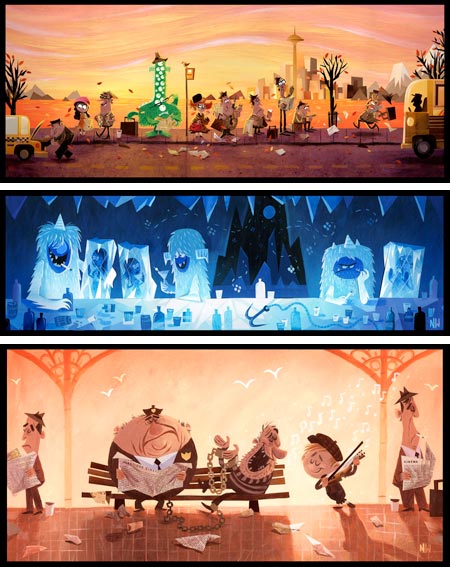
I came across illustrator and animation concept artist Nate Wragg from his participation in the Terrible Yellow Eyes project, and was delighted with his work.Wragg is a member of Pixar Studios, and worked on the cartoon Pursuit. He also was an illustrator for the children’s book Too Many Cooks (Ratatouille), as well as being the author/illustrator of several other books, which you can find listed and linked on the right column of his blog.
The blog has posts about his illustrations, commissioned art and work in progress. He also has prints and art for sale on his own site and on Gallery Nucleus.
Wragg works, at least in some pieces, in acrylic, gouache and paper collage. His wonderfully snappy, angular style shows the pedigree of his work in animation; as does his knack for creating lively, offbeat characters. There is an interview on the Character Design blog.
Wragg also uses a controlled palette to great advantage, with many pieces that are are almost monochromatic or duotone, in which a few carefully chosen color passages make the entire image pop.
Categories:




Charley’s Picks
Bookshop.org
(Bookshop.org affilliate links; sales benefit independent bookshop owners; I get a small percentage to help support my work on Lines and Colors)

John Singer Sargent: Watercolors


Urban Sketching: Understanding Perspective


Charley’s Picks
Amazon
(Amazon.com affiliate links; sales go to a larger yacht for Jeff Bezos; but I get a small percentage to help support my work on Lines and Colors)
John Singer Sargent: Watercolors
Urban Sketching: Understanding Perspective