


Categories
- 3d CGI
- Amusements
- Animation
- Anime & Manga
- Art Materials
- Art Videos
- Blogroll
- Cartoons
- Color
- Comics
- Concept & Visual Dev.
- Creativity
- Digital Art
- Digital Painting
- Displaying Art on the Web
- Drawing
- Eye Candy for Today
- Gallery and Museum Art
- High-res Art Images
- Illustration
- Motion Graphics & Flash
- Museums
- Online Museums
- Outsider Art
- Painting
- Painting a Day
- Paleo Art
- Pastel, Conté & Chalk
- Pen & Ink
- Prints and Printmaking
- Reviews
- Sc-fi and Fantasy
- Sculpture & Dimensional
- Site Comments
- Sketching
- Storyboards
- Tools and Techniques
- Uncategorized
- Vector Art
- Videos & Podcasts
- Vision and Optics
- Watercolor and Gouache
- Webcomics
Archives
- April 2026
- March 2026
- February 2026
- January 2026
- December 2025
- November 2025
- October 2025
- September 2025
- August 2025
- July 2025
- June 2025
- May 2025
- January 2025
- December 2024
- November 2024
- October 2024
- September 2024
- August 2024
- June 2024
- April 2024
- March 2024
- February 2024
- January 2024
- December 2023
- November 2023
- October 2023
- September 2023
- August 2023
- July 2023
- May 2023
- April 2023
- March 2023
- February 2023
- January 2023
- December 2022
- November 2022
- September 2022
- August 2022
- July 2022
- June 2022
- May 2022
- April 2022
- March 2022
- February 2022
- January 2022
- December 2021
- November 2021
- October 2021
- September 2021
- August 2021
- July 2021
- June 2021
- May 2021
- April 2021
- March 2021
- February 2021
- January 2021
- December 2020
- November 2020
- October 2020
- September 2020
- August 2020
- July 2020
- June 2020
- May 2020
- April 2020
- March 2020
- February 2020
- January 2020
- December 2019
- November 2019
- October 2019
- September 2019
- August 2019
- July 2019
- June 2019
- May 2019
- April 2019
- March 2019
- February 2019
- January 2019
- December 2018
- November 2018
- October 2018
- September 2018
- August 2018
- July 2018
- June 2018
- May 2018
- April 2018
- March 2018
- February 2018
- January 2018
- December 2017
- November 2017
- October 2017
- September 2017
- August 2017
- July 2017
- June 2017
- May 2017
- April 2017
- March 2017
- February 2017
- January 2017
- December 2016
- November 2016
- October 2016
- September 2016
- August 2016
- July 2016
- June 2016
- May 2016
- April 2016
- March 2016
- February 2016
- January 2016
- December 2015
- November 2015
- October 2015
- September 2015
- August 2015
- July 2015
- June 2015
- May 2015
- April 2015
- March 2015
- February 2015
- January 2015
- December 2014
- November 2014
- October 2014
- September 2014
- August 2014
- July 2014
- June 2014
- May 2014
- April 2014
- March 2014
- February 2014
- January 2014
- December 2013
- November 2013
- October 2013
- September 2013
- August 2013
- July 2013
- June 2013
- May 2013
- April 2013
- March 2013
- February 2013
- January 2013
- December 2012
- November 2012
- October 2012
- September 2012
- August 2012
- July 2012
- June 2012
- May 2012
- April 2012
- March 2012
- February 2012
- January 2012
- December 2011
- November 2011
- October 2011
- September 2011
- August 2011
- July 2011
- June 2011
- May 2011
- April 2011
- March 2011
- February 2011
- January 2011
- December 2010
- November 2010
- October 2010
- September 2010
- August 2010
- July 2010
- June 2010
- May 2010
- April 2010
- March 2010
- February 2010
- January 2010
- December 2009
- November 2009
- October 2009
- September 2009
- August 2009
- July 2009
- June 2009
- May 2009
- April 2009
- March 2009
- February 2009
- January 2009
- December 2008
- November 2008
- October 2008
- September 2008
- August 2008
- July 2008
- June 2008
- May 2008
- April 2008
- March 2008
- February 2008
- January 2008
- December 2007
- November 2007
- October 2007
- September 2007
- August 2007
- July 2007
- June 2007
- May 2007
- April 2007
- March 2007
- February 2007
- January 2007
- December 2006
- November 2006
- October 2006
- September 2006
- August 2006
- July 2006
- June 2006
- May 2006
- April 2006
- March 2006
- February 2006
- January 2006
- December 2005
- November 2005
- October 2005
- September 2005
- August 2005
Relevant Blogs
Art, Painting & Sketch
- Gurney Journey
- Underpaintings
- Art and Influence
- Painting Perceptions
- Oil Painters of America
- Vasari Paint POV
- Flying Fox
- Urban Sketchers
- Bento (Smithsonian)
- Art Inconnu
- The Hidden Place
- Still Life
- Making a Mark
- The Art of the Landscape
- Exploring Color & Creativity
- Art Contrarian
- Artist A Day
- beinArt Surreal Art Collective
- Eye Level
- David Dunlop
- p.i.g.m.e.n.t.i.u.m
- CultureGrrl
- Joaquín Sorolla blog
- Artists in Pastel
“Painting a Day”
- A Painting a Day (Keiser)
- On Painting (Keiser)
- Julian Merrow-Smith
- Karen Jurick
- Jeffrey Hayes
- Carol Marine
- Abbey Ryan
- Daily Paintworks
Other Painting Blogs
- Virtual Gouache Land
- Neil Hollingsworth
- Marc Hanson
- Kevin Menck
- Marc Dalessio
- Larry Seiler
- Stapleton Kearns
- Colin Page
- Roos Schuring
- Hans Versfelt
- Titus Meeuws
- Régis Pettinari
- René Plein Air
- Belinda Del Pesco
- Robin Weiss
- Nathan Fowkes (Land Sketch)
- William Wray
- Frank Serrano
- Stephen Magsig
- Michael Chesley Johnson
- Twice a Week
- Sarah Wimperis
- Rob Adams
- Michael Cole Manley
- The Dirty Palette Club
- Mike Manley’s Draw!
Gallery Art & Illustration mix
Illustration
- Howard Pyle
- 100 Years of Illustration
- BibliOdyssey
- Illustration Art
- Today’s Inspiration
- Illustration Mundo
- Little Chimp Society
- Danny Gregory
- R D (John Martz
- Illustration Friday blog
- Monster Brains
- Illustrators & Illustrations (RU)
- Elwood H. Smith
- DaniDraws.com
- Designers Who Blog
- iSpot Blog
Sci-Fi & Fantasy
Illustration & Comics
Comics & Cartoons
- Comics Beat
- Robot 6
- Newsarama Blog
- Comic Vine
- Comics Alliance
- Forbidden Planet Int.
- Paolo Rivera
- Bolt City
- Flight
- Scott McCloud
- The Comics Journal
- Comixpedia
- Funnybook Babylon
- James Baker
- Middleton’s Sketchbook
- Boneville
- The Hotel Fred
- Paul Rivoche
- Daily Cartoonist
- Mad About Cartoons (William Wray)
- Digital Strips
Illustration & Concept
Animation & Concept
- Cartoon Brew
- Animation Blog
- Cold Hard Flash
- Concept Art World
- The CAB
- FY Concept Art
- Concept Ships
- Concept Robots
- John Nevarez
- Armand Serrano
- Marcos Mateu-Mestre
- all kinds of stuff (Kricfalusi)
- Yacin the faun (Man Arenas)
- Kelsey Mann
- Cre8tivemarks Blog
- Ice-Cream Monster Toon Cafe
- AAU Character & Creature Design
- AAU Animation Notes
- Articles and Texticles
Paleo & Scientific
Tools & Techniques
Other
Lists of Art Blogs
Art Image Resource Links
Historic Art Images
- Wikimedia Commons: Paintings
- Wikimedia Commons: Drawings
- The Athenaeum
- WikiArt (WikiPaintings)
- Google Art Project: Artists
- Google Art Project: Collections (Museums)
- ArtCyclopedia
- Web Gallery of Art
- Art Renewal Center
- Web Gallery of Impressionism
Auction Consolidation sites
Auction sites
- Sotheby’s
- Bonham’s
- Christies
- Heritage Auctions: Fine Art
- Heritage Auctions: Illustration
- Freeman’s Auctions
- Bukowskis
- Shannon’s
Image Search
Reverse Image Search (search by image)
- Tin Eye
- RevImg
- Google Image Search (camera icon)
- Bing Image Search (camera icon)
Promoting some friends and some clients of my website design business
- Twin Willows T’ai Chi studio in Wilmington DE. Taiji classes with Bryan Davis.
- Ray Hayward, Inspired Teacher of T’ai Chi ( Taiji ) in Minneapolis, Founder of Mindful Motion Tai Chi Academy
- OldHead Tattoo studio and Art Gallery in Wilmington DE. Tattoos and paintings by Bruce Gulick
- Sharon Domenico Art, pet portrait oil paintings
- Platinum Paperhanging, wallpaper hanging, Main Line and Philadelphia, PA
- Lisa Stone Design, interior designer, Main Line and Philadelphia, PA
- Studio12KPT, original art, prints, calendars and other custom printed items by Van Sickle & Rolleri
-
Beau Lotto: Optical illusions show how we see (TED Talk)
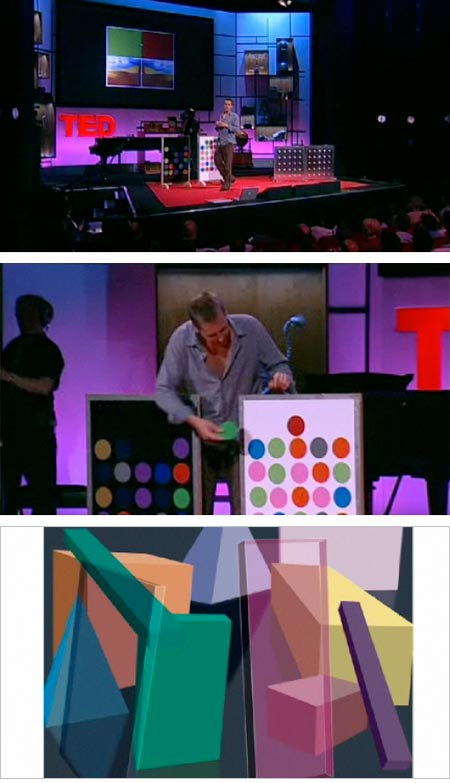
Beau Lotto, of Lottolab, a combination art studio and science lab, has a talk on TED, a conference started in 1984 to bring together bright lights from the disciplines of Technology, Entertainment and Design.These talks are almost always informative, entertaining and brain-ticklingly thought provoking. Some are on art (see my post on The Face of Leonardo?).
In this particular talk, Lotto utilizes several familiar but striking optical illusions (see my previous posts on some of them here and here), plus a few others, but goes beyond the usual concerns of the mechanics of vision into the questions of why we see as we do, why these particular illusions work, and how the way we see functions in our adaptation to the world.
The LottoLab site includes some articles and features on related subjects.
Much of the talk is about the nature of color, and in particular about a point that I often mention as perhaps the single most important thing I have ever learned about color, color mixing and color perception — that context is everything.
Categories:
-
World War I Poster Archive in the Library of Congress

The venerable U.S. Library of Congress, that vast and vastly underestimated trove of knowledge and culture from the nation’s past, keeps moving more and more of its treasures out onto the web, which is a Good Thing for knowledge and culture lovers of all stripes.The Prints and Photographs Collection, among its other treasures, has a searchable archive of wartime posters from World War I. The posters are from all viewpoints, and are usually dedicated to promoting their individual viewpoints in an effort to influencing the outcome of that conflict in one way or another (see my post on Propaganda Posters). To that end many artists and illustrators, some historically renowned, were employed in their creation.
The archive can be browsed in a default sequence (the basis of which is unclear), or by category; and can also be searched.
Each image has a higher resolution JPEG version and an even higher resolution archival TIFF file. There is also bibliographic information on the poster, including, where known, the artist’s name.
Some are more interesting than others, of course, and it takes a little digging, but there are some gems to be found.
[Via MetaFilter]
Categories:
-
Brynn Metheny – The Morae River
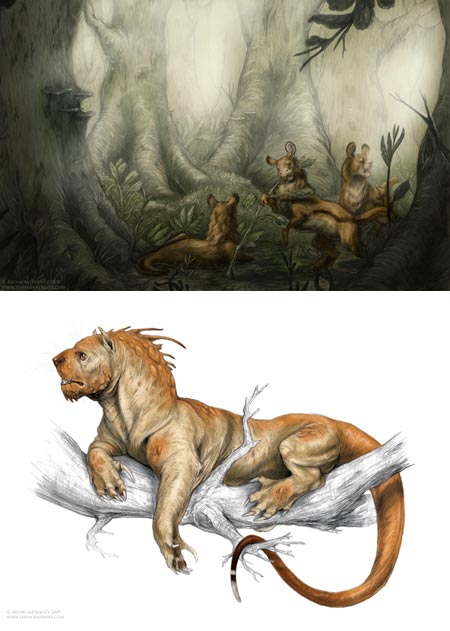
Brynn Metheny is a freelance illustrator based in Oakland, California who loves to draw imaginary creatures.Metheny has taken this fascination with made-up animals and extended it to the point of conjuring up an entire continent, Orcura, through which flows The Morae River. The river basin has a bestiary and a Classification of Species to describe the animals that inhabit it.
The Morae River project is laid out in its own web site, complete with descriptions of the animals, their habitats and behavior. Animals like the Blue-Throated Hulompolus and the Red Tailed Mardik share characteristics of real animals, arranged in fanciful ways and portrayed with what appear to be pencil and watercolor drawings (though the color may be digital, I don’t know).
I like the way the sketch-like pencil drawing of the animals’ environment is often left in place and color is applied only to the animal, leaving a nice contrast of combined media in the same piece.
Metheny also has a blog and a web site, as well as pieces on ConceptArt.org
[Via LCSV4]
Categories:
-
Caspar David Friedrich – Nature Animated

Since I wrote my post about the great 19th Century German landscape artist Caspar David Friedrich back in 2006, many additional resources for viewing his work have appeared on the web; and there is a new exhibition of his work, Caspar David Friedrich — Nature Animated along with a complimentary exhibit, Friedrich, Eight Contemporary Commentaries at the NationalMuseum of Sweden (to 10 January, 2010).Sadly, some of Friedrich’s work was lost in the Allied bombing of Dresden during World War II, though some of that has been recreated in interpretations from black and white photographic records by other artists in subsequent years. (Unfortunately, displays of his work are not always quick to point out which pieces are recreations, and I’m not the one to give you guidance on that point.)
Friedrich was a prolific artist, however, and there is finally an abundance of web resources to view his work as he regains popularity with contemporary art lovers. His popularity waxed an waned during his own lifetime. Friedrich had success in the early part of his career, but fell into disregard and even disdain in the latter part of his life, a life that was marked by tragedy of various kinds almost throughout.
Friedrich’s work can be stunning, particularly his evocative landscapes, in which he attempted to convey more than the landscape itself, stating: “The artist should not only paint what he sees before him, but also what he sees within him. If, however, he sees nothing within him, then he should also omit to paint that which he sees before him.”
Categories:
-
Similarity based image search

OK, so you’ve got this image, and you want to find something similar or related; and you want to find it with needle-like accuracy out there in the vast and windblown haystacks of the web.Search engines, of course, come to mind. Those tireless workhorses of web direction (and misdirection) are always happy to give out their directions (and maybe a few ads) to help in your righteous quest, oh Grail Seeker.
But suppose you don’t have that magic word, the name of the painting or artist, What then?
Enter similarity based image search, the ability to search for other images based on the characteristics of a known image. There are several approaches to this, and several kinds of search engines to use.
In investigating them, I started out with an image that was common, but not too common, Titian’s portrait painting known as Man with a Blue Sleeve (The National Gallery, London, also called A Man with a Quilted Sleeve, which may or may not be a self-portrait, I think it is).
I got an interesting variety of results from several visual search engines with similarity based search features, though none of them returned the image I was hoping for (at least in the first round), Rembrandt’s similarly posed self-portrait (see my post on Web Gallery of Art).
The first kind of search engine can be particularly helpful in this kind of search, in that they allow you to actually upload an image you already have and search for similar images; completely image based, no search words necessary.
TinEye (images above, top) allows you to browse your desktop, upload an image, or enter the URL of an image file on the web, and search for similar images. It does a good job of finding other versions of the same image, which can be very helpful in identifying an image for which you don’t have a name or artist. It wasn’t that helpful for finding related images by the same or other artists, but you could start there and carry on with a more generalized search engine.
BYO Image Search Lab (above, 2nd down) from Idée Labs also lets you upload an image or enter a web URL, but the returns are quite different. I was actually very impressed with the engine’s returns of images with similar composition, color and value, and it returned fascinating images; but it was not particularly helpful in finding other images by Titian or similar images by other artists. It’s fun, though. Idée Labs also has searches based on a selection of colors, or combined tags.
The other engines require that you first find an image through traditional word-based search and then show you similar images to the ones found.
Incognia (above, third down) did a decent job of finding some other paintings by Titian, but was not extensive in its returns and doesn’t identify the source of the image on the thumbnail.
Pixolu (above, 4th down), which uses a Flash based interface, found a wider range of Titian images. It allows you to control the size of the thumbnail display, and drag multiple images to a sidebar and click “Refine” to focus your search. The thumbnails are not directly linked to their source, however. You have to click on them and then look to the right under the thumbnail size control, for the image URL.
Of course, the big boys want to play at this game too.
Venerable Google, which essentially owns web searching (something like 80-90% of all searches now) has a solid similar images labs feature (above, 5th down); probably the most useful and extensive of the lot (they’re #1 for a reason). Google found a range of Titian portraits, as well as similarly composed portraits by other old master artists, and displays the link to the original under the thumbnail. Subsequent pages of results started to stray more widely off topic, but retained a mix of relevant results for several pages. (Still didn’t turn up my Rembrandt, though. Perhaps that was too much to ask.)
Bing, Microsoft’s rebranded search engine, appears to have an automatic similar image feature. When searching for images, clicking on any one image brings up its source in a browser frame, and displays related images in another frame to the left. I don’t like the frame based interface, or the fact that it won’t let me Command-click (on the Mac) to open multiple images in additional browser tabs.
Bing did an OK job of finding some similar images (above, second from bottom); but as I scrolled down in the related images frame (above, bottom) some of the “similar images” just boggled my mind.
Correction: OK, I owe Microsoft an apology (sort of). Apparently the images to the left are not related by similarity, but are results from the original search term. It is evidently finding “Titan” in addition to “Titian”, thinking I’m too lame to have actually meant “Titian” (thanks for nothing, Clippy), which explains the colorful figure of the Boy Wonder and the football stuff. Still wonky, though; and now not related to the topic of this post. Sorry.
Addendum: I want to give you the benefit of one of the key things I’ve learned about searching in my 14 years on the web; and particularly over the last few years of researching topics for Lines and Colors: and that is that search engines are not where you begin and end your search.
Search engines are a great place to begin a search, particularly if you learn to use their more powerful advanced features, but search engines can only take you so far. Much of the web is the so called “deep web”, billions of pages beyond the reach of the major search engines because they are behind logins or database driven sites that don’t get indexed easily. (The last estimate I heard is that Google, by far the largest and most powerful of the major search engines, reaches less than 20% of the total pages on the web. Granted, most of this is corporate documentation, but it’s still a striking figure.)
Use search engines to start your search, but then focus in on the local search available within databased sites that may have the information (or image) that you’re seeking. For example, if go to the large online art sites like Art Renewal Center, Web Gallery of Art, CGFA, The Athenaeum, or Artcyclopedia and use their local search features, and you’ll often have greater access to their resources. The same applies to the online collection databases of museums.
Categories:
-
Velázquez (Self?) Portrait Rediscovered

It may be disconcerting to some, but I actually enjoy the fact that art history, like history in general, is a fluid landscape. New discoveries and the reinterpretation of existing information can make textbooks obsolete overnight and reverse the fortunes of collectors and museums; and can also lead to excitement, disappointment or simply clarification.A reversal of a reversal has led to excitement, and improved the fortunes of the Metropolitan Museum of Art in New York, as the attribution of Portrait of a Man, a painting in their collection once assigned to Spanish master Diego Rodríguez de Silva y Velázquez, but later downgraded to “workshop of” (meaning painted perhaps under his guidance, but by lesser hands) has recently been reexamined, cleaned, restored and reassigned to the master’s hand.
Velázquez is one of the great masters of Western art, considered the greatest of all painters by some, and the reassignment of the painting to him is a significant event.
This is particularly interesting because the painting, when originally attributed to him, was thought to be a self-portrait, an assessment that just seems “right” to me. I say that not because I’m any kind of expert on Velázquez, but simply because the portrait has that particular look I’ve seen in dozens of self-portraits.
This is partly, I think, due to the staring-directly-at-you face-in-the-mirror pose, but partly due that special look that I think comes from the mental shift into that mode of seeing that accompanies drawing and painting from life. (See my posts on Drawing on the Right Side of the Brain, The Face of Leonardo? and Marie-Denise Villers)
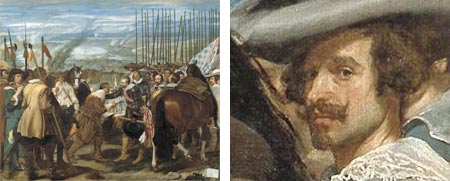
The portrait matches that of the figure of a bystander in Velázquez’s Surrender of Breda (to the far right, image above with detail). That figure also stares directly at us (or the mirror) and has something of that same look to the eyes. This figure too was long thought to be a self portrait while Portrait of a Man was still attributed to Velázquez.Portrait of a Man is more of a study than a finished work, but the face is pretty well finished. To think that we have the face of the artist staring out at us is a wonderful addition to the treat of knowing we have another Velázquez in the world.
Categories:




Charley’s Picks
Bookshop.org
(Bookshop.org affilliate links; sales benefit independent bookshop owners; I get a small percentage to help support my work on Lines and Colors)

John Singer Sargent: Watercolors


Urban Sketching: Understanding Perspective


Charley’s Picks
Amazon
(Amazon.com affiliate links; sales go to a larger yacht for Jeff Bezos; but I get a small percentage to help support my work on Lines and Colors)
John Singer Sargent: Watercolors
Urban Sketching: Understanding Perspective