


Categories
- 3d CGI
- Amusements
- Animation
- Anime & Manga
- Art Materials
- Art Videos
- Blogroll
- Cartoons
- Color
- Comics
- Concept & Visual Dev.
- Creativity
- Digital Art
- Digital Painting
- Displaying Art on the Web
- Drawing
- Eye Candy for Today
- Gallery and Museum Art
- High-res Art Images
- Illustration
- Motion Graphics & Flash
- Museums
- Online Museums
- Outsider Art
- Painting
- Painting a Day
- Paleo Art
- Pastel, Conté & Chalk
- Pen & Ink
- Prints and Printmaking
- Reviews
- Sc-fi and Fantasy
- Sculpture & Dimensional
- Site Comments
- Sketching
- Storyboards
- Tools and Techniques
- Uncategorized
- Vector Art
- Videos & Podcasts
- Vision and Optics
- Watercolor and Gouache
- Webcomics
Archives
- April 2026
- March 2026
- February 2026
- January 2026
- December 2025
- November 2025
- October 2025
- September 2025
- August 2025
- July 2025
- June 2025
- May 2025
- January 2025
- December 2024
- November 2024
- October 2024
- September 2024
- August 2024
- June 2024
- April 2024
- March 2024
- February 2024
- January 2024
- December 2023
- November 2023
- October 2023
- September 2023
- August 2023
- July 2023
- May 2023
- April 2023
- March 2023
- February 2023
- January 2023
- December 2022
- November 2022
- September 2022
- August 2022
- July 2022
- June 2022
- May 2022
- April 2022
- March 2022
- February 2022
- January 2022
- December 2021
- November 2021
- October 2021
- September 2021
- August 2021
- July 2021
- June 2021
- May 2021
- April 2021
- March 2021
- February 2021
- January 2021
- December 2020
- November 2020
- October 2020
- September 2020
- August 2020
- July 2020
- June 2020
- May 2020
- April 2020
- March 2020
- February 2020
- January 2020
- December 2019
- November 2019
- October 2019
- September 2019
- August 2019
- July 2019
- June 2019
- May 2019
- April 2019
- March 2019
- February 2019
- January 2019
- December 2018
- November 2018
- October 2018
- September 2018
- August 2018
- July 2018
- June 2018
- May 2018
- April 2018
- March 2018
- February 2018
- January 2018
- December 2017
- November 2017
- October 2017
- September 2017
- August 2017
- July 2017
- June 2017
- May 2017
- April 2017
- March 2017
- February 2017
- January 2017
- December 2016
- November 2016
- October 2016
- September 2016
- August 2016
- July 2016
- June 2016
- May 2016
- April 2016
- March 2016
- February 2016
- January 2016
- December 2015
- November 2015
- October 2015
- September 2015
- August 2015
- July 2015
- June 2015
- May 2015
- April 2015
- March 2015
- February 2015
- January 2015
- December 2014
- November 2014
- October 2014
- September 2014
- August 2014
- July 2014
- June 2014
- May 2014
- April 2014
- March 2014
- February 2014
- January 2014
- December 2013
- November 2013
- October 2013
- September 2013
- August 2013
- July 2013
- June 2013
- May 2013
- April 2013
- March 2013
- February 2013
- January 2013
- December 2012
- November 2012
- October 2012
- September 2012
- August 2012
- July 2012
- June 2012
- May 2012
- April 2012
- March 2012
- February 2012
- January 2012
- December 2011
- November 2011
- October 2011
- September 2011
- August 2011
- July 2011
- June 2011
- May 2011
- April 2011
- March 2011
- February 2011
- January 2011
- December 2010
- November 2010
- October 2010
- September 2010
- August 2010
- July 2010
- June 2010
- May 2010
- April 2010
- March 2010
- February 2010
- January 2010
- December 2009
- November 2009
- October 2009
- September 2009
- August 2009
- July 2009
- June 2009
- May 2009
- April 2009
- March 2009
- February 2009
- January 2009
- December 2008
- November 2008
- October 2008
- September 2008
- August 2008
- July 2008
- June 2008
- May 2008
- April 2008
- March 2008
- February 2008
- January 2008
- December 2007
- November 2007
- October 2007
- September 2007
- August 2007
- July 2007
- June 2007
- May 2007
- April 2007
- March 2007
- February 2007
- January 2007
- December 2006
- November 2006
- October 2006
- September 2006
- August 2006
- July 2006
- June 2006
- May 2006
- April 2006
- March 2006
- February 2006
- January 2006
- December 2005
- November 2005
- October 2005
- September 2005
- August 2005
Relevant Blogs
Art, Painting & Sketch
- Gurney Journey
- Underpaintings
- Art and Influence
- Painting Perceptions
- Oil Painters of America
- Vasari Paint POV
- Flying Fox
- Urban Sketchers
- Bento (Smithsonian)
- Art Inconnu
- The Hidden Place
- Still Life
- Making a Mark
- The Art of the Landscape
- Exploring Color & Creativity
- Art Contrarian
- Artist A Day
- beinArt Surreal Art Collective
- Eye Level
- David Dunlop
- p.i.g.m.e.n.t.i.u.m
- CultureGrrl
- Joaquín Sorolla blog
- Artists in Pastel
“Painting a Day”
- A Painting a Day (Keiser)
- On Painting (Keiser)
- Julian Merrow-Smith
- Karen Jurick
- Jeffrey Hayes
- Carol Marine
- Abbey Ryan
- Daily Paintworks
Other Painting Blogs
- Virtual Gouache Land
- Neil Hollingsworth
- Marc Hanson
- Kevin Menck
- Marc Dalessio
- Larry Seiler
- Stapleton Kearns
- Colin Page
- Roos Schuring
- Hans Versfelt
- Titus Meeuws
- Régis Pettinari
- René Plein Air
- Belinda Del Pesco
- Robin Weiss
- Nathan Fowkes (Land Sketch)
- William Wray
- Frank Serrano
- Stephen Magsig
- Michael Chesley Johnson
- Twice a Week
- Sarah Wimperis
- Rob Adams
- Michael Cole Manley
- The Dirty Palette Club
- Mike Manley’s Draw!
Gallery Art & Illustration mix
Illustration
- Howard Pyle
- 100 Years of Illustration
- BibliOdyssey
- Illustration Art
- Today’s Inspiration
- Illustration Mundo
- Little Chimp Society
- Danny Gregory
- R D (John Martz
- Illustration Friday blog
- Monster Brains
- Illustrators & Illustrations (RU)
- Elwood H. Smith
- DaniDraws.com
- Designers Who Blog
- iSpot Blog
Sci-Fi & Fantasy
Illustration & Comics
Comics & Cartoons
- Comics Beat
- Robot 6
- Newsarama Blog
- Comic Vine
- Comics Alliance
- Forbidden Planet Int.
- Paolo Rivera
- Bolt City
- Flight
- Scott McCloud
- The Comics Journal
- Comixpedia
- Funnybook Babylon
- James Baker
- Middleton’s Sketchbook
- Boneville
- The Hotel Fred
- Paul Rivoche
- Daily Cartoonist
- Mad About Cartoons (William Wray)
- Digital Strips
Illustration & Concept
Animation & Concept
- Cartoon Brew
- Animation Blog
- Cold Hard Flash
- Concept Art World
- The CAB
- FY Concept Art
- Concept Ships
- Concept Robots
- John Nevarez
- Armand Serrano
- Marcos Mateu-Mestre
- all kinds of stuff (Kricfalusi)
- Yacin the faun (Man Arenas)
- Kelsey Mann
- Cre8tivemarks Blog
- Ice-Cream Monster Toon Cafe
- AAU Character & Creature Design
- AAU Animation Notes
- Articles and Texticles
Paleo & Scientific
Tools & Techniques
Other
Lists of Art Blogs
Art Image Resource Links
Historic Art Images
- Wikimedia Commons: Paintings
- Wikimedia Commons: Drawings
- The Athenaeum
- WikiArt (WikiPaintings)
- Google Art Project: Artists
- Google Art Project: Collections (Museums)
- ArtCyclopedia
- Web Gallery of Art
- Art Renewal Center
- Web Gallery of Impressionism
Auction Consolidation sites
Auction sites
- Sotheby’s
- Bonham’s
- Christies
- Heritage Auctions: Fine Art
- Heritage Auctions: Illustration
- Freeman’s Auctions
- Bukowskis
- Shannon’s
Image Search
Reverse Image Search (search by image)
- Tin Eye
- RevImg
- Google Image Search (camera icon)
- Bing Image Search (camera icon)
Promoting some friends and some clients of my website design business
- Twin Willows T’ai Chi studio in Wilmington DE. Taiji classes with Bryan Davis.
- Ray Hayward, Inspired Teacher of T’ai Chi ( Taiji ) in Minneapolis, Founder of Mindful Motion Tai Chi Academy
- OldHead Tattoo studio and Art Gallery in Wilmington DE. Tattoos and paintings by Bruce Gulick
- Sharon Domenico Art, pet portrait oil paintings
- Platinum Paperhanging, wallpaper hanging, Main Line and Philadelphia, PA
- Lisa Stone Design, interior designer, Main Line and Philadelphia, PA
- Studio12KPT, original art, prints, calendars and other custom printed items by Van Sickle & Rolleri
-
Betty Boop: Snow White
 A friend of mine recently reminded me of the amazing Fleischer Studios Betty Boop cartoons from the 1930’s (see my posts on Max Fleisher and the Max Fleischer Superman cartoons).
Betty Boop, in her original incarnation, was sexy, surreal (in the accurate sense of that word), imaginative, beautifully done and entertaining on several levels.
These were cartoons done when animation as an art form and entertainment medium, while no longer in its infancy, was in its wide-eyed childhood, exploratory and robust with the heady enthusiasm of youth. Animators were delighting in the possibilities animated drawings presented, particularly in freedom from the restraints of physical laws and the conventions of formal narrative.
People, objects and animals bend, morph, disintegrate and reintegrate. The laws of physics are rescinded. The artists indulge in dream-like displays of the bizarre and wonderful. Characters, and logic, assume pretzel-like configurations.
All of this is done with wit, style, imagination and wonderfully snappy drawing. The backgrounds, at times surprisingly dark and strange, are filled with wonderful details that are easy to miss on first viewing.
This example, Betty Boop: Snow White, is one of the best. Directed by Dave Fleischer and animated by Roland C. Crandall, this 7 minute masterpiece takes our darling Betty (created by animator Grim Natwick) through the Snow White story.
But if Disney’s Snow White is a symphony (and it’s a wonderful milestone of animation), this is an improvisational jazz piece by players at the top of their form for inventiveness, exploration and animation “chops”.
The piece, in fact, makes extensive use of the music of the great band leader Cab Calloway, often an integral feature of the Betty Boop cartoons, in this case a smashing rendition of St. James Infirmary Blues, to which all manner of bizzare imagery is set.
You can view it on the Animation Archive, where you can find a treasure trove of early animation (a good place to start is the Film Chest Vintage Cartoons collection).
There is also a site devoted to the Betty Boop cartoons in general that makes them easier to browse (something the Archive is not the best for) and links to them both on the Archive and YouTube.
[Suggestion courtesy of Susan Casper]
Categories:
-
Maria Kalman (update)

As I mentioned back in February, illustrator Maria Kalman is continuing her illustrated blogging for the New York Times with her current blog And the Pursuit of Happiness.In her piece for July 30, 2009, Can Do, she focuses on my favorite of the United States’ “founding fathers” — inventor, raconteur, publisher, writer, ambassador, ladies man and all around interesting fellow, Ben Franklin.
(I’ll take advantage of this article to point out for the benefit of any “Freedom Fries” wingnuts who happen on it, that if Franklin hadn’t convinced the French to jump into opposing the British during the Revolutionary War, thereby pulling our fat out of the fire, we would still be a colony of England. I’ll also mention a favorite quote from Franklin, one that is terribly appropriate for our “war on terror” paranoia-filled times: “They that can give up essential liberty to obtain a little temporary safety deserve neither liberty nor safety.”)
I digress; but then, so does Kalman, delightfully wandering from Franklin to Mellville to Tesla and back again by way of a Jell-o mold competition and a green-eyed man named Fritz; celebrating along the way the inventive spirit that runs through the fabric of U.S. history like a bright fiber-optic thread.
[Via Daring Fireball and Kottke.org]
Categories:
-
Brooks Shane Salzwedel
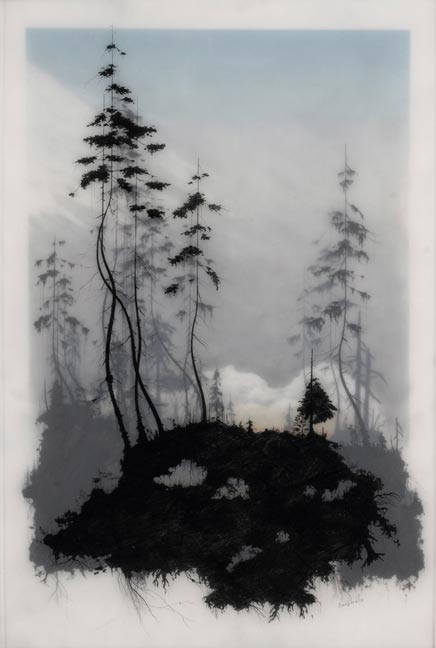
Brooks Shane Salzwedel draws ephemeral landscape images in layers of graphite, tape and resin.His unusual, and painstaking, approach gives his images a delicate feeling of depth and otherworldly mystery. He often juxtaposes artificial constructs, like metal towers, with natural forms, both emphasizing the contrast in form and the odd harmony of their place in his compositions.
His images are largely monochromatic, with occasional touches of faint color, but within their gray and black tones they have a palette of “colors” that are reminiscent of Chinese or Japanese ink painting.
If you’re in Southern California, you can catch the last few days of the Momentum show at Gallery Nucleus in Alhambra, which features work by Salzwedel and five other artists.
From September 12 to October 10, 2009, he will have a solo show at Black Maria Gallery in Los Angeles.
Categories:
-
Art Babble
Art Babble is a terrific site that promises to get even better, and probably rapidly.Art Babble, the tagline for which is “Play Art Loud”, aggregates art related videos from a variety of sources, most notably museums like the Art Institute of Chicago, Museum of Arts & Design, Museum of Contemporary Art San Diego, Norman Rockwell Museum, Rubin Museum of Art, San Jose Museum of Art, The Solomon R. Guggenheim Museum, Van Gogh Museum, and Yerba Buena Center for the Arts; along with Public TV station KQED.
For the most part these seem to be high end, professionally made videos that delve into a variety of art subjects. I’ve only had chance to watch one full video so far, and perhaps I got lucky, but I found it fascinating, illuminating and nicely erudite without being stuffy or overly technical.
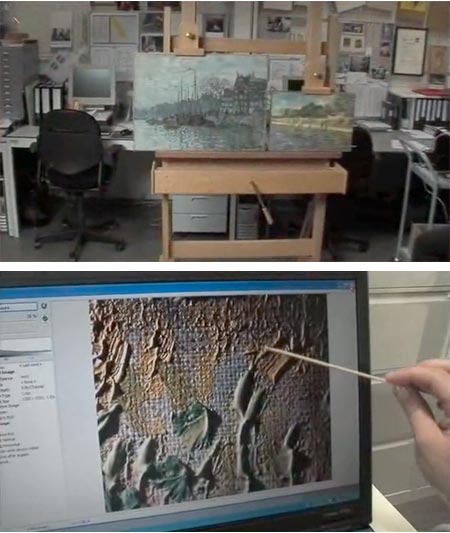
Research in progress: Van Gogh and contemporaries (images above), from the van Gogh Museum in Amsterdam, is a short in which a restorer from the museum examines a painting by Van Gogh and a painting by Monet side by side, utilizing a range of approaches, from naked eye to microscope to x-ray to ultraviolet, and explores similarities in their painting technique, the use of broken color and the choice to allow the ground to show through the brushstrokes to add to the color and texture of the painting.
if the other videos are of this quality, I’ll be looking for a lot of spare moments to return to the site.
You can view the list of videos by topic (“Channels”), by artist, by series or by the participating institution.
Categories:
-
Cheeming Boey

Cheeming Boey draws on styrofoam coffee cups with a sharpie pen.Those of us who have a tendency to doodle on whatever surface is handy may not think that surprising, but the degree of skill and work that he puts into his unusual medium is outstanding.
His subjects range from cartoons to detailed stippled portraits to elaborate decorative drawings inspired by the style of Japanese prints.
The drawings use the entire circumference of the cop, connecting with themselves in a continuous band. The flicker set of his cup drawings features them set against a mirror and also often includes multiple views of the same cup.
There is a photo sequence of his process and a video as well.
Boey’s cups sell in galleries for $120 to $220 and are sometimes placed in plastic cases. There is an article on him on the OC Register.
You’ll often hear disparaging remarks about unorthodox art materials, particularly when they’re not “archival”. I dont’ know about the Sharpie ink, but Boey’s styrofoam “canvas”, as any eco-warrior will tell you, will last for a long long time.
Addendum: The Sharpie blog has an interview with Boey
[Via digg]
Categories:
-
Wizard of Oz characters reinterpreted
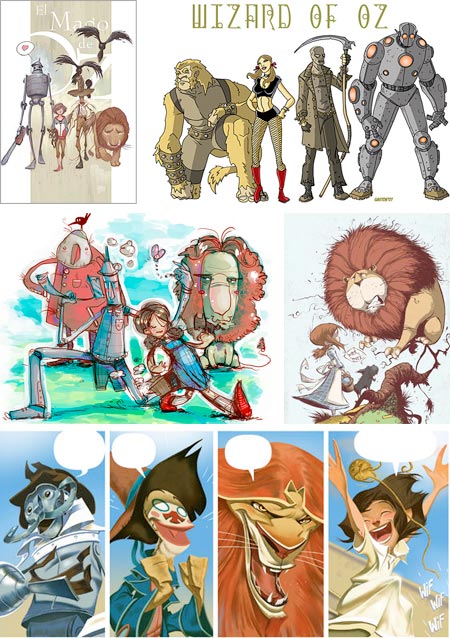
As a fun addition to my previous article on W. W. Denslow, here’s a piece on The Design Inspiration that has collected some contemporary artists’ interpretations of the major characters form the Wizard of Oz book and film: 25 Various Styles of The Wizard of Oz Illustrations.To this list you can add Nancy Dorser, Marvel Comics’ Skottie Young and Image Comics’ Enrique Fernández (also here).
(Images above: Julian Totino Tedesco, Lee Gaston, Tony Papesh, Skottie Young, Enrique Fernández)
Categories:




Charley’s Picks
Bookshop.org
(Bookshop.org affilliate links; sales benefit independent bookshop owners; I get a small percentage to help support my work on Lines and Colors)

John Singer Sargent: Watercolors


Urban Sketching: Understanding Perspective


Charley’s Picks
Amazon
(Amazon.com affiliate links; sales go to a larger yacht for Jeff Bezos; but I get a small percentage to help support my work on Lines and Colors)
John Singer Sargent: Watercolors
Urban Sketching: Understanding Perspective