


Categories
- 3d CGI
- Amusements
- Animation
- Anime & Manga
- Art Materials
- Art Videos
- Blogroll
- Cartoons
- Color
- Comics
- Concept & Visual Dev.
- Creativity
- Digital Art
- Digital Painting
- Displaying Art on the Web
- Drawing
- Eye Candy for Today
- Gallery and Museum Art
- High-res Art Images
- Illustration
- Motion Graphics & Flash
- Museums
- Online Museums
- Outsider Art
- Painting
- Painting a Day
- Paleo Art
- Pastel, Conté & Chalk
- Pen & Ink
- Prints and Printmaking
- Reviews
- Sc-fi and Fantasy
- Sculpture & Dimensional
- Site Comments
- Sketching
- Storyboards
- Tools and Techniques
- Uncategorized
- Vector Art
- Videos & Podcasts
- Vision and Optics
- Watercolor and Gouache
- Webcomics
Archives
- April 2026
- March 2026
- February 2026
- January 2026
- December 2025
- November 2025
- October 2025
- September 2025
- August 2025
- July 2025
- June 2025
- May 2025
- January 2025
- December 2024
- November 2024
- October 2024
- September 2024
- August 2024
- June 2024
- April 2024
- March 2024
- February 2024
- January 2024
- December 2023
- November 2023
- October 2023
- September 2023
- August 2023
- July 2023
- May 2023
- April 2023
- March 2023
- February 2023
- January 2023
- December 2022
- November 2022
- September 2022
- August 2022
- July 2022
- June 2022
- May 2022
- April 2022
- March 2022
- February 2022
- January 2022
- December 2021
- November 2021
- October 2021
- September 2021
- August 2021
- July 2021
- June 2021
- May 2021
- April 2021
- March 2021
- February 2021
- January 2021
- December 2020
- November 2020
- October 2020
- September 2020
- August 2020
- July 2020
- June 2020
- May 2020
- April 2020
- March 2020
- February 2020
- January 2020
- December 2019
- November 2019
- October 2019
- September 2019
- August 2019
- July 2019
- June 2019
- May 2019
- April 2019
- March 2019
- February 2019
- January 2019
- December 2018
- November 2018
- October 2018
- September 2018
- August 2018
- July 2018
- June 2018
- May 2018
- April 2018
- March 2018
- February 2018
- January 2018
- December 2017
- November 2017
- October 2017
- September 2017
- August 2017
- July 2017
- June 2017
- May 2017
- April 2017
- March 2017
- February 2017
- January 2017
- December 2016
- November 2016
- October 2016
- September 2016
- August 2016
- July 2016
- June 2016
- May 2016
- April 2016
- March 2016
- February 2016
- January 2016
- December 2015
- November 2015
- October 2015
- September 2015
- August 2015
- July 2015
- June 2015
- May 2015
- April 2015
- March 2015
- February 2015
- January 2015
- December 2014
- November 2014
- October 2014
- September 2014
- August 2014
- July 2014
- June 2014
- May 2014
- April 2014
- March 2014
- February 2014
- January 2014
- December 2013
- November 2013
- October 2013
- September 2013
- August 2013
- July 2013
- June 2013
- May 2013
- April 2013
- March 2013
- February 2013
- January 2013
- December 2012
- November 2012
- October 2012
- September 2012
- August 2012
- July 2012
- June 2012
- May 2012
- April 2012
- March 2012
- February 2012
- January 2012
- December 2011
- November 2011
- October 2011
- September 2011
- August 2011
- July 2011
- June 2011
- May 2011
- April 2011
- March 2011
- February 2011
- January 2011
- December 2010
- November 2010
- October 2010
- September 2010
- August 2010
- July 2010
- June 2010
- May 2010
- April 2010
- March 2010
- February 2010
- January 2010
- December 2009
- November 2009
- October 2009
- September 2009
- August 2009
- July 2009
- June 2009
- May 2009
- April 2009
- March 2009
- February 2009
- January 2009
- December 2008
- November 2008
- October 2008
- September 2008
- August 2008
- July 2008
- June 2008
- May 2008
- April 2008
- March 2008
- February 2008
- January 2008
- December 2007
- November 2007
- October 2007
- September 2007
- August 2007
- July 2007
- June 2007
- May 2007
- April 2007
- March 2007
- February 2007
- January 2007
- December 2006
- November 2006
- October 2006
- September 2006
- August 2006
- July 2006
- June 2006
- May 2006
- April 2006
- March 2006
- February 2006
- January 2006
- December 2005
- November 2005
- October 2005
- September 2005
- August 2005
Relevant Blogs
Art, Painting & Sketch
- Gurney Journey
- Underpaintings
- Art and Influence
- Painting Perceptions
- Oil Painters of America
- Vasari Paint POV
- Flying Fox
- Urban Sketchers
- Bento (Smithsonian)
- Art Inconnu
- The Hidden Place
- Still Life
- Making a Mark
- The Art of the Landscape
- Exploring Color & Creativity
- Art Contrarian
- Artist A Day
- beinArt Surreal Art Collective
- Eye Level
- David Dunlop
- p.i.g.m.e.n.t.i.u.m
- CultureGrrl
- Joaquín Sorolla blog
- Artists in Pastel
“Painting a Day”
- A Painting a Day (Keiser)
- On Painting (Keiser)
- Julian Merrow-Smith
- Karen Jurick
- Jeffrey Hayes
- Carol Marine
- Abbey Ryan
- Daily Paintworks
Other Painting Blogs
- Virtual Gouache Land
- Neil Hollingsworth
- Marc Hanson
- Kevin Menck
- Marc Dalessio
- Larry Seiler
- Stapleton Kearns
- Colin Page
- Roos Schuring
- Hans Versfelt
- Titus Meeuws
- Régis Pettinari
- René Plein Air
- Belinda Del Pesco
- Robin Weiss
- Nathan Fowkes (Land Sketch)
- William Wray
- Frank Serrano
- Stephen Magsig
- Michael Chesley Johnson
- Twice a Week
- Sarah Wimperis
- Rob Adams
- Michael Cole Manley
- The Dirty Palette Club
- Mike Manley’s Draw!
Gallery Art & Illustration mix
Illustration
- Howard Pyle
- 100 Years of Illustration
- BibliOdyssey
- Illustration Art
- Today’s Inspiration
- Illustration Mundo
- Little Chimp Society
- Danny Gregory
- R D (John Martz
- Illustration Friday blog
- Monster Brains
- Illustrators & Illustrations (RU)
- Elwood H. Smith
- DaniDraws.com
- Designers Who Blog
- iSpot Blog
Sci-Fi & Fantasy
Illustration & Comics
Comics & Cartoons
- Comics Beat
- Robot 6
- Newsarama Blog
- Comic Vine
- Comics Alliance
- Forbidden Planet Int.
- Paolo Rivera
- Bolt City
- Flight
- Scott McCloud
- The Comics Journal
- Comixpedia
- Funnybook Babylon
- James Baker
- Middleton’s Sketchbook
- Boneville
- The Hotel Fred
- Paul Rivoche
- Daily Cartoonist
- Mad About Cartoons (William Wray)
- Digital Strips
Illustration & Concept
Animation & Concept
- Cartoon Brew
- Animation Blog
- Cold Hard Flash
- Concept Art World
- The CAB
- FY Concept Art
- Concept Ships
- Concept Robots
- John Nevarez
- Armand Serrano
- Marcos Mateu-Mestre
- all kinds of stuff (Kricfalusi)
- Yacin the faun (Man Arenas)
- Kelsey Mann
- Cre8tivemarks Blog
- Ice-Cream Monster Toon Cafe
- AAU Character & Creature Design
- AAU Animation Notes
- Articles and Texticles
Paleo & Scientific
Tools & Techniques
Other
Lists of Art Blogs
Art Image Resource Links
Historic Art Images
- Wikimedia Commons: Paintings
- Wikimedia Commons: Drawings
- The Athenaeum
- WikiArt (WikiPaintings)
- Google Art Project: Artists
- Google Art Project: Collections (Museums)
- ArtCyclopedia
- Web Gallery of Art
- Art Renewal Center
- Web Gallery of Impressionism
Auction Consolidation sites
Auction sites
- Sotheby’s
- Bonham’s
- Christies
- Heritage Auctions: Fine Art
- Heritage Auctions: Illustration
- Freeman’s Auctions
- Bukowskis
- Shannon’s
Image Search
Reverse Image Search (search by image)
- Tin Eye
- RevImg
- Google Image Search (camera icon)
- Bing Image Search (camera icon)
Promoting some friends and some clients of my website design business
- Twin Willows T’ai Chi studio in Wilmington DE. Taiji classes with Bryan Davis.
- Ray Hayward, Inspired Teacher of T’ai Chi ( Taiji ) in Minneapolis, Founder of Mindful Motion Tai Chi Academy
- OldHead Tattoo studio and Art Gallery in Wilmington DE. Tattoos and paintings by Bruce Gulick
- Sharon Domenico Art, pet portrait oil paintings
- Platinum Paperhanging, wallpaper hanging, Main Line and Philadelphia, PA
- Lisa Stone Design, interior designer, Main Line and Philadelphia, PA
- Studio12KPT, original art, prints, calendars and other custom printed items by Van Sickle & Rolleri
-
R.J. Matson
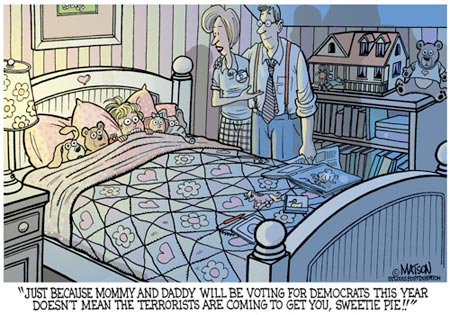
Whenever the topic of political cartoonists comes up, the question of political bias raises its smirking little head and I get comments about “How could you feature this flaming liberal terrorist sympathizer?” or “How could you showcase such a right wing fascist nut case?”.I’ll start out by saying that RJ Matson is unabashedly liberal, unabashedly a Bush basher and also unabashedly a Clinton basher. Either he likes Obama, or simply doesn’t find him a very interesting character to skewer.
Of course, any editorial cartoonist worth their salt will go after the people currently in power, they’re the ones stirring things up, after all, and the ones we need to be reminded to keep our eye on.
While politicians who do bad and/or stupid things make life difficult for the rest of us, they’re paydirt for political cartoonists and satirists.
Regardless of whether a particular cartoonist’s political leanings match our own, we should be able to look at them for their drawing style.
Matson, particularly in the past couple of years, has been working in a line and color style that owes more to the simplicity of classic newspaper comics than to the pen and ink crosshatch style usually associated with political cartoons.
In his older cartoons, he employs a style more in keeping with that tradition, but even there he is somewhat eccentric, and you’ll find stylistic references to other cartoonists like William Stout, Ron Cobb, New Yorker cartoonists like Jack Ziegler, even the historic political cartoons of Thomas Nast.
You’ll also references to 50’s EC horror comics, 60’s superhero comics and other pop culture visual landmarks.
It’s his current, open, line and color style that I particularly enjoy. Though he draws the cartoons so they will be effective either in black and white or in color (as you can see in the R.J. Matson archive on Cagle Cartoons), when reproduced in color, they have a nice feeling of direct drawing, and intentional coloring. It’s hard to put my finger on what it is about the style, but it just feels like Matson has utilized just the line work and just the color elements that he needs to nail his subject, with nothing included that doesn’t add to the effectiveness of the image; which is, of course, the essence of good cartooning.
Matson is the editorial cartoonist for the St. Louis Post-Dispatch, The New York Observer and Roll Call. In addition to his editorial cartoons, his gag cartoons and comic illustrations have appeared in many other publications, including The New Yorker, The Nation, The Daily News, The Washington Post, Rolling Stone and MAD Magazine. He has done cover art for the Capitol Steps comedy group and has illustrated several books.
Matson has been the Secretary of the National Cartoonists Society and is on the Board of Advisors of the Museum of Comic and Cartoon Art in New York.
His web site includes a selection of his illustrations, as well as an extensive archive of his cartoons. The latter can be viewed by publication, selected “Greatest Hits”, or in total. Greatest hits can give you a quick overview of some of his most popular cartoons, but if you like his work, the “All” choice makes for a nice mixture of national and local cartoons.
Categories:
-
Cecilia Beaux

I think of portrait painting as being exceptionally demanding.If you paint an image of a tree, and it doesn’t look accurately like a specific tree, no one will notice as long as it looks correct as a tree. Human beings, however, have an extraordinary facility (probably genetically hardwired) to recognize and understand the human form, and any deviation is easily detected.
Even more remarkable is our ability to discriminate between small variations in subtle features, and immediately recognize one face out of hundreds of thousands, even when that face is aged or young and overall proportions are radically different.
How much more difficult is it then, to not only portray an individual accurately, but to also do so with a artistic flair and mastery of painting technique on the order of that shown by Cecilia Beaux.
Beaux was one of the finest American portrait painters of the late 19th and early 20th Centuries, putting her in the company of many great artists. She fares well in the comparison, in my eyes showing second as an American painter of portraits only to John Singer Sargent (it’s probably just a personal preference that I like her work even more than that of Eakins).
By any measure, I would rank her as one of the major American artists, period.
Her beautifully subtle application of impressionistic color, masterful draftsmanship and confident freedom of brushwork easily put her on par with the best of the “American Impressionist” painters who were her contemporaries.
Like those painters, and the other master painters of the 19th Century, her star faded in the course of the systematic campaign to devalue representational art perpetrated by the post-war modernist art establishment in the late 20th Century.
The art world has been slowly coming to its senses in recent decades and artists like Beaux are once again reclaiming their rightful place in art history.
Beaux was born in Philadelphia. Her mother died shortly after her birth and her father returned to France, leaving her and her elder sister in the care of their maternal grandmother and aunts. Her family encouraged her interest in art, however, and Beaux started to earn her living as an artist at the age of 18.
At that point she was making lithographs, painting decorative paintings on china and small scale portraits, giving private art lessons and teaching at Miss Sanford’s School.
She became skilled as a scientific illustrator, and created fossil drawings for Edward Cope, a pioneering paleontologist and curator at the Academy of Natural Sciences in Philadelphia.
Beaux attended the Pennsylvania Academy of the Fine Arts, where her instructors likely included Thomas Eakins, and supplemented her studies with instruction from other Philadelphia painters, including William Sartain.
She eventually went to Europe and, as was common for American artists of her time, trained at the Académie Julian, where she studied with William-Adolphe Bouguereau, among others, as well as at the Académie Colarossi, and an art colony on the Atlantic coast in Brittany.
She returned to Philadelphia and quickly became one of the most prominent and sought-out portrait painters in the country, painting prominent members of Philadelphia society in an urbane style and on a large scale. She ennobled her sitters with dignified poses, impressive backgrounds and an overall approach that is sometimes referred to as “the grand manner”. This approach, as well as her admirable facility as a painter, invite further comparison to Sargent.
She returned to the Pennsylvania Academy of the Fine Arts as an instructor, becoming the Academy’s first female faculty member, and continued to teach there even after she moved to New York to be more available to the créme de la créme of society who were her patrons.
Her portraits included not only members of the monied class, but notable figures like Henry James and Edith Roosevelt. Eleanor Roosevelt honored her as “…the American woman who had made the greatest contribution to the culture of the world” in 1933.
The American painter William Merritt Chase called her “…not only the greatest living woman painter, but the greatest who has ever lived”.
She was the first American woman invited to display in the Hall of portraits in the Uffizi Gallery in Florence, and her work is in the collection of the Musée d’Orsay. Her paintings are also in major museums across the U.S.
A major exhibition, Cecilia Beaux, American Figure Painter, that started last fall at the High Museum of Art in Atlanta, and then travelled to the Tacoma Art Museum, is currently at the Pennsylvania Academy of the Fine Arts, here in Philadelphia, where she studied and taught, until April 13th, 2008.
I apologize for not giving you a heads-up about this show sooner, but I just got to see it myself yesterday. (Image above: Man with the Cat, portrait of Henry Sturgis Drinker)
It is a sweeping and large scale exhibition, and I came away with my opinion of the stature and ability of this superb painter not only reinforced, but heightened.
Categories:
-
Timothy Bush

Timothy Brush is a children’s book illustrator originally from Pennsylvania and, after living in Illinois, Ohio and Texas as well as Vienna, Rome and the Greek Islands, is now settled in New York City.Bush studied literature in college and is self-taught as an artist. He points out (jokingly, I hope) that he is “completely unqualified to do what I do”. Were he serious, I would have to disagree, of course, as I think he is admirably suited to his role as a children’s book illustrator; both because of his delightful illustrations, and because of the way he describes his school visits.
Not only does he take the time to talk to school classes about the process of illustration and the creation of books, he makes a point of showing them that the real world process of being an artist or writer isn’t a fantasy story, and that professional artists have difficulties, setbacks and disappointments, as well as successes, just as kids do. His talks usually include reading aloud and sessions with everyone drawing together.
Bush’s illustration style varies from simple, almost cartoon-like line and color drawings, to more elaborate and textured watercolor paintings.
You can view his online portfolio either by category, such as action, animals, landscape, etc, or by book title. The two viewing paths are only partially redundant, and there are images to be found in both areas that are not repeated in the other.
In referencing his illustrations by book title, my favorites are Grunt! The Primitive Cave Boy and Benjamin McFadden and the Robot Babysitter (image above). These are some of his more detailed illustrations. The former leans more toward adult book illustration, with realistic landscapes as a backdrop for cartoonish characters and nicely rendered prehistoric mammals. The latter is a visual treat, with lots of rich details, textures and fanciful designs. Robot Babysitter has just been optioned as a feature film by Walt Disney Pictures.
I was also struck by his illustrations for Janey and the Famous Author, in which he again blends somewhat stylized characters with realistic backgrounds, in particular nicely rendered watercolor landscapes and architecture. In these, Bush uses texture and lighting in the backgrounds to create an effective emotional tone for particular points in the story.
[Link via Ann Marshall (see my post on Ann Marshall)]
Categories:
-
The Face of Leonardo?

It has long been assumed that the red chalk drawing shown above is a self-portrait by Leonardo da Vinci.It certainly looks like what we expect or want the great Renaissance artist to look like, his penetrating deep-set eyes gazing out at us from distant past, weighted with the perhaps painful wisdom of great insight into the nature of the world and the ways of man; but its status as a self portrait has been called into question in recent years by prominent art historians; leading to the inevitable question of whether we really know what Leonardo looked like.
There are even those who claim, based on the assumption that the above image is a self-portrait, that similarities between key points in the facial structure show that the enigmatic face of the Mona Lisa could have been modeled on his own.
I don’t buy that one, but I have always accepted the above image as a self portrait, mainly because I recognize in it that “look” that I’ve seen in hundreds of self-portraits. It’s a look that I associate with a particular shift in mental state associated with drawing, something to do with where and how the eyes are focusing (see my post on Drawing on the Right Side of the Brain).
It’s a little hard to tell from this reproduction, and I was hard pressed to find a better one on the web. This is a very old, and very delicate, chalk drawing that is difficult to reproduce, and to see it more clearly you need to look for it in print, as on the back cover of Taschen’s excellent volume Leonardo da Vinci: Sketches and Drawings by Frank Zollner (part of a two volume set of his paintings and drawings – technically not in print in the US, but you can sometimes find it used or even discounted). There, and in other good reproductions, you can see the way the eyes are focused right at the viewer (or a mirror) and have that particular look of an artist deep in the mindset of concentrated drawing.
Still, scholars are saying the assumption that this is Leonardo is in question.
The only portrait of Leonardo for which we have reasonably reliable attribution is Verrocchio’s David, a statue for which Leonardo is believed to have posed as a boy of 15, but it’s difficult to draw immediate comparisons between that and the image of a man who is at least in his late 60’s.
This all leads to a fascinating four-minute presentation at this year’s TED (Technology Entertainment Design) Conference by Siegfried Woldhek, in which he does an astonishing analysis of Da Vinci’s drawings, systematically narrowing them down to possible candidates for self-portraits.
Siegfried Woldhek is a well known Dutch illustrator whose speciality is faces. He’s drawn over a thousand of them, mostly political and literary portraits and caricatures, for newspapers and magazines in Europe.
Drawing on his own experience (if you’ll excuse the expression) and the assumption that Leonardo, who drew everything around him with a passion bordering on obsession, must have created some self portraits (an assumption with which I agree), Woldhek searches through Leonardo’s drawings for evidence of a record of his own visage.
The resulting talk is a wonderfully condensed argument, establishing (without question in my mind) that we do indeed know what Leonardo da Vinci looked like, and from more than one image.
[Link to TED video via BoingBoing]
Categories:
-
Barrett Bailey

Barrett Bailey is an Alabama artist working in the classical realist tradition.Though you will find small still life paintings and an occasional landscape in his online galleries, Bailey is primarily a figure and portrait artist. The Paintings section of his site includes paintings in a range of sizes and degrees of finish, from small portrait sketches to larger scale figure works. For an idea of the scale of his more recent paintings, glance at the photograph of his studio on the Bio page.
Particularly appealing to me are his drawings, both figure drawings and portraits. These are primarily in graphite or charcoal, often on toned paper, and have a variety of surface textures.
Bailey’s site includes a video of the creation of one of his drawings in time lapse, condensing two an a half hours of drawing into less than two minutes. (I mentioned this video previously in my post about ArtDemonstrations.com.)
His bio section also includes a Bookshelf, with some of the books he recommends on figure drawing, portrait painting and related subjects.
Barrett exhibits in Alabama and New York, where he studied at the New York Academy of Art. He in an instructor at Huntingdon College and teaches private Portrait Drawing Classes in Montgomery.
Categories:
-
Marco Sassone

I have to say that I don’t normally respond well to paintings in which representational imagery has been “pushed” stylistically to the point where it borders on being non-representational. Contemporary artists often lose me at that juncture. There seems to be a point where it becomes boring for me, and I seldom follow artists who work in that direction.Marcon Sassone’s work, however, grabbed my attention and appealed to me right off, even though it fits that description. Sassone’s brusque brushstrokes threaten to break up the representational image, as if it were on the verge of dissolution, but he holds back just enough, and includes enough elements of visual interest in his paintings, that they work both as representations of real scenes and severe abstractions from them (all art being “abstract” in the strict sense of that word).
His urban landscapes, in particular, have a feeling of vibration and almost random energy, within which they still form palpable images of real places.
Sassone was born in Tuscany, Italy, studied at the Instituto Galilei and later with Silvio Loffredo, a professor of art at the Academia i Florence.
He later emigrated to California, though a number of his paintings are from a series of views of Venice. He currently works in Toronto and Florence, and exhibits in the U.S. and Europe.
There is currently an Exhibition of his work at the Odon Wagner Gallery in Toronto, that features a number of his views of that city. It runs from April 4 to April 26, 2008.
The images on the Wagner Gallery site are somewhat larger than those on Sassone’s own site, giving you a better feeling for the texture and surface character of his work.
[Link via Art Knowledge News]
Categories:




Charley’s Picks
Bookshop.org
(Bookshop.org affilliate links; sales benefit independent bookshop owners; I get a small percentage to help support my work on Lines and Colors)

John Singer Sargent: Watercolors


Urban Sketching: Understanding Perspective



Charley’s Picks
Amazon
(Amazon.com affiliate links; sales go to a larger yacht for Jeff Bezos; but I get a small percentage to help support my work on Lines and Colors)
John Singer Sargent: Watercolors
Urban Sketching: Understanding Perspective