


Categories
- 3d CGI
- Amusements
- Animation
- Anime & Manga
- Art Materials
- Art Videos
- Blogroll
- Cartoons
- Color
- Comics
- Concept & Visual Dev.
- Creativity
- Digital Art
- Digital Painting
- Displaying Art on the Web
- Drawing
- Eye Candy for Today
- Gallery and Museum Art
- High-res Art Images
- Illustration
- Motion Graphics & Flash
- Museums
- Online Museums
- Outsider Art
- Painting
- Painting a Day
- Paleo Art
- Pastel, Conté & Chalk
- Pen & Ink
- Prints and Printmaking
- Reviews
- Sc-fi and Fantasy
- Sculpture & Dimensional
- Site Comments
- Sketching
- Storyboards
- Tools and Techniques
- Uncategorized
- Vector Art
- Videos & Podcasts
- Vision and Optics
- Watercolor and Gouache
- Webcomics
Archives
- April 2026
- March 2026
- February 2026
- January 2026
- December 2025
- November 2025
- October 2025
- September 2025
- August 2025
- July 2025
- June 2025
- May 2025
- January 2025
- December 2024
- November 2024
- October 2024
- September 2024
- August 2024
- June 2024
- April 2024
- March 2024
- February 2024
- January 2024
- December 2023
- November 2023
- October 2023
- September 2023
- August 2023
- July 2023
- May 2023
- April 2023
- March 2023
- February 2023
- January 2023
- December 2022
- November 2022
- September 2022
- August 2022
- July 2022
- June 2022
- May 2022
- April 2022
- March 2022
- February 2022
- January 2022
- December 2021
- November 2021
- October 2021
- September 2021
- August 2021
- July 2021
- June 2021
- May 2021
- April 2021
- March 2021
- February 2021
- January 2021
- December 2020
- November 2020
- October 2020
- September 2020
- August 2020
- July 2020
- June 2020
- May 2020
- April 2020
- March 2020
- February 2020
- January 2020
- December 2019
- November 2019
- October 2019
- September 2019
- August 2019
- July 2019
- June 2019
- May 2019
- April 2019
- March 2019
- February 2019
- January 2019
- December 2018
- November 2018
- October 2018
- September 2018
- August 2018
- July 2018
- June 2018
- May 2018
- April 2018
- March 2018
- February 2018
- January 2018
- December 2017
- November 2017
- October 2017
- September 2017
- August 2017
- July 2017
- June 2017
- May 2017
- April 2017
- March 2017
- February 2017
- January 2017
- December 2016
- November 2016
- October 2016
- September 2016
- August 2016
- July 2016
- June 2016
- May 2016
- April 2016
- March 2016
- February 2016
- January 2016
- December 2015
- November 2015
- October 2015
- September 2015
- August 2015
- July 2015
- June 2015
- May 2015
- April 2015
- March 2015
- February 2015
- January 2015
- December 2014
- November 2014
- October 2014
- September 2014
- August 2014
- July 2014
- June 2014
- May 2014
- April 2014
- March 2014
- February 2014
- January 2014
- December 2013
- November 2013
- October 2013
- September 2013
- August 2013
- July 2013
- June 2013
- May 2013
- April 2013
- March 2013
- February 2013
- January 2013
- December 2012
- November 2012
- October 2012
- September 2012
- August 2012
- July 2012
- June 2012
- May 2012
- April 2012
- March 2012
- February 2012
- January 2012
- December 2011
- November 2011
- October 2011
- September 2011
- August 2011
- July 2011
- June 2011
- May 2011
- April 2011
- March 2011
- February 2011
- January 2011
- December 2010
- November 2010
- October 2010
- September 2010
- August 2010
- July 2010
- June 2010
- May 2010
- April 2010
- March 2010
- February 2010
- January 2010
- December 2009
- November 2009
- October 2009
- September 2009
- August 2009
- July 2009
- June 2009
- May 2009
- April 2009
- March 2009
- February 2009
- January 2009
- December 2008
- November 2008
- October 2008
- September 2008
- August 2008
- July 2008
- June 2008
- May 2008
- April 2008
- March 2008
- February 2008
- January 2008
- December 2007
- November 2007
- October 2007
- September 2007
- August 2007
- July 2007
- June 2007
- May 2007
- April 2007
- March 2007
- February 2007
- January 2007
- December 2006
- November 2006
- October 2006
- September 2006
- August 2006
- July 2006
- June 2006
- May 2006
- April 2006
- March 2006
- February 2006
- January 2006
- December 2005
- November 2005
- October 2005
- September 2005
- August 2005
Relevant Blogs
Art, Painting & Sketch
- Gurney Journey
- Underpaintings
- Art and Influence
- Painting Perceptions
- Oil Painters of America
- Vasari Paint POV
- Flying Fox
- Urban Sketchers
- Bento (Smithsonian)
- Art Inconnu
- The Hidden Place
- Still Life
- Making a Mark
- The Art of the Landscape
- Exploring Color & Creativity
- Art Contrarian
- Artist A Day
- beinArt Surreal Art Collective
- Eye Level
- David Dunlop
- p.i.g.m.e.n.t.i.u.m
- CultureGrrl
- Joaquín Sorolla blog
- Artists in Pastel
“Painting a Day”
- A Painting a Day (Keiser)
- On Painting (Keiser)
- Julian Merrow-Smith
- Karen Jurick
- Jeffrey Hayes
- Carol Marine
- Abbey Ryan
- Daily Paintworks
Other Painting Blogs
- Virtual Gouache Land
- Neil Hollingsworth
- Marc Hanson
- Kevin Menck
- Marc Dalessio
- Larry Seiler
- Stapleton Kearns
- Colin Page
- Roos Schuring
- Hans Versfelt
- Titus Meeuws
- Régis Pettinari
- René Plein Air
- Belinda Del Pesco
- Robin Weiss
- Nathan Fowkes (Land Sketch)
- William Wray
- Frank Serrano
- Stephen Magsig
- Michael Chesley Johnson
- Twice a Week
- Sarah Wimperis
- Rob Adams
- Michael Cole Manley
- The Dirty Palette Club
- Mike Manley’s Draw!
Gallery Art & Illustration mix
Illustration
- Howard Pyle
- 100 Years of Illustration
- BibliOdyssey
- Illustration Art
- Today’s Inspiration
- Illustration Mundo
- Little Chimp Society
- Danny Gregory
- R D (John Martz
- Illustration Friday blog
- Monster Brains
- Illustrators & Illustrations (RU)
- Elwood H. Smith
- DaniDraws.com
- Designers Who Blog
- iSpot Blog
Sci-Fi & Fantasy
Illustration & Comics
Comics & Cartoons
- Comics Beat
- Robot 6
- Newsarama Blog
- Comic Vine
- Comics Alliance
- Forbidden Planet Int.
- Paolo Rivera
- Bolt City
- Flight
- Scott McCloud
- The Comics Journal
- Comixpedia
- Funnybook Babylon
- James Baker
- Middleton’s Sketchbook
- Boneville
- The Hotel Fred
- Paul Rivoche
- Daily Cartoonist
- Mad About Cartoons (William Wray)
- Digital Strips
Illustration & Concept
Animation & Concept
- Cartoon Brew
- Animation Blog
- Cold Hard Flash
- Concept Art World
- The CAB
- FY Concept Art
- Concept Ships
- Concept Robots
- John Nevarez
- Armand Serrano
- Marcos Mateu-Mestre
- all kinds of stuff (Kricfalusi)
- Yacin the faun (Man Arenas)
- Kelsey Mann
- Cre8tivemarks Blog
- Ice-Cream Monster Toon Cafe
- AAU Character & Creature Design
- AAU Animation Notes
- Articles and Texticles
Paleo & Scientific
Tools & Techniques
Other
Lists of Art Blogs
Art Image Resource Links
Historic Art Images
- Wikimedia Commons: Paintings
- Wikimedia Commons: Drawings
- The Athenaeum
- WikiArt (WikiPaintings)
- Google Art Project: Artists
- Google Art Project: Collections (Museums)
- ArtCyclopedia
- Web Gallery of Art
- Art Renewal Center
- Web Gallery of Impressionism
Auction Consolidation sites
Auction sites
- Sotheby’s
- Bonham’s
- Christies
- Heritage Auctions: Fine Art
- Heritage Auctions: Illustration
- Freeman’s Auctions
- Bukowskis
- Shannon’s
Image Search
Reverse Image Search (search by image)
- Tin Eye
- RevImg
- Google Image Search (camera icon)
- Bing Image Search (camera icon)
Promoting some friends and some clients of my website design business
- Twin Willows T’ai Chi studio in Wilmington DE. Taiji classes with Bryan Davis.
- Ray Hayward, Inspired Teacher of T’ai Chi ( Taiji ) in Minneapolis, Founder of Mindful Motion Tai Chi Academy
- OldHead Tattoo studio and Art Gallery in Wilmington DE. Tattoos and paintings by Bruce Gulick
- Sharon Domenico Art, pet portrait oil paintings
- Platinum Paperhanging, wallpaper hanging, Main Line and Philadelphia, PA
- Lisa Stone Design, interior designer, Main Line and Philadelphia, PA
- Studio12KPT, original art, prints, calendars and other custom printed items by Van Sickle & Rolleri
-
Zuda Comics (update)

When I first wrote about Zuda Comics back in July, DC Comics’ venture into creating an online comics community and developing a commercial line from it was barely more than a web page and a promise.In the intervening time, however, the promise has begun to fill out, and there is now a substantial presence, with some 20 or so webcomics running, and more competing for viewer votes to gain a slot in the roster.
Basically, anyone can submit a webcomic, registered site visitors can then vote on the comics. There is also a provision for leaving feedback on the postings of individual comics and a more general message board.
Those whose submissions are chosen to run as features are offered contracts for a certain period, over which they agree to produce a certain amount of material. Unlike a lot of webcomics, there is actual payment and the potential for royalties here, though not at the same scale as in traditional print comics lines.
I have to point out that I have not read their terms and agreements in detail, and those interested in submitting webcomics for consideration should, of course, carefully do so. There are three agreements listed in their FAQ, and submission instructions here. I would be particularly cautious in making sure you understand the rights being assigned and how that is applicable to your ownership of the material.
On the reading side, after more than 12 years(!) of crabbing about how monumentally clueless Marvel and DC have been about how comics can work on the web, I have to admit that Zuda, at least, is getting many things right.
First of all they seem to finally be aware that computer monitors are horizontal, not vertical like a comic book page, and have created a standard size horizontal format within which all of the comics are presented.
The way the comics are presented is also well beyond the usual clueless interface disasters the the big companies think are appropriate for presenting online comics (which are usually focused on preventing you from “stealing” the pages, and shoving ads in your face in the process).
The presentation of the Zuda webcomics is within a very nicely implemented Flash interface. (This is not a contradiction in terms as my previous rant may suggest, such things are actually possible!) I’m not sure who designed the interface, but someone who worked on it had a good grasp of interactive information design and it works very well.
You can advance through the pages of an individual comic with slide-show style arrow controls, supplemented with a pop-up bar of thumbnail images. The interface tells you what page you are on and indicates the total number of pages currently available for that comic. The entire navigation can be tucked away at will. The Flash module even remembers where you are in a story if you click away and return.
The comics can look slightly pixelated in the window at first. This is actually because they are being scaled down in Flash. The comics are posted in high-resolution and they can either be scaled with a zoom slider within the default window, or toggled to full screen mode. In full screen mode only the comic is visible against a black background, and even the navigation bar can be hidden, leaving just a full screen of high-resolution comic page. This is a wonderful feature and my hat’s off to the Zuda team for making this call and carrying it through with such aplomb.
Of the 20 or so comics currently available, there is some variety of subject, approach and level of ability. If you roll over the comic’s panel in the selection page you get a brief synopsis and creator credits, with more detail provided to the right on the comic’s dedicated page. I haven’t had a chance to read through all of them in detail but there are a couple of standouts.
Bayou (image above, top), written and illustrated by Jeremy Love and colored by Patrick Morgan, isn’t afraid to take on topics like depression-era race relations in the American South, mix them with actual character development and throw in characters from fiction like Br’er Rabbit. The story is well paced and nicely drawn, particularly in zoomed-in or full screen mode, where you can appreciate the use of coquille-board style crayon textures. As of this writing, Bayou is up to 47 pages and feels like it’s just gaining momentum.
High Moon (image above, bottom), written by David Gallaher, with art by Steve Ellis and lettering by Scott O Brown, is only up to 8 pages so it’s hard to judge the story, though it seems to suggest “High Plains Drifter Meets the Werewolf”, but the art by Ellis is just terrific. Again, use the zoom or full screen feature to see his expressive line work, shape-defining hatching, solid draftsmanship and emotionally effective use of color and texture.
These two alone are enough to keep me coming back to Zuda, but I have a feeling we’ll be seeing a lot more from this fledgling online comics publisher, and I hope this turns out to be a successful paradigm for the presentation of new comics stories and fresh talents.
Categories:
-
Leoartz Link Collector

Link Collector is just that, a well arranged collection of links to sites for illustrators, digital painters, concept artists, matte painters and comics artists.The illustrators are primarily science fiction and fantasy, and there is an emphasis on concept art and digital painting. The category labeled “Traditional and Sculpture” seems to refer to traditional media, as opposed to digital, within the fantasy, science fiction and concept art genres, rather than to traditional genres of art. There is little in the way of sculpture yet, but I assume that will take the form of dimensional works in the science fiction and fantasy vein, similar to what one might encounter in the Spectrum collections.
There is a section of Art Resources, with links to other major collections of similar art and illustration, and a growing blogroll. Unlike most blogrolls, which are essentially just lists of links, the listings here, like the listings in the other categories, are accompanied by a short, succinct description of the site and a representative slice of image or a logo, making them much more useful than non-annotated links.
The Link Collector was put together by Leonid Kozienko as part of his Leoartz site; which includes links to his portfolio of digital painting on CGPortfolio as well as his blog. The very brief bio on the CGPortfoio site lists Kozienko’s experience as concept design and illustration for videogames and film. Most of the pieces in the portfolio seem to be experiments and playful interpretations of images from films. The blog is in Russian, but the titles, interestingly enough, are in English; and the images, of course, are independent of language.
Link Collector is available in either English or Russian, and can be toggled between the two with a link at the top. The link I’ve given here is to the English version.
Note: I should give my customary warnings that Link Collector contains links to some NSFW material; and can be a major time sink. Have fun.
Categories:
-
Douglas Fryer
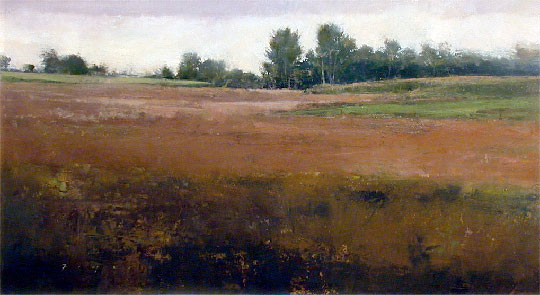 Born in Utah, raised in Illinois and California, Douglas Fryer returned to Utah to study, and went on to teach there and in other parts of the country in addition to establishing a career in illustration. His clients have included Warner Brothers, Harcourt Brace, TDK and Proctor and Gamble among others.
Fryer eventually gravitated toward gallery art, acquired his MFA in Painting and Drawing and transitioned into a career as a successful gallery artist.
His gallery work emphasizes landscape, though you can find engaging figure work as well. His landscapes have the wonderful characteristic of being simultaneously atmospheric and forthrightly declaring themselves to be paint on a surface. Bits of rough scumbling and textural strokes of color are often the essence of a given form; complexity is suggested, but turns to mist on closer inspection. His palette is often muted, but with an underlying feeling of the sensuality of the colors, as if they were whispered descriptions of the scene. Occasionally, it looks as though bright highlights have been laid on with little chunks of Rembrandt impasto.
Fryer now is a principle instructor at Brigham Young University. He doesn’t seem to have a personal site, and I haven’t turned up examples of his illustration, but his gallery work in visible online at the galleries in Arizona, New Mexico and Washington State where he is represented.
My thanks to David Malan, who studied with Fryer, for the suggestion and links. (See my post on Dave Malan.)
Categories:
-
Maggie Taylor

Maggie Taylor uses found materials, a flatbed scanner and Adobe Photoshop to create her wistful, atmospheric photo-collages. Her images have a feeling of 19th Century academic art and a consistency that puts me in mind of Max Ernst’s graphic collage novel Une Semaine du Bonté.Taylor has applied her image making sensibilities, which frequently feel theatrical, with characters presented in front of backgrounds that have been manipulated to appear like painted cloth back-drops, to an often illustrated literary work in her upcoming book Almost Alice (image above). When traditional illustrators take on Alice’s Adventures in Wonderland, I can’t help but compare them to John Tenniel and Arthur Rackham, a light against which few can shine, but Taylor’s soft, dreamy interpretation is different enough to be completely charming.
The flavor of her Alice is in keeping with her other work, which is suffused with Surrealist inspired dream nostalgia and visual non-sequiturs. On her web site you’ll find four galleries of images, the second of which is a preview of the Alice book, which is due out next year. There are also galleries of her earlier work and book illustration in the “extras” section. (I can’t give you convenient direct links because the site is in frames.)
You’ll also find links to her previous book titles, Adobe Photoshop Master Class: Maggie Taylor’s Landscape of Dreams, a “how it’s done” examination of her work by Amy Standen, which is complimented by a Maggie Taylor Landscape of Dreams 2008 Wall Calendar; and Solutions Beginning with A, a limited edition monograph by Lola Haskins and Maggie Taylor, which may only be available from the publisher. There is also mention of an exhibition catalog from the Museum of Photography in Seoul.
There is also an article about Taylor in the June 2007 issue of Adobe Magazine, which can be downloaded in PDF form from the Adobe Magazine web site.
[Link and suggestion courtesy of Daniel van Benthuysen]
Categories:
-
James Paick

James Paick is a concept artist for the gaming industry, working out of Los Angeles and is a graduate of Art Center College of Design.Beyond that I know little, as his blog and web site don’t offer much in the way of biographical info, client lists or project credits.
I do know, however, that there are enough of his images online to get a good feeling for his work, which is atmospheric, full of artfully suggested details and often employs a limited palette to focus attention to the important parts of a composition.
Paick appears to work primarily digitally, but there is a nice section of traditional media sketches on his web site. The largest section in his online gallery is the environments section of the entertainment gallery.
Paick has a sketchblog called scribble pad and is a contributor to the joint blog clockwork, along with Stephen Chang, Eric Chiang, Steve Chon and Eric Ryan. He also has a portfolio on CGSociety.
Categories:
-
Ilya Repin

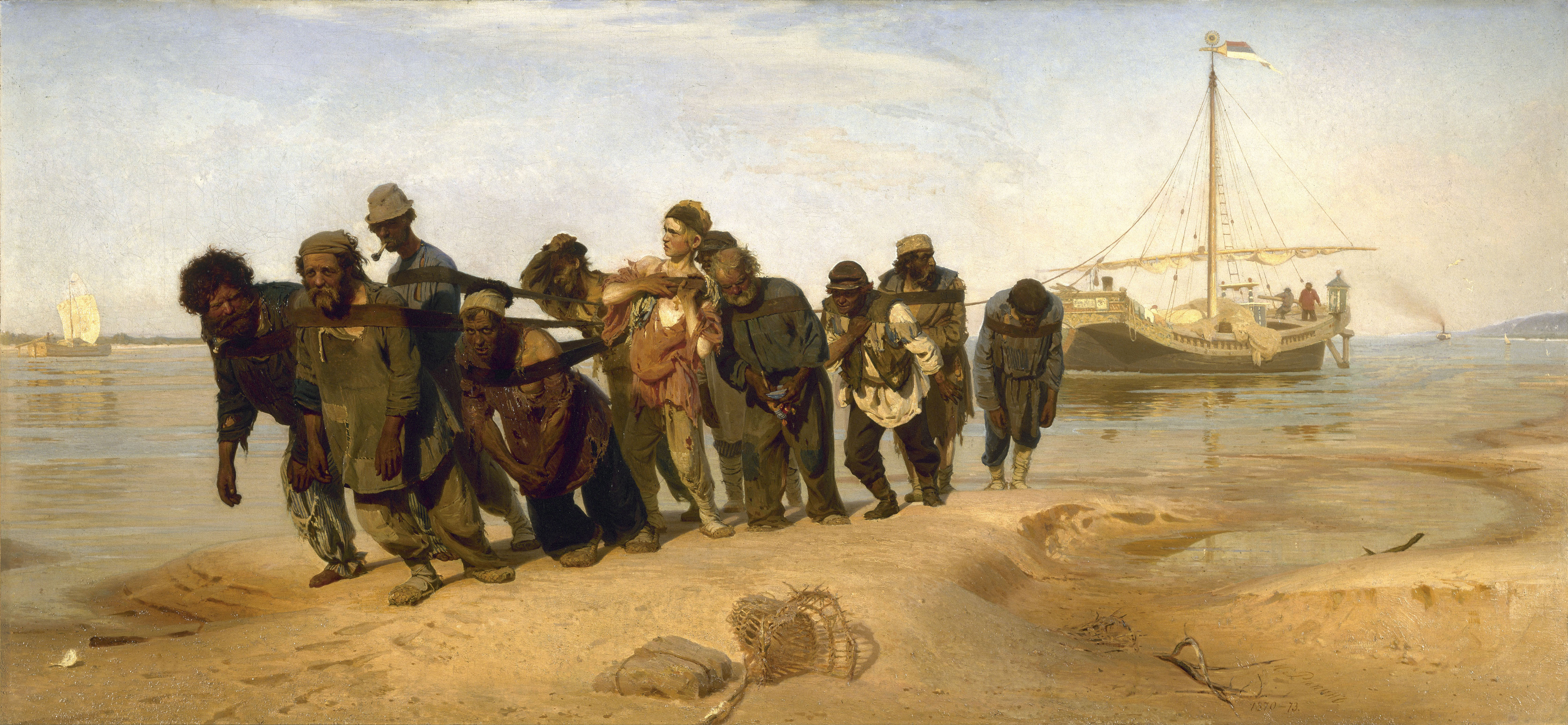
Ilya Repin was probably the foremost proponent of 19th Century realism in Russia. He studied at the Petersburgh Academy of Arts, and was by reports uncommonly talented from a young age.His image of Barge Haulers on the Volga (image above, with detail below, sometimes called “The Volga Boatmen”) was begun in his last year as a student (large image here).
He lived and worked in Paris for three years, returned to his home town in Russia and then moved to Moscow. He was a member of the group of Russian painters known as the Itinerants (or the Wanderers), who exhibited in traveling group exhibitions, along with Ivan Kramskoi, Ivan Shishkin and a number of other notable painters of the time. There is a short essay on Repin, Shishkin and Kramskoi by Vern Swanson on the Art Renewal Center.
Repin became head of a studio associated with the Petersburg Academy of arts and later served as the Academy’s director.
He painted landscapes, often combined with figures, still lifes, genre scenes and psychologically incisive portraits, including royalty and state occasions, but he is best known for his portrayal of peasants and subjects involving social commentary.
There is a semi-official web site maintained by the artist’s great great grandson, though one of the best online sources for images of Repin’s work is Wikipedia, which hosts a nice gallery of his paintings, many of them with hi-res versions (click to the individual image, then look for “full resolution version”).
Categories:




Charley’s Picks
Bookshop.org
(Bookshop.org affilliate links; sales benefit independent bookshop owners; I get a small percentage to help support my work on Lines and Colors)

John Singer Sargent: Watercolors


Urban Sketching: Understanding Perspective


Charley’s Picks
Amazon
(Amazon.com affiliate links; sales go to a larger yacht for Jeff Bezos; but I get a small percentage to help support my work on Lines and Colors)
John Singer Sargent: Watercolors
Urban Sketching: Understanding Perspective