


Categories
- 3d CGI
- Amusements
- Animation
- Anime & Manga
- Art Materials
- Art Videos
- Blogroll
- Cartoons
- Color
- Comics
- Concept & Visual Dev.
- Creativity
- Digital Art
- Digital Painting
- Displaying Art on the Web
- Drawing
- Eye Candy for Today
- Gallery and Museum Art
- High-res Art Images
- Illustration
- Motion Graphics & Flash
- Museums
- Online Museums
- Outsider Art
- Painting
- Painting a Day
- Paleo Art
- Pastel, Conté & Chalk
- Pen & Ink
- Prints and Printmaking
- Reviews
- Sc-fi and Fantasy
- Sculpture & Dimensional
- Site Comments
- Sketching
- Storyboards
- Tools and Techniques
- Uncategorized
- Vector Art
- Videos & Podcasts
- Vision and Optics
- Watercolor and Gouache
- Webcomics
Archives
- April 2026
- March 2026
- February 2026
- January 2026
- December 2025
- November 2025
- October 2025
- September 2025
- August 2025
- July 2025
- June 2025
- May 2025
- January 2025
- December 2024
- November 2024
- October 2024
- September 2024
- August 2024
- June 2024
- April 2024
- March 2024
- February 2024
- January 2024
- December 2023
- November 2023
- October 2023
- September 2023
- August 2023
- July 2023
- May 2023
- April 2023
- March 2023
- February 2023
- January 2023
- December 2022
- November 2022
- September 2022
- August 2022
- July 2022
- June 2022
- May 2022
- April 2022
- March 2022
- February 2022
- January 2022
- December 2021
- November 2021
- October 2021
- September 2021
- August 2021
- July 2021
- June 2021
- May 2021
- April 2021
- March 2021
- February 2021
- January 2021
- December 2020
- November 2020
- October 2020
- September 2020
- August 2020
- July 2020
- June 2020
- May 2020
- April 2020
- March 2020
- February 2020
- January 2020
- December 2019
- November 2019
- October 2019
- September 2019
- August 2019
- July 2019
- June 2019
- May 2019
- April 2019
- March 2019
- February 2019
- January 2019
- December 2018
- November 2018
- October 2018
- September 2018
- August 2018
- July 2018
- June 2018
- May 2018
- April 2018
- March 2018
- February 2018
- January 2018
- December 2017
- November 2017
- October 2017
- September 2017
- August 2017
- July 2017
- June 2017
- May 2017
- April 2017
- March 2017
- February 2017
- January 2017
- December 2016
- November 2016
- October 2016
- September 2016
- August 2016
- July 2016
- June 2016
- May 2016
- April 2016
- March 2016
- February 2016
- January 2016
- December 2015
- November 2015
- October 2015
- September 2015
- August 2015
- July 2015
- June 2015
- May 2015
- April 2015
- March 2015
- February 2015
- January 2015
- December 2014
- November 2014
- October 2014
- September 2014
- August 2014
- July 2014
- June 2014
- May 2014
- April 2014
- March 2014
- February 2014
- January 2014
- December 2013
- November 2013
- October 2013
- September 2013
- August 2013
- July 2013
- June 2013
- May 2013
- April 2013
- March 2013
- February 2013
- January 2013
- December 2012
- November 2012
- October 2012
- September 2012
- August 2012
- July 2012
- June 2012
- May 2012
- April 2012
- March 2012
- February 2012
- January 2012
- December 2011
- November 2011
- October 2011
- September 2011
- August 2011
- July 2011
- June 2011
- May 2011
- April 2011
- March 2011
- February 2011
- January 2011
- December 2010
- November 2010
- October 2010
- September 2010
- August 2010
- July 2010
- June 2010
- May 2010
- April 2010
- March 2010
- February 2010
- January 2010
- December 2009
- November 2009
- October 2009
- September 2009
- August 2009
- July 2009
- June 2009
- May 2009
- April 2009
- March 2009
- February 2009
- January 2009
- December 2008
- November 2008
- October 2008
- September 2008
- August 2008
- July 2008
- June 2008
- May 2008
- April 2008
- March 2008
- February 2008
- January 2008
- December 2007
- November 2007
- October 2007
- September 2007
- August 2007
- July 2007
- June 2007
- May 2007
- April 2007
- March 2007
- February 2007
- January 2007
- December 2006
- November 2006
- October 2006
- September 2006
- August 2006
- July 2006
- June 2006
- May 2006
- April 2006
- March 2006
- February 2006
- January 2006
- December 2005
- November 2005
- October 2005
- September 2005
- August 2005
Relevant Blogs
Art, Painting & Sketch
- Gurney Journey
- Underpaintings
- Art and Influence
- Painting Perceptions
- Oil Painters of America
- Vasari Paint POV
- Flying Fox
- Urban Sketchers
- Bento (Smithsonian)
- Art Inconnu
- The Hidden Place
- Still Life
- Making a Mark
- The Art of the Landscape
- Exploring Color & Creativity
- Art Contrarian
- Artist A Day
- beinArt Surreal Art Collective
- Eye Level
- David Dunlop
- p.i.g.m.e.n.t.i.u.m
- CultureGrrl
- Joaquín Sorolla blog
- Artists in Pastel
“Painting a Day”
- A Painting a Day (Keiser)
- On Painting (Keiser)
- Julian Merrow-Smith
- Karen Jurick
- Jeffrey Hayes
- Carol Marine
- Abbey Ryan
- Daily Paintworks
Other Painting Blogs
- Virtual Gouache Land
- Neil Hollingsworth
- Marc Hanson
- Kevin Menck
- Marc Dalessio
- Larry Seiler
- Stapleton Kearns
- Colin Page
- Roos Schuring
- Hans Versfelt
- Titus Meeuws
- Régis Pettinari
- René Plein Air
- Belinda Del Pesco
- Robin Weiss
- Nathan Fowkes (Land Sketch)
- William Wray
- Frank Serrano
- Stephen Magsig
- Michael Chesley Johnson
- Twice a Week
- Sarah Wimperis
- Rob Adams
- Michael Cole Manley
- The Dirty Palette Club
- Mike Manley’s Draw!
Gallery Art & Illustration mix
Illustration
- Howard Pyle
- 100 Years of Illustration
- BibliOdyssey
- Illustration Art
- Today’s Inspiration
- Illustration Mundo
- Little Chimp Society
- Danny Gregory
- R D (John Martz
- Illustration Friday blog
- Monster Brains
- Illustrators & Illustrations (RU)
- Elwood H. Smith
- DaniDraws.com
- Designers Who Blog
- iSpot Blog
Sci-Fi & Fantasy
Illustration & Comics
Comics & Cartoons
- Comics Beat
- Robot 6
- Newsarama Blog
- Comic Vine
- Comics Alliance
- Forbidden Planet Int.
- Paolo Rivera
- Bolt City
- Flight
- Scott McCloud
- The Comics Journal
- Comixpedia
- Funnybook Babylon
- James Baker
- Middleton’s Sketchbook
- Boneville
- The Hotel Fred
- Paul Rivoche
- Daily Cartoonist
- Mad About Cartoons (William Wray)
- Digital Strips
Illustration & Concept
Animation & Concept
- Cartoon Brew
- Animation Blog
- Cold Hard Flash
- Concept Art World
- The CAB
- FY Concept Art
- Concept Ships
- Concept Robots
- John Nevarez
- Armand Serrano
- Marcos Mateu-Mestre
- all kinds of stuff (Kricfalusi)
- Yacin the faun (Man Arenas)
- Kelsey Mann
- Cre8tivemarks Blog
- Ice-Cream Monster Toon Cafe
- AAU Character & Creature Design
- AAU Animation Notes
- Articles and Texticles
Paleo & Scientific
Tools & Techniques
Other
Lists of Art Blogs
Art Image Resource Links
Historic Art Images
- Wikimedia Commons: Paintings
- Wikimedia Commons: Drawings
- The Athenaeum
- WikiArt (WikiPaintings)
- Google Art Project: Artists
- Google Art Project: Collections (Museums)
- ArtCyclopedia
- Web Gallery of Art
- Art Renewal Center
- Web Gallery of Impressionism
Auction Consolidation sites
Auction sites
- Sotheby’s
- Bonham’s
- Christies
- Heritage Auctions: Fine Art
- Heritage Auctions: Illustration
- Freeman’s Auctions
- Bukowskis
- Shannon’s
Image Search
Reverse Image Search (search by image)
- Tin Eye
- RevImg
- Google Image Search (camera icon)
- Bing Image Search (camera icon)
Promoting some friends and some clients of my website design business
- Twin Willows T’ai Chi studio in Wilmington DE. Taiji classes with Bryan Davis.
- Ray Hayward, Inspired Teacher of T’ai Chi ( Taiji ) in Minneapolis, Founder of Mindful Motion Tai Chi Academy
- OldHead Tattoo studio and Art Gallery in Wilmington DE. Tattoos and paintings by Bruce Gulick
- Sharon Domenico Art, pet portrait oil paintings
- Platinum Paperhanging, wallpaper hanging, Main Line and Philadelphia, PA
- Lisa Stone Design, interior designer, Main Line and Philadelphia, PA
- Studio12KPT, original art, prints, calendars and other custom printed items by Van Sickle & Rolleri
-
Edward Hopper
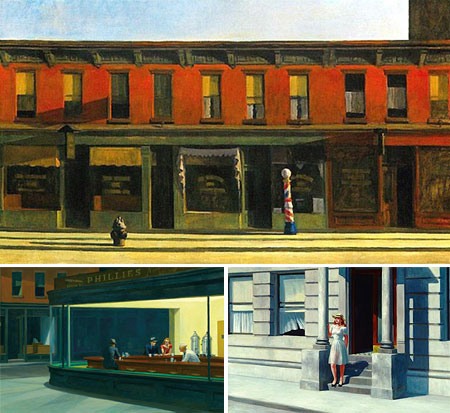
Edward Hopper found stillness in motion and geometry in light. His simultaneously strong and subtle images of houses, streets and intimate rooms invite us to quiet our minds and open our eyes to the beauty of the commonplace as revealed by shadow, sun and the warmth or artificial lights.Hopper takes us down city streets, past rows of shops waiting to open, into cafes and diners, past intimate scenes on porches and stoops and lets us peer voyeuristically into windows. He doesn’t just leave us in front of his images, he guides our eye, saying look, look how the shadows show you this form, look how the sunlight makes this space reveal itself, look at the inside and the outside of this architectural form at the same time. Look.
Hopper, in addition to his fascination with shadow and light, had a fascination with architecture, not in the sense of advanced designs, history or monuments, but in the streets and houses and buildings we encounter every day. His fascination is in the corner of a storefront, the edge of an office building, the porch of a house or the corner of a room.
Hopper takes particular delight in showing us windows, all manner of windows, from the inside looking out, whether from quiet cafes or intimate bedrooms, or from the outside looking in, particularly in night scenes where the inside reveals itself more brightly in the surrounding darkness, or even in his famous Nighthawks diner scene where outside and inside are separated more by the presence of light than by the physical barrier of glass.
Hopper’s technique is deceptively simple, There is no great flourish of painterly display, or dazzling realist detail, he paints directly, almost brusquely, with little regard for anything but conveying the scene and, in particular, the geometry of the scene, all of the planes and angles and intersecting forms. Even his images of people are geometrically composed. A friend of mine recently remarked that Hopper paints his people exactly the same way he paints his architecture.
This becomes particularly apparent in an image like Summertime, in the collection of The Delaware Art Museum (above, lower right), in which the young woman almost appears to be part of the building, her red skin mirrored by the reds in the doorway, her white dress matching the facade of the building and its columns, and the translucent folds of which are echoes of the windblown curtains in the open window.
I think geometry is the key, whether Hopper ever thought of it that way or not, geometry, and his deep, vibrant colors, give his quiet paintings of unassuming scenes a remarkable strength.
Hopper started his career with a correspondence course with the Correspondence School of Illustrating in 1900. He later attended the New York School of Art, where he studied with William Merrit Chase, Robert Henri and Kenneth Hayes Miller. He supported himself for many years as an illustrator, but was not satisfied with that field and kept pursuing gallery representation unsuccessfully until the age of 40. Since then he has become one of the major figures of American art and his work has been the subject of major exhibitions at the Museum of Modern Art and the Whitney.
There is a terrific opportunity for those on the Boston, D.C. and Chicago areas to see major retrospective of Hopper’s work this year and next. The show, simply titled “Edward Hopper”, is at the Museum of Fine Arts, Boston, from now to August 19, 2007. It then moves to the National Gallery of Art in Washington D.C., where I hope to see it, for a run from September 16, 2007 to January 21, 2008, and finishes at the Art Institute of Chicago from February 16 to May 11, 2008.
The exhibit includes many of Hopper’s “greatest hits”, including Summertime, Chop Suey, Early Sunday Morning, New York Movie and Nighthawks.
The Museum of Fine Arts, Boston has a special feature devoted to the exhibit that includes an interactive tour of some of the works in the exhibition, though the images are small.
For a better overview of Hopper’s work on the web, try Bert Christensen’s Cyberspace Gallery, Art Renewal Center, or the other resources I’ve gathered for you below. Art Renewal probably has the largest reproductions, and perhaps the greatest number, as well as including some of Hopper’s etchings, but the color in their images of the paintings often look off to my eye. The reproductions in Bert Christensen’s Cyberspace Gallery are smaller, but their color is truer and he presents a nice selection.
Hopper, who struggled for years to sell a painting, is one of the most popular American artists and there are numerous reproductions and books of his work.
Categories:
-
Jules Bastien-Lepage
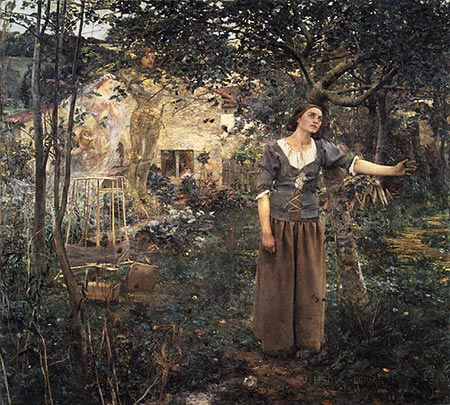
19th Century French painter Jules Bastien-Lepage had a short life. He first gained notice in the Salon as a painter of rural life, a theme to which he would return later in his career. His most noted painting during his lifetime was perhaps a portrait of Sarah Bernhardt, which won him the cross of the Leigon of Honor.Today, however, those who have an appreciation for late 19th Century Academic painting are most likely to focus on his image of “Joan of Arc” (sometimes called “Joan of Arc Hearing Voices” – image above), the original of which is in the Metropolitan Museum of Art in New York.
The painting is quite large at almost nine feet to a side (100×110 inches or 254x279cm), and is striking when you stand in front of it. Bastien has chosen to bathe the young Joan’s moment of revelation from the voices in a soft, even light, making the highest contrast that of her bare arms and upturned face, and the light wall of her parents’ cottage, which serves as a stage against which the tableaux of the three saints can be seen.
The images of the saints are subtle and you only see them after fully registering Joan’s figure, which is painted with a palpable sense of realism. The rest of the scene emerges from the tangle of fruit tree branches and saplings. The effect is that the painting unfolds for you in layers, transitioning gradually from a peasant girl in a garden to the transcendent moment of inspiration for the national heroine of France.
Bastien’s command of rural subjects came from his upbringing in a small village. He used an apple tree in his grandfather’s garden for the tree in in “Joan of Arc”, and based the cottage on his family’s barn. Jeff Patterson has written an interesting article on this painting.
Bastien shows a similar command of the subtleties of diffuse lighting and tonal contrast in his other work, as in this painting of a young peasant girl.
He based his realism on an appreciation for nature as it is, and his painting and philosophy had an effect on the plein air painters of the late 19th Century, including the American painter J. Alden Weir and Spanish realist Joaquin Sorolla y Bastida. It’s also interesting to note that Bastien himself reportedly was particularly inspired by Jan van Eyck.
The artist’s career was hampered by ill-health and his life was cut short in 1884 at the age of 36.
Categories:
-
Tim Bower
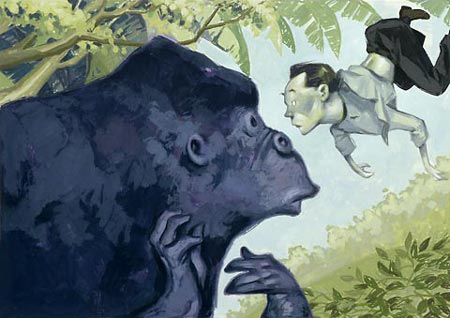
Tim Bower is another of those illustrators whose work I’ve seen and admired, but about whom I can find little background information.The fact that he is represented by Richard Solomon is a clue that he is in the top echelon of currently working illustrators, but even on Solomon’s site, he is lacking the customary bio.
I do know that he is based in New York, has received recognition from the Society of Illustrators, American Illustration magazine, Communication Arts and the American Institute of Graphic Arts, and his clients include The New York Times, The Atlantic Monthly, Rolling Stone, Entertainment Weekly and Sports Illustrated.
His own site is also lacking in a bio, but fortunately does provide a nice selection of his work, including a number of smaller vignette style illustrations and a selection of his black and white work.
Bower has achieved a solid balance between representational and stylized images, giving a feeling of realism where necessary, but never letting you forget that you’re looking at a painting. His color palette is often muted, at times leaning toward monochromatic themes or interesting impressions of duotone.
There is also a gallery of his work on Workbook. It’s interesting to note that Workbook now has a great feature that lets you zoom way in on the images.
Categories:
-
Joseph Paquet

Sitting astride the Arno river, like a ruby on a blue ribbon, Firenze (Florence to us English speakers) is one if Italy’s most beautiful cities. (How the British got “Florence” out of “Firenze”, I don’t know.) Firenze, (OK, OK, I’ll call it Florence) is also the official sister city of Philadelphia, here in the U.S., a fact of which I would wager most residents of both cities are unaware.Florence was the center of the italian Renaissance and has been painted by some of the greatest artists in history, but I was particularly intrigued to see it painted by a contemporary American realist like Joseph Paquet (images above top left and right). These are part of a one-artist show at the Coleman Fine Art gallery in Charleston, South Carolina called “Mostly Florence“, that runs from now to June 2nd, 2007.
Paquet works in a loose, open style, not quite impressionist, but full of lively brushstrokes and rich color. He also has a solid ability to see and use value contrasts, a characteristic of his work that particularly shines in his paintings of Florence, with its wonderful architecture brought into high relief in the warm sun of the Tuscan plains. I was immediately reminded of my own time in Florence, more strongly than I would be by viewing photographs. I particularly enjoy his night scenes, both of intimate street corners and the sweeping vistas looking out over the Duomo from the Piazzalle Michelangelo and other vantage points in the hills “Alta Arno”.
Those same qualities of Paquet’s work also stand out in his painting of “Industrial Landscape” here in the U.S., as well as his more traditional landscapes, which are also highly evocative of time and place. The work on Paquet’s own site is divided into those categories, along with “Interiors and Portraits” and “Seascapes and Marine”, but within the broader classifications of work that is currently available or achived.
Paquet studied at the School of Visual Arts in New York, and his work includes plein air landscapes from that city as well as from his native Minnesota and from his travels. He also studied with John Osborne, who he credits with enabling him to see beyond the scene before him, particularly when creating a studio work based on sketches painted on location, and utilize his own artistic judgement in creating his compositions.
Paquet’s work has been featured in the Washington Post Sunday Magazine, the Classical Realism Journal, The Artist Magazine and American Artist.
Categories:
-
Syd Mead (update)
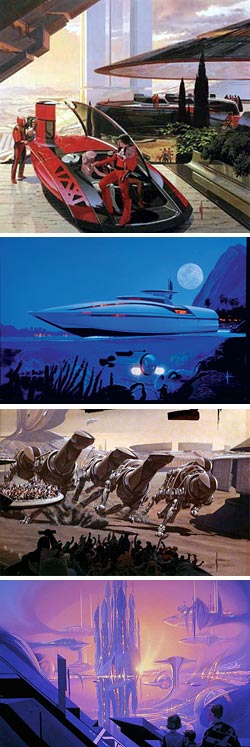 When I first wrote about futurist, concept artist and industrial designer extraordinaire Syd Mead back in November of 2005, I expressed my disappointment with the lack of a gallery on his official site. Unfortunately, that hasn’t changed.
In the intervening year and a half, the official site has changed little, except to add an annoyingly slow Flash introduction; and still, to my utter disbelief, offers no real gallery of Syd Mead’s terrific art, and therefore provides no reason why someone should care about who Syd Mead is, or why they should be on the site unless they already know who Syd mead is. (What are they thinking?)
The terrific books that have been published over the years as collections of his work are unfortunately out of print, and the official site says there are no plans to republish any of them (making their lack of an online gallery even more inexplicable). You may be able to find some of them used if you search Amazon or eBay.
The Bookstore on the site, though it no longer functions as a store, does contain some small images of work from the books. If you click on any of the book titles, it comes up in a little pop-up window. The rest of the site has some scattered small images from Christmas cards and snowboards, but offers no real opportunity to view his paintings in a meaningful way.
Fortunately, there are other resources on the web that I can point you to to give you some idea of how terrific his work is, and give you at least a hint as to his importance in the ranks of influential concept artists and futurist illustrators.
There is a reasonably good gallery on the Gnomon Workshop site, and there are unofficial gallery sites here and here. You can also get an idea from doing a Google image search. You can find an illustrated article on Promotex and an interview on Anime.com.
Mead set the standards for modern futuristic design and influenced two generations of concept artists and designers.
Once you’ve gotten a taste of his groundbreaking visionary art, you may have an idea of why the one significant recent addition to the official site is of interest. A new documentary had become available about the work and influence of Syd Mead, as told in interviews with Mead and a number of the people who worked closely with him on some of his most influential projects. The film is called VISUAL FUTURIST: The Art & Life of Syd Mead and is available through the official site.
Also, the instructional DVDs that were offered by the Gnomon Workshop, where Mead has been an instructor, are still available through both the Syd Mead site and the Gnomon site.
Categories:
-
John Avon
 (Image above © Wizards of the Coast)
English fantasy artist John Avon is one of many in his field who have made the transition from traditional media like oil and acrylic to digital painting. In the section of his site devoted to biography and technique, he goes into more detail than most about the reasons for his choice and the advantages he sees in painting digitally, particularly in a field based on creating complex paintings on deadline.
In addition he goes into some detail on his basic working process, and also mentions some of his favorite artists in the field, including Todd Lockwood, Kev Walker, Daren Bader, Mark Zug and Donato Giancola, concept artist Anthony Waters, and comic book artists Glen Fabry and Carl Critchlow.
Avon counts Wizards of the Coast as his largest client and has been doing illustrations for their fantasy themed Magic: The Gathering card based game for a number of years. The galleries on his site showcase his paintings for the project going back 12 years. The paintings are arranged by year, which also organizes them according to the game module for which they were created.
Avon uses the digital painting tools in Photoshop and Painter to paint richly detailed, highly rendered images of environments, monsters and magical objects, imbuing each with atmosphere, color and drama. He very often utilizes the technique of casting an image in an almost monochromatic light, with brilliant accents of another color to create contrast and focus.
His landscapes, structures and objects are wonderfully imaginative and, even within the fantasy theme of the Magic: The Gathering projects, often take on an other-worldly science fiction feeling; suggesting that magical realms might resemble distant planets, and perhaps vice-versa.
Categories:




Charley’s Picks
Bookshop.org
(Bookshop.org affilliate links; sales benefit independent bookshop owners; I get a small percentage to help support my work on Lines and Colors)

John Singer Sargent: Watercolors


Urban Sketching: Understanding Perspective


Charley’s Picks
Amazon
(Amazon.com affiliate links; sales go to a larger yacht for Jeff Bezos; but I get a small percentage to help support my work on Lines and Colors)
John Singer Sargent: Watercolors
Urban Sketching: Understanding Perspective