


Categories
- 3d CGI
- Amusements
- Animation
- Anime & Manga
- Art Materials
- Art Videos
- Blogroll
- Cartoons
- Color
- Comics
- Concept & Visual Dev.
- Creativity
- Digital Art
- Digital Painting
- Displaying Art on the Web
- Drawing
- Eye Candy for Today
- Gallery and Museum Art
- High-res Art Images
- Illustration
- Motion Graphics & Flash
- Museums
- Online Museums
- Outsider Art
- Painting
- Painting a Day
- Paleo Art
- Pastel, Conté & Chalk
- Pen & Ink
- Prints and Printmaking
- Reviews
- Sc-fi and Fantasy
- Sculpture & Dimensional
- Site Comments
- Sketching
- Storyboards
- Tools and Techniques
- Uncategorized
- Vector Art
- Videos & Podcasts
- Vision and Optics
- Watercolor and Gouache
- Webcomics
Archives
- May 2026
- April 2026
- March 2026
- February 2026
- January 2026
- December 2025
- November 2025
- October 2025
- September 2025
- August 2025
- July 2025
- June 2025
- May 2025
- January 2025
- December 2024
- November 2024
- October 2024
- September 2024
- August 2024
- June 2024
- April 2024
- March 2024
- February 2024
- January 2024
- December 2023
- November 2023
- October 2023
- September 2023
- August 2023
- July 2023
- May 2023
- April 2023
- March 2023
- February 2023
- January 2023
- December 2022
- November 2022
- September 2022
- August 2022
- July 2022
- June 2022
- May 2022
- April 2022
- March 2022
- February 2022
- January 2022
- December 2021
- November 2021
- October 2021
- September 2021
- August 2021
- July 2021
- June 2021
- May 2021
- April 2021
- March 2021
- February 2021
- January 2021
- December 2020
- November 2020
- October 2020
- September 2020
- August 2020
- July 2020
- June 2020
- May 2020
- April 2020
- March 2020
- February 2020
- January 2020
- December 2019
- November 2019
- October 2019
- September 2019
- August 2019
- July 2019
- June 2019
- May 2019
- April 2019
- March 2019
- February 2019
- January 2019
- December 2018
- November 2018
- October 2018
- September 2018
- August 2018
- July 2018
- June 2018
- May 2018
- April 2018
- March 2018
- February 2018
- January 2018
- December 2017
- November 2017
- October 2017
- September 2017
- August 2017
- July 2017
- June 2017
- May 2017
- April 2017
- March 2017
- February 2017
- January 2017
- December 2016
- November 2016
- October 2016
- September 2016
- August 2016
- July 2016
- June 2016
- May 2016
- April 2016
- March 2016
- February 2016
- January 2016
- December 2015
- November 2015
- October 2015
- September 2015
- August 2015
- July 2015
- June 2015
- May 2015
- April 2015
- March 2015
- February 2015
- January 2015
- December 2014
- November 2014
- October 2014
- September 2014
- August 2014
- July 2014
- June 2014
- May 2014
- April 2014
- March 2014
- February 2014
- January 2014
- December 2013
- November 2013
- October 2013
- September 2013
- August 2013
- July 2013
- June 2013
- May 2013
- April 2013
- March 2013
- February 2013
- January 2013
- December 2012
- November 2012
- October 2012
- September 2012
- August 2012
- July 2012
- June 2012
- May 2012
- April 2012
- March 2012
- February 2012
- January 2012
- December 2011
- November 2011
- October 2011
- September 2011
- August 2011
- July 2011
- June 2011
- May 2011
- April 2011
- March 2011
- February 2011
- January 2011
- December 2010
- November 2010
- October 2010
- September 2010
- August 2010
- July 2010
- June 2010
- May 2010
- April 2010
- March 2010
- February 2010
- January 2010
- December 2009
- November 2009
- October 2009
- September 2009
- August 2009
- July 2009
- June 2009
- May 2009
- April 2009
- March 2009
- February 2009
- January 2009
- December 2008
- November 2008
- October 2008
- September 2008
- August 2008
- July 2008
- June 2008
- May 2008
- April 2008
- March 2008
- February 2008
- January 2008
- December 2007
- November 2007
- October 2007
- September 2007
- August 2007
- July 2007
- June 2007
- May 2007
- April 2007
- March 2007
- February 2007
- January 2007
- December 2006
- November 2006
- October 2006
- September 2006
- August 2006
- July 2006
- June 2006
- May 2006
- April 2006
- March 2006
- February 2006
- January 2006
- December 2005
- November 2005
- October 2005
- September 2005
- August 2005
Relevant Blogs
Art, Painting & Sketch
- Gurney Journey
- Underpaintings
- Art and Influence
- Painting Perceptions
- Oil Painters of America
- Vasari Paint POV
- Flying Fox
- Urban Sketchers
- Bento (Smithsonian)
- Art Inconnu
- The Hidden Place
- Still Life
- Making a Mark
- The Art of the Landscape
- Exploring Color & Creativity
- Art Contrarian
- Artist A Day
- beinArt Surreal Art Collective
- Eye Level
- David Dunlop
- p.i.g.m.e.n.t.i.u.m
- CultureGrrl
- Joaquín Sorolla blog
- Artists in Pastel
“Painting a Day”
- A Painting a Day (Keiser)
- On Painting (Keiser)
- Julian Merrow-Smith
- Karen Jurick
- Jeffrey Hayes
- Carol Marine
- Abbey Ryan
- Daily Paintworks
Other Painting Blogs
- Virtual Gouache Land
- Neil Hollingsworth
- Marc Hanson
- Kevin Menck
- Marc Dalessio
- Larry Seiler
- Stapleton Kearns
- Colin Page
- Roos Schuring
- Hans Versfelt
- Titus Meeuws
- Régis Pettinari
- René Plein Air
- Belinda Del Pesco
- Robin Weiss
- Nathan Fowkes (Land Sketch)
- William Wray
- Frank Serrano
- Stephen Magsig
- Michael Chesley Johnson
- Twice a Week
- Sarah Wimperis
- Rob Adams
- Michael Cole Manley
- The Dirty Palette Club
- Mike Manley’s Draw!
Gallery Art & Illustration mix
Illustration
- Howard Pyle
- 100 Years of Illustration
- BibliOdyssey
- Illustration Art
- Today’s Inspiration
- Illustration Mundo
- Little Chimp Society
- Danny Gregory
- R D (John Martz
- Illustration Friday blog
- Monster Brains
- Illustrators & Illustrations (RU)
- Elwood H. Smith
- DaniDraws.com
- Designers Who Blog
- iSpot Blog
Sci-Fi & Fantasy
Illustration & Comics
Comics & Cartoons
- Comics Beat
- Robot 6
- Newsarama Blog
- Comic Vine
- Comics Alliance
- Forbidden Planet Int.
- Paolo Rivera
- Bolt City
- Flight
- Scott McCloud
- The Comics Journal
- Comixpedia
- Funnybook Babylon
- James Baker
- Middleton’s Sketchbook
- Boneville
- The Hotel Fred
- Paul Rivoche
- Daily Cartoonist
- Mad About Cartoons (William Wray)
- Digital Strips
Illustration & Concept
Animation & Concept
- Cartoon Brew
- Animation Blog
- Cold Hard Flash
- Concept Art World
- The CAB
- FY Concept Art
- Concept Ships
- Concept Robots
- John Nevarez
- Armand Serrano
- Marcos Mateu-Mestre
- all kinds of stuff (Kricfalusi)
- Yacin the faun (Man Arenas)
- Kelsey Mann
- Cre8tivemarks Blog
- Ice-Cream Monster Toon Cafe
- AAU Character & Creature Design
- AAU Animation Notes
- Articles and Texticles
Paleo & Scientific
Tools & Techniques
Other
Lists of Art Blogs
Art Image Resource Links
Historic Art Images
- Wikimedia Commons: Paintings
- Wikimedia Commons: Drawings
- The Athenaeum
- WikiArt (WikiPaintings)
- Google Art Project: Artists
- Google Art Project: Collections (Museums)
- ArtCyclopedia
- Web Gallery of Art
- Art Renewal Center
- Web Gallery of Impressionism
Auction Consolidation sites
Auction sites
- Sotheby’s
- Bonham’s
- Christies
- Heritage Auctions: Fine Art
- Heritage Auctions: Illustration
- Freeman’s Auctions
- Bukowskis
- Shannon’s
Image Search
Reverse Image Search (search by image)
- Tin Eye
- RevImg
- Google Image Search (camera icon)
- Bing Image Search (camera icon)
Promoting some friends and some clients of my website design business
- Twin Willows T’ai Chi studio in Wilmington DE. Taiji classes with Bryan Davis.
- Ray Hayward, Inspired Teacher of T’ai Chi ( Taiji ) in Minneapolis, Founder of Mindful Motion Tai Chi Academy
- OldHead Tattoo studio and Art Gallery in Wilmington DE. Tattoos and paintings by Bruce Gulick
- Sharon Domenico Art, pet portrait oil paintings
- Platinum Paperhanging, wallpaper hanging, Main Line and Philadelphia, PA
- Lisa Stone Design, interior designer, Main Line and Philadelphia, PA
- Studio12KPT, original art, prints, calendars and other custom printed items by Van Sickle & Rolleri
-
Basil Wolverton
 What has skin like the cratered and mountainous surface of an alien planet, teeth that look like diseased barnacles, popping bloodshot eyeballs that would have made Big Daddy Roth grimace in envy and, of course, carefully combed hair and a pearl necklace?
Why, it’s one of Basil Wolverton’s charming beauties, of course!
Wolverton was a cartoonist active in the middle part of the 20th Century. He started doing work for newspaper comics and then in comic books. In the mid-40’s, Wolverton created Powerhouse Pepper, a little guy who could out-muscle bullies and strongmen twice his size. The strip ran in comics for 10 years.
In 1946 he won a contest for the best image of “Lena the Hyena”, a character spoken of, but never seen, in Al Capp’s Lil Abner newspaper comic. Lil Abner was so popular at the time that the contest was judged by a celebrity panel composed of Boris Karloff, Frank Sinatra and Salvador Dali, and Wolverton’s winning entry was featured on the cover of Life Magazine.
He eventually developed a specialty for the portrayal of perfect ugliness, a celebration of the grotesque and counter-pretty that has never been matched. He found a likely outlet for these talents in the E.C. horror comics of the 1950’s and on the covers of Mad comics. In the early 50’s, Mad was a comic book rather than a magazine, and was a bastion of outrageous, against-the-grain humor (and had not yet devolved into the faded remnant of its former glory that you see on the shelves today). In the 1970’s he continued the tradition for Plop!, a short lived, anemic version of Mad comics from DC.
Wolverton retired from comics and devoted most of his remaining years to illustrating The Bible Story, for which he provided hundreds of illustrations, some of which are just bizarre, particularly in his interpretation of The End. There is a selection of those drawings here, originally in black and white, but colored by his son Monte Wolverton.
There are a few books available with Wolverton’s work. Some are out of print but should be available with a little digging.
Wolverton’s exaggerated weirdness was an inspiration for the original 1950’s Mad comics artists (See my posts on Wally Wood, Will Elder and Jack Davis), the early 60’s Kustom Kar Kulture artists like Ed Roth, the mid 60’s Undergound cartoonists like Robert Crumb, S. Clay Wilson and Robert Williams, the lowbrow/”Pop Surrealism” artists of today and numerous cartoonists in between.
Categories:
-
Sarah Mensinga

Sarah Mensinga is an illustrator and concept artist living in Texas. The brief bio on her site indicates that she is a graduate of the Sheridan College classical animation program, and has worked on various animated TV shows and films, including The Ant Bully.You can see some of her work for that film in the Film section of her online Galleries, which also include sections for Illustration and Character Design.
Mensinga has a stylized approach with lots of exaggerated thick to thin variation in her forms, giving her drawings a springy, cartoonlike energy well suited to animation concept design.
She is currently using the comics-like quality of that style on a children’s book called Dragon Girl (image above), for which you can see a preliminary version, realized in line and tone drawings, on her site. Her drawings for this have a nice feeling of classic fairy tale animation. Even though these are not intended to be final illustrations, I really enjoy both the loose, informal feel of the drawings and the underappreciated chram of monochromatic tone drawings.
Mensinga also has a blog called Sarah’s Sketches on which she writes about about progress on the book and posts sketches for other projects as well as drawings done just for fun.
[Link via the Flight blog]
Categories:
-
Rembrandt on The Power of Art

Rembrandt is the subject of the PBS/BBC program The Power of Art being broadcast tonight on most PBS stations here in the US.I’ve had plenty to say about Rembrandt in the past, so I’ll leave you with those posts and the subject of the first of them, www.rembrandtpainting.net, which is probably the most comprehensive Rembrandt site on the web, and a self-portrait, above, from 1640 (larger version here), which shows Rembrandt as an artist confident of his mastery, and perhaps comparing his ability to that of Hans Holbein the Younger.
We’ll have to see what Simon Schama does in trying to tell his story with off-kilter camerawork and melodramatic, grimacing actors.
Categories:
-
Poser, Pose Maniacs and Virtual Pose

Most artists who are involved in inventing figures have seen, and probably used, manikins, posable wooden figures about the size of Barbie dolls, that can be used as stand-ins for live models or photographic reference.The basic wooden manikins never seem to move far enough, and the shapes are pretty rudimentary, but there are now more sophisticated versions, like these from Art S. Buck, that look more look actual human figures, male and female, and are articulated more fully. You can even get them for drawing animals.
Several years ago, a computer program called Poser was created to act as a virtual artist’s manikin. Poser has since developed into a consumer-level app for rendering figures in digital compositions, and is overkill for the original purpose as a virtual manikin, but eFrontier has come out with a less expensive version called Poser Figure Artist (Amazon link) just for that purpose (image above, bottom, left).
You’re still talking about $80 or so, inexpensive if you use it a lot, but a bit much for a casual user who just wants to sketch the figure in various poses once in a while, without hiring a model or going through tons of photographic reference looking for a particular pose.
Enter Pose Maniacs, a Japanese web site in which a series of images have been posted (and continue to be added to) of virtual figures in a number of positions. The figures, both male and female, are rendered with superficial musculature visible, which both helps in learning anatomy and neatly sidesteps any questions of propriety (image above, top).
Most of them are 3-D spins that you can turn on an axis by dragging your mouse; others are animated sequences that you can click and drag to cycle forward or backward, enabling you to look for a pose as close as possible to what you need.
The site is largely in Japanese, but there are some alternate words in English, particularly in the navigation at the top left or the pages, and the links under the poses that allow you to choose between opening them in the main window or as a pop-up. You can see all Poses, sort by Tags or Topics.
There is a featured pose of the day, a “30 Second Drawing” feature that gives you a sequence of poses that change every 30 seconds, sort of virtual croquis, a “Negative Space Drawing” that gives you a figure in silhouette, and a “Random Pose“, that you can click to advance to the next choice at your leisure.
This is a good site to bookmark and stop by to do a quick sketch every day, as well as a useful reference if you’re looking for a particular pose and don’t have the time or resources to set up your own manikin, virtual or otherwise.
If you want something more realistic, there are the Virtual Pose books, with photographs of actual models in a multitude of poses (image above, bottom right). The books include CD-ROMs of Quicktime VR files with 35 hi-res poses, in 36 views per pose, that can be rotated and zoomed. Amazon Links: Virtual Pose, Virtual Pose 2, Virtual Pose 3, Virtual Pose Duo.
Note: Virtual Pose site should probably be considered NSFW.
[Pose Maniacs Link courtesy of Eduardo Rubio][Addendum, 2012: Poser has been bought by Smith Micro
and is now aimed at 3-D modelers and is overkill for this. As far as I can tell Poser Figure Artist has been discontinued, though you may be able to find old copies. I don’t know how compatible it will be with current operating systems.As aln alternative, you may want to check out DAZ 3D, a CGI figure modeling tool for which the basic software is usually available for free, as their profit comes from selling additional model and accessory packages.
Another good resource for figure drawing subjects is the online Figure Drawing Training Tool, which is free (supported by donations) and provides timed poses using photographs of both clothed and nude models.
Yet another is The Croquis Cafe, which serves up weekly videos of pose sessions consisting of one, two and five minute poses. You can also view the archives of previous sessions. The Croquis Cafe is provided by On Air Video, a video production company that features a line of arts and crafts instructional videos.
Depending on your choices, can be NSFW.]
Categories:
-
Carlos Cabrera

Carlos Cabrera is an Argentinean concept artist and illustrator who works primarily in the gaming industry. His online Portfolio has images from some of his projects, though some are not represented because of non-disclosure agreements.The About page on his site mentions some of the projects he has worked on and describes his role in their creation.
Cabrera creates really fun monsters, dragons and bizarre animal characters, and paints them with a loose, open style enlivened with the textures of digital brushstrokes.
His portfolio is complimented by step-by-step images of works in progress like this sequence for the image above, as well as several large (100 – 300mb) DivX AVI format video tutorials of various digital painting techniques in Photoshop. (His Tutorials page includes links to download free AVI players for Mac and DivX Codecs for Windows, if you’re not already equipped to view DivX AVI.)
He also contributed, along with Mike Corriero, to Speed Painting tutorials in a downloadable PDF file of articles from the 2DArtist Magazine. (The PDF is accessible from the same page as the video tutorials).
Note: some material may be NSFW.
Categories:
-
Paul S. Brown
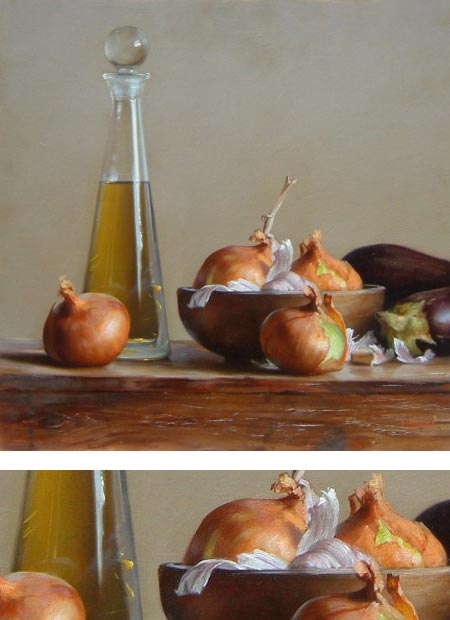
Paul S. Brown paints clarity and stillness.In the process he also does some exceptional still life paintings.
Brown is represented by the Gandy Gallery, a bastion of classical realism, and the selection of his work visible there includes a number of still life paintings, as well as several portraits and self-portraits and a small selection of drawings. I was unable to locate a web presence for the artist other than the Gandy Gallery site.
Brown was born in the U.S., and now lives in the UK. Along the way he studied in the U.S. and later studied and then taught at the Florence Academy of Art in Italy.
Brown’s still life paintings are in the classical tradition in more than one way; they are carefully chosen and arranged tableaux of traditional still life subjects, fruit, vegetables, dish and glassware, set on table tops or tablecloths, and painted with an eye to the Dutch genre painters, but with a vibrant, painterly handling of the materials and a sharp, contemporary sensibility for color.
His objects, in particular vegetables and fruit, carry a tactile sensation of both the physical surface of the objects themselves, the rough sheen of a zucchini, the glossy smoothness of an eggplant or the crisp crinkle of an onion’s skin, and the physical reality of paint on a surface. Though he will sometimes set them against more complex backgrounds, he more often sets his objects off with deceptively simple fields of color, that actually are carefully controlled and contain variations of hue and texture that are a subtle part of the composition, and serve to lead your eye around the work as a more complex background might.
His simple objects are often resting on interesting surfaces, textured wood, smooth but variegated marble, or rows and folds of arranged cloth.
To me, the paintings seem to speak of quite contemplation and the zen-like selfless state that sometimes comes of relaxed focus and careful observation of the visual world.
Categories:




Charley’s Picks
Bookshop.org
(Bookshop.org affilliate links; sales benefit independent bookshop owners; I get a small percentage to help support my work on Lines and Colors)

John Singer Sargent: Watercolors


Urban Sketching: Understanding Perspective


Charley’s Picks
Amazon
(Amazon.com affiliate links; sales go to a larger yacht for Jeff Bezos; but I get a small percentage to help support my work on Lines and Colors)
John Singer Sargent: Watercolors
Urban Sketching: Understanding Perspective