


Categories
- 3d CGI
- Amusements
- Animation
- Anime & Manga
- Art Materials
- Art Videos
- Blogroll
- Cartoons
- Color
- Comics
- Concept & Visual Dev.
- Creativity
- Digital Art
- Digital Painting
- Displaying Art on the Web
- Drawing
- Eye Candy for Today
- Gallery and Museum Art
- High-res Art Images
- Illustration
- Motion Graphics & Flash
- Museums
- Online Museums
- Outsider Art
- Painting
- Painting a Day
- Paleo Art
- Pastel, Conté & Chalk
- Pen & Ink
- Prints and Printmaking
- Reviews
- Sc-fi and Fantasy
- Sculpture & Dimensional
- Site Comments
- Sketching
- Storyboards
- Tools and Techniques
- Uncategorized
- Vector Art
- Videos & Podcasts
- Vision and Optics
- Watercolor and Gouache
- Webcomics
Archives
- May 2026
- April 2026
- March 2026
- February 2026
- January 2026
- December 2025
- November 2025
- October 2025
- September 2025
- August 2025
- July 2025
- June 2025
- May 2025
- January 2025
- December 2024
- November 2024
- October 2024
- September 2024
- August 2024
- June 2024
- April 2024
- March 2024
- February 2024
- January 2024
- December 2023
- November 2023
- October 2023
- September 2023
- August 2023
- July 2023
- May 2023
- April 2023
- March 2023
- February 2023
- January 2023
- December 2022
- November 2022
- September 2022
- August 2022
- July 2022
- June 2022
- May 2022
- April 2022
- March 2022
- February 2022
- January 2022
- December 2021
- November 2021
- October 2021
- September 2021
- August 2021
- July 2021
- June 2021
- May 2021
- April 2021
- March 2021
- February 2021
- January 2021
- December 2020
- November 2020
- October 2020
- September 2020
- August 2020
- July 2020
- June 2020
- May 2020
- April 2020
- March 2020
- February 2020
- January 2020
- December 2019
- November 2019
- October 2019
- September 2019
- August 2019
- July 2019
- June 2019
- May 2019
- April 2019
- March 2019
- February 2019
- January 2019
- December 2018
- November 2018
- October 2018
- September 2018
- August 2018
- July 2018
- June 2018
- May 2018
- April 2018
- March 2018
- February 2018
- January 2018
- December 2017
- November 2017
- October 2017
- September 2017
- August 2017
- July 2017
- June 2017
- May 2017
- April 2017
- March 2017
- February 2017
- January 2017
- December 2016
- November 2016
- October 2016
- September 2016
- August 2016
- July 2016
- June 2016
- May 2016
- April 2016
- March 2016
- February 2016
- January 2016
- December 2015
- November 2015
- October 2015
- September 2015
- August 2015
- July 2015
- June 2015
- May 2015
- April 2015
- March 2015
- February 2015
- January 2015
- December 2014
- November 2014
- October 2014
- September 2014
- August 2014
- July 2014
- June 2014
- May 2014
- April 2014
- March 2014
- February 2014
- January 2014
- December 2013
- November 2013
- October 2013
- September 2013
- August 2013
- July 2013
- June 2013
- May 2013
- April 2013
- March 2013
- February 2013
- January 2013
- December 2012
- November 2012
- October 2012
- September 2012
- August 2012
- July 2012
- June 2012
- May 2012
- April 2012
- March 2012
- February 2012
- January 2012
- December 2011
- November 2011
- October 2011
- September 2011
- August 2011
- July 2011
- June 2011
- May 2011
- April 2011
- March 2011
- February 2011
- January 2011
- December 2010
- November 2010
- October 2010
- September 2010
- August 2010
- July 2010
- June 2010
- May 2010
- April 2010
- March 2010
- February 2010
- January 2010
- December 2009
- November 2009
- October 2009
- September 2009
- August 2009
- July 2009
- June 2009
- May 2009
- April 2009
- March 2009
- February 2009
- January 2009
- December 2008
- November 2008
- October 2008
- September 2008
- August 2008
- July 2008
- June 2008
- May 2008
- April 2008
- March 2008
- February 2008
- January 2008
- December 2007
- November 2007
- October 2007
- September 2007
- August 2007
- July 2007
- June 2007
- May 2007
- April 2007
- March 2007
- February 2007
- January 2007
- December 2006
- November 2006
- October 2006
- September 2006
- August 2006
- July 2006
- June 2006
- May 2006
- April 2006
- March 2006
- February 2006
- January 2006
- December 2005
- November 2005
- October 2005
- September 2005
- August 2005
Relevant Blogs
Art, Painting & Sketch
- Gurney Journey
- Underpaintings
- Art and Influence
- Painting Perceptions
- Oil Painters of America
- Vasari Paint POV
- Flying Fox
- Urban Sketchers
- Bento (Smithsonian)
- Art Inconnu
- The Hidden Place
- Still Life
- Making a Mark
- The Art of the Landscape
- Exploring Color & Creativity
- Art Contrarian
- Artist A Day
- beinArt Surreal Art Collective
- Eye Level
- David Dunlop
- p.i.g.m.e.n.t.i.u.m
- CultureGrrl
- Joaquín Sorolla blog
- Artists in Pastel
“Painting a Day”
- A Painting a Day (Keiser)
- On Painting (Keiser)
- Julian Merrow-Smith
- Karen Jurick
- Jeffrey Hayes
- Carol Marine
- Abbey Ryan
- Daily Paintworks
Other Painting Blogs
- Virtual Gouache Land
- Neil Hollingsworth
- Marc Hanson
- Kevin Menck
- Marc Dalessio
- Larry Seiler
- Stapleton Kearns
- Colin Page
- Roos Schuring
- Hans Versfelt
- Titus Meeuws
- Régis Pettinari
- René Plein Air
- Belinda Del Pesco
- Robin Weiss
- Nathan Fowkes (Land Sketch)
- William Wray
- Frank Serrano
- Stephen Magsig
- Michael Chesley Johnson
- Twice a Week
- Sarah Wimperis
- Rob Adams
- Michael Cole Manley
- The Dirty Palette Club
- Mike Manley’s Draw!
Gallery Art & Illustration mix
Illustration
- Howard Pyle
- 100 Years of Illustration
- BibliOdyssey
- Illustration Art
- Today’s Inspiration
- Illustration Mundo
- Little Chimp Society
- Danny Gregory
- R D (John Martz
- Illustration Friday blog
- Monster Brains
- Illustrators & Illustrations (RU)
- Elwood H. Smith
- DaniDraws.com
- Designers Who Blog
- iSpot Blog
Sci-Fi & Fantasy
Illustration & Comics
Comics & Cartoons
- Comics Beat
- Robot 6
- Newsarama Blog
- Comic Vine
- Comics Alliance
- Forbidden Planet Int.
- Paolo Rivera
- Bolt City
- Flight
- Scott McCloud
- The Comics Journal
- Comixpedia
- Funnybook Babylon
- James Baker
- Middleton’s Sketchbook
- Boneville
- The Hotel Fred
- Paul Rivoche
- Daily Cartoonist
- Mad About Cartoons (William Wray)
- Digital Strips
Illustration & Concept
Animation & Concept
- Cartoon Brew
- Animation Blog
- Cold Hard Flash
- Concept Art World
- The CAB
- FY Concept Art
- Concept Ships
- Concept Robots
- John Nevarez
- Armand Serrano
- Marcos Mateu-Mestre
- all kinds of stuff (Kricfalusi)
- Yacin the faun (Man Arenas)
- Kelsey Mann
- Cre8tivemarks Blog
- Ice-Cream Monster Toon Cafe
- AAU Character & Creature Design
- AAU Animation Notes
- Articles and Texticles
Paleo & Scientific
Tools & Techniques
Other
Lists of Art Blogs
Art Image Resource Links
Historic Art Images
- Wikimedia Commons: Paintings
- Wikimedia Commons: Drawings
- The Athenaeum
- WikiArt (WikiPaintings)
- Google Art Project: Artists
- Google Art Project: Collections (Museums)
- ArtCyclopedia
- Web Gallery of Art
- Art Renewal Center
- Web Gallery of Impressionism
Auction Consolidation sites
Auction sites
- Sotheby’s
- Bonham’s
- Christies
- Heritage Auctions: Fine Art
- Heritage Auctions: Illustration
- Freeman’s Auctions
- Bukowskis
- Shannon’s
Image Search
Reverse Image Search (search by image)
- Tin Eye
- RevImg
- Google Image Search (camera icon)
- Bing Image Search (camera icon)
Promoting some friends and some clients of my website design business
- Twin Willows T’ai Chi studio in Wilmington DE. Taiji classes with Bryan Davis.
- Ray Hayward, Inspired Teacher of T’ai Chi ( Taiji ) in Minneapolis, Founder of Mindful Motion Tai Chi Academy
- OldHead Tattoo studio and Art Gallery in Wilmington DE. Tattoos and paintings by Bruce Gulick
- Sharon Domenico Art, pet portrait oil paintings
- Platinum Paperhanging, wallpaper hanging, Main Line and Philadelphia, PA
- Lisa Stone Design, interior designer, Main Line and Philadelphia, PA
- Studio12KPT, original art, prints, calendars and other custom printed items by Van Sickle & Rolleri
-
Käthe Kollwitz

German artist Käthe Kollwitz began her career as a painter until, inspired by the prints of Max Klinger, she began creating etchings, lithographs and woodcuts, eventually abandoning painting for graphics.Kollwitz was also a sculptor and her drawings and graphics have a distinctly sculptural quality, as if rough-hewn from wood or stone.
Her subjects were “rough” as well, often drawn from the poor and downtrodden in Berlin, who her husband attended as a doctor. She remained committed to pacifist and socialist ideals throughout her career. Much of her early work in particular was shaped by the death of one of her sons in the First World War.
She was the first woman elected to the Prussian Academy of Art, a post from which she was ejected by the Nazi Party, who also forbade her to exhibit; although they used some of her work for propaganda and included her in their derisive exhibition of “Degenerate Art”.
Through it all, she continued to create, and her work, even when portraying grief and tragedy, resonates with an uncanny strength.
There is an exhibit of her prints, posters and drawings at the CSU Art Museum in Long Beach, California from June 23 to August 5, 2006. Unfortunately there isn’t an online gallery accompanying the exhibit listing.
There is a Käthe Kollwitz museum in Berlin that has a gallery of her work.
The Fine Arts Museum of San Francisco has over 60 images of her work in their online image base, including the image above (detail here).
Link via Art Knowledge News.
Categories:
-
A History of Webcomics
 Ten years ago, the landscape of comics on the web was a vast empty plain dotted with a few (very few) examples of what we now call webcomics. One of them was my own online comic, Argon Zark!, which was the first long-form comic created specifically for distribution on the web (started in June of 1995).
It was preceded by short form and single strips that had moved from print to the web, most notably Where the Buffalo Roam by Hans Bjordahl, which had been distributed over the internet via Usenet newsgroups even before the first graphical web browsers came into use, and Dr. Fun, a single panel cartoon that had began running in September of 1993.
Soon after the first Zark page went up, newspaper cartoonist Bill Holbrook brought Kevin and Kell to the web. Other online comics started to dot the landscape and the nascent world of webcomics started to look like a small colony. In June of 1996, Peter Zale began the strip that would become Helen, Sweetheart of the Internet, the first webcomic that would move in the other direction, (eventually making the transition from webcomic to sydicated newspaper comic in 2000).
The tiny colony was fast becoming a thriving town. Major landmarks like Sluggy Freelance and User Friendly appeared, Scott McCloud began his “infinite canvas” online comics experiments, Penny Arcade and Keenspace erected their skyscrapers an the town grew into a city. By the turn of the century, the advance of webcomics began to snowball. Even the sleepy self-satisfied print comics companies were trying to figure out how to use this phenomenon to sell more of their usual wares.
It’s hard to estimate how many webcomics there are today, or even how many of them are added daily (yes, daily), but where once an empty plain stood is now a webcomics megalopolis, stretching as far as the eye can see in all directions.
The history of webcomics is a lot more complex an detailed than I can possibly indicate here, which is why it’s so cool that webcomics author and commentator T Campbell has done the painstaking research and organization to put together A History of Webcomics, which has just been released from Antarctic Press.
There isn’t a lot of direct promotinoal material available on the book. You can read an discussion board interview with T Campbell on the Comicon boards.
(There is also a good set of articles on The Webcomics Examiner, on The Artistic History of Webcomics, in which Campbell was also involved and Argon Zark! is also prominently mentioned.)
Campbell has traced the history of webcomics in considerable detail in this volume, and included a number of illustrations of key points and players in the field.
The book includes several illustrations of mine: two Argon Zark! pages, a drawing of my characters and a chapter heading (image at left, top) that I did specifically for the book, in which my characters Argon, Zeta and Cybert peer out of a Netscape 1 browser window (Netscape had just come out when I started Argon Zark!), and point at characters from Hans Bjordahl’s Where the Buffalo Roam (incorporating Hans’ own drawings), ensconced in windows of the first and second generation of Mosaic, the first widely used graphical browser on the web.
This has never been a personal sketch blog, and perhaps it’s a little self indulgent to feature a book that my work figures prominently in, but it happens to be quite a good book, and I’m allowed to be self indulgent today, it’s my birthday!
Categories:
-
Mike Luckovich
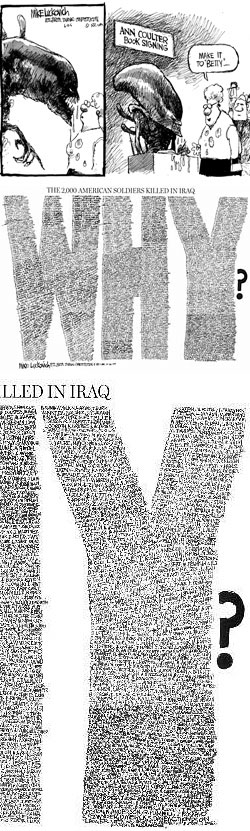 Mike Luckovich doesn’t pull his punches.
Luckovich has been the editorial cartoonist for the Atlanta Journal-Constitution for 18 years. Sometimes his cartoons earn him vitriol and threatening letters and sometimes they earn him editorial acclaim. They often bring him both simultaneously.
When he goes after a public figure he considers foolish, irresponsible or even reprehensible, he shoots with a fully loaded pen. For example, he portrays Ann Coulter, (who recently accused widows of the World Trade Center disaster, who had pushed for the formation of the 9-11 Commision and come out in support of Democratic candidates, of “enjoying their husbands’ deaths”, in an attempt by Coulter to stir up controversy and increase sales of her new book), as drooling, acid-blooded alien (image at left, top, his blog entry here).
One of the cartoons that simultaneously earned him threats and accolades (and probably had an influence on his receipt of the 2006 Pulitzer Prize for Editorial Cartooning) was a remarkably unique piece of editorial image creation. He sat down at a larger than normal sheet of board and hand-lettered the 2000 names of the soldiers who had been killed in Iraq at that point in time, arranging them in the form of the word “Why?” (image at left, middle and detail, bottom – click on image here for large version). Love it or hate it, you have to admit it makes a powerful statement.
Luckovich’s drawing style doesn’t pull any punches either, His loose, unrestrained linework and frenetic hatching look as if his drawings were created at a furious pace, his pen too charged with emotion to make more careful lines. I have no idea how carefully he actually draws, it’s just that his finished drawings have the look to me of frantic activity driven by some unspeakable urgency.
Luckovich won the Pulitzer prize for Editorial Cartooning in 1995, and was awarded it again this year. He was also awarded the Reuben this year, the National Cartoonist Society’s award for cartoonist of the year. (You can find a fascinating history of the Ruben winners from 1946 to 2003, with bios and artwork, on the NCS site.)
His official site at the Atlanta Journal-Constitution has a selection of his previous cartoons, but it’s not that easy to browse, and the gallery of available reprints is crippled with watermarking (see my rant about watermarking in yesterday’s post), so you may want to just do a Google image search. There is a good gallery of his cartoons on the Pulitzer Prize site.
There are collections of his cartoons, LOTSA LUCKOVICH and Four More Wars!. The former is out of print, but copies may still be available if his acid-tinged cartoons haven’t eaten through the paper.
I heard an interview with Luckovich on the radio and he actually sounded soft-spoken and deliberate, but his cartoons come at you like buckshot at a quail hunt.
Categories:
-
Tim Hildebrandt 1939-2006

It’s difficult to separate the work of fantasy and science fiction artist Tim Hildebrandt from that of his brother Greg. For the greater part of their careers they have collaborated on most of their work.Word has gone around the web that Tim Hildebrandt died Sunday (June 11) at the age of 67 of complications from diabetes.
The Brothers Hildebrandt, as they are often referred to, have done book, magazine, game, card and calendar illustrations that are some of the most widely known in the fantasy art field. Before Peter Jackson’s movies cemented the “look” of the world and characters of Tolkien’s Lord of the Rings, the Hildebrandts created one of the more widely known visual interpretations of Tolkien’s work with their calendar illustrations in the 1970’s. They also created widely distributed illustrations for collectable cards of Star Wars themes and Marvel Comics superheroes.
Their work together was often brash, bold, in-your-face and exaggeratedly colorful. They would frequently employ the technique of juxtaposing brilliant complementary colors on the same face or figure in areas of backlighting or secondary highlights to increase the visual drama and “push” the color. (Complementary colors, such as blue and orange, are actually the inverse of one another. If you stare at a patch of light blue for 30 seconds and close your eyes or look at a white sheet, you will see orange. Many artists and illustrators know that this process is constantly occurring when you perceive colors, and the placement of a color next to its compliment will exaggerate the intensity of both colors. This is the basis of much “op art” and is particularly common in fantasy and science fiction art and comic books.)
The two brothers did go their separate ways at times. Of the two I think that Tim was perhaps more inclined to subtlety. He did a lot of science fiction illustration in which the color range was a bit more muted and atmospheric. Both brothers have been prolific and there is a good deal of their work available in books, calendars and posters.
The official Brothers Hildebrandt site has some good images. Unfortunately, a large number of them are defaced by the overzealous application of watermarking. (When will people realize that they can’t “protect” an image by limiting its size or watermarking it on the web? If the image is in print, anyone with a scanner can produce a higher-resolution version than anything you’re likely to post on the web.)
If you find the watermarking as frustrating as I do, you may want to simply do a Google image search to turn up images like the one above (larger version here), but if you’re looking for printed versions, make sure they’re the approved versions from which profit is actually going to the artists or their families.
Categories:
-
Joe Ciardiello
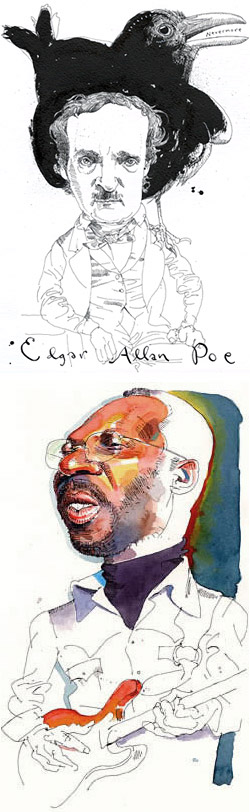 Sometimes there is a fine line, if you’ll excuse the expression, between drawing and painting.
Illustrator Joe Ciardiello manages to walk on both sides of that line at will by developing his color work out of his black and white drawing style.
His black and white drawings have a wonderfully loose and lively line quality, often mixing lightly suggested figures with more fully rendered detail in the areas of focus, usually the faces, in his drawings of well known individuals. Those drawings, themselves, straddle the line between caricatures and portraits, employing varying degrees of exaggeration.
Most interesting is the way he will render portions of a drawing in color. With deft applications of watercolor, at times sketchy and at other times as rendered as a painting, he will bring even more intense focus to the face of an individual or accent other elements in the drawing.
Ciardiello seems to choose a different point in each drawing for the balance between color and black and white elements. The result is a terrific mix that can have the rendered subtlety of a painting and the charming immediacy of a drawing in a single image.
Ciardiello has a new website (designed by Jack Harris, himself a talented illustrator) that makes an effective showcase for his work. There are sections for Illustration and more casual Drawings from sketchbooks, including travel sketches from Venice that I particularly enjoy.
The highlight, though, is the section on images of Musicians, an area in which Ciardiello excels. He is a musician himself, he plays drums with several groups including an all-illustrator band, the Half-Tones, and his images of greats from jazz, blues and rock reflect the touch of someone intimately familiar with these players and their music.
Ciardiello has worked for major publications like The New York Times, Rolling Stone, The Atlantic Monthly, Esquire, Jazziz, The New Yorker and others. His drawings cover a wide range of subjects from politics to sports to literature, but it is his portraits/caricatures of musicians that are most widely recognized, and they are emphasized in the prints available in the For Sale section of the site.
As you look through his work you’ll be delighted with the playfulness and visual fun of Ciardiello’s unique mixture of lines and colors.
Categories:
-
Gobelins Animation Students

France is the largest producer of animation in Europe, and the third largest in the world.Gobelins, L’Ecole De L’image (Gobelins, School of the Image), is a school in Paris that, in addition to studies in Graphic Arts, Multimedia and Photography, offers an apparently superb program in animation. I make that judgement on the basis of the quality of their animation students’ short films.
Each year since 2002, the Gobelins animation students have divided up into small teams of 4 or 5 students and created short (90 second) animations for entry in the Annecy International Animated Film Festival (English version here).
The resultant short animated films are just a treat.
There is some general information about the school in English and about their summer program, which is offered in English as well as French.
The majority of the school’s site is only available in French, but the films rely very little on words and there are links to view them in the browser as well as direct podcast “Add to iTunes” links. The clips require Quicktime, but you should have that anyway if you care about viewing quality video on the web.
The image above is from a delightful part traditional, part CGI animation called Sébastien, one of this year’s entries. I could go on about the individual entries but UK animator and designer Michael Hirsh has a good introduction to this year’s Gobelins entries on his excellent Articles and Texticles blog, which is where I learned that the current entries were available.
I give links below to the school itself as well as their previous years animation festival entries.
If you were surprised to learn that France is the third largest producer of animation worldwide, you may also be surprised an delighted to preview the next generation of French animators.
Link via Articles and Texticles.
Addendum: Michael Hirsh writes to say that one of the animations teams has created a fascinating website describing the process of creating their short, Pyrats, including background designs, character model sheets, storyboards and more. They also discuss it on their blog (English version). Michael fills you in on the details here.
Categories:




Charley’s Picks
Bookshop.org
(Bookshop.org affilliate links; sales benefit independent bookshop owners; I get a small percentage to help support my work on Lines and Colors)

John Singer Sargent: Watercolors


Urban Sketching: Understanding Perspective


Charley’s Picks
Amazon
(Amazon.com affiliate links; sales go to a larger yacht for Jeff Bezos; but I get a small percentage to help support my work on Lines and Colors)
John Singer Sargent: Watercolors
Urban Sketching: Understanding Perspective