


Categories
- 3d CGI
- Amusements
- Animation
- Anime & Manga
- Art Materials
- Art Videos
- Blogroll
- Cartoons
- Color
- Comics
- Concept & Visual Dev.
- Creativity
- Digital Art
- Digital Painting
- Displaying Art on the Web
- Drawing
- Eye Candy for Today
- Gallery and Museum Art
- High-res Art Images
- Illustration
- Motion Graphics & Flash
- Museums
- Online Museums
- Outsider Art
- Painting
- Painting a Day
- Paleo Art
- Pastel, Conté & Chalk
- Pen & Ink
- Prints and Printmaking
- Reviews
- Sc-fi and Fantasy
- Sculpture & Dimensional
- Site Comments
- Sketching
- Storyboards
- Tools and Techniques
- Uncategorized
- Vector Art
- Videos & Podcasts
- Vision and Optics
- Watercolor and Gouache
- Webcomics
Archives
- May 2026
- April 2026
- March 2026
- February 2026
- January 2026
- December 2025
- November 2025
- October 2025
- September 2025
- August 2025
- July 2025
- June 2025
- May 2025
- January 2025
- December 2024
- November 2024
- October 2024
- September 2024
- August 2024
- June 2024
- April 2024
- March 2024
- February 2024
- January 2024
- December 2023
- November 2023
- October 2023
- September 2023
- August 2023
- July 2023
- May 2023
- April 2023
- March 2023
- February 2023
- January 2023
- December 2022
- November 2022
- September 2022
- August 2022
- July 2022
- June 2022
- May 2022
- April 2022
- March 2022
- February 2022
- January 2022
- December 2021
- November 2021
- October 2021
- September 2021
- August 2021
- July 2021
- June 2021
- May 2021
- April 2021
- March 2021
- February 2021
- January 2021
- December 2020
- November 2020
- October 2020
- September 2020
- August 2020
- July 2020
- June 2020
- May 2020
- April 2020
- March 2020
- February 2020
- January 2020
- December 2019
- November 2019
- October 2019
- September 2019
- August 2019
- July 2019
- June 2019
- May 2019
- April 2019
- March 2019
- February 2019
- January 2019
- December 2018
- November 2018
- October 2018
- September 2018
- August 2018
- July 2018
- June 2018
- May 2018
- April 2018
- March 2018
- February 2018
- January 2018
- December 2017
- November 2017
- October 2017
- September 2017
- August 2017
- July 2017
- June 2017
- May 2017
- April 2017
- March 2017
- February 2017
- January 2017
- December 2016
- November 2016
- October 2016
- September 2016
- August 2016
- July 2016
- June 2016
- May 2016
- April 2016
- March 2016
- February 2016
- January 2016
- December 2015
- November 2015
- October 2015
- September 2015
- August 2015
- July 2015
- June 2015
- May 2015
- April 2015
- March 2015
- February 2015
- January 2015
- December 2014
- November 2014
- October 2014
- September 2014
- August 2014
- July 2014
- June 2014
- May 2014
- April 2014
- March 2014
- February 2014
- January 2014
- December 2013
- November 2013
- October 2013
- September 2013
- August 2013
- July 2013
- June 2013
- May 2013
- April 2013
- March 2013
- February 2013
- January 2013
- December 2012
- November 2012
- October 2012
- September 2012
- August 2012
- July 2012
- June 2012
- May 2012
- April 2012
- March 2012
- February 2012
- January 2012
- December 2011
- November 2011
- October 2011
- September 2011
- August 2011
- July 2011
- June 2011
- May 2011
- April 2011
- March 2011
- February 2011
- January 2011
- December 2010
- November 2010
- October 2010
- September 2010
- August 2010
- July 2010
- June 2010
- May 2010
- April 2010
- March 2010
- February 2010
- January 2010
- December 2009
- November 2009
- October 2009
- September 2009
- August 2009
- July 2009
- June 2009
- May 2009
- April 2009
- March 2009
- February 2009
- January 2009
- December 2008
- November 2008
- October 2008
- September 2008
- August 2008
- July 2008
- June 2008
- May 2008
- April 2008
- March 2008
- February 2008
- January 2008
- December 2007
- November 2007
- October 2007
- September 2007
- August 2007
- July 2007
- June 2007
- May 2007
- April 2007
- March 2007
- February 2007
- January 2007
- December 2006
- November 2006
- October 2006
- September 2006
- August 2006
- July 2006
- June 2006
- May 2006
- April 2006
- March 2006
- February 2006
- January 2006
- December 2005
- November 2005
- October 2005
- September 2005
- August 2005
Relevant Blogs
Art, Painting & Sketch
- Gurney Journey
- Underpaintings
- Art and Influence
- Painting Perceptions
- Oil Painters of America
- Vasari Paint POV
- Flying Fox
- Urban Sketchers
- Bento (Smithsonian)
- Art Inconnu
- The Hidden Place
- Still Life
- Making a Mark
- The Art of the Landscape
- Exploring Color & Creativity
- Art Contrarian
- Artist A Day
- beinArt Surreal Art Collective
- Eye Level
- David Dunlop
- p.i.g.m.e.n.t.i.u.m
- CultureGrrl
- Joaquín Sorolla blog
- Artists in Pastel
“Painting a Day”
- A Painting a Day (Keiser)
- On Painting (Keiser)
- Julian Merrow-Smith
- Karen Jurick
- Jeffrey Hayes
- Carol Marine
- Abbey Ryan
- Daily Paintworks
Other Painting Blogs
- Virtual Gouache Land
- Neil Hollingsworth
- Marc Hanson
- Kevin Menck
- Marc Dalessio
- Larry Seiler
- Stapleton Kearns
- Colin Page
- Roos Schuring
- Hans Versfelt
- Titus Meeuws
- Régis Pettinari
- René Plein Air
- Belinda Del Pesco
- Robin Weiss
- Nathan Fowkes (Land Sketch)
- William Wray
- Frank Serrano
- Stephen Magsig
- Michael Chesley Johnson
- Twice a Week
- Sarah Wimperis
- Rob Adams
- Michael Cole Manley
- The Dirty Palette Club
- Mike Manley’s Draw!
Gallery Art & Illustration mix
Illustration
- Howard Pyle
- 100 Years of Illustration
- BibliOdyssey
- Illustration Art
- Today’s Inspiration
- Illustration Mundo
- Little Chimp Society
- Danny Gregory
- R D (John Martz
- Illustration Friday blog
- Monster Brains
- Illustrators & Illustrations (RU)
- Elwood H. Smith
- DaniDraws.com
- Designers Who Blog
- iSpot Blog
Sci-Fi & Fantasy
Illustration & Comics
Comics & Cartoons
- Comics Beat
- Robot 6
- Newsarama Blog
- Comic Vine
- Comics Alliance
- Forbidden Planet Int.
- Paolo Rivera
- Bolt City
- Flight
- Scott McCloud
- The Comics Journal
- Comixpedia
- Funnybook Babylon
- James Baker
- Middleton’s Sketchbook
- Boneville
- The Hotel Fred
- Paul Rivoche
- Daily Cartoonist
- Mad About Cartoons (William Wray)
- Digital Strips
Illustration & Concept
Animation & Concept
- Cartoon Brew
- Animation Blog
- Cold Hard Flash
- Concept Art World
- The CAB
- FY Concept Art
- Concept Ships
- Concept Robots
- John Nevarez
- Armand Serrano
- Marcos Mateu-Mestre
- all kinds of stuff (Kricfalusi)
- Yacin the faun (Man Arenas)
- Kelsey Mann
- Cre8tivemarks Blog
- Ice-Cream Monster Toon Cafe
- AAU Character & Creature Design
- AAU Animation Notes
- Articles and Texticles
Paleo & Scientific
Tools & Techniques
Other
Lists of Art Blogs
Art Image Resource Links
Historic Art Images
- Wikimedia Commons: Paintings
- Wikimedia Commons: Drawings
- The Athenaeum
- WikiArt (WikiPaintings)
- Google Art Project: Artists
- Google Art Project: Collections (Museums)
- ArtCyclopedia
- Web Gallery of Art
- Art Renewal Center
- Web Gallery of Impressionism
Auction Consolidation sites
Auction sites
- Sotheby’s
- Bonham’s
- Christies
- Heritage Auctions: Fine Art
- Heritage Auctions: Illustration
- Freeman’s Auctions
- Bukowskis
- Shannon’s
Image Search
Reverse Image Search (search by image)
- Tin Eye
- RevImg
- Google Image Search (camera icon)
- Bing Image Search (camera icon)
Promoting some friends and some clients of my website design business
- Twin Willows T’ai Chi studio in Wilmington DE. Taiji classes with Bryan Davis.
- Ray Hayward, Inspired Teacher of T’ai Chi ( Taiji ) in Minneapolis, Founder of Mindful Motion Tai Chi Academy
- OldHead Tattoo studio and Art Gallery in Wilmington DE. Tattoos and paintings by Bruce Gulick
- Sharon Domenico Art, pet portrait oil paintings
- Platinum Paperhanging, wallpaper hanging, Main Line and Philadelphia, PA
- Lisa Stone Design, interior designer, Main Line and Philadelphia, PA
- Studio12KPT, original art, prints, calendars and other custom printed items by Van Sickle & Rolleri
-
Francisco Goya

The life and career of Spanish master Francisco José de Goya y Luciente bridge the end of the 18th century and beginning of the 19th, a time in Spain of wars, upheaval, inquisition and radical change.Goya chronicled much of it in a mercurial style — from elegantly finessed to slashingly rough — that reflected the tenor of the times, and in many ways, anticipated and influenced the directions of such diverse future art movements as Realism, Expressionism, Surrealism and Modernism.
Goya painted portraits, landscapes, still life, historical scenes and genre scenes, but was known in particular for his depictions of war and conflict — ostensibly in a manner of historical record, but the assumption is (and I think it’s pretty clear), that he was commenting on the misery, tragedy and madness of conflict in a manner that would not have been approved of by the established powers of the time.
He painted what is considered the first straightforward life-size female nude in Western art that did not have some religious, allegorical or mythological narrative to excuse it, The Naked Maja, and a companion painting of the same figure in the same pose, but dressed, as The Clothed Maja (images above, middle). In some ways, the bold position and confrontational stare in the latter is more provocative than the nude version. Both were confiscated from the patron at one point by the Spanish Inquisition.
At various times Goya painted genteel portraits and explosive, dramatic scenes of violence and despair. He was also a master draftsman and printmaker, depicting in one series Caprichos, or visual fantasies of social commentary on the follies of society (The Sleep of Reason Produces Monsters, shown above, top), and in another The Disaster of War.
Late in his life, his health and mental state failing, he painted a mysterious series of darkly themed paintings on canvas and directly on the walls of the house in which he was living, that have come to be known at the “Black Paintings“. Most of the wall paintings were transferred to canvas, but with little relative success. These were never meant by Goya to be sold or displayed, but were a personal outpouring of his own grief or rage. The most famous of them is Saturn Devouring his Son (above, forth from bottom), which is assumed by many to be an allegory of civil war couched in narrative of myth.
There is currently an exhibition of Goya’s work at the Museum of Fine Arts Boston, Goya Order and Disorder, that is on view until January 19, 2015. There is a small preview on the museum’s site, but once again, as with the current exhibit of the work of illustrator Mac Conner in New York, the British newspaper The Guardian does a better job of previewing and promoting an American exhibition than the museum itself (images from the show, above top, down to the self-portrait of Goya painting).
Categories:
-
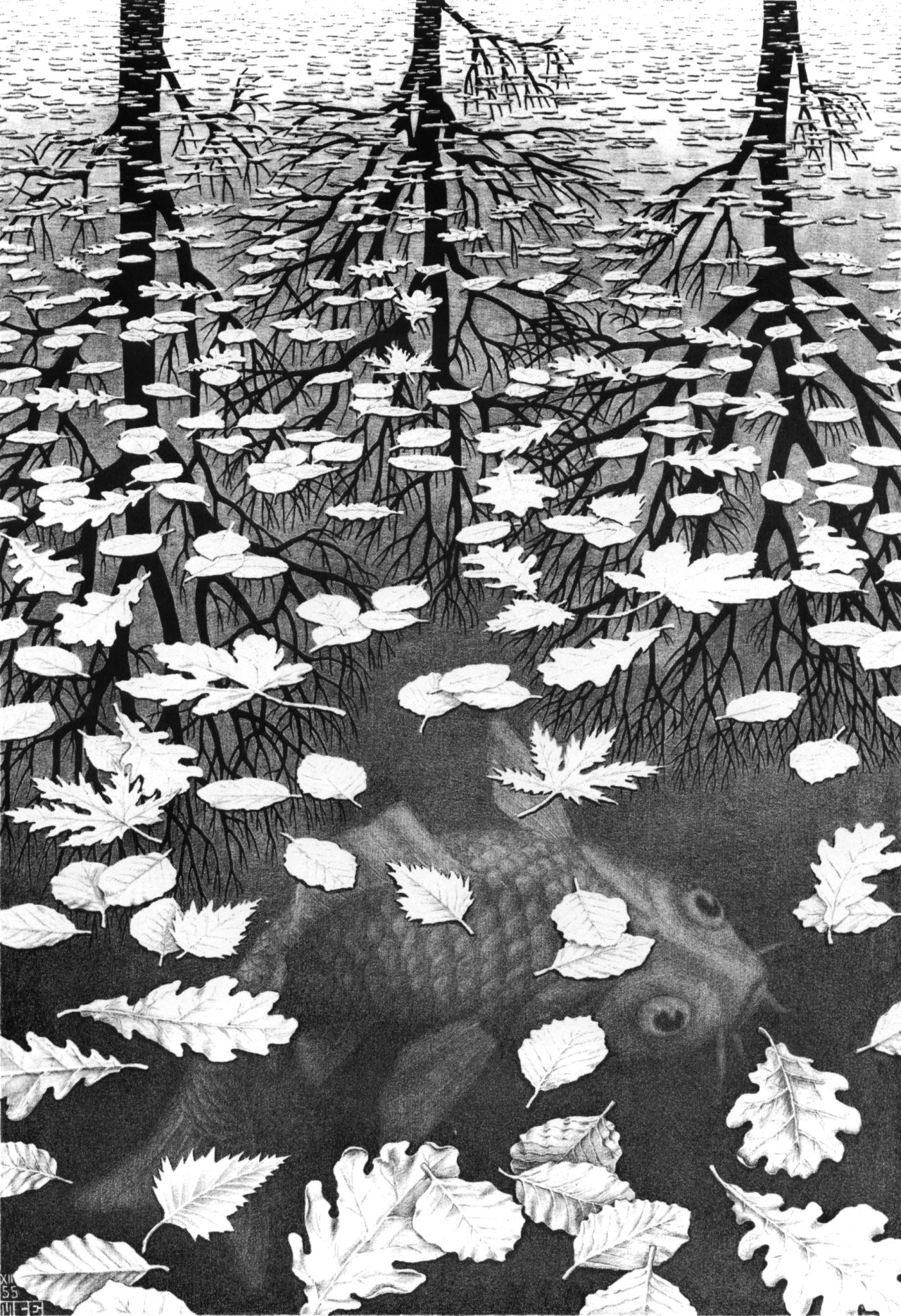
Eye Candy for Today: Escher’s Three Worlds

Three Worlds, M.C. EscherLithograph, roughly 14×10 inches (36x25cm). Image on Wikiart, larger here.
While it’s not one of Escher’s more obvious brain twisting visual conundrums, it’s a teaser nonetheless — also beautiful, subtle, and one of my favorites.
In addition to the thought provoking subject, superb drawing and beautifully handled reflection and surface perspective, I love the way the composition transitions graphically from dark against light at the top to light against dark at the bottom.
Categories:
-
Casey Childs

Casey Childs is a painter based in Utah who focuses on portrait and figurative subjects.His approach to paint handling varies from brusque to refined, in keeping with the feeling generated by his subject and composition. Often his figures will be painted in the context of room interiors, in the course of which he also works with still life subjects.
While not exactly narrative, there always seems to be an element in Childs’ paintings of something unseen happening, whether suggested in the position of his subject, hinted at in the way your eye is lead through the composition or reflected in the expression in a face.
Childs’ website has portfolios of his work in various categories of painting and drawing.
In a recent project, Childs created charcoal portrait drawings of 25 Influential Figures, which have been released as a box set of prints.
Working from historical photographs of figures as diverse as Louis Pasteur, Helen Keller, Frederick Douglass, Mark Twain and Frank Lloyd Wright (examples above), he has created a series of penetrating portraits that make wonderful use of lost and found line, paper grain expressed as texture and delicate value changes.
[Via Vasari Oil Colors]
Categories:
-
Eye Candy for Today: Canaletto’s drawing of the Porta Portello

The Porta Portello with the Brenta Canal in Padua, Canaletto (Giovanni Antonio Canal)On Google Art Project, high-res downloadable file on Wikimedia Commons, original is in the Albertina, Vienna.
In pen and brown ink with brown and gray washes. Unfortunately, neither the museum or Google Art Project give the dimensions. To me it has the look of a fairly large drawing; I might hazard a guess at perhaps 24 inches across (60cm), but that’s only a guess.
It’s worth either zooming the Google Art version or downloading the Wikimedia version to see the image details in larger views. The crops I can provide here don’t do the drawing justice.
I just love Canaletto’s ink and wash drawings, perhaps second only to Rembrandt’s, which is saying something. Not that they’re particularly similar, just that they just have such wonderful qualities that I could stare at them for extended periods, slack-jawed with admiration.
Canaletto manages to be simultaneously sharp and precise in his draftsmanship but loose and sketch-like in his rendering — a combination that just tickles my brain and makes it giggle like a happy baby. I think it has much to do with his delineation of straights with that beautifully wavy, broken line of his.
Categories:
-
Mac Conner

MacCauley “Mac” Conner is an illustrator noted for his work in the mid-20th century, in particular at the height of his popularity and influence in the 1950s.His style bridged the realism of early 20th century illustration, the flattened, graphic mid-century modern style with which he is most associated, and the more rendered approach of traditional romance novels and genre fiction. Much of his best known work was done in gouache, a common medium among deadline-bound illustrators — prized for its matt surface and fast-drying qualities — before it was displaced by acrylic and later digital media.
A new exhibition at the Museum of the City of New York, “Mac Conner: A New York Life“, celebrates his work, concentrating on his 1950s style. The show is being promoted by drawing parallels between the fictional 1950s advertising and design agencies of the Mad Men television series and the real agencies of the era like the one Conner co-founded.
The museum’s website includes a gallery of images from the show, and you will find the same images repeated in other mentions on the web. The images on the museum’s site are relatively small, however. The largest and best reproductions of them are on the site of the English newspaper The Guardian (click in the upper right of the images in their slideshow to enlarge them).
It’s not easy to find other resources on Conner’s work, but there are a few. Notable is a Pinterest board posted by Georgette Cartwright Nichols on which the images may be small, but you get a broader cross-section of his styles. The images include romance covers and location paintings of landmarks here in Philadelphia, where Conner graduated from the Pennsylvania Museum and School of Industrial Art, which later separated into the Philadelphia Museum of Art and the Philadelphia College of Art (now the University of the Arts).
“Mac Conner: A New York Life” is on view at the Museum of the City of New York until January 19, 2015.
Mac Conner is currently 100 years old. He was able to attend the opening of the show, and will turn 101 in November.
[Via Wired]
Categories:
-
Sorolla and America in Madrid

Sorolla and America is an exhibition of the work of the great Spanish painter related to his travels here in the US. It was organized jointly by the Meadows Museum in Dallas, The San Diego Museum of Art Fundación MAPFRE in Madrid.After its run at the Meadows Museum and the San Diego Museum of Art (links to my previous articles about the show), it is now on display at Fundación MAPFRE until 11 January 2015. There is a slideshow of images from the exhibition here.
There is a new book accompanying the exhibit, Sorolla and America, but I have not seen it.
There is also a nice and reasonably priced book currently available, that I have seen and can recommend: Sorolla: The Masterworks.
[Via Sorolla Paintings]
Categories:




Charley’s Picks
Bookshop.org
(Bookshop.org affilliate links; sales benefit independent bookshop owners; I get a small percentage to help support my work on Lines and Colors)

John Singer Sargent: Watercolors


Urban Sketching: Understanding Perspective



Charley’s Picks
Amazon
(Amazon.com affiliate links; sales go to a larger yacht for Jeff Bezos; but I get a small percentage to help support my work on Lines and Colors)
John Singer Sargent: Watercolors
Urban Sketching: Understanding Perspective