


Categories
- 3d CGI
- Amusements
- Animation
- Anime & Manga
- Art Materials
- Art Videos
- Blogroll
- Cartoons
- Color
- Comics
- Concept & Visual Dev.
- Creativity
- Digital Art
- Digital Painting
- Displaying Art on the Web
- Drawing
- Eye Candy for Today
- Gallery and Museum Art
- High-res Art Images
- Illustration
- Motion Graphics & Flash
- Museums
- Online Museums
- Outsider Art
- Painting
- Painting a Day
- Paleo Art
- Pastel, Conté & Chalk
- Pen & Ink
- Prints and Printmaking
- Reviews
- Sc-fi and Fantasy
- Sculpture & Dimensional
- Site Comments
- Sketching
- Storyboards
- Tools and Techniques
- Uncategorized
- Vector Art
- Videos & Podcasts
- Vision and Optics
- Watercolor and Gouache
- Webcomics
Archives
- May 2026
- April 2026
- March 2026
- February 2026
- January 2026
- December 2025
- November 2025
- October 2025
- September 2025
- August 2025
- July 2025
- June 2025
- May 2025
- January 2025
- December 2024
- November 2024
- October 2024
- September 2024
- August 2024
- June 2024
- April 2024
- March 2024
- February 2024
- January 2024
- December 2023
- November 2023
- October 2023
- September 2023
- August 2023
- July 2023
- May 2023
- April 2023
- March 2023
- February 2023
- January 2023
- December 2022
- November 2022
- September 2022
- August 2022
- July 2022
- June 2022
- May 2022
- April 2022
- March 2022
- February 2022
- January 2022
- December 2021
- November 2021
- October 2021
- September 2021
- August 2021
- July 2021
- June 2021
- May 2021
- April 2021
- March 2021
- February 2021
- January 2021
- December 2020
- November 2020
- October 2020
- September 2020
- August 2020
- July 2020
- June 2020
- May 2020
- April 2020
- March 2020
- February 2020
- January 2020
- December 2019
- November 2019
- October 2019
- September 2019
- August 2019
- July 2019
- June 2019
- May 2019
- April 2019
- March 2019
- February 2019
- January 2019
- December 2018
- November 2018
- October 2018
- September 2018
- August 2018
- July 2018
- June 2018
- May 2018
- April 2018
- March 2018
- February 2018
- January 2018
- December 2017
- November 2017
- October 2017
- September 2017
- August 2017
- July 2017
- June 2017
- May 2017
- April 2017
- March 2017
- February 2017
- January 2017
- December 2016
- November 2016
- October 2016
- September 2016
- August 2016
- July 2016
- June 2016
- May 2016
- April 2016
- March 2016
- February 2016
- January 2016
- December 2015
- November 2015
- October 2015
- September 2015
- August 2015
- July 2015
- June 2015
- May 2015
- April 2015
- March 2015
- February 2015
- January 2015
- December 2014
- November 2014
- October 2014
- September 2014
- August 2014
- July 2014
- June 2014
- May 2014
- April 2014
- March 2014
- February 2014
- January 2014
- December 2013
- November 2013
- October 2013
- September 2013
- August 2013
- July 2013
- June 2013
- May 2013
- April 2013
- March 2013
- February 2013
- January 2013
- December 2012
- November 2012
- October 2012
- September 2012
- August 2012
- July 2012
- June 2012
- May 2012
- April 2012
- March 2012
- February 2012
- January 2012
- December 2011
- November 2011
- October 2011
- September 2011
- August 2011
- July 2011
- June 2011
- May 2011
- April 2011
- March 2011
- February 2011
- January 2011
- December 2010
- November 2010
- October 2010
- September 2010
- August 2010
- July 2010
- June 2010
- May 2010
- April 2010
- March 2010
- February 2010
- January 2010
- December 2009
- November 2009
- October 2009
- September 2009
- August 2009
- July 2009
- June 2009
- May 2009
- April 2009
- March 2009
- February 2009
- January 2009
- December 2008
- November 2008
- October 2008
- September 2008
- August 2008
- July 2008
- June 2008
- May 2008
- April 2008
- March 2008
- February 2008
- January 2008
- December 2007
- November 2007
- October 2007
- September 2007
- August 2007
- July 2007
- June 2007
- May 2007
- April 2007
- March 2007
- February 2007
- January 2007
- December 2006
- November 2006
- October 2006
- September 2006
- August 2006
- July 2006
- June 2006
- May 2006
- April 2006
- March 2006
- February 2006
- January 2006
- December 2005
- November 2005
- October 2005
- September 2005
- August 2005
Relevant Blogs
Art, Painting & Sketch
- Gurney Journey
- Underpaintings
- Art and Influence
- Painting Perceptions
- Oil Painters of America
- Vasari Paint POV
- Flying Fox
- Urban Sketchers
- Bento (Smithsonian)
- Art Inconnu
- The Hidden Place
- Still Life
- Making a Mark
- The Art of the Landscape
- Exploring Color & Creativity
- Art Contrarian
- Artist A Day
- beinArt Surreal Art Collective
- Eye Level
- David Dunlop
- p.i.g.m.e.n.t.i.u.m
- CultureGrrl
- Joaquín Sorolla blog
- Artists in Pastel
“Painting a Day”
- A Painting a Day (Keiser)
- On Painting (Keiser)
- Julian Merrow-Smith
- Karen Jurick
- Jeffrey Hayes
- Carol Marine
- Abbey Ryan
- Daily Paintworks
Other Painting Blogs
- Virtual Gouache Land
- Neil Hollingsworth
- Marc Hanson
- Kevin Menck
- Marc Dalessio
- Larry Seiler
- Stapleton Kearns
- Colin Page
- Roos Schuring
- Hans Versfelt
- Titus Meeuws
- Régis Pettinari
- René Plein Air
- Belinda Del Pesco
- Robin Weiss
- Nathan Fowkes (Land Sketch)
- William Wray
- Frank Serrano
- Stephen Magsig
- Michael Chesley Johnson
- Twice a Week
- Sarah Wimperis
- Rob Adams
- Michael Cole Manley
- The Dirty Palette Club
- Mike Manley’s Draw!
Gallery Art & Illustration mix
Illustration
- Howard Pyle
- 100 Years of Illustration
- BibliOdyssey
- Illustration Art
- Today’s Inspiration
- Illustration Mundo
- Little Chimp Society
- Danny Gregory
- R D (John Martz
- Illustration Friday blog
- Monster Brains
- Illustrators & Illustrations (RU)
- Elwood H. Smith
- DaniDraws.com
- Designers Who Blog
- iSpot Blog
Sci-Fi & Fantasy
Illustration & Comics
Comics & Cartoons
- Comics Beat
- Robot 6
- Newsarama Blog
- Comic Vine
- Comics Alliance
- Forbidden Planet Int.
- Paolo Rivera
- Bolt City
- Flight
- Scott McCloud
- The Comics Journal
- Comixpedia
- Funnybook Babylon
- James Baker
- Middleton’s Sketchbook
- Boneville
- The Hotel Fred
- Paul Rivoche
- Daily Cartoonist
- Mad About Cartoons (William Wray)
- Digital Strips
Illustration & Concept
Animation & Concept
- Cartoon Brew
- Animation Blog
- Cold Hard Flash
- Concept Art World
- The CAB
- FY Concept Art
- Concept Ships
- Concept Robots
- John Nevarez
- Armand Serrano
- Marcos Mateu-Mestre
- all kinds of stuff (Kricfalusi)
- Yacin the faun (Man Arenas)
- Kelsey Mann
- Cre8tivemarks Blog
- Ice-Cream Monster Toon Cafe
- AAU Character & Creature Design
- AAU Animation Notes
- Articles and Texticles
Paleo & Scientific
Tools & Techniques
Other
Lists of Art Blogs
Art Image Resource Links
Historic Art Images
- Wikimedia Commons: Paintings
- Wikimedia Commons: Drawings
- The Athenaeum
- WikiArt (WikiPaintings)
- Google Art Project: Artists
- Google Art Project: Collections (Museums)
- ArtCyclopedia
- Web Gallery of Art
- Art Renewal Center
- Web Gallery of Impressionism
Auction Consolidation sites
Auction sites
- Sotheby’s
- Bonham’s
- Christies
- Heritage Auctions: Fine Art
- Heritage Auctions: Illustration
- Freeman’s Auctions
- Bukowskis
- Shannon’s
Image Search
Reverse Image Search (search by image)
- Tin Eye
- RevImg
- Google Image Search (camera icon)
- Bing Image Search (camera icon)
Promoting some friends and some clients of my website design business
- Twin Willows T’ai Chi studio in Wilmington DE. Taiji classes with Bryan Davis.
- Ray Hayward, Inspired Teacher of T’ai Chi ( Taiji ) in Minneapolis, Founder of Mindful Motion Tai Chi Academy
- OldHead Tattoo studio and Art Gallery in Wilmington DE. Tattoos and paintings by Bruce Gulick
- Sharon Domenico Art, pet portrait oil paintings
- Platinum Paperhanging, wallpaper hanging, Main Line and Philadelphia, PA
- Lisa Stone Design, interior designer, Main Line and Philadelphia, PA
- Studio12KPT, original art, prints, calendars and other custom printed items by Van Sickle & Rolleri
-
Alex Niño

There are a number of strong communities of comics art (those of you in the expensive seats read: “graphic storytelling”) in various parts of the world, each with its own stylistic leanings. Some, like Japan, France and Belgium are more familiar to us here in the U.S. than others, like Italy, the UK, South America, China, Korea and the Phillipines.Unlike comics artists in China, Korea and most other countries in the Western Pacific rim that produce comics, artists in the Philippines took their primary influences not from Japanese Manga styles but from Spanish, South American and North American influences.
In the early 1970’s established artists from the Phillipines, many of them with with their own studios and publishing endeavors, like Alfredo Alcala, Nestor Redondo (a personal favorite), and Tony De Zuñiga began to do work for American companies like Marvel, DC and Warren.
I don’t know the details, but it may have had a lot to do with the crackdown and sanitization of the comics medium that resulted when the Marcos government declared martial law and began to outlaw or control all mass media in the country.
In the U.S., the Filipino artists’ unique styles and intense, detailed rendering brought them the immediate attention of publishers and readers, and had a dramatic impact on the American comics artists working at the time.
The elder Filipino comics artists (in the Phillipines, is was “komiks”, as there is apparently no “C” in the alphabet), soon began to bring some of their younger contemporaries into the American market. One of the most notable of these was Alex Niño, who would become a star comics (and komiks) artist in his own right.
Niño illustrated over 300 stories for publishers in the Phillipines; and in the U.S. did work for Marvel, DC, Warren, Byron Preiss and Heavy Metal magazine.
Drawing on influences that ranged from his fellow Filipino artists to golden age pen and ink illustrators like Franklin Booth and Joseph Clement Coll and science fiction illustrators like Virgil Finlay, Niño created a synthesis of pen and ink styles that he used to propel his highly imaginative flights of fantasy.
His work ranged from quietly elegant renderings to over-the-top, wildly stylized fantasies that had some of the manic energy of American underground comics.
His rendering style combined the calligraphic thin-to-thick line work common to American comics with the intensely textural rendering of pen and ink illustration, to unique effect.
In the late 80’s and early 90’s Niño’s decorative style and fertile imagination led him to doing production and design work for Disney Studios, contributing to feature animation like Treasure Planet, Mulan, The Emperor’s New Grove and Atlantis.
Auad Publishing, who I have mentioned in the past as the publisher of terrific books on Franklin Booth, Alex Toth and other illustrators and comics artists, has just released The Art of Alex Niño, a 160 page labor of love into which Auad had crammed page after page of Niño’s lavishly rendered illustrations, drawings and comics pages, including several complete short stories.
The book covers a wide range of Niño’s styles, and includes a healthy sampling of color work (perhaps a quarter of the book). As much as I enjoy his color work, it was in his black and white work, particularly in the Warren magazines, that I think Niño was able to utilize his drawing and rendering strengths, and his dramatic sense of page design, to best advantage.
The Gallery of Niño’s work on the Auad site is small, and the is no official site for Niño or large single repository of his work in the web that I’m aware of. I’ve tried to line up some other resources for you below.
Categories:
-
Anna Richards Brewster in American Art Review

Another quick magazine mention. Anna Richards Brewster, an under-sung American painter who I profiled recently, is featured in a 10-page article in the October, 2008 Issue of American Art Review.For $6 (U.S.), you get a nice overview of her work and 20 images. The article bears the same title as the current traveling exhibit, and related book, Anna Richards Brewster, American Impressionist.
The issue is on newsstands now (try larger bookstores) and should be available on the American Art Review web site as a back issue (Volume XX, Number 5) in a month or so.
Categories:
-
Dean Cornwell in Illustration Magazine
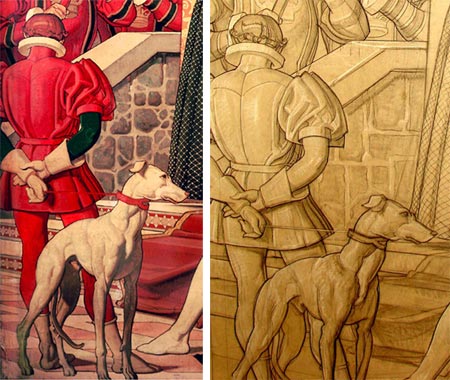
As I mentioned in my previous article on Dean Cornwell, he was a second generation inheritor of the traditions of the Brandywine School of American illustration, having studied with Harvey Dunn, a student of Howard Pyle.Cornwell’s other major influence was painter and muralist Frank Brangwyn, with whom he studied when he turned his career toward mural painting.
Cornwell’s vivid, muscular murals and dramatic, painterly magazine illustrations earned him the appellation “Dean of Illustrators’.
The new issue of Illustration Magazine has an extensive and (I love this phrase) lavishly illustrated article on Cornwell; that plays a much needed role in filling in for the books on Cornwell that should be, but aren’t, in print; notably Dean Cornwell: Dean of Illustrators by Patricia Janis Broder.
You can see a preview of thumbnail images of the entire issue here, though the images are too small to appreciate his work. I give some links to other Cornwell resources in my previous post.
The article features a wide range of Cornwell’s work, including editorial illustrations, posters and pubic service ads for War Bonds, and some of his major mural work, including the famous murals in New York that I mentioned in my other post (images above), and a series for the Los Angeles Central Library, both of which were the subject of controversy.
Jim Winstead, on his blog trainedMonkey, relates how Cornwell was so desperate to win the competition for the latter commission that he entered the contest three times, twice under assumed names; and came in first under the submission for his own name, and second and third for the submissions under his two assumed names.
The Illustration Magazine article also includes some of Cornwell’s detailed and beautifully realized preliminary drawings, which were reputedly were the main reason, along with his limited palette and pre-mixing of colors, that he could sometimes execute a finished illustration in a little as three or four hours.
[Link and notice about the issue via Gurney Journey]
Categories:
-
Colin Stimpson (update)

The classic story of Hansel and Gretel informed us of the alarming eating habits of witches, who love to lure children into their gingerbread houses, fatten them up with sweets, snap them into the oven and cook them right up. Yum.How unsophisticated, though, and how simply old fashioned by today’s standards of cooking shows and recipe books; and how delightful then, to have a modern take on the gruesome eating habits of pointy hatted, children eating witches that writer Martin Howard and artist Colin Stimpson have cooked up as How to Cook Children: A Grisly Recipe Book, a funny and refreshingly politically incorrect update on the idea.
It is indeed a grisly recipe book, and the recipes include such delicacies as “Cajun Cherub Gumbo”, “Barbied Shrimps” and “Deepfried Small Fry with Fries”, each elucidated by a guest witch/chef with a particular speciality for cooking up the little darlings.
The real pleasure here, though, is in Stimpson’s snappy, witty, and charmingly gruesome illustrations.
I wrote about Colin Stimpson last Summer. In addition to his illustration work, he has been a concept and color guide artist on a number of animated feature films for Walt Disney Studios, as well as serving as Art Director for The Emperor’s New Groove.
He brings some of the lively style, springy line and artful exaggeration common to animation and concept art to his gleeful portrayals of our witchy chefs and their dastardly cookery.
The book is available in the UK through Pickabook and Amazon.co.uk, but unfortunately not through Amazon.com here in the the U.S. (at least not yet, Stimpson was kind enough to send me a review copy).
The Amazon UK site does have a few images, but small ones; and except for the home page of his site, Stimpson’s online portfolio doesn’t include work from the new book yet.
Fortunately, concept artist and blogger John Nevarez (see my 2005 post on John Nevarez) has posted 12 beautiful images, linked to high-resolution versions, in three posts on his blog, here, here and here.
Wicked tasty.
Categories:
-
Arthur Streeton
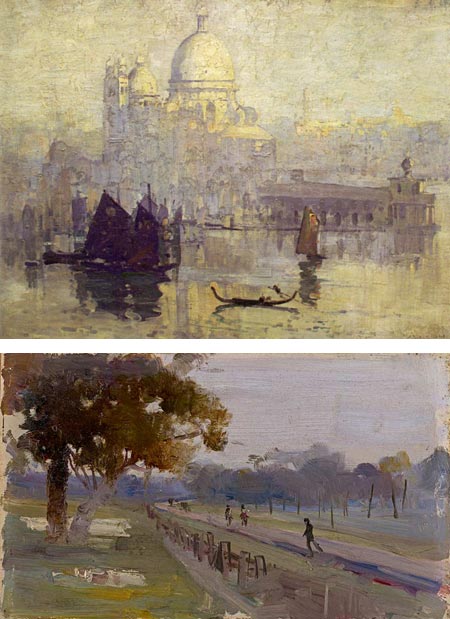
The practice of painting outdoors (or en plein air, see my recent post on pochade boxes), spread from France, where it first came into wide practice, to other parts of Europe, America, and other parts of the world, largely through the impact the French painters had on artists from other countries who came to the artistic centers of Europe to study.Arthur Streeton was an Australian artist who, along with a small group of contemporaries, brought the practice, and the influence of the French Impressionists, to his homeland.
Largely self-taught as a young man, he became particularly impressed by what he read and saw in photographs of the works of the Barbizon School of French painters, particularly Corot, and later became influenced by the Impressionists, who inherited the practice from their Barbizon mentors.
Streeton’s formal study was at the National Gallery of Victoria School, and he went on plein air painting trips on the areas surrounding Melbourne. He joined groups of like-minded artists working in artist camps in Box Hill and Heidleberg (Victoria).
Along with Tom Roberts and Frederick McCubbin, he participated in the first show of Impressionist influenced works in Australia. The show was called the “9 by 5 Impression Exhibition” and consisted largely of plein air paintings on cigar box lids of that size (image above, bottom).
Like the American Impressionists, the Australian painters were not so much devotees of Impressionist theory, as simply painters who adopted what they liked from the Impressionist approach into their own unique style.
Streeton moved to London, after passing through Cairo, where he painted for five months, and then Naples. He moved back to Australia, then back to England; and then traveled Europe, including a notable stint of painting in Venice. Back to Australia again and then back to England, where he joined the British Army medical Corps in the course of the First World War.
He eventually returned to Australia and became one of the most notable and successful of Australian artists.
His bright, fresh color and lively brushwork are evident in both his cigar box sketches and his larger finished work.
Categories:
-
The Totoro Forest Project

Hayao Miyazaki, arguably the foremost director of anime (Japanese animation), has long been concerned with issues of the conservation of the natural world. It is evident in his work, in films that deal directly with the subject, like Princess Mononoke, and as a pervasive theme through all of his films, though the subject is never handled in a simplistic, heavy handed or preaching manner.Miyazaki has also been active in real-world preservation efforts, in particular the ongoing effort to preserve Sayama Forest, a large urban park just outside the limits of Tokyo that served as the inspiration for my favorite of his films, My Neighbor Totoro (see my post on Hayao Miyazaki).
Economic and population pressures from one of the world’s most populous cities is putting increasing pressure on the forest, as is happening to forests worldwide.
In what is partly a direct effort to save this particular forest, partly an effort to set an example and send a message about not squandering our natural treasures worldwide, and partly an acknowledgement by artists of their admiration for Miyazaki and his accomplishments, a number of artists, including Daisuki “Dice” Tsutsumi, Enrico Casarosa, Ronnie Del Carmen and many others from Pixar Animation Studios, are participating in a benefit auction of artworks to benefit the “Totoro No Furusato National Fund”, a non-profit that is working to preserve the forest.
The forest itself has become associated with Miyazaki and his character Totoro, who is a kind of forest spirit, and the project is called the Totoro Forest Project.
Unfortunately, despite the fact that Eric Orchard was kind enough to let me know about this well in advance, I got the dates wrong and I’m late in telling you about it. The online auction ended yesterday. I apologize for the late notice; I thought the online auction began today, but today (September 6, 2008) is actually the date for the live auction event at Pixar Studios.
You can still browse the gallery of works on the site, and make a direct contribution to the preservation effort, or purchase the book of art from the project, the proceeds of which also go to the non-profit. (The site isn’t clear about how to purchase the book yet, but says it will be available today.)
A selected group of the works will be featured in a special exhibition at the Cartoon Art Museum in San Francisco from September 20th to December 7th, 2008.
About 200 artists participated, including many I’ve featured here on Lines and Colors, such as Erik Tiemens, James Jean, Ian McCaig, Khang Le, Kazu Kibuishi, Kevin Dart, Peter de Seve, Neil Campbell Ross, Manuel Arenas, Chris Appelhans, Chris Turnham, Christian Alzmann, Bobby Chiu, William Joyce, Tadahiro Uesugi, Shino Arihara, Sam Weber and many others.
(Image above: Katsuya Terada, Jackson Sze, Charles Vess, Hermann Meija)
Categories:




Charley’s Picks
Bookshop.org
(Bookshop.org affilliate links; sales benefit independent bookshop owners; I get a small percentage to help support my work on Lines and Colors)

John Singer Sargent: Watercolors


Urban Sketching: Understanding Perspective


Charley’s Picks
Amazon
(Amazon.com affiliate links; sales go to a larger yacht for Jeff Bezos; but I get a small percentage to help support my work on Lines and Colors)
John Singer Sargent: Watercolors
Urban Sketching: Understanding Perspective