


Categories
- 3d CGI
- Amusements
- Animation
- Anime & Manga
- Art Materials
- Art Videos
- Blogroll
- Cartoons
- Color
- Comics
- Concept & Visual Dev.
- Creativity
- Digital Art
- Digital Painting
- Displaying Art on the Web
- Drawing
- Eye Candy for Today
- Gallery and Museum Art
- High-res Art Images
- Illustration
- Motion Graphics & Flash
- Museums
- Online Museums
- Outsider Art
- Painting
- Painting a Day
- Paleo Art
- Pastel, Conté & Chalk
- Pen & Ink
- Prints and Printmaking
- Reviews
- Sc-fi and Fantasy
- Sculpture & Dimensional
- Site Comments
- Sketching
- Storyboards
- Tools and Techniques
- Uncategorized
- Vector Art
- Videos & Podcasts
- Vision and Optics
- Watercolor and Gouache
- Webcomics
Archives
- May 2026
- April 2026
- March 2026
- February 2026
- January 2026
- December 2025
- November 2025
- October 2025
- September 2025
- August 2025
- July 2025
- June 2025
- May 2025
- January 2025
- December 2024
- November 2024
- October 2024
- September 2024
- August 2024
- June 2024
- April 2024
- March 2024
- February 2024
- January 2024
- December 2023
- November 2023
- October 2023
- September 2023
- August 2023
- July 2023
- May 2023
- April 2023
- March 2023
- February 2023
- January 2023
- December 2022
- November 2022
- September 2022
- August 2022
- July 2022
- June 2022
- May 2022
- April 2022
- March 2022
- February 2022
- January 2022
- December 2021
- November 2021
- October 2021
- September 2021
- August 2021
- July 2021
- June 2021
- May 2021
- April 2021
- March 2021
- February 2021
- January 2021
- December 2020
- November 2020
- October 2020
- September 2020
- August 2020
- July 2020
- June 2020
- May 2020
- April 2020
- March 2020
- February 2020
- January 2020
- December 2019
- November 2019
- October 2019
- September 2019
- August 2019
- July 2019
- June 2019
- May 2019
- April 2019
- March 2019
- February 2019
- January 2019
- December 2018
- November 2018
- October 2018
- September 2018
- August 2018
- July 2018
- June 2018
- May 2018
- April 2018
- March 2018
- February 2018
- January 2018
- December 2017
- November 2017
- October 2017
- September 2017
- August 2017
- July 2017
- June 2017
- May 2017
- April 2017
- March 2017
- February 2017
- January 2017
- December 2016
- November 2016
- October 2016
- September 2016
- August 2016
- July 2016
- June 2016
- May 2016
- April 2016
- March 2016
- February 2016
- January 2016
- December 2015
- November 2015
- October 2015
- September 2015
- August 2015
- July 2015
- June 2015
- May 2015
- April 2015
- March 2015
- February 2015
- January 2015
- December 2014
- November 2014
- October 2014
- September 2014
- August 2014
- July 2014
- June 2014
- May 2014
- April 2014
- March 2014
- February 2014
- January 2014
- December 2013
- November 2013
- October 2013
- September 2013
- August 2013
- July 2013
- June 2013
- May 2013
- April 2013
- March 2013
- February 2013
- January 2013
- December 2012
- November 2012
- October 2012
- September 2012
- August 2012
- July 2012
- June 2012
- May 2012
- April 2012
- March 2012
- February 2012
- January 2012
- December 2011
- November 2011
- October 2011
- September 2011
- August 2011
- July 2011
- June 2011
- May 2011
- April 2011
- March 2011
- February 2011
- January 2011
- December 2010
- November 2010
- October 2010
- September 2010
- August 2010
- July 2010
- June 2010
- May 2010
- April 2010
- March 2010
- February 2010
- January 2010
- December 2009
- November 2009
- October 2009
- September 2009
- August 2009
- July 2009
- June 2009
- May 2009
- April 2009
- March 2009
- February 2009
- January 2009
- December 2008
- November 2008
- October 2008
- September 2008
- August 2008
- July 2008
- June 2008
- May 2008
- April 2008
- March 2008
- February 2008
- January 2008
- December 2007
- November 2007
- October 2007
- September 2007
- August 2007
- July 2007
- June 2007
- May 2007
- April 2007
- March 2007
- February 2007
- January 2007
- December 2006
- November 2006
- October 2006
- September 2006
- August 2006
- July 2006
- June 2006
- May 2006
- April 2006
- March 2006
- February 2006
- January 2006
- December 2005
- November 2005
- October 2005
- September 2005
- August 2005
Relevant Blogs
Art, Painting & Sketch
- Gurney Journey
- Underpaintings
- Art and Influence
- Painting Perceptions
- Oil Painters of America
- Vasari Paint POV
- Flying Fox
- Urban Sketchers
- Bento (Smithsonian)
- Art Inconnu
- The Hidden Place
- Still Life
- Making a Mark
- The Art of the Landscape
- Exploring Color & Creativity
- Art Contrarian
- Artist A Day
- beinArt Surreal Art Collective
- Eye Level
- David Dunlop
- p.i.g.m.e.n.t.i.u.m
- CultureGrrl
- Joaquín Sorolla blog
- Artists in Pastel
“Painting a Day”
- A Painting a Day (Keiser)
- On Painting (Keiser)
- Julian Merrow-Smith
- Karen Jurick
- Jeffrey Hayes
- Carol Marine
- Abbey Ryan
- Daily Paintworks
Other Painting Blogs
- Virtual Gouache Land
- Neil Hollingsworth
- Marc Hanson
- Kevin Menck
- Marc Dalessio
- Larry Seiler
- Stapleton Kearns
- Colin Page
- Roos Schuring
- Hans Versfelt
- Titus Meeuws
- Régis Pettinari
- René Plein Air
- Belinda Del Pesco
- Robin Weiss
- Nathan Fowkes (Land Sketch)
- William Wray
- Frank Serrano
- Stephen Magsig
- Michael Chesley Johnson
- Twice a Week
- Sarah Wimperis
- Rob Adams
- Michael Cole Manley
- The Dirty Palette Club
- Mike Manley’s Draw!
Gallery Art & Illustration mix
Illustration
- Howard Pyle
- 100 Years of Illustration
- BibliOdyssey
- Illustration Art
- Today’s Inspiration
- Illustration Mundo
- Little Chimp Society
- Danny Gregory
- R D (John Martz
- Illustration Friday blog
- Monster Brains
- Illustrators & Illustrations (RU)
- Elwood H. Smith
- DaniDraws.com
- Designers Who Blog
- iSpot Blog
Sci-Fi & Fantasy
Illustration & Comics
Comics & Cartoons
- Comics Beat
- Robot 6
- Newsarama Blog
- Comic Vine
- Comics Alliance
- Forbidden Planet Int.
- Paolo Rivera
- Bolt City
- Flight
- Scott McCloud
- The Comics Journal
- Comixpedia
- Funnybook Babylon
- James Baker
- Middleton’s Sketchbook
- Boneville
- The Hotel Fred
- Paul Rivoche
- Daily Cartoonist
- Mad About Cartoons (William Wray)
- Digital Strips
Illustration & Concept
Animation & Concept
- Cartoon Brew
- Animation Blog
- Cold Hard Flash
- Concept Art World
- The CAB
- FY Concept Art
- Concept Ships
- Concept Robots
- John Nevarez
- Armand Serrano
- Marcos Mateu-Mestre
- all kinds of stuff (Kricfalusi)
- Yacin the faun (Man Arenas)
- Kelsey Mann
- Cre8tivemarks Blog
- Ice-Cream Monster Toon Cafe
- AAU Character & Creature Design
- AAU Animation Notes
- Articles and Texticles
Paleo & Scientific
Tools & Techniques
Other
Lists of Art Blogs
Art Image Resource Links
Historic Art Images
- Wikimedia Commons: Paintings
- Wikimedia Commons: Drawings
- The Athenaeum
- WikiArt (WikiPaintings)
- Google Art Project: Artists
- Google Art Project: Collections (Museums)
- ArtCyclopedia
- Web Gallery of Art
- Art Renewal Center
- Web Gallery of Impressionism
Auction Consolidation sites
Auction sites
- Sotheby’s
- Bonham’s
- Christies
- Heritage Auctions: Fine Art
- Heritage Auctions: Illustration
- Freeman’s Auctions
- Bukowskis
- Shannon’s
Image Search
Reverse Image Search (search by image)
- Tin Eye
- RevImg
- Google Image Search (camera icon)
- Bing Image Search (camera icon)
Promoting some friends and some clients of my website design business
- Twin Willows T’ai Chi studio in Wilmington DE. Taiji classes with Bryan Davis.
- Ray Hayward, Inspired Teacher of T’ai Chi ( Taiji ) in Minneapolis, Founder of Mindful Motion Tai Chi Academy
- OldHead Tattoo studio and Art Gallery in Wilmington DE. Tattoos and paintings by Bruce Gulick
- Sharon Domenico Art, pet portrait oil paintings
- Platinum Paperhanging, wallpaper hanging, Main Line and Philadelphia, PA
- Lisa Stone Design, interior designer, Main Line and Philadelphia, PA
- Studio12KPT, original art, prints, calendars and other custom printed items by Van Sickle & Rolleri
-
Larry Francis
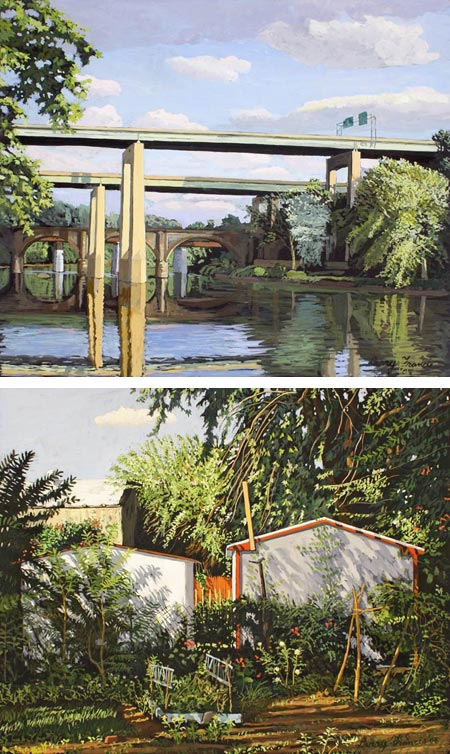
Scale is an interesting aspect of painting and drawing. I’m always fascinated when artists choose to work at both relatively large and relatively small size, particularly when working with the same subject matter (see my posts about Thomas Paquette and his large oils and very small guoache paintings).Philadelphia area painter Larry Francis also paints fairly large oils (perhaps 48×60″; 121x152cm), and small gouache paintings (around 11×14″; 27x35cm) . His subject matter, which is consistent in both types of paintings, includes an interesting range of ordinary subjects in and around Philadelphia.
By “ordinary” I mean commonplace scenes that would not be thought of as particularly scenic, like images of suburban houses and yards, typical city street corners, small sections of parks, neighborhood stores, bridges and other views, the like of which we pass by every day without thinking.
This, of course, is one of the things that art does best, to wake us to more alert observation of our surroundings and remind us that the ordinary is extraodinary, the commonplace worthy of notice and appreciation.
Even Francis’ views of the Schuylkill river, which could have been chosen from more scenic vantage points, instead are often views of bridges and bridge piers, the kind of view commuters might glance at without noticing day after day as they make their routine trips into center city along the river drives.
I particularly like his paintings of Schuylkill river bridges, which perhaps can be thought of as in the tradition of Thomas Eakins, who often included Schuylkill river bridges in his portrayals of scullers. Eakins obviously couldn’t have painted the Route 1 expressway bridge (foreground of the image at top, larger version here), though I have to think he might have included it had it existed at the time.
Francis consistently reveals beauty in the ordinary, with geometric arrangements of houses and commercial buildings arrayed in planes of light, broken with dappled shadows from vegetation and the horizontal bands of color in streets and sidewalks.
I was struck but the issue of scale because I had encountered an oil painting of his at the Pennsylvania Academy of the Fine Arts, where he is an instructor, showing a view of the Schuylkill river from the same vantage point as the one above, though wider in aspect and much larger in size, perhaps 4’x12′ (121x365cm). I was struck by the painting, and delighted to have the chance to see his small gouache paintings of the same area at his current show at the Gross McCleaf Gallery, which is focused in particular on his small gouaches.
I was also glad I had a chance to meet the artist at the opening, and I asked him about his approach. I had made an assumption because of the finessed attention to detail, and the unhurried feeling of relaxed observation evident in these small works, that he was working, at least in part, from photographic reference. He paints these gouache paintings on location, however, working perhaps two paintings a day to catch the different states of light, and returning to the scene two or three times to finish them.
Those in the Philadelphia area still have a chance to catch the show at the Gross McCleaf Gallery, which runs until this Saturday, January 24, 2009.
Categories:
-
American Presidents (Patrick Moberg)

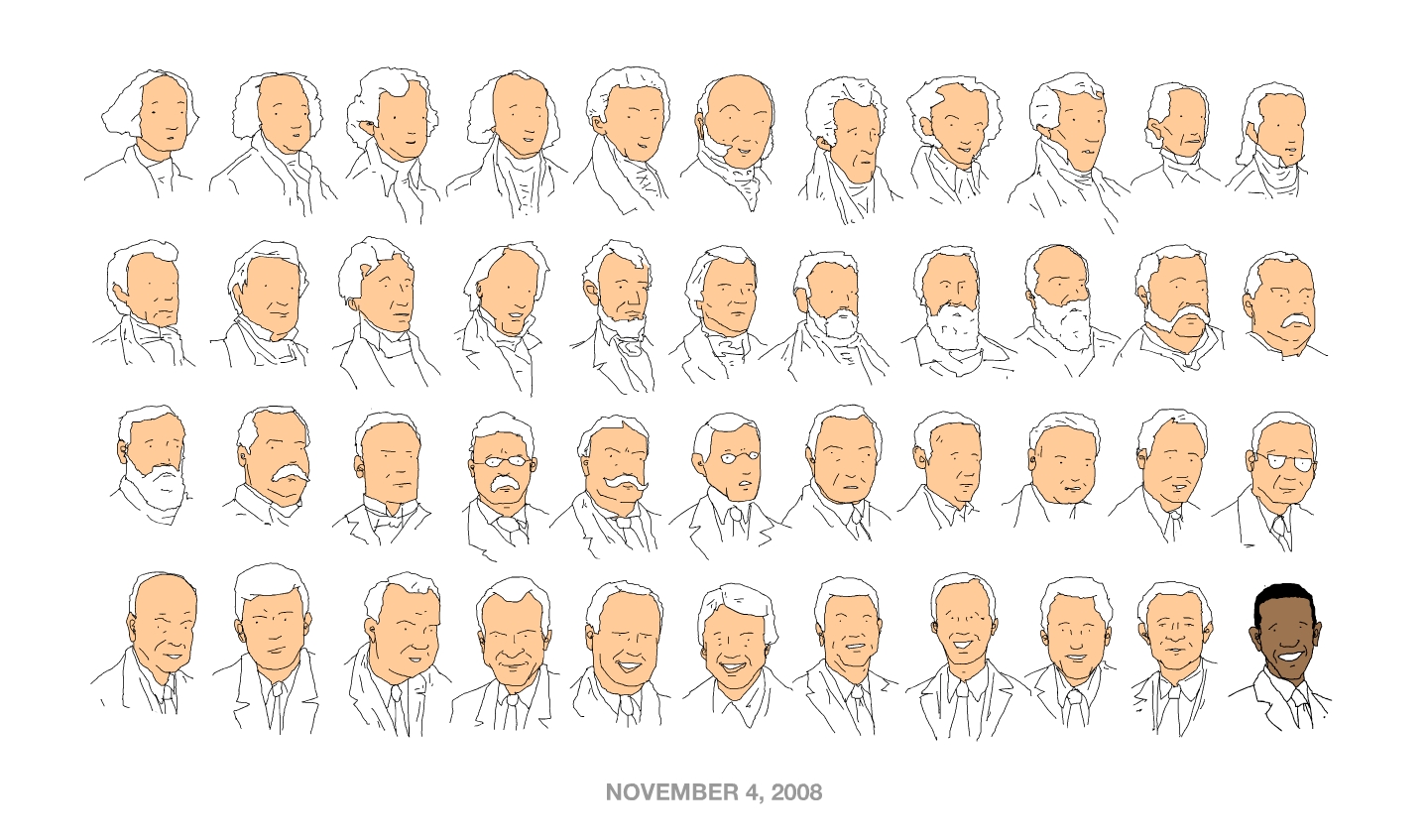
In a somewhat different take on a series of portraits of the former and present presidents of the U.S than my previous post on Presidential Portraits, illustrator Patrick Moberg has a piece that I believe is titled November 4, 2008.It gives a nicely striking comparison of certain physical characteristics of the American presidents to date.
On Moberg’s site you can purchase signed prints of the image. You can also see Moberg’s portfolio of whimsical, cartoon style illustration.
[Via Coudal Partners]
Categories:
-
Presidential Portraits (Rick Tuma)

With lots of attention being paid to the inauguration of the new American President today, here’s a set of portrait drawings of the 43 former U.S. presidents by Rick Tuma, a staff artist for the Chicago Tribune. The series is posted as a special feature called Presidential Portraits on the Tribune’s web site.Tuma painted his series of presidential portraits in ivory black watercolor on bristol board. If you go to his web site and choose “Other Things” at the bottom of the portfolio pages (easy to miss if you don’t know to look for it) you can flip through the thumbnails to the page about the series.
Tuma also does a variety of illustration for the Tribune, from info-graphics to cartooning, and also does freelance work in addition. His online portfolio is divided between watercolor, pencil and digital. (He also apparently collects toys, you can see a QTVR view of his toy-filled work station at the tribune here.)
It’s interesting to see the range of presidents’ faces as portrayed by a single artist. Some of them are of course more interesting as subjects for drawings than others. I’ve selected a couple of the images above for that reason and a couple for relevance to current events.
Categories:
-
Andreas Aronsson

Whenever we look at a representational drawing or painting that appears to have depth or dimensionality, we are looking at a “projection”, a two-dimensional representation of a three dimensional object or scene.There are several types or projections, the most familiar are “perspective projection” (traditional linear perspective), in which lines drawn from the sides of parallel objects converge on vanishing points, and “oblique projection”, in which those lines remain parallel (the “Sim City” look).
In any of them it is possible to create an image that superficially seems reasonable, but would actually be impossible as a three dimensional object. Many of us are familiar with these in the form of traditional “optical illusions” and in the graphics of M.C. Escher.
Andreas Aronsson is, in his words, a “Professional IT‑technician. Spare time multimedia experimenter. In Sweden.” He has a fascination with impossible objects, and regularly posts his own playful “Impossible Figures” to his blog.
These often take the form of objects (usually done in perspective projection) with shared sides or lines of connection that defy real-world geometry. They make for fun visuals; and examination of them generates a playful brain-tickle that gives us pause to reflect on the nature of the visual presentation of objects, what we take for granted and how easily our eye can be fooled into accepting the three dimensionality of lines in a two-dimensional surface (even if that surface is a screen).
You can flip through the posts on his site tagged with “Impossible Figure“. You can also read his page “About Impossible Figures” in which he talks about his fascination with them and his working process in creating his images.
[Via Neatorama]
Categories:
-
Charles Leickert
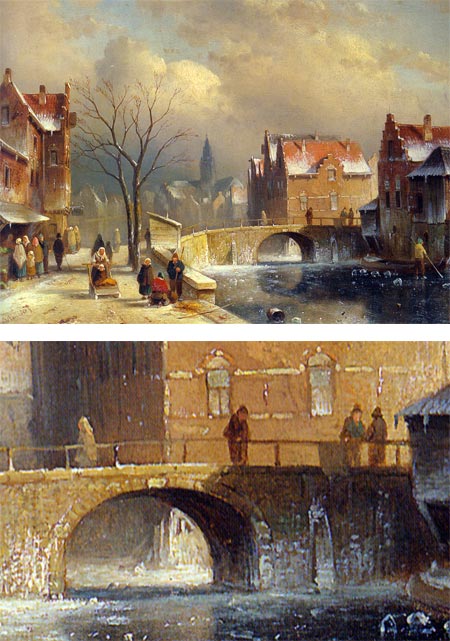
Charles Henri Joseph Leickert was a painter who would have been well suited to painting scenes of the freezing weather we’re currently experiencing in much of the United States.Leickert was a Belgian born painter who lived and worked most of his life in the Netherlands. He specialized in winter landscapes, often with a “street scene” kind of view down a frozen river, lake or canal (image above with detail, larger version here). Most of his frozen river or lake paintings portrayed bustling activity, in which the citizenry would be out skating, ice fishing, pushing sleds filled with goods, and otherwise utilizing the frozen surface as a street.
He romanticized his scenes, frequently with towering dark clouds or brilliant dramatic lighting. He reveled in the eye candy of architectural details and the textures of brick, tile and stone.
He did balance out his oeuvre with images of summer, painting similar river or street scenes teeming with warm weather activity, and framing them with similarly dramatic skies filled with billowing clouds.
Leickert moved the Hague at a young age, and studied there under several Dutch landscape painters, including Andreas Schelfhout, who had a similar speciality in winter scenes, which had proved to be more popular than his other subjects.
The 19th Century Dutch art market seemed to have an appetite for winter scenes in which life appeared to go blithely on in spite of the cold.
Get the skates out.
Categories:
-
Andrew Wyeth, 1917 – 2009

Andrew Wyeth, an American realist painter who in some ways epitomized the conflict between late 20th Century Modernism and the Realist tradition, died today in his sleep in his home in Chadds Ford, Pennsylvania at the age of 91.Wyeth was the son of the great American illustrator N.C. Wyeth. Those familiar with the elder Wyeth’s work will know that he cast a mighty big shadow. Son Andrew, one of five children, differentiated himself from his father by working in watercolor and tempera instead of oil, replacing his father’s bold colors with a subdued, almost suppressed palette, and emphasizing texture in place of color.
His quiet depictions of the Brandywine Valley countryside and the area around the family’s summer home in Maine, along with his often melancholy portrayals of residents of those areas, made him prominent as one of the public’s most admired American artists in the 20th Century.
Of course that very popularity, and the simple matter of his realist (though sometimes surreal) subject matter, and traditionalist technique, made him a target for derision among modernist critics, who denigrated classical traditions with a vengeance during their time of dominating the art world. Though his early watercolors were well received, and Christina’s World was purchased by the Museum of Modern Art, the modernists eventually felt the need to tear him down. They hurled at Wyeth the intended insult of calling him a “mere illustrator”, as though there were no more vehement way to say “not an artist”, and in the process, of course, belittling his father’s accomplishments.
Wyeth quietly persisted in the face of the post-war Modernist tides, and continued his pursuit of contemplative scenes, keen observation and command of the somewhat arcane techniques of egg tempera, a demanding and difficult to master medium that predates oil painting by centuries.
It didn’t hurt, of course, that Wyeth’s paintings were in demand and sold for high figures during the artist’s lifetime (a relatively rare thing in the history of art); and he became one of the best known American artists ever, eclipsing his father’s fame from previous generations. Wyeth eventually had the last laugh, as a good deal critical attention eventually came into line the popular acclaim after the Modernist wave had crashed and the fab foam began receding under the currents of the return of traditional artistic values.
I personally run hot and cold on Andrew Wyeth’s work, finding less appeal in his major tempera paintings than in his intimate and informal watercolors and drawings, particularly those of the Brandywine Valley, near where I grew up. Wyeth at his best was a keen eye and a careful observer, letting nature guide his hand. His figure paintings and drawings almost always included something of the countryside, or the rustic buildings and interiors associated with it, as an integral co-subject, more than simply a backdrop.
The painting above, Dryad, painted in 2000 (more detail and info here), reverses that situation; in a way sublimating the figure and nominal subject of the painting, model Senna Moore, to Wyeth’s intensely focused rendering of a great oak on his Chadds Ford property that had been split open by lightning.
Admittedly, I have trouble viewing Andrew Wyeth without making comparisons with his father. Because of the high regard I have for his work, N.C. Wyeth is my favorite illustrator and one of my favorite painters in general, it’s a difficult and probably unfair comparison.
If you want to see Andrew Wyeth’s work in the context of his artistic family, the Brandywine River Museum, near his home in Chadds Ford, Pennsylvania, has a terrific collection of work by Andrew, his artistically inclined sisters, his son, Jamie, also a noted artist, and, of course, his father, N.C. Wyeth. (If anyone puts the lie to the phrase “mere illustration”, it’s N.C. Wyeth, who was to my mind one of the finest American painters, period.)
There is also a nice, and inexpensive, book that puts the three generations of Wyeth’s, N.C., Andrew and Jamie, in one volume, An American Vision: Three Generations of Wyeth Art: N.C. Wyeth, Andrew Wyeth, James Wyeth.
For more, see my post on Andrew Wyeth from 2006.
Addendum: Katherine Tyrrell has an extensive Squidoo Lens of information and resources relating to Andrew Wyeth.
Categories:




Charley’s Picks
Bookshop.org
(Bookshop.org affilliate links; sales benefit independent bookshop owners; I get a small percentage to help support my work on Lines and Colors)

John Singer Sargent: Watercolors


Urban Sketching: Understanding Perspective


Charley’s Picks
Amazon
(Amazon.com affiliate links; sales go to a larger yacht for Jeff Bezos; but I get a small percentage to help support my work on Lines and Colors)
John Singer Sargent: Watercolors
Urban Sketching: Understanding Perspective