


Categories
- 3d CGI
- Amusements
- Animation
- Anime & Manga
- Art Materials
- Art Videos
- Blogroll
- Cartoons
- Color
- Comics
- Concept & Visual Dev.
- Creativity
- Digital Art
- Digital Painting
- Displaying Art on the Web
- Drawing
- Eye Candy for Today
- Gallery and Museum Art
- High-res Art Images
- Illustration
- Motion Graphics & Flash
- Museums
- Online Museums
- Outsider Art
- Painting
- Painting a Day
- Paleo Art
- Pastel, Conté & Chalk
- Pen & Ink
- Prints and Printmaking
- Reviews
- Sc-fi and Fantasy
- Sculpture & Dimensional
- Site Comments
- Sketching
- Storyboards
- Tools and Techniques
- Uncategorized
- Vector Art
- Videos & Podcasts
- Vision and Optics
- Watercolor and Gouache
- Webcomics
Archives
- May 2026
- April 2026
- March 2026
- February 2026
- January 2026
- December 2025
- November 2025
- October 2025
- September 2025
- August 2025
- July 2025
- June 2025
- May 2025
- January 2025
- December 2024
- November 2024
- October 2024
- September 2024
- August 2024
- June 2024
- April 2024
- March 2024
- February 2024
- January 2024
- December 2023
- November 2023
- October 2023
- September 2023
- August 2023
- July 2023
- May 2023
- April 2023
- March 2023
- February 2023
- January 2023
- December 2022
- November 2022
- September 2022
- August 2022
- July 2022
- June 2022
- May 2022
- April 2022
- March 2022
- February 2022
- January 2022
- December 2021
- November 2021
- October 2021
- September 2021
- August 2021
- July 2021
- June 2021
- May 2021
- April 2021
- March 2021
- February 2021
- January 2021
- December 2020
- November 2020
- October 2020
- September 2020
- August 2020
- July 2020
- June 2020
- May 2020
- April 2020
- March 2020
- February 2020
- January 2020
- December 2019
- November 2019
- October 2019
- September 2019
- August 2019
- July 2019
- June 2019
- May 2019
- April 2019
- March 2019
- February 2019
- January 2019
- December 2018
- November 2018
- October 2018
- September 2018
- August 2018
- July 2018
- June 2018
- May 2018
- April 2018
- March 2018
- February 2018
- January 2018
- December 2017
- November 2017
- October 2017
- September 2017
- August 2017
- July 2017
- June 2017
- May 2017
- April 2017
- March 2017
- February 2017
- January 2017
- December 2016
- November 2016
- October 2016
- September 2016
- August 2016
- July 2016
- June 2016
- May 2016
- April 2016
- March 2016
- February 2016
- January 2016
- December 2015
- November 2015
- October 2015
- September 2015
- August 2015
- July 2015
- June 2015
- May 2015
- April 2015
- March 2015
- February 2015
- January 2015
- December 2014
- November 2014
- October 2014
- September 2014
- August 2014
- July 2014
- June 2014
- May 2014
- April 2014
- March 2014
- February 2014
- January 2014
- December 2013
- November 2013
- October 2013
- September 2013
- August 2013
- July 2013
- June 2013
- May 2013
- April 2013
- March 2013
- February 2013
- January 2013
- December 2012
- November 2012
- October 2012
- September 2012
- August 2012
- July 2012
- June 2012
- May 2012
- April 2012
- March 2012
- February 2012
- January 2012
- December 2011
- November 2011
- October 2011
- September 2011
- August 2011
- July 2011
- June 2011
- May 2011
- April 2011
- March 2011
- February 2011
- January 2011
- December 2010
- November 2010
- October 2010
- September 2010
- August 2010
- July 2010
- June 2010
- May 2010
- April 2010
- March 2010
- February 2010
- January 2010
- December 2009
- November 2009
- October 2009
- September 2009
- August 2009
- July 2009
- June 2009
- May 2009
- April 2009
- March 2009
- February 2009
- January 2009
- December 2008
- November 2008
- October 2008
- September 2008
- August 2008
- July 2008
- June 2008
- May 2008
- April 2008
- March 2008
- February 2008
- January 2008
- December 2007
- November 2007
- October 2007
- September 2007
- August 2007
- July 2007
- June 2007
- May 2007
- April 2007
- March 2007
- February 2007
- January 2007
- December 2006
- November 2006
- October 2006
- September 2006
- August 2006
- July 2006
- June 2006
- May 2006
- April 2006
- March 2006
- February 2006
- January 2006
- December 2005
- November 2005
- October 2005
- September 2005
- August 2005
Relevant Blogs
Art, Painting & Sketch
- Gurney Journey
- Underpaintings
- Art and Influence
- Painting Perceptions
- Oil Painters of America
- Vasari Paint POV
- Flying Fox
- Urban Sketchers
- Bento (Smithsonian)
- Art Inconnu
- The Hidden Place
- Still Life
- Making a Mark
- The Art of the Landscape
- Exploring Color & Creativity
- Art Contrarian
- Artist A Day
- beinArt Surreal Art Collective
- Eye Level
- David Dunlop
- p.i.g.m.e.n.t.i.u.m
- CultureGrrl
- Joaquín Sorolla blog
- Artists in Pastel
“Painting a Day”
- A Painting a Day (Keiser)
- On Painting (Keiser)
- Julian Merrow-Smith
- Karen Jurick
- Jeffrey Hayes
- Carol Marine
- Abbey Ryan
- Daily Paintworks
Other Painting Blogs
- Virtual Gouache Land
- Neil Hollingsworth
- Marc Hanson
- Kevin Menck
- Marc Dalessio
- Larry Seiler
- Stapleton Kearns
- Colin Page
- Roos Schuring
- Hans Versfelt
- Titus Meeuws
- Régis Pettinari
- René Plein Air
- Belinda Del Pesco
- Robin Weiss
- Nathan Fowkes (Land Sketch)
- William Wray
- Frank Serrano
- Stephen Magsig
- Michael Chesley Johnson
- Twice a Week
- Sarah Wimperis
- Rob Adams
- Michael Cole Manley
- The Dirty Palette Club
- Mike Manley’s Draw!
Gallery Art & Illustration mix
Illustration
- Howard Pyle
- 100 Years of Illustration
- BibliOdyssey
- Illustration Art
- Today’s Inspiration
- Illustration Mundo
- Little Chimp Society
- Danny Gregory
- R D (John Martz
- Illustration Friday blog
- Monster Brains
- Illustrators & Illustrations (RU)
- Elwood H. Smith
- DaniDraws.com
- Designers Who Blog
- iSpot Blog
Sci-Fi & Fantasy
Illustration & Comics
Comics & Cartoons
- Comics Beat
- Robot 6
- Newsarama Blog
- Comic Vine
- Comics Alliance
- Forbidden Planet Int.
- Paolo Rivera
- Bolt City
- Flight
- Scott McCloud
- The Comics Journal
- Comixpedia
- Funnybook Babylon
- James Baker
- Middleton’s Sketchbook
- Boneville
- The Hotel Fred
- Paul Rivoche
- Daily Cartoonist
- Mad About Cartoons (William Wray)
- Digital Strips
Illustration & Concept
Animation & Concept
- Cartoon Brew
- Animation Blog
- Cold Hard Flash
- Concept Art World
- The CAB
- FY Concept Art
- Concept Ships
- Concept Robots
- John Nevarez
- Armand Serrano
- Marcos Mateu-Mestre
- all kinds of stuff (Kricfalusi)
- Yacin the faun (Man Arenas)
- Kelsey Mann
- Cre8tivemarks Blog
- Ice-Cream Monster Toon Cafe
- AAU Character & Creature Design
- AAU Animation Notes
- Articles and Texticles
Paleo & Scientific
Tools & Techniques
Other
Lists of Art Blogs
Art Image Resource Links
Historic Art Images
- Wikimedia Commons: Paintings
- Wikimedia Commons: Drawings
- The Athenaeum
- WikiArt (WikiPaintings)
- Google Art Project: Artists
- Google Art Project: Collections (Museums)
- ArtCyclopedia
- Web Gallery of Art
- Art Renewal Center
- Web Gallery of Impressionism
Auction Consolidation sites
Auction sites
- Sotheby’s
- Bonham’s
- Christies
- Heritage Auctions: Fine Art
- Heritage Auctions: Illustration
- Freeman’s Auctions
- Bukowskis
- Shannon’s
Image Search
Reverse Image Search (search by image)
- Tin Eye
- RevImg
- Google Image Search (camera icon)
- Bing Image Search (camera icon)
Promoting some friends and some clients of my website design business
- Twin Willows T’ai Chi studio in Wilmington DE. Taiji classes with Bryan Davis.
- Ray Hayward, Inspired Teacher of T’ai Chi ( Taiji ) in Minneapolis, Founder of Mindful Motion Tai Chi Academy
- OldHead Tattoo studio and Art Gallery in Wilmington DE. Tattoos and paintings by Bruce Gulick
- Sharon Domenico Art, pet portrait oil paintings
- Platinum Paperhanging, wallpaper hanging, Main Line and Philadelphia, PA
- Lisa Stone Design, interior designer, Main Line and Philadelphia, PA
- Studio12KPT, original art, prints, calendars and other custom printed items by Van Sickle & Rolleri
-
Thugs on Film

Thugs on Film is one of my favorites of the crop of independent Flash animation short series that have come and gone over the past few years.Distributed by Mondo Mini Shows, Thugs on Film is lamentably no longer being produced. Mondo’s awkward an inelegant distribution and promotion model always confused me, and evidently, other potential viewers as well. They now seem intent on putting most of their efforts into Happy Tree Friends, a series whose appeal is lost on me.
No so with Thugs on Film, a wonderfully snarky setup in which a couple of British
thieves, er, independent small businessmen, sit around in a warehouse full oflootmerchandise and review movies, awarding the reviewed feature a rating at the end based on the number ofpilferedrecently acquired Rolexes up their sleeves. Thugs on Film is just up my alley, irreverent, funny and drawn with a style that has a nice springy feeling of rough line work and is designed with the requirements of inexpensive limited animation for Flash in mind.The designers and animators take advantage of color and simple shapes to create mood and settings, and the limited animation is used to best advantage to compliment the writing. The characters, Stubby and Cecil, are well designed, both visually and conceptually, and play well off of each other.
For a while, you couldn’t even find these animations. Mondo’s misguided attempts to keep them monetized instead kept them out of reach, and confused even devoted fans trying to search out the episodes.
Some of them (though certainly not all) are now available again on the Thugs on Film section of the Mondo Mini Shows site, even if it’s in a less than wonderful interface. Wait for a short eSurance spot and the episode plays. You can choose more from the scrolling menu below the main screen.
The older ones ended with an interactive quiz, with a different short snippet shown in response to your answer, but these seem to be short circuited now into ads for Happy Tree Friends and eSurance.
Some of the older episodes are also better and more elaborate, they apparently got a little tired of the formula after a while.
You can also look through the other Mondo cartoons, though except for an occasional episode of Like, News, none of them has particularly grabbed my attention.
Created by Dan Todd, Thugs on Film was a group effort. I’m not sure how consistent the team was throughout its run, but here are some of the credits from a middle period episode (in which they reviewed The Mummy Returns): Directed by W Kamu Bell, Design by Rhode Montijo, Storyboards by David Donar, Backgrounds by Jenny Hansen and animation by John Cimino, Mark Giambruno and Mark West.
I give Thugs on Film five Rolexes.
Categories:
-
Stanhope Forbes

Stanhope Alexander Forbes was an Irish painter who was considered to be the leader of the Newlyn School of painters. This was more of a loose artists’ colony than a concerted school of painting style.Forbes studied under John Sparkes, and then enrolled in the Royal Academy School, where he briefly studied with Frederick Lord Leighton and Alma Tadema.
He continued his studies in France, where he came into contact with some of the French painters who were beginning to paint “en plein air”. He would eventually devote himself to the demanding practice of plein air figure painting, composing large scale canvasses, often with multiple models, that sometimes took months to complete.
He moved back across the channel and, looking for a place that afforded good light, abundant scenery and village life to paint, settled in Newlyn, which was convenient to Penzance, Cornwall. The new railway station there allowed easy travel to London and its galleries.
Other artists were attracted to the area for the same reasons, similar to the way plein air artists of the time were in France attracted to Barbizon, near Paris, in the US to New Hope, Pennsylvania, near Philadelphia and various places in California that were also accessible by rail.
In Newlyn, Forbes painted outdoor scenes of working fishermen and village life, and when the weather was inclement, painted indoor scenes. He usually had at least two paintings in progress at any time, one outdoors and one indoors.
Forbes is often credited as the father of the Newlyn school, and was the most renowned of the painters working there at the time. His style never became “impressionistic” but his brushwork loosened as time went on, and he was devoted to the qualities inherent in plein air painting, saying it afforded “…that quality of freshness, most difficult of attainment by any other means and which one is apt to lose when the work is brought into the studio for completion”.
Categories:
-
Philip Burke

Philip Burke is another of those artists whose images are more commonly known than his name. Whether you’ve heard of Burke or not, you’ve probably seen his his wildly exaggerated portraits of rock stars, splashed with lurid colors and jumping out at you from the pages of popular magazines with expressionistic abandon.His work has been on the covers and interior pages of publications like Time, Newsweek, The New Yorker, Vogue, Sports Illustrated, The New York Times, TV Guide, Fortune and, of course, Rolling Stone, where he was the featured artist for several years. You’ll find a major section devoted to his work in the collection Rolling Stone: The Illustrated Portraits.
He has received awards and notice from the Society of Illustrators, the Society of Publication Design and the Society of Newspaper Design.
Burke’s portraits cover a range of public figures from entertainment, sports and politics, but his real love seems to be those in the music culture, from James Brown to the Beatles to David Byrne to Miles Davis to Carlos Santana (above).
If you go to www.philipburke.com, it resolves to the “official” site of L.B. Madison Fine Art, presumably his rep. There is a broad cross-section of Burke’s work here, arranged in various ways, along with a bio and other information. Unfortunately the images are watermarked; though most of them are not defaced to the point where you can’t at least get a feeling for the original image.
There is also an unofficial gallery on A Feast of Crumbs on which you can see the images without the intrusion of watermarking.
Burke does more than take the usual caricaturist’s license with the shape and placement of his subject’s features. Though his portraits can sometimes be less exaggerated, they are often wildly sculpted into outrageous forms, giving a real push to the psychological implications that you can read into some of them.
His colors are also “pushed”; brilliant contrasting hues seem to fight amongst themselves for dominance in their attempts to define the forms, each pulling their own way but somehow working together in the final image to snap into the clear focus of of the portrait. Remarkable.
Addendum: Thanks to Dale Stephanos for a link to this post from Stephen Kroninger’s blog in which he posts a wealth of early work from Philip Burke.
Categories:
-
Dafen, China – Where All the Paintings Come From

I’m not certain how the statistic was arrived at, but the figure being bandied about is that 60% of the world’s paintings come from a single village in China.Dafen (Dafen shequ) is actually more of a suburb than a village, lying outside Shenzhen, a city of 10 million northeast of Hong Kong. In the early 1990’s a group of 20 or so artists moved to the area at the urging and under the guidance of artist/businessman Huang Jiang, and began turning out quantities of replicas of famous paintings by artists like Da Vinci, Van Gogh, Dali, Rembrandt, the French Impressionists and others.
The enterprise became wildly successful and more artists were recruited, a number now believed to be in the thousands. The paintings are sold through a number of outlets, both brick-and-mortar and online (do a Google search for Dafen paintings), while some of them are original in design (think ads for “starving artist sales” and cheap “sofa sized paintings”), most are copies of famous paintings and are clearly promoted as replicas.
 While there are replica painting enterprises with similar processes in other countries (notably Russia), nothing approaches the scale of the output from Dafen.
The area has become a gated community, with a large sculpture of a hand with paintbrush outside its gates, and indulges in its identity as an art center, even to the point of facsimile painting “matches”, in which a hundred or more painters compete in creating replicas of the same painting in a timed event (image at left – AP).
The site and journal for REGIONAL, a design and research network whose founders are currently working in Shenzhen, commissioned some of the Dafen painters (many of whom studied at art academies) to turn their painting skills from painting replicas to painting self-portraits. A few of them are posted along with the article Self-Portraiture and emerging artistic consciousness in Dafen ‘Oil Painting’ Village, accompanied by a photo of the artist and one of their representative facsimile works.
The images at top, taken from the article, are of painter Xu ZanPeng, who specializes in Russian Baroque painters, including a detail of one of her replica paintings of Kramskoy’s Unknown Woman (see my recent post on Ivan Kramskoy).
I doubt there is any town in the world into which oil paint, brushes and canvas are trucked in, and paintings trucked out, in such quantities. According to the Chicago Tribune, Dafen shipped over $120 million in paintings last year, which is a lot when you consider that the prices are usually quite low.
I guess it’s good that there’s a large worldwide market for oil paintings, even if it’s not exactly the kind of market for which we might have hoped.
[Link to REGIONAL article via BoingBoing]
Categories:
-
Build Your Own Easel (Ben Grosser)

Ben Grosser is an artist and composer who also directs the Imaging Technology Group at the Beckman Institute. As a painter, Grosser paints large scale non-represenational works. After being frustrated early in his painting career by the cost of large easels that would accommodate his desire to paint large canvasses, he decided to build his own.Impressed by the helpfulness of the free information of various kinds on the web at the time (1998), Grosser decided to contribute his plans to those interested and posted them on his website.
He has continued that practice and the plans, which are detailed, accompanied by a materials list and photographs, are available freely on his web site today.
With them, he states that even a novice, with borrowed tools and no woodworking experience, can build their own large easel for under $100, handling paintings as well as some large easels costing many times that much.
There is also a gallery of photos from people who have built their own easels using Grosser’s plans (images above, bottom row), as well as emails with anecdotes, descriptions of customizations and clever enhancements, and even stories of easels built from scrap materials for under $20, some of them looking wonderfully rough hewn and rustic.
Grosser was offering easily downloadable PDF versions of his plans, but his generosity was repaid by scavengers ripping off his free plans, stripping out his credits and selling them on eBay as if they had created them; so he has had to discontinue the PDFs. The web based plans, however, remain available.
If you decide to build an easel, be sure to send him photos and comments about your experience.
[Link via Ujwala Prabhu]
Categories:
-
David Lloyd
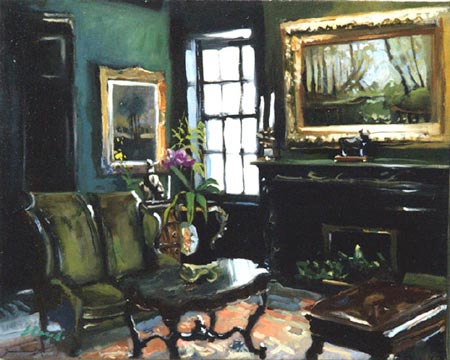
David Lloyd is self-taught as an artist. Born in Virginia and raised in Houston, he studied Drama, English Literature and Philosophy at the University of Houston.Lloyd has developed a style that wavers between painterly realism and a graphic feeling that recalls the modernist influenced styles of mid-20th century illustrators like Al Parker.
Lloyd works in acrylic at a relatively small size (at least in those paintings for which I can find sizes), frequently 8×10″ (20x25cm).
Lloyd’s subjects range from mountainous landscapes to intimate still lifes to portraits and figurative works to illuminated night streets mirrored in rain. My favorites are his quiet interiors, their subtle darks in sharp contrast to brightly illuminated windows.
There is often a sketch-like feeling to the drawing component of his paintings, in which verticals are left casually askew and forms are briefly suggested.
At other times the works can feel more finished, as in the image above; there is always a feeling, though, that he has stopped at the moment when there was “enough” to the image, never pushing into the dangerous territory of potentially overworking the painting.
Lloyd maintains both an Artblog, where he posts recent paintings, and a Sketchblog, in which he posts his sketches which are frequently done in pen and ink on toned paper, occasionally accented with wash.
Lloyd is represented by the Jean Bragg Gallery and the Canal Street Gallery in Houston, as well as making his work directly available through his web site.
Categories:




Charley’s Picks
Bookshop.org
(Bookshop.org affilliate links; sales benefit independent bookshop owners; I get a small percentage to help support my work on Lines and Colors)

John Singer Sargent: Watercolors


Urban Sketching: Understanding Perspective


Charley’s Picks
Amazon
(Amazon.com affiliate links; sales go to a larger yacht for Jeff Bezos; but I get a small percentage to help support my work on Lines and Colors)
John Singer Sargent: Watercolors
Urban Sketching: Understanding Perspective