


Categories
- 3d CGI
- Amusements
- Animation
- Anime & Manga
- Art Materials
- Art Videos
- Blogroll
- Cartoons
- Color
- Comics
- Concept & Visual Dev.
- Creativity
- Digital Art
- Digital Painting
- Displaying Art on the Web
- Drawing
- Eye Candy for Today
- Gallery and Museum Art
- High-res Art Images
- Illustration
- Motion Graphics & Flash
- Museums
- Online Museums
- Outsider Art
- Painting
- Painting a Day
- Paleo Art
- Pastel, Conté & Chalk
- Pen & Ink
- Prints and Printmaking
- Reviews
- Sc-fi and Fantasy
- Sculpture & Dimensional
- Site Comments
- Sketching
- Storyboards
- Tools and Techniques
- Uncategorized
- Vector Art
- Videos & Podcasts
- Vision and Optics
- Watercolor and Gouache
- Webcomics
Archives
- June 2026
- May 2026
- April 2026
- March 2026
- February 2026
- January 2026
- December 2025
- November 2025
- October 2025
- September 2025
- August 2025
- July 2025
- June 2025
- May 2025
- January 2025
- December 2024
- November 2024
- October 2024
- September 2024
- August 2024
- June 2024
- April 2024
- March 2024
- February 2024
- January 2024
- December 2023
- November 2023
- October 2023
- September 2023
- August 2023
- July 2023
- May 2023
- April 2023
- March 2023
- February 2023
- January 2023
- December 2022
- November 2022
- September 2022
- August 2022
- July 2022
- June 2022
- May 2022
- April 2022
- March 2022
- February 2022
- January 2022
- December 2021
- November 2021
- October 2021
- September 2021
- August 2021
- July 2021
- June 2021
- May 2021
- April 2021
- March 2021
- February 2021
- January 2021
- December 2020
- November 2020
- October 2020
- September 2020
- August 2020
- July 2020
- June 2020
- May 2020
- April 2020
- March 2020
- February 2020
- January 2020
- December 2019
- November 2019
- October 2019
- September 2019
- August 2019
- July 2019
- June 2019
- May 2019
- April 2019
- March 2019
- February 2019
- January 2019
- December 2018
- November 2018
- October 2018
- September 2018
- August 2018
- July 2018
- June 2018
- May 2018
- April 2018
- March 2018
- February 2018
- January 2018
- December 2017
- November 2017
- October 2017
- September 2017
- August 2017
- July 2017
- June 2017
- May 2017
- April 2017
- March 2017
- February 2017
- January 2017
- December 2016
- November 2016
- October 2016
- September 2016
- August 2016
- July 2016
- June 2016
- May 2016
- April 2016
- March 2016
- February 2016
- January 2016
- December 2015
- November 2015
- October 2015
- September 2015
- August 2015
- July 2015
- June 2015
- May 2015
- April 2015
- March 2015
- February 2015
- January 2015
- December 2014
- November 2014
- October 2014
- September 2014
- August 2014
- July 2014
- June 2014
- May 2014
- April 2014
- March 2014
- February 2014
- January 2014
- December 2013
- November 2013
- October 2013
- September 2013
- August 2013
- July 2013
- June 2013
- May 2013
- April 2013
- March 2013
- February 2013
- January 2013
- December 2012
- November 2012
- October 2012
- September 2012
- August 2012
- July 2012
- June 2012
- May 2012
- April 2012
- March 2012
- February 2012
- January 2012
- December 2011
- November 2011
- October 2011
- September 2011
- August 2011
- July 2011
- June 2011
- May 2011
- April 2011
- March 2011
- February 2011
- January 2011
- December 2010
- November 2010
- October 2010
- September 2010
- August 2010
- July 2010
- June 2010
- May 2010
- April 2010
- March 2010
- February 2010
- January 2010
- December 2009
- November 2009
- October 2009
- September 2009
- August 2009
- July 2009
- June 2009
- May 2009
- April 2009
- March 2009
- February 2009
- January 2009
- December 2008
- November 2008
- October 2008
- September 2008
- August 2008
- July 2008
- June 2008
- May 2008
- April 2008
- March 2008
- February 2008
- January 2008
- December 2007
- November 2007
- October 2007
- September 2007
- August 2007
- July 2007
- June 2007
- May 2007
- April 2007
- March 2007
- February 2007
- January 2007
- December 2006
- November 2006
- October 2006
- September 2006
- August 2006
- July 2006
- June 2006
- May 2006
- April 2006
- March 2006
- February 2006
- January 2006
- December 2005
- November 2005
- October 2005
- September 2005
- August 2005
Relevant Blogs
Art, Painting & Sketch
- Gurney Journey
- Underpaintings
- Art and Influence
- Painting Perceptions
- Oil Painters of America
- Vasari Paint POV
- Flying Fox
- Urban Sketchers
- Bento (Smithsonian)
- Art Inconnu
- The Hidden Place
- Still Life
- Making a Mark
- The Art of the Landscape
- Exploring Color & Creativity
- Art Contrarian
- Artist A Day
- beinArt Surreal Art Collective
- Eye Level
- David Dunlop
- p.i.g.m.e.n.t.i.u.m
- CultureGrrl
- Joaquín Sorolla blog
- Artists in Pastel
“Painting a Day”
- A Painting a Day (Keiser)
- On Painting (Keiser)
- Julian Merrow-Smith
- Karen Jurick
- Jeffrey Hayes
- Carol Marine
- Abbey Ryan
- Daily Paintworks
Other Painting Blogs
- Virtual Gouache Land
- Neil Hollingsworth
- Marc Hanson
- Kevin Menck
- Marc Dalessio
- Larry Seiler
- Stapleton Kearns
- Colin Page
- Roos Schuring
- Hans Versfelt
- Titus Meeuws
- Régis Pettinari
- René Plein Air
- Belinda Del Pesco
- Robin Weiss
- Nathan Fowkes (Land Sketch)
- William Wray
- Frank Serrano
- Stephen Magsig
- Michael Chesley Johnson
- Twice a Week
- Sarah Wimperis
- Rob Adams
- Michael Cole Manley
- The Dirty Palette Club
- Mike Manley’s Draw!
Gallery Art & Illustration mix
Illustration
- Howard Pyle
- 100 Years of Illustration
- BibliOdyssey
- Illustration Art
- Today’s Inspiration
- Illustration Mundo
- Little Chimp Society
- Danny Gregory
- R D (John Martz
- Illustration Friday blog
- Monster Brains
- Illustrators & Illustrations (RU)
- Elwood H. Smith
- DaniDraws.com
- Designers Who Blog
- iSpot Blog
Sci-Fi & Fantasy
Illustration & Comics
Comics & Cartoons
- Comics Beat
- Robot 6
- Newsarama Blog
- Comic Vine
- Comics Alliance
- Forbidden Planet Int.
- Paolo Rivera
- Bolt City
- Flight
- Scott McCloud
- The Comics Journal
- Comixpedia
- Funnybook Babylon
- James Baker
- Middleton’s Sketchbook
- Boneville
- The Hotel Fred
- Paul Rivoche
- Daily Cartoonist
- Mad About Cartoons (William Wray)
- Digital Strips
Illustration & Concept
Animation & Concept
- Cartoon Brew
- Animation Blog
- Cold Hard Flash
- Concept Art World
- The CAB
- FY Concept Art
- Concept Ships
- Concept Robots
- John Nevarez
- Armand Serrano
- Marcos Mateu-Mestre
- all kinds of stuff (Kricfalusi)
- Yacin the faun (Man Arenas)
- Kelsey Mann
- Cre8tivemarks Blog
- Ice-Cream Monster Toon Cafe
- AAU Character & Creature Design
- AAU Animation Notes
- Articles and Texticles
Paleo & Scientific
Tools & Techniques
Other
Lists of Art Blogs
Art Image Resource Links
Historic Art Images
- Wikimedia Commons: Paintings
- Wikimedia Commons: Drawings
- The Athenaeum
- WikiArt (WikiPaintings)
- Google Art Project: Artists
- Google Art Project: Collections (Museums)
- ArtCyclopedia
- Web Gallery of Art
- Art Renewal Center
- Web Gallery of Impressionism
Auction Consolidation sites
Auction sites
- Sotheby’s
- Bonham’s
- Christies
- Heritage Auctions: Fine Art
- Heritage Auctions: Illustration
- Freeman’s Auctions
- Bukowskis
- Shannon’s
Image Search
Reverse Image Search (search by image)
- Tin Eye
- RevImg
- Google Image Search (camera icon)
- Bing Image Search (camera icon)
Promoting some friends and some clients of my website design business
- Twin Willows T’ai Chi studio in Wilmington DE. Taiji classes with Bryan Davis.
- Ray Hayward, Inspired Teacher of T’ai Chi ( Taiji ) in Minneapolis, Founder of Mindful Motion Tai Chi Academy
- OldHead Tattoo studio and Art Gallery in Wilmington DE. Tattoos and paintings by Bruce Gulick
- Sharon Domenico Art, pet portrait oil paintings
- Platinum Paperhanging, wallpaper hanging, Main Line and Philadelphia, PA
- Lisa Stone Design, interior designer, Main Line and Philadelphia, PA
- Studio12KPT, original art, prints, calendars and other custom printed items by Van Sickle & Rolleri
-
Carlos Cabrera

Carlos Cabrera is an Argentinean concept artist and illustrator who works primarily in the gaming industry. His online Portfolio has images from some of his projects, though some are not represented because of non-disclosure agreements.The About page on his site mentions some of the projects he has worked on and describes his role in their creation.
Cabrera creates really fun monsters, dragons and bizarre animal characters, and paints them with a loose, open style enlivened with the textures of digital brushstrokes.
His portfolio is complimented by step-by-step images of works in progress like this sequence for the image above, as well as several large (100 – 300mb) DivX AVI format video tutorials of various digital painting techniques in Photoshop. (His Tutorials page includes links to download free AVI players for Mac and DivX Codecs for Windows, if you’re not already equipped to view DivX AVI.)
He also contributed, along with Mike Corriero, to Speed Painting tutorials in a downloadable PDF file of articles from the 2DArtist Magazine. (The PDF is accessible from the same page as the video tutorials).
Note: some material may be NSFW.
Categories:
-
Paul S. Brown
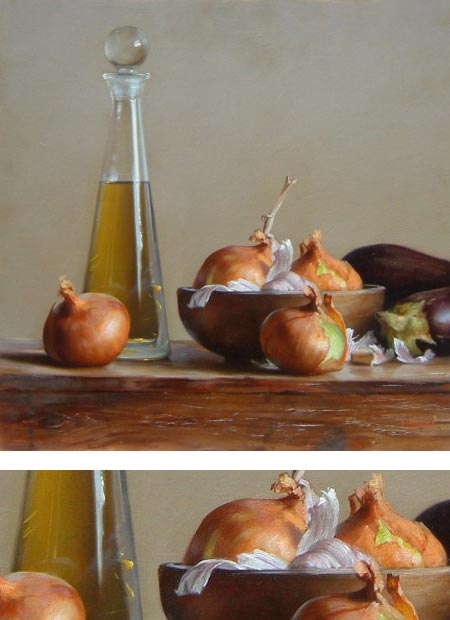
Paul S. Brown paints clarity and stillness.In the process he also does some exceptional still life paintings.
Brown is represented by the Gandy Gallery, a bastion of classical realism, and the selection of his work visible there includes a number of still life paintings, as well as several portraits and self-portraits and a small selection of drawings. I was unable to locate a web presence for the artist other than the Gandy Gallery site.
Brown was born in the U.S., and now lives in the UK. Along the way he studied in the U.S. and later studied and then taught at the Florence Academy of Art in Italy.
Brown’s still life paintings are in the classical tradition in more than one way; they are carefully chosen and arranged tableaux of traditional still life subjects, fruit, vegetables, dish and glassware, set on table tops or tablecloths, and painted with an eye to the Dutch genre painters, but with a vibrant, painterly handling of the materials and a sharp, contemporary sensibility for color.
His objects, in particular vegetables and fruit, carry a tactile sensation of both the physical surface of the objects themselves, the rough sheen of a zucchini, the glossy smoothness of an eggplant or the crisp crinkle of an onion’s skin, and the physical reality of paint on a surface. Though he will sometimes set them against more complex backgrounds, he more often sets his objects off with deceptively simple fields of color, that actually are carefully controlled and contain variations of hue and texture that are a subtle part of the composition, and serve to lead your eye around the work as a more complex background might.
His simple objects are often resting on interesting surfaces, textured wood, smooth but variegated marble, or rows and folds of arranged cloth.
To me, the paintings seem to speak of quite contemplation and the zen-like selfless state that sometimes comes of relaxed focus and careful observation of the visual world.
Categories:
-
Martin French

California born illustrator Martin French graduated from the Art Center College of Design and now lives in Oregon, where he serves as Illustration Chair for the new BFA Illustration program, which he helped found, at the Pacific Northwest College of Art in Portland.His professional work includes graphics for the Salt Lake City Olympics and the Grammy Awards; and illustrations for clients like Apple, Pepsi, Dreamworks, Time Warner, Nike, National Geographic, Scholastic and Dutton. He has received recognition from American Illustration, Communication Arts, Graphis Print, Spectrum and the Society of Illustrators, among others.
French has a web site and blog and a gallery on the site of his rep, Morgan Gaynin.
He works in what he terms “mixed media”, which looks to be largely ink and watercolor or gouache, but his work is “mixed media” in another sense. His illustrations are a beautiful integration of the disciplines of drawing, painting and design.
French carves up his image area into blocks of lively color, across which his figures appear to be splayed with effortless confidence. He then surrounds and envelops them with dazzling, energetic elements of line, color, spatter, textures, and vivid brushstrokes.
The resulting images are amazingly lively and energetic; frenetic but never chaotic, and forceful without being forced. His portrayals of musicians, singers and dancers, in particular, are ringing with graphic elements that seem to be evocations of musical textures, calligraphic ink lines suggestive of loud and soft passages and color elements that feel like swooping basslines, dashes of high notes and soaring melodies.
Categories:
-
Gian Lorenzo Bernini

In my mind there is a “short list” of great sculptors. In chronological order, it goes: Donatello, Michelangelo, Bernini.There are others, of course, but these guys have the corner offices. If I were being generous, I might give an office to Rodin as well, but he would be a junior partner in the firm. Up in the penthouse, there are a couple of ancient Greek geniuses from whom these guys essentially learned everything, but we don’t know their names.
Even though Bernini didn’t get to have a Teenage Mutant Ninja Turtle named after him (quel dommage!), his place on my personal list is assured.
Donatello was the one who picked up the torch of of the classical Greek sculptors and made it blaze again; and Michelangelo was supremely dramatic, larger than life in more ways than one; but Bernini, ah… Bernini was the mage, the sorcerer, the Vermeer of sculpture (not a phrase I take lightly). If Vermeer was master of light and time, Bernini was master of space.
I didn’t come to that conclusion from photographs of his work. The portrayal of sculpture is one area where photographs, books and the web let us down, allowing only a glimpse at the reality of sculpture as a definition of space. You only truly experience sculpture when you physically inhabit the same space. Great sculpture reaches out, like invisible Einsteinian gravitational folds, and changes the space around it, making it alive with its presence.
Painters create by adding, stone sculptors by subtracting, taking away material that defines the space around the object. Yes, painters work with the yin and yang of space and object as well, but you generally can’t saunter around in the space of a painting.
You don’t simply look at sculpture, the way you might at a painting, immersing yourself in a scene through the portal of the picture frame, you dance with sculpture. You walk around it, first one way, then the other; you step up, you step back; you alamand left, dosey doe and bow to your partner. Great sculpture reveals itself as you change your relationship to it, modifying your view until the interrelated forms, and the space they define, are assembled complete, like a CGI model in your head.
So my take on Bernini doesn’t come from books or photographs, though I was familiar with him from those sources, but from my experiences during a trip to Rome of walking around his sculptures in the Fountain of the Four Rivers in the Piazza Navona, The Fountain of Triton in the Piazza Barberini, and in particular, his works in the Galleria Borghese. There are four of his amazing sculptures displayed prominently in the Borghese’s galleries, but I’ll focus on one of them.
Ironically, after I’ve made so much noise about viewing sculpture from all sides, Bernini meant for Apollo and Daphne (shown in two slightly different views, above) to be seen from a particular vantage point (which you never see in photographs), as though you were coming up behind Apollo, who has been struck with Eros’ famous arrow and, enraptured with love, is pursuing the nymph Daphne. Daphne has been hit with Eros’ lesser known other arrow, causing her to despise the very thought of love, and has called upon her father, the river god, to transform her into a tree to free her from Apollo’s grasp; a transformation we are witness to in the moment Bernini has cast his own magic spell, capturing them both in gleaming marble.
Daphne’s curled tresses, streaming out behind her, are morphing at their ends into leaves, intertwined with the branches of her delicate fingers. The areas where her flesh is turning to bark also serve to remind us that she is, in reality, emerging from stone, in the sculptural equivalent of a life-like painting or drawing that fades at its edges to reveal that it is actually marks on a surface and not a person, as in Ruben’s remarkable Portrait of Isabella Brandt.
Try to keep in your mind as you gaze at Bernini’s lithe and fluid figures (and other great sculptures of this kind) that this is stone we are looking at!
Compare Bernini’s David, in dramatic motion, his face contorted with intensity (and modeled after Bernini’s own), to Donatello’s beautifully modeled but weirdly effeminate version; and to Michelangelo’s famous and monumentally heroic, but statically posed, figure.
Bernini was also a painter, draftsman and architect, and designed the dramatic piazza and colonnades of St. Peter’s Basilica in Rome, as well as several palaces, churches and facades for churches, altars and public fountains.
The PBS series, Power of Art, continues tonight with Bernini as it’s theme, and focuses on his amazing sculptural arrangement and painted wood construction, The Ecstasy of St. Theresa. (I’m hoping this chapter of the program focuses more on the work and less on grimacing actors.)
Video is actually a much better vehicle for examining sculpture than photography, with its ability to move around the work. Short of seeing Bernini’s work in person (The Artcyclopedia lists museums where you can do that) it’s probably the best we can do, since there unfortunately is no large repository of Quicktime VR files of great sculpture on the web that I’m aware of (but what a great idea that would be)!
Categories:
-
Laurent Beauvallet

Laurent Beauvallet is a French illustrator and concept artist now living in England. He has worked on a number of well known collectable card games like Legend of the Five Rings (image above), Everquest, Warhammer40K and Star Wars, as well as console games like Nightmare Creatures, Galleon and Heavenly Sword.His illustrations have appeared on the covers of numerous books, as well as magazines like Heavy Metal and have been featured in the Spectrum collections of contemporary fantastic art.
His web site includes galleries of his concept art and character design, sorted by project, and illustration, which includes book cover art, work for collectable card games as well as portraits, unpublished and personal work, life studies, gesture drawings and travel sketches. In addition, the Information page has a gallery of cover art at the bottom of the page.
Though his site doesn’t talk about process, it looks to me as though Beauvallet works primarily digitally for his professional work, but he achieves a nice painterly look of brushstrokes and blending. His images look unfussed with, as though the first strokes were left in place, giving them a nice fresh feeling. He will often create compositions that are almost monochromatic except for the main characters. He appears to work with traditional drawing media for life studies and sketching.
Beauvallet also maintains a blog called parvo beati (meaning “happy with little”), which includes more of his quick sketches from life. There is an interview with the artist in a recent issue of 2d Artist, the PDF magazine. You can download the interview as a separate PDF.
Categories:
-
Nick Bertozzi

One of the great things about the burgeoning independent comics scene here in the U.S. is that a wider readership is beginning to see beyond the narrow cliché of “comics = superheroes” that has dominated the public’s general perception of what comics are, and open their eyes to some of the wider possibilities of the medium.Comics (graphic stories) are a terrific place, for example, for cultural mash-ups, and a wonderful case in point is Nick Bertozzi’s “art history by way of noir murder mystery with a touch of supernatural fantasy graphic novel”, The Salon.
Set in the pre-modernist cultural stew of Paris 100 years ago, the story pulls together protagonists like Picasso, Braque, Gertrude Stein, Leo Stein, Erik Sati and Guillaume Apollinaire in a fantastical murder mystery, in the course of which we are given the birth of Cubism revealed in discussions on a train and scrawls on a napkin.
Bertozzi weaves his tale in horizontal panels, giving it a somewhat cinematic consistency, and throws his images at us with brusquely drawn, rough edged ink lines, at times using intentional crudeness to push them in our face, at other times pulling back into woodcut-like refinement, and casts them in hauntingly expressive duotones.
His story, likewise, swings from from refined to crude, from intellectual ponderings on the nature of art to sex scenes and the scatological details of Georges Braque squatting on a chamber pot. Throughout it all, Bertozzi makes it abundantly clear that this particular story could not have been told effenctively in any way other than the unique synergy of words and pictures that we call comics.
You can read the first few pages online here (though the link for the fourth one seems broken at the moment), and a few others in the course of this interview with Bertozzi on The Comics Reporter; or you can watch a short promotional video. The fact that a “trailer” for a comics story feels natural points up the often mentioned relationship between comics and film. There is also a short film linked from Bertozzi’s site on The Making of Salon.
Ths comics page on his site features glimpses at some of Bertozzi’s other stories, including his recent collaboration with Jason Lutes, Houdini: The Handcuff King (the first title released under the auspices of The Center for Cartoon Studies), Drop Ceiling, an ongoing story originally serialized in Rubber Necker, and another history-based story, this one closer to actual history, of Ernest Shackelton.
Bertozzi also has illustration clients that include The New York Times, Fortune, SPIN Magazine and others. In addition he teaches a Comicbook Storytelling Workshop at the School of Visual Arts in New York.
Categories:




Charley’s Picks
Bookshop.org
(Bookshop.org affilliate links; sales benefit independent bookshop owners; I get a small percentage to help support my work on Lines and Colors)

John Singer Sargent: Watercolors


Urban Sketching: Understanding Perspective


Charley’s Picks
Amazon
(Amazon.com affiliate links; sales go to a larger yacht for Jeff Bezos; but I get a small percentage to help support my work on Lines and Colors)
John Singer Sargent: Watercolors
Urban Sketching: Understanding Perspective