


Categories
- 3d CGI
- Amusements
- Animation
- Anime & Manga
- Art Materials
- Art Videos
- Blogroll
- Cartoons
- Color
- Comics
- Concept & Visual Dev.
- Creativity
- Digital Art
- Digital Painting
- Displaying Art on the Web
- Drawing
- Eye Candy for Today
- Gallery and Museum Art
- High-res Art Images
- Illustration
- Motion Graphics & Flash
- Museums
- Online Museums
- Outsider Art
- Painting
- Painting a Day
- Paleo Art
- Pastel, Conté & Chalk
- Pen & Ink
- Prints and Printmaking
- Reviews
- Sc-fi and Fantasy
- Sculpture & Dimensional
- Site Comments
- Sketching
- Storyboards
- Tools and Techniques
- Uncategorized
- Vector Art
- Videos & Podcasts
- Vision and Optics
- Watercolor and Gouache
- Webcomics
Archives
- August 2026
- July 2026
- June 2026
- May 2026
- April 2026
- March 2026
- February 2026
- January 2026
- December 2025
- November 2025
- October 2025
- September 2025
- August 2025
- July 2025
- June 2025
- May 2025
- January 2025
- December 2024
- November 2024
- October 2024
- September 2024
- August 2024
- June 2024
- April 2024
- March 2024
- February 2024
- January 2024
- December 2023
- November 2023
- October 2023
- September 2023
- August 2023
- July 2023
- May 2023
- April 2023
- March 2023
- February 2023
- January 2023
- December 2022
- November 2022
- September 2022
- August 2022
- July 2022
- June 2022
- May 2022
- April 2022
- March 2022
- February 2022
- January 2022
- December 2021
- November 2021
- October 2021
- September 2021
- August 2021
- July 2021
- June 2021
- May 2021
- April 2021
- March 2021
- February 2021
- January 2021
- December 2020
- November 2020
- October 2020
- September 2020
- August 2020
- July 2020
- June 2020
- May 2020
- April 2020
- March 2020
- February 2020
- January 2020
- December 2019
- November 2019
- October 2019
- September 2019
- August 2019
- July 2019
- June 2019
- May 2019
- April 2019
- March 2019
- February 2019
- January 2019
- December 2018
- November 2018
- October 2018
- September 2018
- August 2018
- July 2018
- June 2018
- May 2018
- April 2018
- March 2018
- February 2018
- January 2018
- December 2017
- November 2017
- October 2017
- September 2017
- August 2017
- July 2017
- June 2017
- May 2017
- April 2017
- March 2017
- February 2017
- January 2017
- December 2016
- November 2016
- October 2016
- September 2016
- August 2016
- July 2016
- June 2016
- May 2016
- April 2016
- March 2016
- February 2016
- January 2016
- December 2015
- November 2015
- October 2015
- September 2015
- August 2015
- July 2015
- June 2015
- May 2015
- April 2015
- March 2015
- February 2015
- January 2015
- December 2014
- November 2014
- October 2014
- September 2014
- August 2014
- July 2014
- June 2014
- May 2014
- April 2014
- March 2014
- February 2014
- January 2014
- December 2013
- November 2013
- October 2013
- September 2013
- August 2013
- July 2013
- June 2013
- May 2013
- April 2013
- March 2013
- February 2013
- January 2013
- December 2012
- November 2012
- October 2012
- September 2012
- August 2012
- July 2012
- June 2012
- May 2012
- April 2012
- March 2012
- February 2012
- January 2012
- December 2011
- November 2011
- October 2011
- September 2011
- August 2011
- July 2011
- June 2011
- May 2011
- April 2011
- March 2011
- February 2011
- January 2011
- December 2010
- November 2010
- October 2010
- September 2010
- August 2010
- July 2010
- June 2010
- May 2010
- April 2010
- March 2010
- February 2010
- January 2010
- December 2009
- November 2009
- October 2009
- September 2009
- August 2009
- July 2009
- June 2009
- May 2009
- April 2009
- March 2009
- February 2009
- January 2009
- December 2008
- November 2008
- October 2008
- September 2008
- August 2008
- July 2008
- June 2008
- May 2008
- April 2008
- March 2008
- February 2008
- January 2008
- December 2007
- November 2007
- October 2007
- September 2007
- August 2007
- July 2007
- June 2007
- May 2007
- April 2007
- March 2007
- February 2007
- January 2007
- December 2006
- November 2006
- October 2006
- September 2006
- August 2006
- July 2006
- June 2006
- May 2006
- April 2006
- March 2006
- February 2006
- January 2006
- December 2005
- November 2005
- October 2005
- September 2005
- August 2005
Relevant Blogs
Art, Painting & Sketch
- Gurney Journey
- Underpaintings
- Art and Influence
- Painting Perceptions
- Oil Painters of America
- Vasari Paint POV
- Flying Fox
- Urban Sketchers
- Bento (Smithsonian)
- Art Inconnu
- The Hidden Place
- Still Life
- Making a Mark
- The Art of the Landscape
- Exploring Color & Creativity
- Art Contrarian
- Artist A Day
- beinArt Surreal Art Collective
- Eye Level
- David Dunlop
- p.i.g.m.e.n.t.i.u.m
- CultureGrrl
- Joaquín Sorolla blog
- Artists in Pastel
“Painting a Day”
- A Painting a Day (Keiser)
- On Painting (Keiser)
- Julian Merrow-Smith
- Karen Jurick
- Jeffrey Hayes
- Carol Marine
- Abbey Ryan
- Daily Paintworks
Other Painting Blogs
- Virtual Gouache Land
- Neil Hollingsworth
- Marc Hanson
- Kevin Menck
- Marc Dalessio
- Larry Seiler
- Stapleton Kearns
- Colin Page
- Roos Schuring
- Hans Versfelt
- Titus Meeuws
- Régis Pettinari
- René Plein Air
- Belinda Del Pesco
- Robin Weiss
- Nathan Fowkes (Land Sketch)
- William Wray
- Frank Serrano
- Stephen Magsig
- Michael Chesley Johnson
- Twice a Week
- Sarah Wimperis
- Rob Adams
- Michael Cole Manley
- The Dirty Palette Club
- Mike Manley’s Draw!
Gallery Art & Illustration mix
Illustration
- Howard Pyle
- 100 Years of Illustration
- BibliOdyssey
- Illustration Art
- Today’s Inspiration
- Illustration Mundo
- Little Chimp Society
- Danny Gregory
- R D (John Martz
- Illustration Friday blog
- Monster Brains
- Illustrators & Illustrations (RU)
- Elwood H. Smith
- DaniDraws.com
- Designers Who Blog
- iSpot Blog
Sci-Fi & Fantasy
Illustration & Comics
Comics & Cartoons
- Comics Beat
- Robot 6
- Newsarama Blog
- Comic Vine
- Comics Alliance
- Forbidden Planet Int.
- Paolo Rivera
- Bolt City
- Flight
- Scott McCloud
- The Comics Journal
- Comixpedia
- Funnybook Babylon
- James Baker
- Middleton’s Sketchbook
- Boneville
- The Hotel Fred
- Paul Rivoche
- Daily Cartoonist
- Mad About Cartoons (William Wray)
- Digital Strips
Illustration & Concept
Animation & Concept
- Cartoon Brew
- Animation Blog
- Cold Hard Flash
- Concept Art World
- The CAB
- FY Concept Art
- Concept Ships
- Concept Robots
- John Nevarez
- Armand Serrano
- Marcos Mateu-Mestre
- all kinds of stuff (Kricfalusi)
- Yacin the faun (Man Arenas)
- Kelsey Mann
- Cre8tivemarks Blog
- Ice-Cream Monster Toon Cafe
- AAU Character & Creature Design
- AAU Animation Notes
- Articles and Texticles
Paleo & Scientific
Tools & Techniques
Other
Lists of Art Blogs
Art Image Resource Links
Historic Art Images
- Wikimedia Commons: Paintings
- Wikimedia Commons: Drawings
- The Athenaeum
- WikiArt (WikiPaintings)
- Google Art Project: Artists
- Google Art Project: Collections (Museums)
- ArtCyclopedia
- Web Gallery of Art
- Art Renewal Center
- Web Gallery of Impressionism
Auction Consolidation sites
Auction sites
- Sotheby’s
- Bonham’s
- Christies
- Heritage Auctions: Fine Art
- Heritage Auctions: Illustration
- Freeman’s Auctions
- Bukowskis
- Shannon’s
Image Search
Reverse Image Search (search by image)
- Tin Eye
- RevImg
- Google Image Search (camera icon)
- Bing Image Search (camera icon)
Promoting some friends and some clients of my website design business
- Twin Willows T’ai Chi studio in Wilmington DE. Taiji classes with Bryan Davis.
- Ray Hayward, Inspired Teacher of T’ai Chi ( Taiji ) in Minneapolis, Founder of Mindful Motion Tai Chi Academy
- OldHead Tattoo studio and Art Gallery in Wilmington DE. Tattoos and paintings by Bruce Gulick
- Sharon Domenico Art, pet portrait oil paintings
- Platinum Paperhanging, wallpaper hanging, Main Line and Philadelphia, PA
- Lisa Stone Design, interior designer, Main Line and Philadelphia, PA
- Studio12KPT, original art, prints, calendars and other custom printed items by Van Sickle & Rolleri
-
Eye Candy for Today: Julian Alden Weir’s The Factory Village

The Factory Village, Julian Alden WeirIn the collection of the Metropolitan Museum of Art. Use the “Download” or “Enlarge” links under the image on their site.
In this late 19th century scene — that makes factory life seem almost idyllic — I love Weir’s textural application of paint and the way he uses it to soften his edges, particularly in the trunk and branches of the tree.
Categories:
-
DIY Pochade Boxes – make your own cheap pochade box from simple materials

As I pointed out in my previous post on making DIY pochade boxes out of cigar boxes, the cost of a commercial pochade box can sometimes be prohibitive, particularly for those on a tight budget or who are as yet uncertain if they want to commit serious resources to plein air painting.
So blog posts and videos in which artists share their designs for Do It Yourself pochade boxes are becoming more common. Though the cigar box conversion is the most common, there are also more ambitious designs either built from scratch materials or from larger found wooden boxes, as well as some unorthodox starting points like office form holders and even a laptop computer shell.
I’ve gathered a few of them here — certainly not comprehensive, but hopefully representative and useful. Some are quite detailed and extensive in their descriptions and instructions, others are a bit sketchy, but I’ve tried to include those that have techniques of interest. Some even offer printed plans, either for free or for a reasonable fee.
Though there are some exceptions, most of these posts and videos are less than professionally presented. For an alternative with details and high production values, see my recent post about James Gurney’s new video on How to Make a Sketch Easel.
Look around with a search engine (particularly by using image search) and you will likely find more posts and videos on DIY pochade boxes; even those without details can offer food for thought. For those who have accounts, you may find additional resources on sites like Wet Canvas or Pinterest.
I’ll follow up this post in the next few days with a refreshed version of my original post on Pochade Boxes, that offers an overview of commercially available options.
Blog posts
 Jim Sterrett
This influential 2009 post on how to build a “Sterrett Box”, as it came to be called, was the second DIY pochade box I remember seeing on the web, after Ellie Clemon’s cigar box pochade box post in 2004 (see my previous article on DIY Cigar Box pochade boxes). Sterrett also published a post on diy pochade boxes by others inspired by his design, and another on his plans for making a wet panel carrier. Sketchin Dan
Not really a blog post, but a series of annotated photos on Flickr, this is also one of the older examples I’m aware of in which an artist shares their home made pochade box design. Darrell Anderson
Made from cut lumber, this box will take panels up to 18 inches and includes a camera mount for taking time-lapse shots of paintings in progress. Jeremy Sams
This 9 1/4 x 11 1/2″ box, meant to handle 8 x 10 panels, features a tip-out hinged brush holder. David Gluck
This box starts out with two 12×16 cradled birch painting panels, and provides a large mixing area. Directions are fairly extensive and it looks like the size could likely be easily reduced by using smaller panels. Carol L. Douglas
In this unusual metal design, the starting point is an aluminum form holder and the end result is very lightweight.YouTube videos
 Hugo Dolores
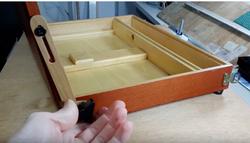
In this two part video (part 2 here), the artist starts out with a found wooden box (larger than a cigar box, eBay maybe?), but gives worthwhile ideas and details for the hardware and compartment adaptations to make a pochade box suitable for either oil or watercolor.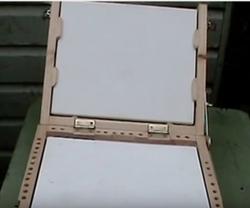 J. Geekie
Geekie has apparently gone through several iterations of his design, and you may find additional details, as well as alternate designs in other videos. Videos are hand-held and a bit shaky, but I thought the designs interesting enough to be worth sharing. Karen McLain
In this unusual bit of recycling, McLain takes the screen and components out of a defunct laptop computer and turns its case into pochade box without a tripod mount, simply held on a lap, table or stool. Larisa Carli
In this annotated time-lapse video, Carli starts with a found wooden box, but gives enough information to be useful in building a pastel-specific pochade box. Mustafa Jannan
Video is wordless and annotated in German and English, with enough interesting ideas to be worthwhile. Richard Kooyman
In this basic design, panels are held in place with a simple spring clamp, but the box looks sturdy, has double brackets to hold the lid in place and features panel storage. Scott Ruthven
Ruthven’s video is more an annotated demo than instructions, but the box is quite nicely designed. Tension for the panel holder is provided by a bungee cord. WBarts
A short, wordless annotated video, but the details are in the Comments area — Click on “Show More” under the video. Includes links to additional detail photos on Flickr.Blog posts & videos with printed plans
 Bob Perrish – Artist Easel Plans
This long running site started with a set of plans for a pochade box that the author called “The Ttanium Easel” (at left). It features slide-out shelves and a lift-out under-palette tray for either panels or materials. Perrish has expanded the offerings over time to include plans for a dedicated pastel box, a watercolor box and a lighter variation pochade box without the storage compartment but with a detachable side tray. He also offers plans for actual in-studio easels. He describes the plans here.
As of this writing, his pochade box plans sell for $20.00. Christopher Clark
In addition to his blog post, on which he offers free PDF plans, Clark also has a YouTube video about his DIY pochade box.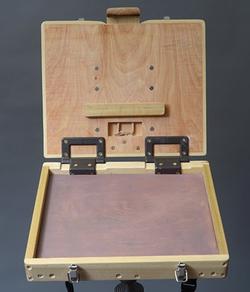 Howard Lyon
In an extensive post on the Muddy Colors group blog, Howard Lyon gives detailed instructions, a parts list and free diagram images with materials and sizes. The box features extra strong hinges, and an adjustable panel holder system using magnets to position the base and an extendable top holder tensioned by rubber bands. Zan Barrage
After some initial versions and revisions demonstrated in YouTube videos (and here), Barrage outlined his DIY pochade box process in a blog post, and now offers downloadable plans for $2.99 through Lulu.
Categories:
-
Gobelins students’ animations for Annecy 2017

As I’ve been noting every year since 2006, each year at this time, small teams of graduating students from Gobelins, l’école de l’image (Gobelins School of Communications) in Paris create short animations (usually about 1 minute) to be used as introductions to each of the five day’s events at the Annecy International Festival of Animation.The emphasis is on 2D hand drawn animation though at least one of this year’s shorts uses CGI. This year’s theme is “La Chine a l’honneur” which I think loosely translates as “Honoring China”.
You can see all five shorts on YouTube. Uncharacteristically this year, there are short ads in front of some of the YouTube videos, but they’re of the kind that can be skipped after a few seconds. (I couldn’t find the shorts on the on the Gobelins website.)
(Note: images above are just screen caps from each of the five films, not clickable embeds. Please follow the provided link to view the films.)
Categories:
-
Eye Candy for Today: Giacomo Guardi gouache painting of Venice

View of the Rialto Bridge, Giacomo GuardiGouache on paper, roughly 5 x 9 inches (13 x 24 cm); in the collection of the Morgan Library and Museum.
On the Morgan’s page, you can use the Download link under the image, or the Zoom tab above it. When using the zoom, it’s helpful to know that in the controls under the image, the last one on the right opens the zoomed image full screen.
When viewed in detail, the wonderful economy of Guardi’s notation becomes evident. Abbreviated brush lines delineate the windows, splashes of opaque gouache form heads and bodies, and brief indications of value change give the buildings dimension. Look at the way the reflections are indicated under the buildings at right.
Categories:
-
DIY Cigar Box Pochade Boxes – make your own cheap pochade box from a cigar box
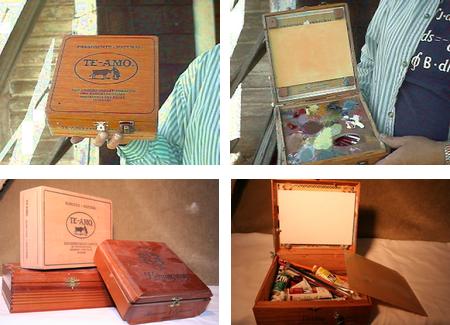
As I described in my original post on the subject (which will be updated shortly), pochade boxes are small, usually wooden boxes, meant to serve as a portable artist’s palette and easel for painting on location. Many also contain storage for supplies. Most are equipped to be mounted to camera tripods, but some are simply meant to be held in one’s lap or set on a table when painting.Pochade boxes have become the defacto standard for plein air painting, largely supplanting the larger French easels and being more common than the field easels and plein air systems meant to handle larger canvases.
Most commercial pochade boxes represent an investment, often a barrier for painters unsure if they want to commit to plein air painting on a regular basis, or for those on a budget.
As of this writing, the least expensive commercial pochade box of which I’m aware is the Guerrilla Painter Pocket Box — a small handheld “thumb box” for 5×7 panels that retails for between $70.00 and $85.00 USD. It has no provision for mounting to a tripod (though holes are drilled for adding a proprietary mounting bracket for an additional $24.00). Most other commercial pochade boxes range in price from $125.00 to $400.00 and up.
So Do It Yourself instructions have gained momentum in recent years. By far, the most common type of these are cigar box to pochade box conversions.
Most cigar stores continually go through cigar boxes as they sell individual cigars, many of them are wood and some are quite nicely finished and well suited in size and shape for making a pochade box. You can usually pick them up either for free or for three or four dollars. Most are made of lightweight wood. When you go looking, you may want to bring a tape measure or typical painting panel to be sure the box you choose will fit your chosen panel size (usually set into the lid).
If you don’t have access to a cigar store, new cigar boxes and similar wooden boxes can be purchased on Amazon (and here), or from craft sources like Michaels or Joann Fabrics for $7.00 or $8.00, though some of these may be too shallow to allow much storage under a palette. You can also check eBay and/or your parent’s attic for any kind of wooden box that seems suitable.
 You could also do a similar conversion from an artist’s sketch box (and here), which would be a more expensive start, but would include a correctly sized palette, stronger hinges and latches, and often a handle.
Most cigar boxes have weak, inexpensive hinges, not likely to hold up under the stress of holding a panel while painting, so they usually need to be replaced or supplemented. Also, some accommodation must be made for holding the lid open at a usable angle when using it as an easel. Most DIY versions will also add a stronger latch and often a handle of some kind. Usually, dowels or small wood blocks are cut to length and glued in the corners of the base to provide a palette support, with space underneath for supplies. Wooden, acrylic or glass palettes must usually be cut to size. Existing wooden palettes can be cut down. Palettes can also be made from masonite painting panels coated in gesso and sanded smooth.
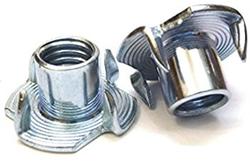 The more complete versions will include a “T-nut“, a threaded mounting that allows for putting the box on a photographic tripod, like most commercial pochade boxes. The appropriate size to match tripod mounts appears to be 1/4-20 (1/4″ diameter, 20 threads per inch). Usually, additional wood must be added in the area of the T-Nut to provide a more solid mounting than the typical cigar box’s thin, light wood.
The boxes without provision for tripod mounting are meant to be used in your lap or on a table. Some have a thumb hole cut into the bottom of one of the compartments, making a “thumb box” that allows the box to be held in one hand like a traditional artist’s palette.
I’ve tried to provide an overview here of some cigar box to pochade box conversions. This is by no means comprehensive, it’s just meant to be a representative sampling with an emphasis on those that I feel convey enough DIY information to be useful. In the listings below, I’ve linked the author’s name to their post or video describing the project.
Most of these instructions are casually presented rather than laid out in comprehensive detail, so you may have to hunt a bit for the relevant details, but we should be appreciative of the time taken by these artists to share their experience and ideas.
I will follow up this post with another devoted to more elaborate DIY pochade box instructions not based on cigar boxes, most of which are larger and can accommodate larger panels, with more adjustment and room for storage, and sharing more features in common with commercial pochade boxes.
Cigar box pochade box conversions –
no tripod mount Ellie Clemens
This was the first mention of building a cigar box pochade box I encountered on the web, and at the time the only one I knew of, so I think of it as the original online instruction for building one, and it is still one of the best. Unfortunately, the original website no longer exists, so I have linked to a version on the Internet Archive.Two strips of lath support the palette, which is cut with a thumb hole so it can be held separately. Brass mending strips and a small bolt hold the lid up and four blocks glued into the lid make a holder for a 5×7 panel.
 Plein Air Muse
This is a pretty basic cigar box conversion, with some dowels supporting the palette and a couple of braces for holding open the lid. Lori McNee
Another straightforward conversion, with wood or plastic blocks for palette supports and wing nuts for the lid. Plastic surface savers and one of the hinge bolts hold the panel in place. There are better photos of her box on Empty Easel.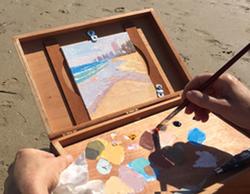 PJ Cook
This cigar box came with a divided tray which sets in the box upside-down to become the palette. A block on the back supports the lid and framing clips hold the panel in place. Sharon Will
A clever use of canvas stretcher keys to support the palette and an unusual slide hinge highlight this conversion. A small L-shaped fastener holds the panel in the lid. Stephen D’Amato
A nicely done cigar box pochade for both watercolor and oil. Metal brackets and a wing nut hold the lid. L-shaped fasteners hold the panel. A leather strap holds the box closed and keeps the panel from sliding out in transit. Plastic watercolor trays have been cut down to fit into the compartment and the oil palette rests above them. Thomas Jefferson Kitts
This conversion is a “thumb box”, meant to be held in one hand like a traditional palette while painting. The bottom is compartmentalized and one compartment has the thumb hole, placed so the box can be balanced in the hand. Everything but the palette surface and panel are removed when painting to keep it as light as possible. A wooden ledge and simple office clips hold the panel in place.Cigar box pochade box conversions –
with T-nut or other tripod mounting Marla Goodman
A box with a larger than usual mixing area, but too shallow to provide much storage. Techniques are applicable to other size boxes. A cut-to-size piece of masonite in the bottom provides the extra depth and strength necessary to use the T-nut. A unique clip and plastic tubing arrangement holds open the lid. Paint stirrers are used to brace the painting panels, which are simply held on with binder clips. Closure is velcro. Gabrielle Sivitz
A two-part post. Not exactly a cigar box, but the principles are the same. A wood block holds the lid up. Four corks cut to size hold the acrylic palette in place, with room underneath for supplies.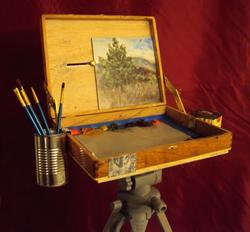 Austin Maloney
Metal “mending strips” and a wing nut hold the lid in position. Another bolt and wing nut in a slot in the lid hold the panel in place. A commercial tripod mounting plate from Guerilla Painter is used instead of a T-nut. Linda Schroeter
This looks like an unusually sturdy cigar box, but the instructions are pretty detailed. Dowels are hot-glued in the corners to support the palette, which is made from a masonite painting panel, painted and cut with a thumb hole to use separately. L-shaped brackets can hold panels in the lid, which is held open with metal braces and a wing nut. An extra piece of wood has been glued to the bottom to support the tripod mount; four rubber feet raise the box above that for use on a table. Frank Hobbs
A clever extender for the panel holder, made from lattice, is a highlight of this functional box. Another piece of lattice provides the extra thickness and strength in the bottom of the box necessary for the T-nut tripod mount. A piece of v-shaped molding serves as a trough to keep the fresh paint separate from the mixing area. A wood strip on the back supports the open lid. Jeff McRobbie
This is probably the best tutorial and most sophisticated design I’ve seen for a DIY cigar box pochade box. The wooden block on the back of the box that holds open the lid in use is set in a slot with a wing nut, allowing the angle of the lid to be adjusted. A square of plywood in the bottom of the box provides the extra depth and strength needed for the T-nut mounting. Strips of narrow wood support the palette, and another is adapted to be a removable brush holder that plugs into the outside of the box with lengths of clothes-hanger wire. The panel holder looks sophisticated, but seems easy enough to construct, and features a wooden adjustment knob on the back of the lid. The panel holder and knob extend a bit from the box when closed, but still make a compact design. smoothie77
This YouTube video (w/skipable ad) shows an interesting conversion with double slide-out trays. A little short on the how-to instructions, but food for thought. Bart Charlow
This YouTube video (no ads) features an unusual configuration with two cigar boxes stacked together. Two mending strips and a thumbscrew hold open the lid. Cork in the lid allows pushpins to hold watercolor paper. A third, shallow cigarbox tucks inside the top of the first and acts as a removable tray that can be attached to the outside of the box with additional thumbscrews and L-brackets. The bottom cigar box is a storage area, and a slide out piece below that holds a brush washer when in use. The tripod mount has not been added at this point.Look around
I will follow this post with another about more elaborate DIY pochade boxes, as well as updating my original post on commercial pochade boxes.
But when looking for ideas for a cigar box conversion, don’t limit yourself to those presented here. Look at the more elaborate homemade boxes as well as the commercial ones to see how they’ve solved the basic problems of storage, palette arrangement, easel adjustment and panel or paper holding for inspiration. You will also find variations aimed more at watercolor or pastels.
If you come up with some clever ideas, consider sharing them with others the way these artists have.
Categories:
-
Eye Candy for Today: Monet’s Springtime

Springtime, Claude MonetLink is to zoomable version on the Google Art Project; downloadable version on Wikipedia; original is in the Walters Art Museum.
In this painting by Monet of his first wife and frequent model, Camille Doncieux, we can see the painter’s fascination with light and color.
The foliage is gesturally indicated, with mere suggestions of leafy texture. The background grass is just brushy patches of color.
Monet’s attention is on Camille’s face, and even more, on her clothing and the dappled sun effects on the dress and foreground grass. Monet has carried the pinks of the dress into the sun splashes in the green grass. Under his guidance, our eye sees it as natural.
The rendering of the dress is more subtle than it first appears, with shifting areas of almost complementary color held in check by careful matching of value.
The variation of color just in the bonnet is remarkable.
Categories:




Charley’s Picks
Bookshop.org
(Bookshop.org affilliate links; sales benefit independent bookshop owners; I get a small percentage to help support my work on Lines and Colors)

Carlson’s Guide to Landscape Painting

Drawing and Sketching in Pencil


Bridgman’s Complete Guide to Drawing from Life



Charley’s Picks
Amazon
(Amazon.com affiliate links; sales go to a larger yacht for Jeff Bezos; but I get a small percentage to help support my work on Lines and Colors)
Carlson’s Guide to Landscape Painting
Drawing and Sketching in Pencil
Bridgman’s Complete Guide to Drawing from Life