


Categories
- 3d CGI
- Amusements
- Animation
- Anime & Manga
- Art Materials
- Art Videos
- Blogroll
- Cartoons
- Color
- Comics
- Concept & Visual Dev.
- Creativity
- Digital Art
- Digital Painting
- Displaying Art on the Web
- Drawing
- Eye Candy for Today
- Gallery and Museum Art
- High-res Art Images
- Illustration
- Motion Graphics & Flash
- Museums
- Online Museums
- Outsider Art
- Painting
- Painting a Day
- Paleo Art
- Pastel, Conté & Chalk
- Pen & Ink
- Prints and Printmaking
- Reviews
- Sc-fi and Fantasy
- Sculpture & Dimensional
- Site Comments
- Sketching
- Storyboards
- Tools and Techniques
- Uncategorized
- Vector Art
- Videos & Podcasts
- Vision and Optics
- Watercolor and Gouache
- Webcomics
Archives
- August 2026
- July 2026
- June 2026
- May 2026
- April 2026
- March 2026
- February 2026
- January 2026
- December 2025
- November 2025
- October 2025
- September 2025
- August 2025
- July 2025
- June 2025
- May 2025
- January 2025
- December 2024
- November 2024
- October 2024
- September 2024
- August 2024
- June 2024
- April 2024
- March 2024
- February 2024
- January 2024
- December 2023
- November 2023
- October 2023
- September 2023
- August 2023
- July 2023
- May 2023
- April 2023
- March 2023
- February 2023
- January 2023
- December 2022
- November 2022
- September 2022
- August 2022
- July 2022
- June 2022
- May 2022
- April 2022
- March 2022
- February 2022
- January 2022
- December 2021
- November 2021
- October 2021
- September 2021
- August 2021
- July 2021
- June 2021
- May 2021
- April 2021
- March 2021
- February 2021
- January 2021
- December 2020
- November 2020
- October 2020
- September 2020
- August 2020
- July 2020
- June 2020
- May 2020
- April 2020
- March 2020
- February 2020
- January 2020
- December 2019
- November 2019
- October 2019
- September 2019
- August 2019
- July 2019
- June 2019
- May 2019
- April 2019
- March 2019
- February 2019
- January 2019
- December 2018
- November 2018
- October 2018
- September 2018
- August 2018
- July 2018
- June 2018
- May 2018
- April 2018
- March 2018
- February 2018
- January 2018
- December 2017
- November 2017
- October 2017
- September 2017
- August 2017
- July 2017
- June 2017
- May 2017
- April 2017
- March 2017
- February 2017
- January 2017
- December 2016
- November 2016
- October 2016
- September 2016
- August 2016
- July 2016
- June 2016
- May 2016
- April 2016
- March 2016
- February 2016
- January 2016
- December 2015
- November 2015
- October 2015
- September 2015
- August 2015
- July 2015
- June 2015
- May 2015
- April 2015
- March 2015
- February 2015
- January 2015
- December 2014
- November 2014
- October 2014
- September 2014
- August 2014
- July 2014
- June 2014
- May 2014
- April 2014
- March 2014
- February 2014
- January 2014
- December 2013
- November 2013
- October 2013
- September 2013
- August 2013
- July 2013
- June 2013
- May 2013
- April 2013
- March 2013
- February 2013
- January 2013
- December 2012
- November 2012
- October 2012
- September 2012
- August 2012
- July 2012
- June 2012
- May 2012
- April 2012
- March 2012
- February 2012
- January 2012
- December 2011
- November 2011
- October 2011
- September 2011
- August 2011
- July 2011
- June 2011
- May 2011
- April 2011
- March 2011
- February 2011
- January 2011
- December 2010
- November 2010
- October 2010
- September 2010
- August 2010
- July 2010
- June 2010
- May 2010
- April 2010
- March 2010
- February 2010
- January 2010
- December 2009
- November 2009
- October 2009
- September 2009
- August 2009
- July 2009
- June 2009
- May 2009
- April 2009
- March 2009
- February 2009
- January 2009
- December 2008
- November 2008
- October 2008
- September 2008
- August 2008
- July 2008
- June 2008
- May 2008
- April 2008
- March 2008
- February 2008
- January 2008
- December 2007
- November 2007
- October 2007
- September 2007
- August 2007
- July 2007
- June 2007
- May 2007
- April 2007
- March 2007
- February 2007
- January 2007
- December 2006
- November 2006
- October 2006
- September 2006
- August 2006
- July 2006
- June 2006
- May 2006
- April 2006
- March 2006
- February 2006
- January 2006
- December 2005
- November 2005
- October 2005
- September 2005
- August 2005
Relevant Blogs
Art, Painting & Sketch
- Gurney Journey
- Underpaintings
- Art and Influence
- Painting Perceptions
- Oil Painters of America
- Vasari Paint POV
- Flying Fox
- Urban Sketchers
- Bento (Smithsonian)
- Art Inconnu
- The Hidden Place
- Still Life
- Making a Mark
- The Art of the Landscape
- Exploring Color & Creativity
- Art Contrarian
- Artist A Day
- beinArt Surreal Art Collective
- Eye Level
- David Dunlop
- p.i.g.m.e.n.t.i.u.m
- CultureGrrl
- Joaquín Sorolla blog
- Artists in Pastel
“Painting a Day”
- A Painting a Day (Keiser)
- On Painting (Keiser)
- Julian Merrow-Smith
- Karen Jurick
- Jeffrey Hayes
- Carol Marine
- Abbey Ryan
- Daily Paintworks
Other Painting Blogs
- Virtual Gouache Land
- Neil Hollingsworth
- Marc Hanson
- Kevin Menck
- Marc Dalessio
- Larry Seiler
- Stapleton Kearns
- Colin Page
- Roos Schuring
- Hans Versfelt
- Titus Meeuws
- Régis Pettinari
- René Plein Air
- Belinda Del Pesco
- Robin Weiss
- Nathan Fowkes (Land Sketch)
- William Wray
- Frank Serrano
- Stephen Magsig
- Michael Chesley Johnson
- Twice a Week
- Sarah Wimperis
- Rob Adams
- Michael Cole Manley
- The Dirty Palette Club
- Mike Manley’s Draw!
Gallery Art & Illustration mix
Illustration
- Howard Pyle
- 100 Years of Illustration
- BibliOdyssey
- Illustration Art
- Today’s Inspiration
- Illustration Mundo
- Little Chimp Society
- Danny Gregory
- R D (John Martz
- Illustration Friday blog
- Monster Brains
- Illustrators & Illustrations (RU)
- Elwood H. Smith
- DaniDraws.com
- Designers Who Blog
- iSpot Blog
Sci-Fi & Fantasy
Illustration & Comics
Comics & Cartoons
- Comics Beat
- Robot 6
- Newsarama Blog
- Comic Vine
- Comics Alliance
- Forbidden Planet Int.
- Paolo Rivera
- Bolt City
- Flight
- Scott McCloud
- The Comics Journal
- Comixpedia
- Funnybook Babylon
- James Baker
- Middleton’s Sketchbook
- Boneville
- The Hotel Fred
- Paul Rivoche
- Daily Cartoonist
- Mad About Cartoons (William Wray)
- Digital Strips
Illustration & Concept
Animation & Concept
- Cartoon Brew
- Animation Blog
- Cold Hard Flash
- Concept Art World
- The CAB
- FY Concept Art
- Concept Ships
- Concept Robots
- John Nevarez
- Armand Serrano
- Marcos Mateu-Mestre
- all kinds of stuff (Kricfalusi)
- Yacin the faun (Man Arenas)
- Kelsey Mann
- Cre8tivemarks Blog
- Ice-Cream Monster Toon Cafe
- AAU Character & Creature Design
- AAU Animation Notes
- Articles and Texticles
Paleo & Scientific
Tools & Techniques
Other
Lists of Art Blogs
Art Image Resource Links
Historic Art Images
- Wikimedia Commons: Paintings
- Wikimedia Commons: Drawings
- The Athenaeum
- WikiArt (WikiPaintings)
- Google Art Project: Artists
- Google Art Project: Collections (Museums)
- ArtCyclopedia
- Web Gallery of Art
- Art Renewal Center
- Web Gallery of Impressionism
Auction Consolidation sites
Auction sites
- Sotheby’s
- Bonham’s
- Christies
- Heritage Auctions: Fine Art
- Heritage Auctions: Illustration
- Freeman’s Auctions
- Bukowskis
- Shannon’s
Image Search
Reverse Image Search (search by image)
- Tin Eye
- RevImg
- Google Image Search (camera icon)
- Bing Image Search (camera icon)
Promoting some friends and some clients of my website design business
- Twin Willows T’ai Chi studio in Wilmington DE. Taiji classes with Bryan Davis.
- Ray Hayward, Inspired Teacher of T’ai Chi ( Taiji ) in Minneapolis, Founder of Mindful Motion Tai Chi Academy
- OldHead Tattoo studio and Art Gallery in Wilmington DE. Tattoos and paintings by Bruce Gulick
- Sharon Domenico Art, pet portrait oil paintings
- Platinum Paperhanging, wallpaper hanging, Main Line and Philadelphia, PA
- Lisa Stone Design, interior designer, Main Line and Philadelphia, PA
- Studio12KPT, original art, prints, calendars and other custom printed items by Van Sickle & Rolleri
-
Illustration Friday redesigned website

Illustration Friday is a venerable community website that each week presents a “challenge” in the form of a topic (e.g. “Fluid”, Messenger”, “Disguise”, “Vanity”, “Stripes”, “Fearless”, etc.) that illustrators, aspiring illustrators and artists of all stripes can use as a springboard for their own interpretation.This is just a no deadline, no pressure way to keep the creative wheels greased, and participants can post their work to the site, compare and communicate with others. Participants can also suggest topics. You might be surprised by how many professional illustrators participate.
Here is a page on How it Works, and a general About page.
The new design refresh features a brighter interface, larger thumbnails, and an easy way to browse by most recent, medium or style.
As the name implies, new topic is posted every Friday (hey, that’s tomorrow!).
For more see my previous post about Illustration Friday.
Categories:
-
Fantasy art auction in support of Cyril van der Haegen

Despite what those politicians (on both sides of the aisle) who accept large campaign donations from the health insurance industry might try to tell you, the U.S. health care system is not the “best in the world” and is not “doing just fine” without some kind of government intervention — not while millions of citizens of the most prosperous industrialized nation in the world are uninsured.Among the uninsured, unfortunately, are a number of self-employed artists. One of them is the well known illustrator and concept artist Cyril van der Haegen, who is battling a rare form of Leukemia and a condition known as Smoldering Myeloma.
Several fellow artists (organized, I think, by Dave Seeley) have set up a fantasy art auction to help Van der Haegen with his medical bills and medication expenses.
Contributors include Julie Bell, Boris Vallejo, Stephan Martiniere, Donato Giancola, Dan Dos Santos, Gregory Manchess, Jon Foster, Rebecca Guay, Lars Grant West, Todd Lockwood, Scott Fischer, Bruce Jensen, Sam Burley and Dave Seeley.
There will be a live auction at ComicCon, and in conjunction, there is an online eBay auction that is now open for bids.
There is more information on Dave Seeley’s site.
You can see Van der Haegen’s work on his website and deviantART page.
The eBay auction ends July 14th.
(Images above: Dave Seeley, Donato Giancola, Todd Lockwood, Lars Grant West, Dan Dos Santos, Gregory Manchess, Jon Foster)
[Via Irene Gallo on Twitter]
Categories:
-
Bendito Machine
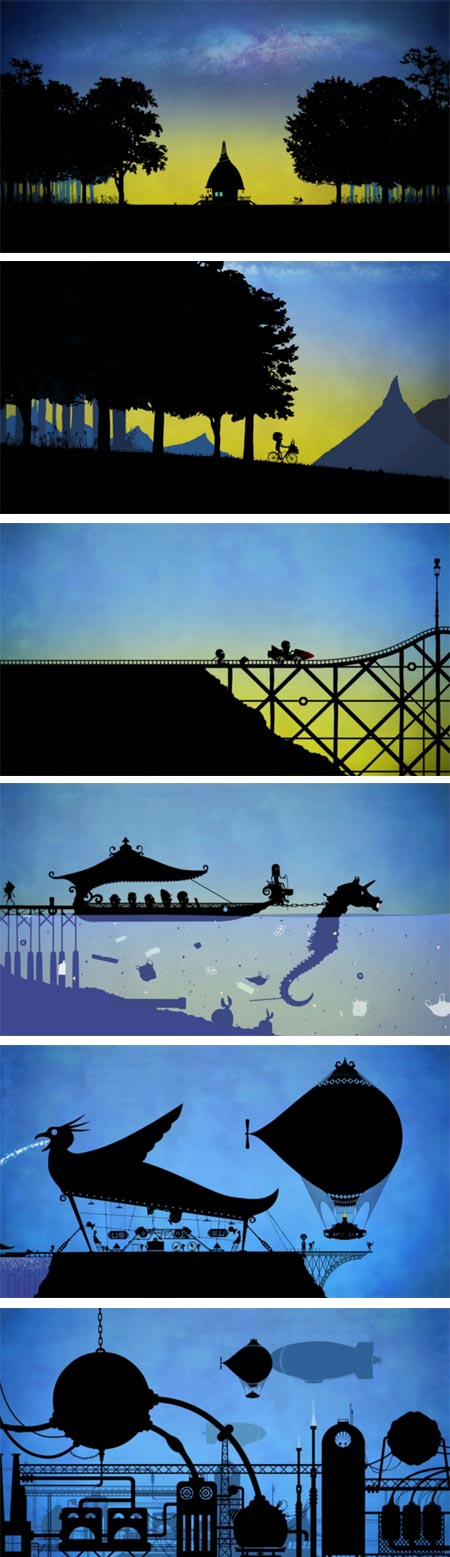
Bendito Machine (blessed machine) is a series of nicely realized fantastical animations created by Jossie Malis, produced by Zumbakamera and animated by Malis and Pau Martinez.This is a series of animations, done primarily and very effectively in sihlouette, of which the most recent and by some degree the most entertaining, is Bendito Machine IV – Fuel the Machines (Vimeo link).
It’s about a man who, um… takes a ride — several, in fact.
I don’t think you lose anything by viewing that one first and then going back to the others.
[Via Annalee Newitz on io9]
Categories:
-
Gilbert Stuart, not just presidents

Today is the Fourth of July, “Independence Day” here in the U.S., a holiday on which we celebrate not having to pay undue deference to a little old lady who wears funny hats.Amid carrying on the traditions of beer and barbecues handed down by our nation’s founding fathers, there is sometimes talk of the fathers themselves — the framers of our government and its basic documents, and when those guys are mentioned, out come the Gilbert Stuart portraits.
Stuart, as I explained in my previous post on him, was a premiere American portraitist, but his skills a painter are overshadowed by his “greatest hits” of presidential portraits, notably of “not so handsome” George Washington (above, top, with detail), as well as other key figures like John “I make George look good” Adams (third down) and Thomas “I can’t stick around to have my portrait finished” Jefferson (fourth down).
As interesting as these portraits can be, I think Stuart shines much more readily in his portraits of less well known figures like Matilda Stoughton de Jaudenes (third and fourth from the bottom) and Marianne Ashley Walker (bottom two), in which you can see his economical, painterly brushwork and much more lively portrayals than those of the stiffly posed politicians.
(I don’t know if Walker had the hots for Stuart, or he just wished she did, or what, but that’s some smoldering look he captured there.)
The images above are from two excellent sources of high resolution images of Stuart’s work, the Metropolitan Museum of Art and the Google Art Project. For more, see my previous post on Gilbert Stuart, which lists additional resources.
Categories:
-
The Higgs Boson Explained (PHD Comics)
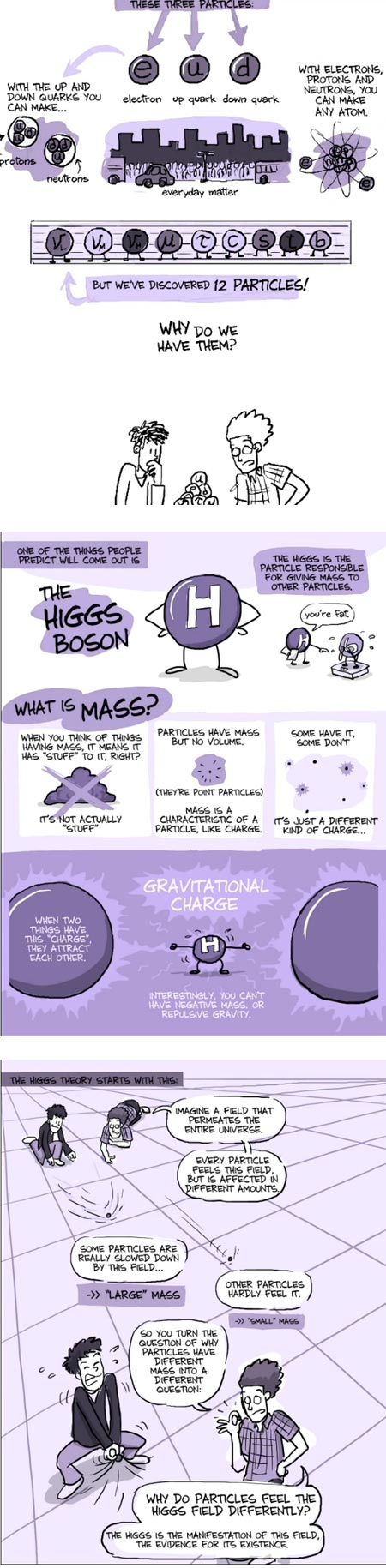
Curious about the “Higgs Boson” breakthrough mentioned in the popular science news lately, and/or the nature of the very small10 particles that make up life, the universe and everything? (Of course you are!)Well Daniel Whiteson, an experimental physicist at CERN, where the exciting high energy particle smashing action has been taking place, explains it to you, as illustrated and animated in “animated whiteboard” style by Jorge Cham of PHD (Piled Higher and Deeper) Comics in a short called The Higgs Boson Explained (on Vimeo).
(The animation begins about 30 seconds in. The above screens are just samples, and not meant to read as a sequence).
This was recorded and animated prior to the recent announcement that the mysterious and elusive particle (which Mr. Higgs so carelessly misplaced) has likely been found by the happy matter smashers at CERN (well, 99.999% likely).
Don’t you just feel smarter already?
[Via Rebecca J. Rosen on The Atlantic]
Categories:
-
J. Paul Getty Museum on Google Art Project
![J. Paul Getty Museum on Google Art Project: ean Baptiste Siméon Chardin [with detail], John William Godward, Roelandt Savery, Vincent van Gogh, Titian [Tiziano Vecellio], Nicolaes Maes, Camille Pissarro, Aert de Gelder, Claude Monet, Pieter de Hooch](http://www.linesandcolors.com/images/2012-07/getty_450.jpg)
Having never been to the J. Paul Getty Museum, all I know about it is limited to what I see online, but judging from that, and particularly from the selection from the museum available for viewing in zoomable high-resolution versions on the Google Art Project, their collection is quite fantastic.I’ve included a detail from the Chardin still life at top (second down) as a reminder of how terrific the zoomable images are on the Google Art Project (see my previous post on the Google Art Project).
(Images above: Jean Baptiste Siméon Chardin [with detail], John William Godward, Roelandt Savery, Vincent van Gogh, Titian [Tiziano Vecellio], Nicolaes Maes, Camille Pissarro, Aert de Gelder, Claude Monet, Pieter de Hooch)
Categories:



Charley’s Picks
Bookshop.org
(Bookshop.org affilliate links; sales benefit independent bookshop owners; I get a small percentage to help support my work on Lines and Colors)
Carlson’s Guide to Landscape Painting
Drawing and Sketching in Pencil

Bridgman’s Complete Guide to Drawing from Life
Charley’s Picks
Amazon
(Amazon.com affiliate links; sales go to a larger yacht for Jeff Bezos; but I get a small percentage to help support my work on Lines and Colors)
Carlson’s Guide to Landscape Painting
Drawing and Sketching in Pencil
Bridgman’s Complete Guide to Drawing from Life