


Categories
- 3d CGI
- Amusements
- Animation
- Anime & Manga
- Art Materials
- Art Videos
- Blogroll
- Cartoons
- Color
- Comics
- Concept & Visual Dev.
- Creativity
- Digital Art
- Digital Painting
- Displaying Art on the Web
- Drawing
- Eye Candy for Today
- Gallery and Museum Art
- High-res Art Images
- Illustration
- Motion Graphics & Flash
- Museums
- Online Museums
- Outsider Art
- Painting
- Painting a Day
- Paleo Art
- Pastel, Conté & Chalk
- Pen & Ink
- Prints and Printmaking
- Reviews
- Sc-fi and Fantasy
- Sculpture & Dimensional
- Site Comments
- Sketching
- Storyboards
- Tools and Techniques
- Uncategorized
- Vector Art
- Videos & Podcasts
- Vision and Optics
- Watercolor and Gouache
- Webcomics
Archives
- May 2026
- April 2026
- March 2026
- February 2026
- January 2026
- December 2025
- November 2025
- October 2025
- September 2025
- August 2025
- July 2025
- June 2025
- May 2025
- January 2025
- December 2024
- November 2024
- October 2024
- September 2024
- August 2024
- June 2024
- April 2024
- March 2024
- February 2024
- January 2024
- December 2023
- November 2023
- October 2023
- September 2023
- August 2023
- July 2023
- May 2023
- April 2023
- March 2023
- February 2023
- January 2023
- December 2022
- November 2022
- September 2022
- August 2022
- July 2022
- June 2022
- May 2022
- April 2022
- March 2022
- February 2022
- January 2022
- December 2021
- November 2021
- October 2021
- September 2021
- August 2021
- July 2021
- June 2021
- May 2021
- April 2021
- March 2021
- February 2021
- January 2021
- December 2020
- November 2020
- October 2020
- September 2020
- August 2020
- July 2020
- June 2020
- May 2020
- April 2020
- March 2020
- February 2020
- January 2020
- December 2019
- November 2019
- October 2019
- September 2019
- August 2019
- July 2019
- June 2019
- May 2019
- April 2019
- March 2019
- February 2019
- January 2019
- December 2018
- November 2018
- October 2018
- September 2018
- August 2018
- July 2018
- June 2018
- May 2018
- April 2018
- March 2018
- February 2018
- January 2018
- December 2017
- November 2017
- October 2017
- September 2017
- August 2017
- July 2017
- June 2017
- May 2017
- April 2017
- March 2017
- February 2017
- January 2017
- December 2016
- November 2016
- October 2016
- September 2016
- August 2016
- July 2016
- June 2016
- May 2016
- April 2016
- March 2016
- February 2016
- January 2016
- December 2015
- November 2015
- October 2015
- September 2015
- August 2015
- July 2015
- June 2015
- May 2015
- April 2015
- March 2015
- February 2015
- January 2015
- December 2014
- November 2014
- October 2014
- September 2014
- August 2014
- July 2014
- June 2014
- May 2014
- April 2014
- March 2014
- February 2014
- January 2014
- December 2013
- November 2013
- October 2013
- September 2013
- August 2013
- July 2013
- June 2013
- May 2013
- April 2013
- March 2013
- February 2013
- January 2013
- December 2012
- November 2012
- October 2012
- September 2012
- August 2012
- July 2012
- June 2012
- May 2012
- April 2012
- March 2012
- February 2012
- January 2012
- December 2011
- November 2011
- October 2011
- September 2011
- August 2011
- July 2011
- June 2011
- May 2011
- April 2011
- March 2011
- February 2011
- January 2011
- December 2010
- November 2010
- October 2010
- September 2010
- August 2010
- July 2010
- June 2010
- May 2010
- April 2010
- March 2010
- February 2010
- January 2010
- December 2009
- November 2009
- October 2009
- September 2009
- August 2009
- July 2009
- June 2009
- May 2009
- April 2009
- March 2009
- February 2009
- January 2009
- December 2008
- November 2008
- October 2008
- September 2008
- August 2008
- July 2008
- June 2008
- May 2008
- April 2008
- March 2008
- February 2008
- January 2008
- December 2007
- November 2007
- October 2007
- September 2007
- August 2007
- July 2007
- June 2007
- May 2007
- April 2007
- March 2007
- February 2007
- January 2007
- December 2006
- November 2006
- October 2006
- September 2006
- August 2006
- July 2006
- June 2006
- May 2006
- April 2006
- March 2006
- February 2006
- January 2006
- December 2005
- November 2005
- October 2005
- September 2005
- August 2005
Relevant Blogs
Art, Painting & Sketch
- Gurney Journey
- Underpaintings
- Art and Influence
- Painting Perceptions
- Oil Painters of America
- Vasari Paint POV
- Flying Fox
- Urban Sketchers
- Bento (Smithsonian)
- Art Inconnu
- The Hidden Place
- Still Life
- Making a Mark
- The Art of the Landscape
- Exploring Color & Creativity
- Art Contrarian
- Artist A Day
- beinArt Surreal Art Collective
- Eye Level
- David Dunlop
- p.i.g.m.e.n.t.i.u.m
- CultureGrrl
- Joaquín Sorolla blog
- Artists in Pastel
“Painting a Day”
- A Painting a Day (Keiser)
- On Painting (Keiser)
- Julian Merrow-Smith
- Karen Jurick
- Jeffrey Hayes
- Carol Marine
- Abbey Ryan
- Daily Paintworks
Other Painting Blogs
- Virtual Gouache Land
- Neil Hollingsworth
- Marc Hanson
- Kevin Menck
- Marc Dalessio
- Larry Seiler
- Stapleton Kearns
- Colin Page
- Roos Schuring
- Hans Versfelt
- Titus Meeuws
- Régis Pettinari
- René Plein Air
- Belinda Del Pesco
- Robin Weiss
- Nathan Fowkes (Land Sketch)
- William Wray
- Frank Serrano
- Stephen Magsig
- Michael Chesley Johnson
- Twice a Week
- Sarah Wimperis
- Rob Adams
- Michael Cole Manley
- The Dirty Palette Club
- Mike Manley’s Draw!
Gallery Art & Illustration mix
Illustration
- Howard Pyle
- 100 Years of Illustration
- BibliOdyssey
- Illustration Art
- Today’s Inspiration
- Illustration Mundo
- Little Chimp Society
- Danny Gregory
- R D (John Martz
- Illustration Friday blog
- Monster Brains
- Illustrators & Illustrations (RU)
- Elwood H. Smith
- DaniDraws.com
- Designers Who Blog
- iSpot Blog
Sci-Fi & Fantasy
Illustration & Comics
Comics & Cartoons
- Comics Beat
- Robot 6
- Newsarama Blog
- Comic Vine
- Comics Alliance
- Forbidden Planet Int.
- Paolo Rivera
- Bolt City
- Flight
- Scott McCloud
- The Comics Journal
- Comixpedia
- Funnybook Babylon
- James Baker
- Middleton’s Sketchbook
- Boneville
- The Hotel Fred
- Paul Rivoche
- Daily Cartoonist
- Mad About Cartoons (William Wray)
- Digital Strips
Illustration & Concept
Animation & Concept
- Cartoon Brew
- Animation Blog
- Cold Hard Flash
- Concept Art World
- The CAB
- FY Concept Art
- Concept Ships
- Concept Robots
- John Nevarez
- Armand Serrano
- Marcos Mateu-Mestre
- all kinds of stuff (Kricfalusi)
- Yacin the faun (Man Arenas)
- Kelsey Mann
- Cre8tivemarks Blog
- Ice-Cream Monster Toon Cafe
- AAU Character & Creature Design
- AAU Animation Notes
- Articles and Texticles
Paleo & Scientific
Tools & Techniques
Other
Lists of Art Blogs
Art Image Resource Links
Historic Art Images
- Wikimedia Commons: Paintings
- Wikimedia Commons: Drawings
- The Athenaeum
- WikiArt (WikiPaintings)
- Google Art Project: Artists
- Google Art Project: Collections (Museums)
- ArtCyclopedia
- Web Gallery of Art
- Art Renewal Center
- Web Gallery of Impressionism
Auction Consolidation sites
Auction sites
- Sotheby’s
- Bonham’s
- Christies
- Heritage Auctions: Fine Art
- Heritage Auctions: Illustration
- Freeman’s Auctions
- Bukowskis
- Shannon’s
Image Search
Reverse Image Search (search by image)
- Tin Eye
- RevImg
- Google Image Search (camera icon)
- Bing Image Search (camera icon)
Promoting some friends and some clients of my website design business
- Twin Willows T’ai Chi studio in Wilmington DE. Taiji classes with Bryan Davis.
- Ray Hayward, Inspired Teacher of T’ai Chi ( Taiji ) in Minneapolis, Founder of Mindful Motion Tai Chi Academy
- OldHead Tattoo studio and Art Gallery in Wilmington DE. Tattoos and paintings by Bruce Gulick
- Sharon Domenico Art, pet portrait oil paintings
- Platinum Paperhanging, wallpaper hanging, Main Line and Philadelphia, PA
- Lisa Stone Design, interior designer, Main Line and Philadelphia, PA
- Studio12KPT, original art, prints, calendars and other custom printed items by Van Sickle & Rolleri
-
Learning to draw: where to go from here
 Tim, a Lines and Colors reader, wrote me to say that he had recently become inspired to return to the practice of drawing. He had purchased a copy of Betty Edwards’ Drawing on the Right Side of the Brain (see my post here), and was looking for other books and resources to pursue his interest from there, hopefully with a classical or Renaissance method.
Edwards’ book is an excellent place to start for someone who has a new or rekindled interest in drawing. I frequently recommend it as the book concentrates of the fundamental and most difficult problem adults face in learning to draw, and that is learning to see what is actually before them, and not what they think they see.
I feel her book, however, is lacking the other “half” of drawing, the art of it, the finesse and artistic choices that separate “art” from “just drawing” and that separate the masters from the ordinary. Though she has attempted to address this somewhat in recent editions, there are better sources for pursuing the art of drawing.
This is not meant to be a comprehensive list, certainly not of drawing books, or even of drawing books and resources that answer the particular question at hand, but a few suggestions drawn (if you’ll excuse the expression) from my personal experience.
A book I will recommend, though it is not specifically related to drawing but to art and art study in general, is Robert Henri’s The Art Spirit.
As for drawing instruction in a classical or Renaissance method, there isn’t a great deal in the way of drawing texts from the Renaissance; techniques were passed down from master to apprentice, rarely committed to writing. Modern representational drawing texts concentrate on Academic teachings, which are derived from principles developed in the Renaissance and subsequent years up to the late 19th Century.
The dedicated path:
Classic drawing textbooks (not necessary “Classical”) These two volumes have been standards in art schools in the U.S. for decades. Look for them used online, in used bookstores or on eBay; they’re overpriced and current printings are apparently of poor quality.
 A Guide to Drawing, Daniel M. Mendelowitz
Art of Responsive Drawing, Nathan Goldstein
The study of drawing:
 The Natural Way to Draw: A Working Plan for Art Study, Kimon Nicolaides
If you’re really committed, Kimon Nicolaides has the game plan, but it’s a demanding course of study.
The Practice And Science Of Drawing, Harold Speed
A valuable text, with insights and practical information. There is a full version on Project Gutenberg, though the reproductions leave something to be desired. [Addendum: There is a better Facsimile Edition on the Internet Archive. See my more recent post on The Practice And Science Of Drawing.]
Other titles:
 Charles Bargue and Jean-Leon Gerome: Drawing Course, Gerald M. Ackerman
A 19th Century Academic approach, form a student of master Jean-Léon Gerome
Drawing Lessons from the Great Masters, Robert Beverly Hale
I had the good fortune to have Robert Beverly Hale as my artistic anatomy instructor when I was a student at The Pennsylvania Academy of the Fine Arts. His teachings have been codified in a series of books, illustrated with selections of old master drawings.
 The Artist’s Complete Guide to Figure Drawing: A Contemporary Perspective on the Classical Tradition, Anthony Ryder
See my post on Tony Ryder, and here
Classical Drawing Atelier: A Contemporary Guide to Traditional Studio Practice, Juliette Aristides
A modern take on Academic techniques
The gentle path
 Keys to Drawing, Bert Dodson
Keys to Drawing with Imagination: Strategies and Exercises for Gaining Confidence and Enhancing Your Creativity, Bert Dodson
Dodson eases you into some of the same techniques and concerns covered by Mendelowitz and Goldstein, with a friendlier approach and less of a brusque college textbook manner. See my review of Keys to Drawing with Imagination
 Bridgman’s Complete Guide to Drawing from Life, George Bridgman
The Human Figure, John H. Vanderpoel
Put solidity and an understanding of form into your figure drawing with Bridgeman and Vanderpoel.
Study master drawings
Look for used books of collections of master drawings, study them and copy from the masters (as they did from previous masters) to understand what they have done with line, tone, space and form.
Dover Books has many titles with master drawings that are inexpensive new. Though the reproduction is not superb, they are still very good for study and enjoyment.
 150 Masterpieces of Drawing by Anthony Toney
Look for other inexpensive collections like Drawing ideas of the masters: Improve your drawings by studying the masters by Frederick Malins
Libraries
Look to your local library for everything mentioned here and more. If you live near a state university, you may find their library open to residents, including borrowing privileges.
Online:
Line by Line is an introductory drawing course running in weekly installments on the New York Times (see my post here). There are many other online resources that should be the subject of a separate post.
Studying the real thing: master drawings
Seeing old master, Baroque and 19th Century drawing in person is a treat, inspiring and very instructive. Drawings reveal their subtleties in person even more than paintings. They can’t be kept on display because of light damage, so you have to look for shows.
On the East Coast of the U.S. The Met in NY and the National Gallery in D.C rotate out selections from their collections of works on paper in small dedicated galleries. Look for other major museums to have similar small spaces devoted to works on paper. The Morgan Library in NY often has great drawing shows.
Studying the real thing: life drawing
This is a directory of life drawing (figure model) open sessions, workshops and other easily accessible classes: Figure Drawing Open Studios, Workshops, and Continuing Education Classes, see my post on the Directory of Figure Drawing Sessions.
Fake it from home: life drawing
Pose Maniacs, Virtual Pose and Figure Drawing training Tool let you practice life drawing from home, the former with computer generated figures, the latter two with photographs.
The most important things
The most important thing: keep drawing. If it’s not a dedicated course of study, make it a hobby, a habit, a coffee break, a meditation. A quick sketch once a day is better than an elaborate plan of study that you can’t maintain.
 Zen of Seeing: Seeing/Drawing as Meditation by Frederick Franck
This is an essay on drawing, and the special kind of seeing associated with drawing (that I think is at the core of the techniques in Drawing on the Right side of the Brain and other texts) as a form of meditation.
More importantly, it is instructive in drawing as a practice, an activity, something you do, rather than something you are trying to accomplish. It’s hard to overstate what a dramatic difference in frame of mind this seemingly small shift can make.
Drawing for Pleasure, Valerie C. Douet
I mention this title, not because the drawings within are treasures of old master accomplishment — they’re not, but because of the attitude and approach expressed by the book and its title.
Unless you mess it up by trying too hard, hanging all kinds of expectations and self-measurement on it or make the gross mistake of comparing your current level of ability with others, drawing is, after all, fun.
So my best word of advice? Draw and have fun drawing. The rest will follow.
[Addendum: On rereading this post, I wanted to add one of my favorite quotes.
From Howard Ikemoto:
When my daughter was about seven years old, she asked me one day what I did at work. I told her I worked at the college — that my job was to teach people how to draw. She stared back at me, incredulous, and said, “You mean they forget?” ]
Categories:
-
Irving Ramsay Wiles

The son of Hudson River School painter Lemuel Maynard Wiles, Irving Ramsay Wiles began study with the great American painter William Merritt Chase at the age of 18. He studied with both Chase and noted painter James Carroll Beckworth at the Art Student’s League in New York, where he would later teach.Wiles continued to study with Chase independently at his Tenth Street Studio, painting it’s interior (above, third down) as Chase often did (also here). Wiles and Chase were to remain friends throughout their lives.
Wiles also continued his studies in Paris at the Académie Julian and in the atelier of Emile Auguste Carolus-Duran, who is noted as John Singer Sargent’s teacher.
Sargent’s bravura brushwork had a distinct influence on Wiles’ portraiture (and I can’t imagine he was unaware of Cecilia Beaux), while his painterly approach to landscape, interiors and still life owes much to the influence of Chase.
Early in his career, Wiles worked as an illustrator for a number of American magazines. He eventually made a name for himself as a portrait artist. In his later years he allowed himself more time for landscapes and personal subjects.
Wiles is sometimes considered an American Impressionist painter (as is Chase, and sometimes Sargent), though that term is a somewhat vague classification.
There is a selection of his work on the Sotheby’s auction house Sold Lot Archives, some of which have both static and Zoomable versions. The latter allow you to see his brushwork in detail (albeit in a small window).
Similarly the Smithsonian Museum of American Art has several pieces in Zoomable versions, these can be viewed in a full screen window, including the stunning Russian Tea (above, second from the bottom).
A new monograph on Wiles, Irving Ramsay Wiles, N.A., 1861-1948: Portraits and Pictures, 1899-1948 by Geoffrey K. Fleming, is due to be published in January.
Categories:
-
Drazen Kozjan

Drazen Kozjan was born in Croatia and now lives in Canada, where his family moved when he was young. His career has included visual development and storyboarding for a number of features, including The Neverending Story, Rupert the Bear, Franklin The Turtle and George Shrinks.He is also an editorial illustrator and children’s book illustrator, with credits for several books, including The Biggest Girl In the World by Joanne Stanbridge, Diary of a Fairy Godmother by Esm Raji Codell and How to Tame a Bully by Nancy Wilcox-Richards.
Kozjan’s crisp, spare style manages to be evocative without ever being labored. His interior book illustrations are often done with fine line and deft touches of tone. His color illustrations, in contrast, frequently feel like they are line drawings with color fills, but are often accomplished with sharply delineated forms instead of outlines.
He works in pen and ink, marker pens, gouache and watercolor, as well as digital media, specifically Photoshop, in which he colors most of his recent work.
His website has galleries for individual book titles as well as other work.
Kozjan also maintains a blog called Hypnotik Eye, in which he discusses his projects and posts personal sketches and life drawings, along with occasional mentions of other artists from the history of illustration whose work he admires.
You can also see his portrait of Rod Serling on Hey Oscar Wilde, It’s Clobberin’ Time! (see my post on Hey Oscar Wilde, It’s Clobberin’ Time!).
There is a recent interview with Drazen Kozjan on Fuel Your Illustration.
Categories:
-
Glenn Jones
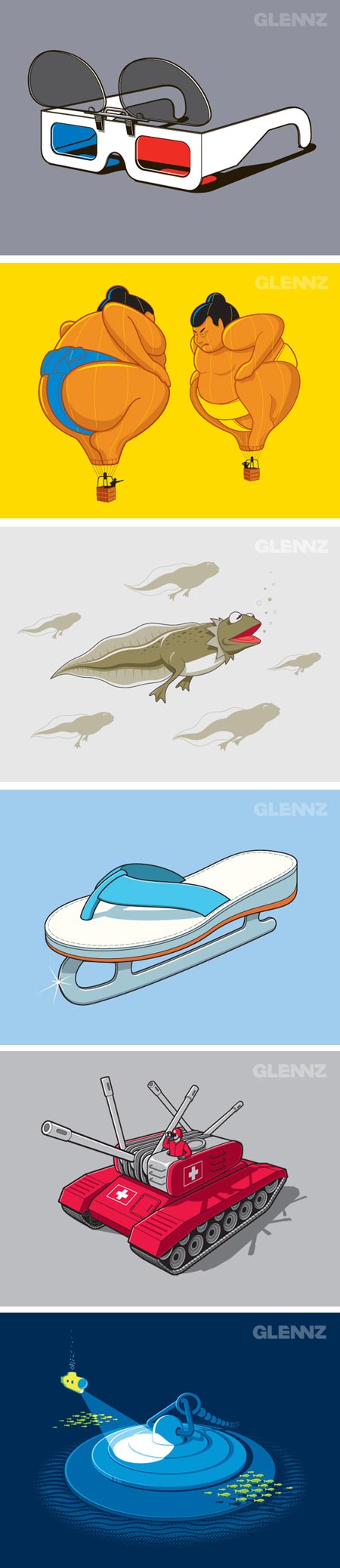
Glenn Jones, a freelance illustrator and graphic designer based in Auckland, New Zealand, creates deceptively simple images that always have a twist or hook, usually leaving you smiling if not laughing out loud.After a 15 year design industry career, Jones found that his T-shirt designs for Threadless.com were so successful that he started his own line, GlennzTees.
His website splits into his personal website, the Genns Tees store, and his Behance Portfolio (also here), along with links to his pages on Facebook, Twitter and Flickr.
You can also find example of his work displayed on Digital Art Empire and Design your way.
Categories:
-
Titian and the Golden Age of Venetian Painting

Tiziano Vecellio, commonly called Titian, was one of the great masters of the Italian Renaissance. His reputation spread form his native Venice to Rome and the other art centers of Italy, as well as to Spain and throughout Europe.His mastery of oil painting, use of color, and strength in all phases of painting — portraits, mythological subjects, allegories, altarpieces and landscapes with figures — along with his painterly approach, made him tremendously influential in his time and well after.
Two of his major works, Diana and Actaeon (above, top) and Diana and Callisto (above, bottom) form the core of a new exhibition at the High Museum of Art in Atlanta, Titian and the Golden Age of Venetian Painting: Masterpieces from the National Galleries of Scotland.
The exhibition includes 25 paintings from the Venetian Renaissance, including works by Tintoretto, Veronese and Lotto, that are on loan from the National Gallery of Scotland.
Titian’s two Diana paintings were commissioned by King Phillip II of Spain, and are related, meant to be seen as a pair. Though they depict two different moments from the life of the mythological figure, they are both tableaux of Titian’s masterful figures, pulled together by the common visual theme of a stream running through them. The two paintings are traveling to the U.S. for the first time.
Though Titian’s youthful experimentation had abated by the time he painted these works in his 60’s, his technical mastery was in full force.
Titian and the Golden Age of Venetian Painting: Masterpieces from the National Galleries of Scotland is on display until January 2, 2011.
For more, see my earlier posts on Titian, and on his Polyptych of the Ressurection.
Categories:
-
Chris Ryniak

On his blog Chris Ryniak describes himself as “monster & critter maker”.On his website you will find galleries of his monsters & critters both as paintings (also here) and as small scale sculptures in epoxy, glass, vinyl and acrylic.
My timing is a little off with this post, in that his show at MyPlasticHeart in NYC, This Could Get Ugly, is wrapping up on October 24, but you can (at least for the time being) also see a gallery of his sculptures and paintings associated with the show.
Ryniak is a graduate and former instructor of the Ringling School of Art and Design in Florida, and is currently based in Ohio.
Ryniak’s beasties have a kind of oddball charm, with buggy eyes, fish-like parts and lots of teeth. His paintings, which I believe are primarily done in acrylic, have a decorative dimensional feeling to them, with backgrounds de-emphasized and the textural qualities of the, er… critters, emphasized..
[Via Drawn!]
Categories:




Charley’s Picks
Bookshop.org
(Bookshop.org affilliate links; sales benefit independent bookshop owners; I get a small percentage to help support my work on Lines and Colors)

John Singer Sargent: Watercolors


Urban Sketching: Understanding Perspective


Charley’s Picks
Amazon
(Amazon.com affiliate links; sales go to a larger yacht for Jeff Bezos; but I get a small percentage to help support my work on Lines and Colors)
John Singer Sargent: Watercolors
Urban Sketching: Understanding Perspective