


Categories
- 3d CGI
- Amusements
- Animation
- Anime & Manga
- Art Materials
- Art Videos
- Blogroll
- Cartoons
- Color
- Comics
- Concept & Visual Dev.
- Creativity
- Digital Art
- Digital Painting
- Displaying Art on the Web
- Drawing
- Eye Candy for Today
- Gallery and Museum Art
- High-res Art Images
- Illustration
- Motion Graphics & Flash
- Museums
- Online Museums
- Outsider Art
- Painting
- Painting a Day
- Paleo Art
- Pastel, Conté & Chalk
- Pen & Ink
- Prints and Printmaking
- Reviews
- Sc-fi and Fantasy
- Sculpture & Dimensional
- Site Comments
- Sketching
- Storyboards
- Tools and Techniques
- Uncategorized
- Vector Art
- Videos & Podcasts
- Vision and Optics
- Watercolor and Gouache
- Webcomics
Archives
- May 2026
- April 2026
- March 2026
- February 2026
- January 2026
- December 2025
- November 2025
- October 2025
- September 2025
- August 2025
- July 2025
- June 2025
- May 2025
- January 2025
- December 2024
- November 2024
- October 2024
- September 2024
- August 2024
- June 2024
- April 2024
- March 2024
- February 2024
- January 2024
- December 2023
- November 2023
- October 2023
- September 2023
- August 2023
- July 2023
- May 2023
- April 2023
- March 2023
- February 2023
- January 2023
- December 2022
- November 2022
- September 2022
- August 2022
- July 2022
- June 2022
- May 2022
- April 2022
- March 2022
- February 2022
- January 2022
- December 2021
- November 2021
- October 2021
- September 2021
- August 2021
- July 2021
- June 2021
- May 2021
- April 2021
- March 2021
- February 2021
- January 2021
- December 2020
- November 2020
- October 2020
- September 2020
- August 2020
- July 2020
- June 2020
- May 2020
- April 2020
- March 2020
- February 2020
- January 2020
- December 2019
- November 2019
- October 2019
- September 2019
- August 2019
- July 2019
- June 2019
- May 2019
- April 2019
- March 2019
- February 2019
- January 2019
- December 2018
- November 2018
- October 2018
- September 2018
- August 2018
- July 2018
- June 2018
- May 2018
- April 2018
- March 2018
- February 2018
- January 2018
- December 2017
- November 2017
- October 2017
- September 2017
- August 2017
- July 2017
- June 2017
- May 2017
- April 2017
- March 2017
- February 2017
- January 2017
- December 2016
- November 2016
- October 2016
- September 2016
- August 2016
- July 2016
- June 2016
- May 2016
- April 2016
- March 2016
- February 2016
- January 2016
- December 2015
- November 2015
- October 2015
- September 2015
- August 2015
- July 2015
- June 2015
- May 2015
- April 2015
- March 2015
- February 2015
- January 2015
- December 2014
- November 2014
- October 2014
- September 2014
- August 2014
- July 2014
- June 2014
- May 2014
- April 2014
- March 2014
- February 2014
- January 2014
- December 2013
- November 2013
- October 2013
- September 2013
- August 2013
- July 2013
- June 2013
- May 2013
- April 2013
- March 2013
- February 2013
- January 2013
- December 2012
- November 2012
- October 2012
- September 2012
- August 2012
- July 2012
- June 2012
- May 2012
- April 2012
- March 2012
- February 2012
- January 2012
- December 2011
- November 2011
- October 2011
- September 2011
- August 2011
- July 2011
- June 2011
- May 2011
- April 2011
- March 2011
- February 2011
- January 2011
- December 2010
- November 2010
- October 2010
- September 2010
- August 2010
- July 2010
- June 2010
- May 2010
- April 2010
- March 2010
- February 2010
- January 2010
- December 2009
- November 2009
- October 2009
- September 2009
- August 2009
- July 2009
- June 2009
- May 2009
- April 2009
- March 2009
- February 2009
- January 2009
- December 2008
- November 2008
- October 2008
- September 2008
- August 2008
- July 2008
- June 2008
- May 2008
- April 2008
- March 2008
- February 2008
- January 2008
- December 2007
- November 2007
- October 2007
- September 2007
- August 2007
- July 2007
- June 2007
- May 2007
- April 2007
- March 2007
- February 2007
- January 2007
- December 2006
- November 2006
- October 2006
- September 2006
- August 2006
- July 2006
- June 2006
- May 2006
- April 2006
- March 2006
- February 2006
- January 2006
- December 2005
- November 2005
- October 2005
- September 2005
- August 2005
Relevant Blogs
Art, Painting & Sketch
- Gurney Journey
- Underpaintings
- Art and Influence
- Painting Perceptions
- Oil Painters of America
- Vasari Paint POV
- Flying Fox
- Urban Sketchers
- Bento (Smithsonian)
- Art Inconnu
- The Hidden Place
- Still Life
- Making a Mark
- The Art of the Landscape
- Exploring Color & Creativity
- Art Contrarian
- Artist A Day
- beinArt Surreal Art Collective
- Eye Level
- David Dunlop
- p.i.g.m.e.n.t.i.u.m
- CultureGrrl
- Joaquín Sorolla blog
- Artists in Pastel
“Painting a Day”
- A Painting a Day (Keiser)
- On Painting (Keiser)
- Julian Merrow-Smith
- Karen Jurick
- Jeffrey Hayes
- Carol Marine
- Abbey Ryan
- Daily Paintworks
Other Painting Blogs
- Virtual Gouache Land
- Neil Hollingsworth
- Marc Hanson
- Kevin Menck
- Marc Dalessio
- Larry Seiler
- Stapleton Kearns
- Colin Page
- Roos Schuring
- Hans Versfelt
- Titus Meeuws
- Régis Pettinari
- René Plein Air
- Belinda Del Pesco
- Robin Weiss
- Nathan Fowkes (Land Sketch)
- William Wray
- Frank Serrano
- Stephen Magsig
- Michael Chesley Johnson
- Twice a Week
- Sarah Wimperis
- Rob Adams
- Michael Cole Manley
- The Dirty Palette Club
- Mike Manley’s Draw!
Gallery Art & Illustration mix
Illustration
- Howard Pyle
- 100 Years of Illustration
- BibliOdyssey
- Illustration Art
- Today’s Inspiration
- Illustration Mundo
- Little Chimp Society
- Danny Gregory
- R D (John Martz
- Illustration Friday blog
- Monster Brains
- Illustrators & Illustrations (RU)
- Elwood H. Smith
- DaniDraws.com
- Designers Who Blog
- iSpot Blog
Sci-Fi & Fantasy
Illustration & Comics
Comics & Cartoons
- Comics Beat
- Robot 6
- Newsarama Blog
- Comic Vine
- Comics Alliance
- Forbidden Planet Int.
- Paolo Rivera
- Bolt City
- Flight
- Scott McCloud
- The Comics Journal
- Comixpedia
- Funnybook Babylon
- James Baker
- Middleton’s Sketchbook
- Boneville
- The Hotel Fred
- Paul Rivoche
- Daily Cartoonist
- Mad About Cartoons (William Wray)
- Digital Strips
Illustration & Concept
Animation & Concept
- Cartoon Brew
- Animation Blog
- Cold Hard Flash
- Concept Art World
- The CAB
- FY Concept Art
- Concept Ships
- Concept Robots
- John Nevarez
- Armand Serrano
- Marcos Mateu-Mestre
- all kinds of stuff (Kricfalusi)
- Yacin the faun (Man Arenas)
- Kelsey Mann
- Cre8tivemarks Blog
- Ice-Cream Monster Toon Cafe
- AAU Character & Creature Design
- AAU Animation Notes
- Articles and Texticles
Paleo & Scientific
Tools & Techniques
Other
Lists of Art Blogs
Art Image Resource Links
Historic Art Images
- Wikimedia Commons: Paintings
- Wikimedia Commons: Drawings
- The Athenaeum
- WikiArt (WikiPaintings)
- Google Art Project: Artists
- Google Art Project: Collections (Museums)
- ArtCyclopedia
- Web Gallery of Art
- Art Renewal Center
- Web Gallery of Impressionism
Auction Consolidation sites
Auction sites
- Sotheby’s
- Bonham’s
- Christies
- Heritage Auctions: Fine Art
- Heritage Auctions: Illustration
- Freeman’s Auctions
- Bukowskis
- Shannon’s
Image Search
Reverse Image Search (search by image)
- Tin Eye
- RevImg
- Google Image Search (camera icon)
- Bing Image Search (camera icon)
Promoting some friends and some clients of my website design business
- Twin Willows T’ai Chi studio in Wilmington DE. Taiji classes with Bryan Davis.
- Ray Hayward, Inspired Teacher of T’ai Chi ( Taiji ) in Minneapolis, Founder of Mindful Motion Tai Chi Academy
- OldHead Tattoo studio and Art Gallery in Wilmington DE. Tattoos and paintings by Bruce Gulick
- Sharon Domenico Art, pet portrait oil paintings
- Platinum Paperhanging, wallpaper hanging, Main Line and Philadelphia, PA
- Lisa Stone Design, interior designer, Main Line and Philadelphia, PA
- Studio12KPT, original art, prints, calendars and other custom printed items by Van Sickle & Rolleri
-
William Stout: Hallucinations

Long time readers of Lines and Colors will know that I have long been an admirer of the work of William Stout. Stout is well know as a paleontological artist, film concept designer, illustrator and comics artist.His style ranges as widely as his areas of endeavor, but I take particular pleasure in his ink and watercolor drawings.
Stout has a terrific pen and ink style, and his black an white illustrations pop with judiciously applied texture and finessed line work; but when he combines that skill with his talents as a painter, he creates images with visual charm that I find wonderfully appealing.
There have been a number of his illustrations that I’ve encountered over time, scattered here and there for different publications or purposes, that I’ve long wished were available in some more complete form.
I was delighted, then, to receive a review copy of a new book from Flesk Publications that is the first of a pair of editions collecting some of Stout’s best ink and watercolor images.
William Stout: Hallucinations collects his images of characters from film, pulp fiction, pop culture and even Aasop’s Fables, all rendered with that wonderful snap and zing of his pen style and the rich depth of his watercolors. Dragons, fauns, trolls and monsters fill the pages, along with character from the Wizard of Oz and John Carter of Mars.
There are sample images that can be viewed on the Flesk site. You can see more of Stout’s work on his own website.
It’s actually no surprise that I like Stout’s ink and watercolor style so much, in that the list of artist that Stout credits in the introduction with influencing this style are also among my favorites from the great Golden Age of illustration: Arthur Rackham, Edmund Dulac, William Heath Robinson, John Bauer, Gustaf Tenggren and John R. Neill.
Flesk Publications is offering the book in two editions, a hardbound, signed limited edition of 500, and a paperback edition.
The companion volume, William Stout: Inspirations, which collects his ink and watercolor images of women from fantasy and fairy tales, will be released in September of this year.
Both Flesk Publications and William Stout will be at this week’s Comic-Con international in San Diego, CA.
Categories:
-
Franz von Stuck
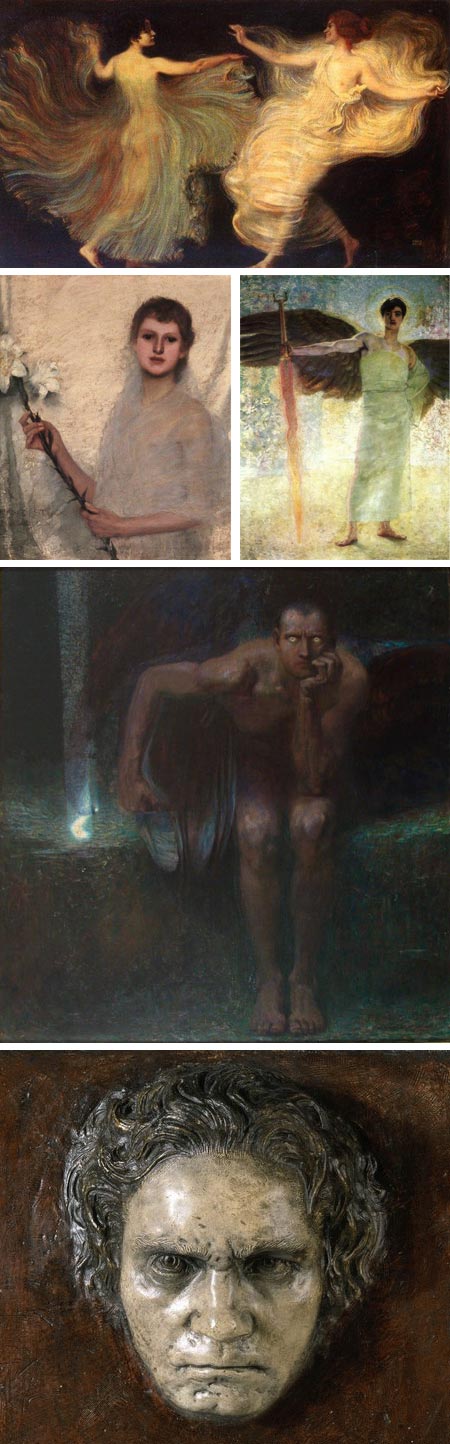
German symbolist and Art Nouveau painter Franz von Stuck (sometimes simply “Franz Stuck”) began his career as an illustrator and cartoonist for popular magazines; but after winning a gold medal at his first painting exhibition, and experiencing subsequent critical success, he began to devote himself to painting, engraving and sculpture, as well as architecture.Von Stuck studied at the Munich Academy, and later returned to take up his role as a professor, counting among his students noted modernist stars like Paul Klee, Wassily Kandinsky and Josef Albers.
Stuck was one of the founders of the Munich Secession, a group of like minded artists who withdrew from the official auspices of academic art and established styes outside the mainstream (the most widely recognized of these groups was the Vienna Secession, which included Gustav Klimt).
Von Stuck was highly successful and critically well regarded in his time, though his fame and influence faded toward the end of his life. He is sometimes compared to Arnold Böcklin, by whom he was greatly influenced. The comparisons are often unfavorable, but Von Stuck went his own way and was responsible for wonderfully intense interpretations of mythological subjects and literary subjects, like his portrayal of Lucifer (above, third down).
He designed and constructed his own frames, which he considered an integral part of the work. He was a talented sculptor as well as a painter, at times applying both skill sets to works like his striking painted relief of Beethoven (above, bottom), based on a mask of the composer once thought to be a death mask, but later established as a mask made from Beethoven’s face during his lifetime. Von Stuck’s portrait evokes the kind of fiery intensity we associate with “Ludwig van’s” stirring work.
Categories:
-
Jamie Burton

Indiana born, Seattle based illustrator, painter, comic book artist and 3D gaming environmental artist Jamie Burton studied at the John Herron School of Art in Indianapolis, and then at the Joe Kubert School of Art in New Jersey, where he prepared for subsequent work as a comic book inker for DC Comics.Burton transitioned into concept and environmental art for the gaming industry, but still likes to let his imagination roam freely with his paintings and poster designs.
His website has sections for paintings, illustrations, ink drawings, sketches and posters. In the paintings section you will find examples of his wonderfully wild and offbeat depictions of characters, animals, environments and all manner of flights of fancy.
There is also a Merchandise section on his site with prints and originals. He also has a blog where you can find pieces not included on his site, and sometimes larger versions of works that you will see there.
Burton uses a high-chroma palette, often casting entire elements or groups of elements in an almost monochromatic scheme, punched up with lots of complimentary color relationships and set off with deep value contrasts, to make his pieces “pop”. He works in a variety of media — pencil, ink, acrylic, oil and digital.
In his paintings he mixes in areas of patterns, frequently with an Aztec or Mayan feeling, suggestions of masks and bizarre costumes, to create a fun visual mix, zapped with electric colors and delivered with a good dose of humor.
Categories:
-
Walter Gotschke
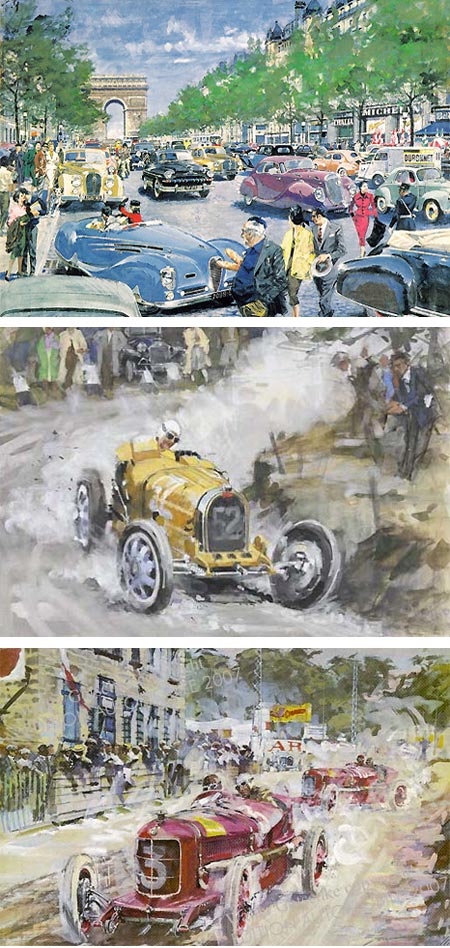
Walter Gotschke is one of the names intimately linked with the early history of automotive art, a subset of illustration that followed the rise of the importance of automobiles themselves in the 20th Century.Gotschke was born in the Czech Republic, but spent much of his career in Germany while it was under nazi rule and was drafted into military service during WW II. His portrayals of German cars, including many advertisements for mercedes and Diamler, were accompanied by illustrations of WW II era aircraft and other non-automotive subjects.
His illustrations of various automobiles also included Italian, American and other car makers.
Gotschke is perhaps most often associated with his lively, sketch-like gouache illustrations of classic racing cars, roaring around tracks, their distinctive grilles punching through dust and smoke, as daredevil drivers coaxed the machines through twists and turns.
These were often briefly noted, with crisp strokes of gouache, hazes of wash and bright but not preternaturally intense colors. Gotschke also created more developed paintings, some of which you will find on the official website under “Art Prints: Cultural History” (image above, top).
The site itself suffers a bit from awkward navigation, and you’ll find that searching through the Picture Library quickly moves from the English language areas into the German language part of the site.
A little digging, however, will uncover many examples of Gotschke’s watercolor and gouache representations of the 20th Century’s obsession and fascination with the automobile.
[Suggestion courtesy of David Teter]
Categories:
-
ColorJack
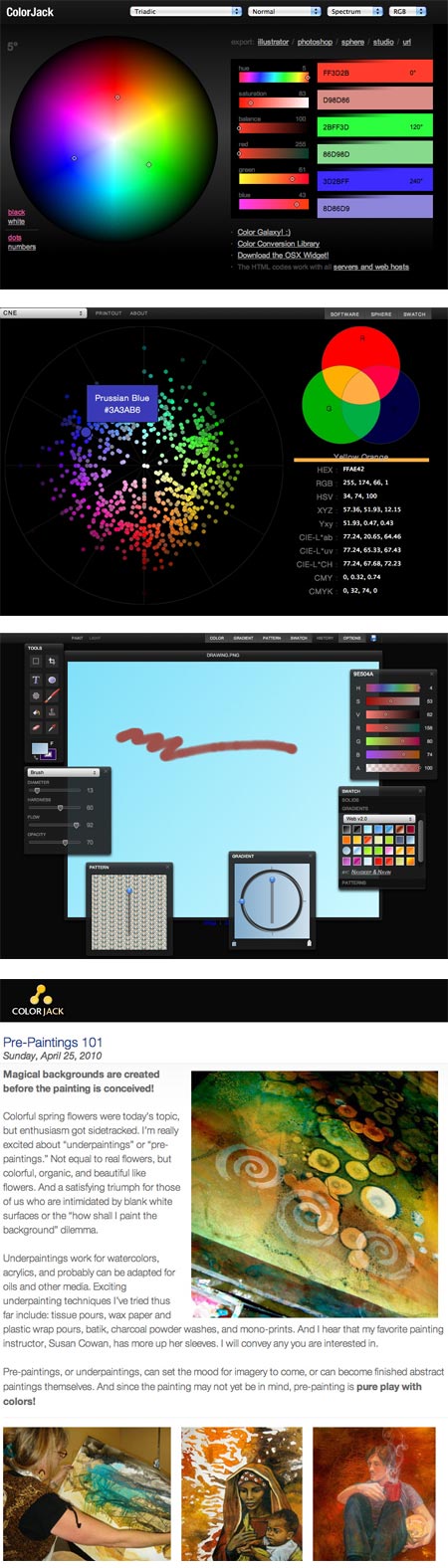
Like many of the online interactive color visualization and color picking utilities, ColorJack offers multiple interfaces with different options and capabilities.The most interesting of these, and most popular of the ColorJack options, is their Color Sphere, or Color Theory Visualizer (image above, top). More than simply a color picker, this displays the secondary, tertiary and multiple other colors in some of the most common color harmony relationships (complimentary, split-complementary, triadic, etc.); and allows you to dynamically see their relationship in the color space as you move the chosen color within the sphere, or adjust one of the color’s characteristics in the bars to the right of the sphere.
Another interface is the Color Galaxy (above, second down); it displays the color wheel position of various named colors, displayed from a color index chosen from a drop-down menu at top left. This would be more useful to painters if there were a choice traditional painters pigments, though you will find some of them in the “CNE” choice. There are choices for Munsell’s catalog listings, though you need to be familiar with his cryptic indexing system for it to be particularly useful.
Other options include the obligatory swatches feature, an online drawing app they call Sketchpad (above, third down), other color pickers, color relates articles, and a blog (image above, bottom).
Navigation between the sections is inconsistent, but you’ll find interesting features if you’re willing to flip around and investigate.
Categories:
-
Marc Gabbana (update)

Since I last wrote about illustrator and concept artist Marc Gabbana back in 2005, his website has been revised and expanded with many more of his wonderful concept illustrations for films like Matrix Reloaded, Martix Revolutions, Star Wars Episode I and II, Monsterhouse, War of the Worlds, Beowulf, and the recent Disney production of Dicken’s A Christmas Carol.Gabbana has a versatile style, ranging from atmospheric realism to highly rendered but delightfully cartoony flights of sci-fi whimsey. He also works in a variety of media, preferring digital for his recent concept illos, but working in acrylic, pencil, ink and marker for older pieces.
One of the things I enjoy most about his acrylic paintings and some of his more playful digital paintings (images above, middle), in addition to his terrifically fun use of brilliant colors and dynamic value relationships, is his approach to texture. Look for the detail crops of some of his robots and machines in which he delights in the pitted surfaces of worn metal.
His portfolio also includes illustrations for advertising, various publications, comic book covers, model kits and other products, as well as personal images in which he lets his imagination run wild.
Gabbana now has a blog, called Black Hammer, and has just released two instructional DVD’s through Gnomon Workshop, Visual Development with Marc Gabbana Volume One and Volume Two. You can see a couple of excerpts from them on Sketch Theatre.
He also did the recent cover for Airbrush Action magazine’s 25th Anniversary issue (May-June, 2010, digital version orders here), that includes a ten page article on Gabbana. In addition he created the illustration for the Spectrum 15 Call for Entries (images above, top, see my posts on Spectrum 14 and Spectrum 13).
As you explore his site and look back through the film concepts, be sure not to miss Gabbana’s beautiful pen and marker concepts for the Star Wars movies (above, bottom).
Categories:




Charley’s Picks
Bookshop.org
(Bookshop.org affilliate links; sales benefit independent bookshop owners; I get a small percentage to help support my work on Lines and Colors)

John Singer Sargent: Watercolors


Urban Sketching: Understanding Perspective


Charley’s Picks
Amazon
(Amazon.com affiliate links; sales go to a larger yacht for Jeff Bezos; but I get a small percentage to help support my work on Lines and Colors)
John Singer Sargent: Watercolors
Urban Sketching: Understanding Perspective