


Categories
- 3d CGI
- Amusements
- Animation
- Anime & Manga
- Art Materials
- Art Videos
- Blogroll
- Cartoons
- Color
- Comics
- Concept & Visual Dev.
- Creativity
- Digital Art
- Digital Painting
- Displaying Art on the Web
- Drawing
- Eye Candy for Today
- Gallery and Museum Art
- High-res Art Images
- Illustration
- Motion Graphics & Flash
- Museums
- Online Museums
- Outsider Art
- Painting
- Painting a Day
- Paleo Art
- Pastel, Conté & Chalk
- Pen & Ink
- Prints and Printmaking
- Reviews
- Sc-fi and Fantasy
- Sculpture & Dimensional
- Site Comments
- Sketching
- Storyboards
- Tools and Techniques
- Uncategorized
- Vector Art
- Videos & Podcasts
- Vision and Optics
- Watercolor and Gouache
- Webcomics
Archives
- April 2026
- March 2026
- February 2026
- January 2026
- December 2025
- November 2025
- October 2025
- September 2025
- August 2025
- July 2025
- June 2025
- May 2025
- January 2025
- December 2024
- November 2024
- October 2024
- September 2024
- August 2024
- June 2024
- April 2024
- March 2024
- February 2024
- January 2024
- December 2023
- November 2023
- October 2023
- September 2023
- August 2023
- July 2023
- May 2023
- April 2023
- March 2023
- February 2023
- January 2023
- December 2022
- November 2022
- September 2022
- August 2022
- July 2022
- June 2022
- May 2022
- April 2022
- March 2022
- February 2022
- January 2022
- December 2021
- November 2021
- October 2021
- September 2021
- August 2021
- July 2021
- June 2021
- May 2021
- April 2021
- March 2021
- February 2021
- January 2021
- December 2020
- November 2020
- October 2020
- September 2020
- August 2020
- July 2020
- June 2020
- May 2020
- April 2020
- March 2020
- February 2020
- January 2020
- December 2019
- November 2019
- October 2019
- September 2019
- August 2019
- July 2019
- June 2019
- May 2019
- April 2019
- March 2019
- February 2019
- January 2019
- December 2018
- November 2018
- October 2018
- September 2018
- August 2018
- July 2018
- June 2018
- May 2018
- April 2018
- March 2018
- February 2018
- January 2018
- December 2017
- November 2017
- October 2017
- September 2017
- August 2017
- July 2017
- June 2017
- May 2017
- April 2017
- March 2017
- February 2017
- January 2017
- December 2016
- November 2016
- October 2016
- September 2016
- August 2016
- July 2016
- June 2016
- May 2016
- April 2016
- March 2016
- February 2016
- January 2016
- December 2015
- November 2015
- October 2015
- September 2015
- August 2015
- July 2015
- June 2015
- May 2015
- April 2015
- March 2015
- February 2015
- January 2015
- December 2014
- November 2014
- October 2014
- September 2014
- August 2014
- July 2014
- June 2014
- May 2014
- April 2014
- March 2014
- February 2014
- January 2014
- December 2013
- November 2013
- October 2013
- September 2013
- August 2013
- July 2013
- June 2013
- May 2013
- April 2013
- March 2013
- February 2013
- January 2013
- December 2012
- November 2012
- October 2012
- September 2012
- August 2012
- July 2012
- June 2012
- May 2012
- April 2012
- March 2012
- February 2012
- January 2012
- December 2011
- November 2011
- October 2011
- September 2011
- August 2011
- July 2011
- June 2011
- May 2011
- April 2011
- March 2011
- February 2011
- January 2011
- December 2010
- November 2010
- October 2010
- September 2010
- August 2010
- July 2010
- June 2010
- May 2010
- April 2010
- March 2010
- February 2010
- January 2010
- December 2009
- November 2009
- October 2009
- September 2009
- August 2009
- July 2009
- June 2009
- May 2009
- April 2009
- March 2009
- February 2009
- January 2009
- December 2008
- November 2008
- October 2008
- September 2008
- August 2008
- July 2008
- June 2008
- May 2008
- April 2008
- March 2008
- February 2008
- January 2008
- December 2007
- November 2007
- October 2007
- September 2007
- August 2007
- July 2007
- June 2007
- May 2007
- April 2007
- March 2007
- February 2007
- January 2007
- December 2006
- November 2006
- October 2006
- September 2006
- August 2006
- July 2006
- June 2006
- May 2006
- April 2006
- March 2006
- February 2006
- January 2006
- December 2005
- November 2005
- October 2005
- September 2005
- August 2005
Relevant Blogs
Art, Painting & Sketch
- Gurney Journey
- Underpaintings
- Art and Influence
- Painting Perceptions
- Oil Painters of America
- Vasari Paint POV
- Flying Fox
- Urban Sketchers
- Bento (Smithsonian)
- Art Inconnu
- The Hidden Place
- Still Life
- Making a Mark
- The Art of the Landscape
- Exploring Color & Creativity
- Art Contrarian
- Artist A Day
- beinArt Surreal Art Collective
- Eye Level
- David Dunlop
- p.i.g.m.e.n.t.i.u.m
- CultureGrrl
- Joaquín Sorolla blog
- Artists in Pastel
“Painting a Day”
- A Painting a Day (Keiser)
- On Painting (Keiser)
- Julian Merrow-Smith
- Karen Jurick
- Jeffrey Hayes
- Carol Marine
- Abbey Ryan
- Daily Paintworks
Other Painting Blogs
- Virtual Gouache Land
- Neil Hollingsworth
- Marc Hanson
- Kevin Menck
- Marc Dalessio
- Larry Seiler
- Stapleton Kearns
- Colin Page
- Roos Schuring
- Hans Versfelt
- Titus Meeuws
- Régis Pettinari
- René Plein Air
- Belinda Del Pesco
- Robin Weiss
- Nathan Fowkes (Land Sketch)
- William Wray
- Frank Serrano
- Stephen Magsig
- Michael Chesley Johnson
- Twice a Week
- Sarah Wimperis
- Rob Adams
- Michael Cole Manley
- The Dirty Palette Club
- Mike Manley’s Draw!
Gallery Art & Illustration mix
Illustration
- Howard Pyle
- 100 Years of Illustration
- BibliOdyssey
- Illustration Art
- Today’s Inspiration
- Illustration Mundo
- Little Chimp Society
- Danny Gregory
- R D (John Martz
- Illustration Friday blog
- Monster Brains
- Illustrators & Illustrations (RU)
- Elwood H. Smith
- DaniDraws.com
- Designers Who Blog
- iSpot Blog
Sci-Fi & Fantasy
Illustration & Comics
Comics & Cartoons
- Comics Beat
- Robot 6
- Newsarama Blog
- Comic Vine
- Comics Alliance
- Forbidden Planet Int.
- Paolo Rivera
- Bolt City
- Flight
- Scott McCloud
- The Comics Journal
- Comixpedia
- Funnybook Babylon
- James Baker
- Middleton’s Sketchbook
- Boneville
- The Hotel Fred
- Paul Rivoche
- Daily Cartoonist
- Mad About Cartoons (William Wray)
- Digital Strips
Illustration & Concept
Animation & Concept
- Cartoon Brew
- Animation Blog
- Cold Hard Flash
- Concept Art World
- The CAB
- FY Concept Art
- Concept Ships
- Concept Robots
- John Nevarez
- Armand Serrano
- Marcos Mateu-Mestre
- all kinds of stuff (Kricfalusi)
- Yacin the faun (Man Arenas)
- Kelsey Mann
- Cre8tivemarks Blog
- Ice-Cream Monster Toon Cafe
- AAU Character & Creature Design
- AAU Animation Notes
- Articles and Texticles
Paleo & Scientific
Tools & Techniques
Other
Lists of Art Blogs
Art Image Resource Links
Historic Art Images
- Wikimedia Commons: Paintings
- Wikimedia Commons: Drawings
- The Athenaeum
- WikiArt (WikiPaintings)
- Google Art Project: Artists
- Google Art Project: Collections (Museums)
- ArtCyclopedia
- Web Gallery of Art
- Art Renewal Center
- Web Gallery of Impressionism
Auction Consolidation sites
Auction sites
- Sotheby’s
- Bonham’s
- Christies
- Heritage Auctions: Fine Art
- Heritage Auctions: Illustration
- Freeman’s Auctions
- Bukowskis
- Shannon’s
Image Search
Reverse Image Search (search by image)
- Tin Eye
- RevImg
- Google Image Search (camera icon)
- Bing Image Search (camera icon)
Promoting some friends and some clients of my website design business
- Twin Willows T’ai Chi studio in Wilmington DE. Taiji classes with Bryan Davis.
- Ray Hayward, Inspired Teacher of T’ai Chi ( Taiji ) in Minneapolis, Founder of Mindful Motion Tai Chi Academy
- OldHead Tattoo studio and Art Gallery in Wilmington DE. Tattoos and paintings by Bruce Gulick
- Sharon Domenico Art, pet portrait oil paintings
- Platinum Paperhanging, wallpaper hanging, Main Line and Philadelphia, PA
- Lisa Stone Design, interior designer, Main Line and Philadelphia, PA
- Studio12KPT, original art, prints, calendars and other custom printed items by Van Sickle & Rolleri
-
Leo and Diane Dillon

Lionel Dillon and Diane Sorber met while attending Parsons School of Design in New York in 1954. Their initial rivalry evolved into competitive friendship, a romantic relationship and eventually what has become a lasting marriage and artistic partnership.They call their collaborative artistic approach the “third artist”, viewing themselves as a single artist composed of the greatest strengths of the two individuals, and more capable together than either could be individually. Though not unique, this kind of artistic cooperation is rare and difficult to manage, usually because of the issues artists have with clashes of ego.
The Dillons seem to have found key to working through these issues and have managed a very successful creative relationship. Usually credited as “Leo and Diane Dillon” or “The Dillons”, they are now widely recognized in American illustration and have garnered numerous awards for their illustrations for children’s books, science fiction and fantasy novels and mainstream works; including two Caldecott Medals, several New York Times Best Illustrated Awards, Boston Gobe/Horn Book Awards, Coretta Scott King Awards and the Society of Illustrators Gold Medal.
There is an interview with the Dillons on Locus in which they discuss the evolution and methods of their collaborative process.
Their work delves into a broad swath of cultural influences, and utilizes an equally wide array of media, techniques and stylistic direction, always in an effort to bring relevance to the nature of the work that the illustration is meant to accompany.
Looking over illustrations from the course of their career you will find work that is highly stylized and very graphic, work that is rendered in naturalistic detail and work that combines varying degrees of stylized design and realism.
Their illustrations can be wonderfully specific to the topic of the work, as in their fancifully appropriate illustrations for Nancy Willard’s Pish, Posh, Said Hieronymus Bosch (image above, top).
The Akron Art Museum in Ohio is currently showing an exhibition called The Global Artistry of Leo and Diane Dillon that runs from now until June 21, 2009.
The Dillons don’t seem to have a dedicated web site, but I’ve assembled some resources below.
There was a book of their work published in 1981, The Art of Leo and Diane Dillon, but it’s out of print. It looks like Ken Steacy is publishing a new one.
Of course, you can also look for some of the many other books they’ve illustrated.
[Exhibition listing via Art Knowledge News]
Categories:
-
Living Rock

“Living rock” refers to sculptures, monuments and buildings that are sculpted in place, usually out of a mountainside or outcropping of rock, and intended to remain in place; as opposed to most sculptural or carved stone objects for which the stone is transported for carving and the finished work usually transported again and/or assembled in another location.Some examples of living rock are quite familiar and among the most famous monuments in the world, Mount Rushmore and some of the great monuments of Egypt, for example.
R.J. Evens has assembled a collection of photos on Quazen of some lesser known examples of living rock, both ancient and contemporary: Living Rock: Massive Monuments Sculpted in Situ.
The image above is of a giant Buddha in Leshan, China that is over 70 meters (230ft) in height.
[Via Neatorama]
Categories:
-
Edward Gorey
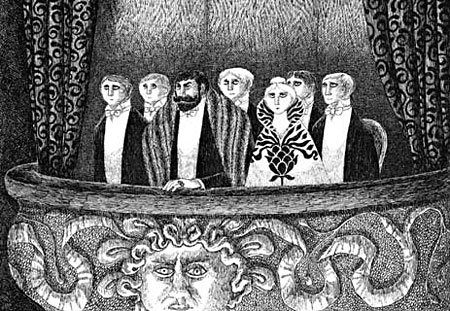
Perhaps you’ve seen his unforgettable drawings in the introductory animation for the PBS Mystery! series (animated by Derkek Lamb); perhaps you’ve seen one or more of his over 75 published books; or perhaps you’ve somehow encountered stray examples of his wonderfully eccentric pen drawings, filled with enigmatic figures in long coats or longer dresses, as likely to hold a knife as a croquet mallet (though either could be equally suspicious of being a murder weapon), and children of questionable intent and even more questionable future; and, of course, perhaps you’re already a devoted Edward Gorey fan.Gorey himself was something of an enigmatic figure, considered eccentric by some, with a perhaps undeserved association with grim, morbid or horrorific work, when in fact his work has always been whimsical, with just a twist of macabre humor.
Gorey’s wonderfully retro drawing style, at times spare, but often filled with luxurious swaths of pen and ink texture, lends itself perfectly to his off-kilter view of the world and the charming denizens with whom he populates it.
His small, utterly charming and disarming picture books (which you may or may not consider children’s storybooks, depending your thoughts about books in which terrible things happen to the children involved), are wonders of wordcraft as well as spellbindingly drawn. The seemingly simple haiku-like captions make you pause, and pause again, while a slow motion laugh arises, ghost-like, from the bottom of your brain pan and finds its way to your mouth as you stare.
Gorey is sometimes associated with Charles Adams, the two were acquainted and shared the same literary agent as well as admiration for each other’s work. An association I like to make is with the wonderfully off-kilter cartoons of B. Kliban, who I’m certain must have been influenced by Gorey, (as he was by Saul Steinberg), and who, in turn, was a prime influence on the Far Side’s Gary Larsen (along with Gorey, Adams and Gahan Wilson – it all comes around, folks).
Gorey said his fascination with the macabre began at age 5 when he discovered Bram Stoker’s Dracula, was “scared to death” and began to teach himself to draw. Though he worked in Doubleday’s art department for years, his own book ideas were rejected by publisher after publisher until The Unstrung Harp made it to press and began a string of successful titles.
He later did set designs for the Broadway version of Dracula, in which the entire sets were large reproductions of his pen drawings, intricately detailed castle interiors and drawing rooms; and entirely black and white, except.. one object in each set was brilliant blood-red.
You can now buy a fold-out and fold-up toy book version of the sets as Edward Gorey’s Dracula: A Toy Theatre: Die Cut, Scored and Perforated Foldups and Foldouts.
Unfortunately, there doesn’t seem to be a major repository of Gorey’s work on the web, so I’ve gathered some scattered resources below, though most of them are not representative of his best work..
If you haven’t exposed yourself to Gorey’s brain-tweaking and eye delighting books, I might recommend Amphigorey, an inexpensive collection of several of his small books (which was followed by several other collections in similar format). There are, of course, many other titles.
If you live within reach of Southeastern Pennsylvania, you can still catch a terrific show of Gorey’s originals, Elegant Enigmas: The Art of Edward Gorey, at the Brandywine River Museum until May 17, 2009. (Here is a review of the show, and background about Gorey, from the Philadelphia Inquirer.)
The Edward Gorey House, in his former home in Yarmouthport, MA, is open to the public on a regular basis.
Addendum: Michael Connors of Morguefile has written to add this link to reproduction of Gorey’s Gashleycrumb Tinies, his “Alphabet Book” (delightful!).
Categories:
-
William Holman Hunt and the Pre-Raphaelite Vision
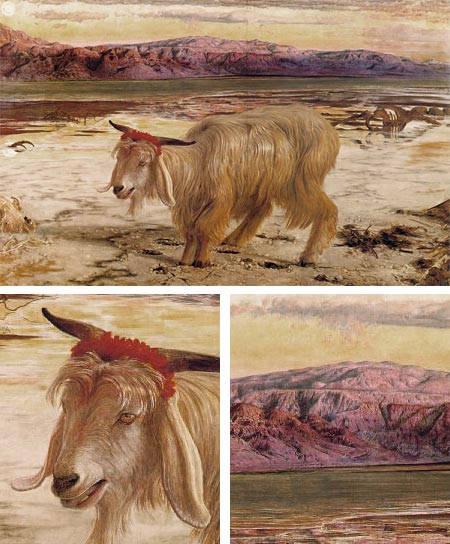
Sin and Salvation: William Holman Hunt and the Pre-Raphaelite Vision is the title of a show of the artist’s paintings, drawings, engravings, photographs and other items (64 objects) opening on June 14 at the Minneapolis Institute of the Arts.Hunt is one of the three principle founders of the Pre-Raphaelite Brotherhood, and along with Sir John Everett Millais, one of my two favorite Pre-Raphaelite painters.
Hunt and Millais imbued their canvasses with brilliant color of almost impressionistic intensity, but restrained within a precise realism that strove to be faithful to nature. Their art was meant to be closer in spirit to medieval art than to the classical compositions and formal poses of the Renaissance, which they saw as exemplified by Raphael, in which nature was sublimated to formal aesthetics; hence the characterization of themselves as “Pre-Raphaelites”.
I wrote an article about William Holman Hunt previously, in which I talked about my admiration for the brilliant, jewel-like quality of his paintings, as in the small but intensely beautiful painting of Isabella and the Pot of Basil that is in the Delaware Art Museum.
The show at the MIA was organized by the Art Gallery of Toronto ad the Manchester Art Gallery in the UK, and borrows heavily from the latter museum’s excellent collection.
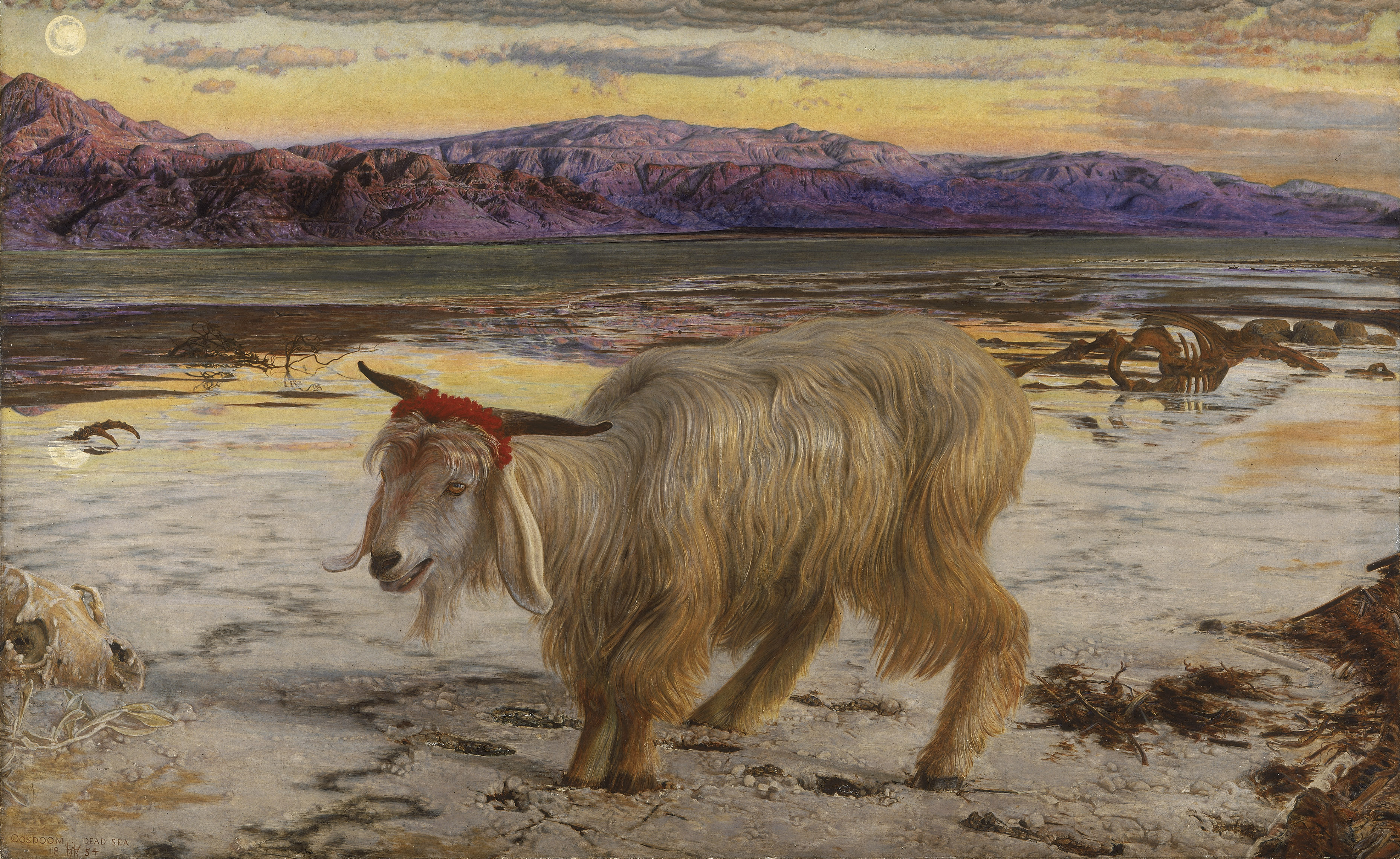
The painting shown above, The Scapegoat (large version here) is not in the show, though an alternate version of the same subject, is which the composition features a rather striking rainbow, will be on display.
Sin and Salvation: William Holman Hunt and the Pre-Raphaelite Vision at the Minneapolis Institute of the Arts June 14 to September 6, 2009.
[Via Art Knowledge News]
Categories:
-
MicroVisions 4 Auction

As I mentioned in my article last month about the MicroVisions 4 auction in support of the Society of Illustrators Scholarship Fund, the auction of several small original pieces by top science fiction and fantasy illustrators is now in progress.You can find additional details in Irene Gallo’s MicroVisions auction article on Tor.com.
The small size of the works (5×7″, 12x17cm) allows for an entry point for acquiring works by these artists that is lower than their larger work, which usually goes for amounts beyond the reach of a casual collector.
The MicroVisions auction itself is through eBay. As of this writing the auction has 4 days, 5 hours and a few odd minutes to run.
(Images above, left to right: Michael Whelan, Francis Vallejo, Greg Ruth, Luis Royo)
Categories:
-
The Virtual Paintout
 Kentucky artist Bill Guffey has come up with a great idea for a Virtual Paintout, in which participants use Google Maps Street Views as the subjects for paintings in traditional media.
Guffey actually talked with the Google Maps team and received their approval to the idea of creating paintings from Google Maps Street Views and selling them. The only caveat is that if the original source photographic view is shown along with the painting, that credit be assigned for the photograph (Google logo and copyright visible in the photograph). There is no claim of restriction on the paintings themselves.
This addresses the issue with using photographs by others as source material for artists, in that photographs themselves can be works of art, and are copyrightable.
The issues there are somewhat murky, involving interpretation based on verisimilitude and the legal status of the source photograph. An interesting example of this is the controversy surrounding the use of an AP photo for Shepard Fairey’s “Hope” poster of Barack Obama, and the subsequent suit by the AP.
The OK by Google over use of their maps photography for paintings obviates the issue of permission in individual cases where paintings are made using traditional media (though I’m sure that digital manipulation of the source photographs to make a digital work is another issue entirely).
Guffey, who has been using Google Maps Street views in a series of this own paintings, such as his State Series, realized that this opened the door to a Virtual Paintout, using Google Maps views of a particular place as the theme to create a virtual version of a traditional paintout gathering.
This is in some ways similar to the themed group painting and blog posting projects like Karin Jurick’s Different Strokes from Different Folks, in which the source inspiration is a single photograph (see my posts on Different Strokes from Different Folks and Different Strokes from Different Folks Portrait Swap).
Previous Virtual Paintout locations included Baltimore and Seattle. The most recent completed Virtual Paintout location was Amsterdam, from which I’ve pulled a few examples at left (top to bottom: Phil Holt, Sharon Williamson, Carol Morgan, Bill Guffey).
The new, current Virtual Paintout location is Paris (ah, Paris!). This one starts now and runs to the end of May. The blog post provides a map and a link to the larger original map on Google. You would use the latter to access Street View.
If you haven’t used Google Street View before, prepare to be amazed. On the full size map, drag the small icon of a person from the upper left view control bar into the image to see a street view from that location. Mouse across the image to rotate the view or look up and down. Move the figure in the inset map to move the view, or click back on the minus sign in the upper left to pull back to map view.
Find a location you like, perhaps take a screenshot for further reference and start painting. (Are there any views in central Paris that are not potential views for a painting?) There are more complete instructions, including how to submit your painting to the Virtual Paintout blog, in the blog’s right hand column.
You can see more of Guffey’s own work, much of which has a painterly plein air feeling, even when painted from Street View photographs, on his blog and web site.
Categories:




Charley’s Picks
Bookshop.org
(Bookshop.org affilliate links; sales benefit independent bookshop owners; I get a small percentage to help support my work on Lines and Colors)

John Singer Sargent: Watercolors


Urban Sketching: Understanding Perspective


Charley’s Picks
Amazon
(Amazon.com affiliate links; sales go to a larger yacht for Jeff Bezos; but I get a small percentage to help support my work on Lines and Colors)
John Singer Sargent: Watercolors
Urban Sketching: Understanding Perspective