


Categories
- 3d CGI
- Amusements
- Animation
- Anime & Manga
- Art Materials
- Art Videos
- Blogroll
- Cartoons
- Color
- Comics
- Concept & Visual Dev.
- Creativity
- Digital Art
- Digital Painting
- Displaying Art on the Web
- Drawing
- Eye Candy for Today
- Gallery and Museum Art
- High-res Art Images
- Illustration
- Motion Graphics & Flash
- Museums
- Online Museums
- Outsider Art
- Painting
- Painting a Day
- Paleo Art
- Pastel, Conté & Chalk
- Pen & Ink
- Prints and Printmaking
- Reviews
- Sc-fi and Fantasy
- Sculpture & Dimensional
- Site Comments
- Sketching
- Storyboards
- Tools and Techniques
- Uncategorized
- Vector Art
- Videos & Podcasts
- Vision and Optics
- Watercolor and Gouache
- Webcomics
Archives
- April 2026
- March 2026
- February 2026
- January 2026
- December 2025
- November 2025
- October 2025
- September 2025
- August 2025
- July 2025
- June 2025
- May 2025
- January 2025
- December 2024
- November 2024
- October 2024
- September 2024
- August 2024
- June 2024
- April 2024
- March 2024
- February 2024
- January 2024
- December 2023
- November 2023
- October 2023
- September 2023
- August 2023
- July 2023
- May 2023
- April 2023
- March 2023
- February 2023
- January 2023
- December 2022
- November 2022
- September 2022
- August 2022
- July 2022
- June 2022
- May 2022
- April 2022
- March 2022
- February 2022
- January 2022
- December 2021
- November 2021
- October 2021
- September 2021
- August 2021
- July 2021
- June 2021
- May 2021
- April 2021
- March 2021
- February 2021
- January 2021
- December 2020
- November 2020
- October 2020
- September 2020
- August 2020
- July 2020
- June 2020
- May 2020
- April 2020
- March 2020
- February 2020
- January 2020
- December 2019
- November 2019
- October 2019
- September 2019
- August 2019
- July 2019
- June 2019
- May 2019
- April 2019
- March 2019
- February 2019
- January 2019
- December 2018
- November 2018
- October 2018
- September 2018
- August 2018
- July 2018
- June 2018
- May 2018
- April 2018
- March 2018
- February 2018
- January 2018
- December 2017
- November 2017
- October 2017
- September 2017
- August 2017
- July 2017
- June 2017
- May 2017
- April 2017
- March 2017
- February 2017
- January 2017
- December 2016
- November 2016
- October 2016
- September 2016
- August 2016
- July 2016
- June 2016
- May 2016
- April 2016
- March 2016
- February 2016
- January 2016
- December 2015
- November 2015
- October 2015
- September 2015
- August 2015
- July 2015
- June 2015
- May 2015
- April 2015
- March 2015
- February 2015
- January 2015
- December 2014
- November 2014
- October 2014
- September 2014
- August 2014
- July 2014
- June 2014
- May 2014
- April 2014
- March 2014
- February 2014
- January 2014
- December 2013
- November 2013
- October 2013
- September 2013
- August 2013
- July 2013
- June 2013
- May 2013
- April 2013
- March 2013
- February 2013
- January 2013
- December 2012
- November 2012
- October 2012
- September 2012
- August 2012
- July 2012
- June 2012
- May 2012
- April 2012
- March 2012
- February 2012
- January 2012
- December 2011
- November 2011
- October 2011
- September 2011
- August 2011
- July 2011
- June 2011
- May 2011
- April 2011
- March 2011
- February 2011
- January 2011
- December 2010
- November 2010
- October 2010
- September 2010
- August 2010
- July 2010
- June 2010
- May 2010
- April 2010
- March 2010
- February 2010
- January 2010
- December 2009
- November 2009
- October 2009
- September 2009
- August 2009
- July 2009
- June 2009
- May 2009
- April 2009
- March 2009
- February 2009
- January 2009
- December 2008
- November 2008
- October 2008
- September 2008
- August 2008
- July 2008
- June 2008
- May 2008
- April 2008
- March 2008
- February 2008
- January 2008
- December 2007
- November 2007
- October 2007
- September 2007
- August 2007
- July 2007
- June 2007
- May 2007
- April 2007
- March 2007
- February 2007
- January 2007
- December 2006
- November 2006
- October 2006
- September 2006
- August 2006
- July 2006
- June 2006
- May 2006
- April 2006
- March 2006
- February 2006
- January 2006
- December 2005
- November 2005
- October 2005
- September 2005
- August 2005
Relevant Blogs
Art, Painting & Sketch
- Gurney Journey
- Underpaintings
- Art and Influence
- Painting Perceptions
- Oil Painters of America
- Vasari Paint POV
- Flying Fox
- Urban Sketchers
- Bento (Smithsonian)
- Art Inconnu
- The Hidden Place
- Still Life
- Making a Mark
- The Art of the Landscape
- Exploring Color & Creativity
- Art Contrarian
- Artist A Day
- beinArt Surreal Art Collective
- Eye Level
- David Dunlop
- p.i.g.m.e.n.t.i.u.m
- CultureGrrl
- Joaquín Sorolla blog
- Artists in Pastel
“Painting a Day”
- A Painting a Day (Keiser)
- On Painting (Keiser)
- Julian Merrow-Smith
- Karen Jurick
- Jeffrey Hayes
- Carol Marine
- Abbey Ryan
- Daily Paintworks
Other Painting Blogs
- Virtual Gouache Land
- Neil Hollingsworth
- Marc Hanson
- Kevin Menck
- Marc Dalessio
- Larry Seiler
- Stapleton Kearns
- Colin Page
- Roos Schuring
- Hans Versfelt
- Titus Meeuws
- Régis Pettinari
- René Plein Air
- Belinda Del Pesco
- Robin Weiss
- Nathan Fowkes (Land Sketch)
- William Wray
- Frank Serrano
- Stephen Magsig
- Michael Chesley Johnson
- Twice a Week
- Sarah Wimperis
- Rob Adams
- Michael Cole Manley
- The Dirty Palette Club
- Mike Manley’s Draw!
Gallery Art & Illustration mix
Illustration
- Howard Pyle
- 100 Years of Illustration
- BibliOdyssey
- Illustration Art
- Today’s Inspiration
- Illustration Mundo
- Little Chimp Society
- Danny Gregory
- R D (John Martz
- Illustration Friday blog
- Monster Brains
- Illustrators & Illustrations (RU)
- Elwood H. Smith
- DaniDraws.com
- Designers Who Blog
- iSpot Blog
Sci-Fi & Fantasy
Illustration & Comics
Comics & Cartoons
- Comics Beat
- Robot 6
- Newsarama Blog
- Comic Vine
- Comics Alliance
- Forbidden Planet Int.
- Paolo Rivera
- Bolt City
- Flight
- Scott McCloud
- The Comics Journal
- Comixpedia
- Funnybook Babylon
- James Baker
- Middleton’s Sketchbook
- Boneville
- The Hotel Fred
- Paul Rivoche
- Daily Cartoonist
- Mad About Cartoons (William Wray)
- Digital Strips
Illustration & Concept
Animation & Concept
- Cartoon Brew
- Animation Blog
- Cold Hard Flash
- Concept Art World
- The CAB
- FY Concept Art
- Concept Ships
- Concept Robots
- John Nevarez
- Armand Serrano
- Marcos Mateu-Mestre
- all kinds of stuff (Kricfalusi)
- Yacin the faun (Man Arenas)
- Kelsey Mann
- Cre8tivemarks Blog
- Ice-Cream Monster Toon Cafe
- AAU Character & Creature Design
- AAU Animation Notes
- Articles and Texticles
Paleo & Scientific
Tools & Techniques
Other
Lists of Art Blogs
Art Image Resource Links
Historic Art Images
- Wikimedia Commons: Paintings
- Wikimedia Commons: Drawings
- The Athenaeum
- WikiArt (WikiPaintings)
- Google Art Project: Artists
- Google Art Project: Collections (Museums)
- ArtCyclopedia
- Web Gallery of Art
- Art Renewal Center
- Web Gallery of Impressionism
Auction Consolidation sites
Auction sites
- Sotheby’s
- Bonham’s
- Christies
- Heritage Auctions: Fine Art
- Heritage Auctions: Illustration
- Freeman’s Auctions
- Bukowskis
- Shannon’s
Image Search
Reverse Image Search (search by image)
- Tin Eye
- RevImg
- Google Image Search (camera icon)
- Bing Image Search (camera icon)
Promoting some friends and some clients of my website design business
- Twin Willows T’ai Chi studio in Wilmington DE. Taiji classes with Bryan Davis.
- Ray Hayward, Inspired Teacher of T’ai Chi ( Taiji ) in Minneapolis, Founder of Mindful Motion Tai Chi Academy
- OldHead Tattoo studio and Art Gallery in Wilmington DE. Tattoos and paintings by Bruce Gulick
- Sharon Domenico Art, pet portrait oil paintings
- Platinum Paperhanging, wallpaper hanging, Main Line and Philadelphia, PA
- Lisa Stone Design, interior designer, Main Line and Philadelphia, PA
- Studio12KPT, original art, prints, calendars and other custom printed items by Van Sickle & Rolleri
-
More Leyendecker and other great stuff

OK, I realize I just posted about the amazing Golden Age illustrator J.C. Leyendecker a couple of weeks ago, and I’ve written about him half a dozen times in the past, but I have this general rule that says there’s no such thing as too much Leyendecker.The first item I want to tell you about is a limited edition book that accompanies the exhibit I talked about in my last post, Americans Abroad: J.C. Leyendecker and the European Academic Influence on American Illustation.
Frustratingly, my schedule won’t allow me to get to New York before this exhibit closes on Saturday (July 12), but a friend was kind enough to pick up a copy of the exhibition catalog for me.
Aside from the fact that it makes me even more disappointed that I won’t see the show in person, it’s the next best thing, because the book is wonderful. It’s full of beautiful illustrations by J.C. Leyendecker, his brother Francis X Leyendecker (underrated in the shadow of his brother) and a number of other great Golden Age illustrators who were classically trained, including Edwin Austin Abbey, Edwin Howland Blashfield, Anton Otto Fischer, Norman Mills Price, Everett Shinn, William Thomas Smedley, Violet Oakley and others.
The book is a treat and, given the scarcity of Leyendecker material in print these days, a steal at $25 just for the beautiful reproductions of his work.
On that note, the second item is a new Leyendecker book on the horizon (finally!!). J.C. Leyendecker by Laurence S. Cutler, Judy Goffman Cutler is due in September of this year. The link I give here is to the Amazon pre-publication listing.
Lastly, for those who can’t get to the show or grab the book(s), I have a nice new Leyendecker web link as well. An anonymous benefactor who goes by the name of Mr. Door Tree has kindly posted some Leyendecker goodies to his Golden Age Comic Book Stories blog, including the image above, Cuchulain in Battle, from The Century Magazine, 1906, which is also in the Society of Illustrators show and catalog.
Addendum: Unfortunately, as of 8’28/08, the Leyendecker post on Golden Age Comic Book Stories has been taken down, and I don’t know another source for these images. I’ll leave the link in case they reappear.
Addendum II The new book J.C. Leyendecker by Laurence S. Cutler and Judy Goffman Cutler has been published. While I haven’t gotten my copy yet, reports are that they have done a terrific job, investing years of research and filling the book with hundreds of carefully prepared images.
Categories:
-
The Undersea Adventures of Capt’n Eli (Jay Piscopo)
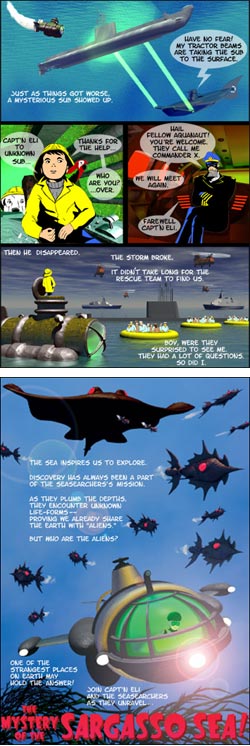 The Undersea Adventures of Capt’n Eli is a reminder of the fun and unpretentious adventure comics of the “Silver Age” (1960’s an 70’s) and before, in this case updated with a bit of anime flavor in the way outline and flat color drawings of the characters are set against rendered and 3-D backgrounds.
Drawn and written by Maine artist Jay Piscopo, Capt’n Eli was created as a promotional vehicle for a specialty root beer company. Comics and characters created in that kind of role are often half-hearted, designed-by-committee and drawn by disinterested commercial artists. Capt’t Eli, on the other hand, is a delightful exception to that rule, and surprised me when I first encountered it to the extent that I likened it to finding a classic Fantastic Four comic in your shredded wheat box.
Capt’n Eli carries a bit of that 60’s Marvel flavor, plus some of the wonderful camp feeling of earlier “Golden Age” comics (to which it makes reference with the character of “Commander X”), plus a healthy dose of Johnny Quest, which featured the character design work of Alex Toth. Capt’n Eli is an undersea sci-fi adventure story featuring high-tech submarines, flying mini-subs, time travel, monsters, robots, nefarious villains and lost civilizations; in short, a nice mixture for all-ages adventure comics fun.
The submarines, helicopters, robots and other tech gadgets in the story are rendered out as 3-D models, giving an additional flavor of Popular Science stories on wild designs for future submarines and aircraft. I particularly like the enemy subs that have a feeling of the Nautilus from the classic Disney version of 20,000 Leagues Under the Sea.
The combination of the outline and flat color drawings against rendered backgrounds and 3-D objects may seem jarring to some, though anyone whose seen my own webcomic knows I’m completely comfortable with it (grin), and the use of that approach in Japanese animation has made it seem less unusual in recent years.
It was through my webcomic that I encountered Capt’n Eli, when Jay Piscopo wrote me several years ago and asked me to take a look at the strip, which was then available as a webcomic. I did, and wrote a nice review of it on the Zark Comics Links page. Piscopo subsequently asked me if I would like to write a foreword to the new print collection, which I was delighted to do.
It took a little time to reach fruition, but The Undersea Adventures of Capt’n Eli has finally been released as a 104 page trade paperback (“graphic novel” format) containing two Capt’n Eli stories and a “Golden Age” Commander X story, and is available through the Capt’n Eli site for $9.99, on the same ordering page with the company’s root beer and other sodas (read “pop” for those of you in the U.S. and Canadian midwest); along with other Capt’n Eli gear. You can also find it on Amazon.
The volume features a cover by comics artist Steve Rude, and pin-ups by Rude, Herb Trimpe and Howard Chaykin. You can see a few (unfortunately small) sample pages from one of the stories by selecting “The Story Begins” at the bottom of this page. You can also read the full first Capt’n Eli webisode, The Mystery of Me, and some earlier material in the Archives (though, again, the web versions are kind of small).
The Capt’n Eli site also has a gallery of pin-ups and a bio of artist Jay Piscopo, who has a background as an art director at Tom Snyder Productions producing educational CD_ROMs like Fizz and Martina Math Adventures, created the The Scrap City Pack Rats comic for Goodwill Industries, and was an animator for the ABC Saturday morning show Squigglevision. Piscopo teaches classes in cartooning at the Maine College of Art.
The second volume of The Undersea Adventures of Capt’n Eli is slated for release in October of this year and should be available though the web site, Amazon and a number of comic book stores.
Oh, and the root beer’s pretty good too.
Categories:
-
Web Gallery of Art

The Web Gallery of Art (WGA) is one of the best and most extensive of the “online museums” on the web.The WGA is more specific than some, with a focus on European Art from the Gothic to the Romantic periods (1100 to 1850). The gallery has a search function, as you would expect, as well as an alphabetical Artist Index (at the bottom of every page).
Clicking on an artist’s name in the index brings up either a page of thumbnails, or, if the artist’s listing is extensive enough, text links to two or more sections, each of which has a page or more of thumbnails.
Clicking on a thumbnail opens a pop-up with a large version of the image. (I’ve experienced some problems with this when using Safari for Mac, try refreshing the window if it’s blank. The popup feature works more reliably in IE and Firefox). The popup has a choice of images sizes, though 100% seems optimal for quality.
There is also a column in the thumbnails pages with an “I”; clicking on this gives you a page with a medium size image and text details about the image (date, size, medium and description or background information). The artist thumbnail pages and image detail pages also have a link at page top to the artist’s biography.
An interesting feature of the WGA is the “Dual Mode” (a link at page top), which makes use of frames (a browser feature that allows for the display of more than one web page in the same window) to allow you to either search a list in one frame and have the results display in the other (the default), or, if you deselect that choice at the bottom of the frame, you can search two lists independently, bringing up two different selections side by side for comparison. (In the image above I’ve chosen to compare Titian’s Man With the Blue Sleeve to one of Rembrandt’s self portraits.)
As usual with frames, it’s often possible to find yourself a bit confused and you may need to back out to the front page and start over, but it’s a nice feature if you get used to it.
The Web Gallery of Art has an extensive database of over 20,000 images, lots of information about the artists and the individual works, and nicely includes many drawings and graphics as well as paintings. This can be a terrific resource, and/or a major time-sink.
Enjoy.
Categories:
-
Mark A. Garlick

No, It’s not fireworks, at least not of the terrestrial variety.(For the benefit of those in other parts of the world, I’ll point out that today, July 4th, is Independence Day here in the U.S., a holiday usually associated with fireworks displays.)
The fireworks shown here are celestial, in an interpretation of a supernova, the explosion of a large star that has collapsed in on itself when it can no longer sustain the fusion reaction necessary to hold its current form against the crush of its own gravity, in a painting by U.K. space artist and scientific illustrator Mark A. Garlick.
Garlick has a doctorate in astrophysics, giving him the scientific background to understand the phenomena he is portraying from the inside out. He has a site devoted specifically to his space art at space-art.co.uk, and another more general portfolio site in which he has galleries of earth sciences illustrations, paleo art, science fiction illustration and additional space art.
Garlick was working in traditional media, and some of the images are done in gouache, acrylic or pastel; but the majority of his recent work is done digitally, painted in Photoshop, sometimes with the addition of 3-D CGI in 3DS Max, Terragen or Bryce. He will also mix traditional and digital techniques.
Though he works in a variety of genres, it is his space art and earth science illustrations that I find most appealing. His bright color palette and sense of precise but lively realism give a feeling of immediacy that photography often doesn’t. Of course, one of the things space artists can do is show us views that telescopes and probes cannot. (See my post on pioneering space artist Chesley Bonestell.)
Garlck’s clients include Scientific American, Asimov’s Science Fiction, New Scientist, The Guardian, Astronomy Magazine, Sky and Telescope and others. He is also a fellow in the International Association of Astronomical Artists, an organization devoted to promoting the genre.
Garlick is also the author of five popular books on astronomy.
Categories:
-
Guy Billout

Guy Billout seems fascinated with patterns, whether of hedgerow mazes, the multiple columns of colonnades, tiled floors or repeated structures; particularly those patterns that lead us to one conclusion, only to be presented with another.Billout is a French illustrator who deals in quiet irony. His images are still and contemplative, even when portraying dramatic events like a ship being turned upside down under the crest of an enormous wave, lightning strikes being reeled in by a man on a roof with a boat hook or the prehistoric filling of the Mediterranean Sea as viewed by modern tourists at Gibraltar.
He invites you into a seemingly normal scene, in which he quietly but firmly pulls the rug out from under your expectations as you notice the details.
Lighthouse lights bend to surmount cliffs, or provide a walkway for the operator, a couple warm themselves by a fireplace, which on closer inspection contains the fire of a city being bombed, people walk on parts of an image, the sky line or horizon line, a white dune is climbed on one side by a desert traveller, on the other by an arctic hunter, bridges stop and resume in mid-crossing or are constructed by rolling out girders like duct tape in midair.
Billout has been a long time contributor to the Atlantic Monthly and other major publications, as well as doing a variety of commercial work. He is a faculty member of the Parsons Illustration Department and his books include The Frog Who Wanted to See the Sea, Bus 24 and a new collection, Something’s Not Quite Right
At times his reminds me of Magritte, twisting our preconceptions of how the world is arranged, sometimes of the juxtaposition of multiple worlds by magic realists like Rob Gonsalves; at other times he can bring to mind the over the edge humorous rearrangements of reality by Saul Steinberg or B. Kliban.
Like all of those artists, Billout excels at that aspect of art that brings us to a refreshingly different point of view on the world. He lays out a a geometric grid of stillness to quite our minds, and then drops a pebble of irony into the pool, allowing it to gently ripple through our unconscious mind until it dawns on us that, indeed, something’s not quite right here; but not quite right in a most delightful way.
It’s unfortunate that most of the images available are somewhat small, because the devil, as they say, is in the details.
Categories:
-
Illusionistic 3-D painting on sidewalks and walls

I’ve written before about the illusionistic 3-D sidewalk “paintings” in chalk by artists like Kurt Wenner and Julian Beever, as well as the large scale illusionistic murals by Eric Grohe.Web Urbanist has posted a nice overview, Amazing 3D Art from the Best Street Artists, with a selection of work by Wenner (image above), Beever, and others; including Edgar Muller and Manfred Stader, Tracy Lee Stum, Eduardo Relero, Rod Tryon and Anthony Cappetto, giving you a quick look at some highlights of this apparently growing phenomenon. It also features muralists like Grohe and Greg Brown, and even a 3-D graffiti artist known as Diam.
Some of the pavement chalk art takes the form of large scale reproductions of famous works by artists like Da Vinci, Vermeer, Rembrandt and others.
Much of the work that has made this a phenomenon is based on anamorphoses, images that are distorted in such a way that they only look “right” form a certain vantage point. The limitation is a trade off for the illusionistic power the images can have to appear three dimensional when seen from that viewpoint. You can see an example of how this works here.
Anamorphosis has been used in art for centuries; you can see a particularly striking example of it in Hans Holbien the Younger’s famous double portrait The Ambassadors, which contains the anamorphic apparition of a skull.
The new urban sidewalk artists have used this approach to create images of objects and environments that, when viewed from the correct vantage point, appear to extend above or below the pavement on which they are painted.
Wenner has gotten new, upscale website since I wrote about him, casting himself as available for corporate commissions and highlighting his architectural designs. Beever is still coasting along like a street artist, with a homemade looking, 90’s style site, but he has added additional images.
Wenner’s site includes some videos of him working, and there are some others on YouTube of a short documentary, Masterpieces in Chalk.
If you look around, you’ll find a few not covered in the Urbanist article, like Cuong Nguyen.
Muralists like Grohe or Brown are in the long artistic tradition of “trompe l’oeil” (French for “trick the eye”), in which artists have created images that appear to have dimensionality beyond the surface on which they are painted, relying less on anamorphosis and more on realism. This tradition includes some of the fantastic dome paintings in which the vault of heaven, filled with angels and religious figures floating in apparent disregard for gravity, is projected on the interior of a dome.
Of course, if you step back and think about it, the modernists were right; all representational art is an illusion.
Categories:




Charley’s Picks
Bookshop.org
(Bookshop.org affilliate links; sales benefit independent bookshop owners; I get a small percentage to help support my work on Lines and Colors)

John Singer Sargent: Watercolors


Urban Sketching: Understanding Perspective


Charley’s Picks
Amazon
(Amazon.com affiliate links; sales go to a larger yacht for Jeff Bezos; but I get a small percentage to help support my work on Lines and Colors)
John Singer Sargent: Watercolors
Urban Sketching: Understanding Perspective