


Categories
- 3d CGI
- Amusements
- Animation
- Anime & Manga
- Art Materials
- Art Videos
- Blogroll
- Cartoons
- Color
- Comics
- Concept & Visual Dev.
- Creativity
- Digital Art
- Digital Painting
- Displaying Art on the Web
- Drawing
- Eye Candy for Today
- Gallery and Museum Art
- High-res Art Images
- Illustration
- Motion Graphics & Flash
- Museums
- Online Museums
- Outsider Art
- Painting
- Painting a Day
- Paleo Art
- Pastel, Conté & Chalk
- Pen & Ink
- Prints and Printmaking
- Reviews
- Sc-fi and Fantasy
- Sculpture & Dimensional
- Site Comments
- Sketching
- Storyboards
- Tools and Techniques
- Uncategorized
- Vector Art
- Videos & Podcasts
- Vision and Optics
- Watercolor and Gouache
- Webcomics
Archives
- April 2026
- March 2026
- February 2026
- January 2026
- December 2025
- November 2025
- October 2025
- September 2025
- August 2025
- July 2025
- June 2025
- May 2025
- January 2025
- December 2024
- November 2024
- October 2024
- September 2024
- August 2024
- June 2024
- April 2024
- March 2024
- February 2024
- January 2024
- December 2023
- November 2023
- October 2023
- September 2023
- August 2023
- July 2023
- May 2023
- April 2023
- March 2023
- February 2023
- January 2023
- December 2022
- November 2022
- September 2022
- August 2022
- July 2022
- June 2022
- May 2022
- April 2022
- March 2022
- February 2022
- January 2022
- December 2021
- November 2021
- October 2021
- September 2021
- August 2021
- July 2021
- June 2021
- May 2021
- April 2021
- March 2021
- February 2021
- January 2021
- December 2020
- November 2020
- October 2020
- September 2020
- August 2020
- July 2020
- June 2020
- May 2020
- April 2020
- March 2020
- February 2020
- January 2020
- December 2019
- November 2019
- October 2019
- September 2019
- August 2019
- July 2019
- June 2019
- May 2019
- April 2019
- March 2019
- February 2019
- January 2019
- December 2018
- November 2018
- October 2018
- September 2018
- August 2018
- July 2018
- June 2018
- May 2018
- April 2018
- March 2018
- February 2018
- January 2018
- December 2017
- November 2017
- October 2017
- September 2017
- August 2017
- July 2017
- June 2017
- May 2017
- April 2017
- March 2017
- February 2017
- January 2017
- December 2016
- November 2016
- October 2016
- September 2016
- August 2016
- July 2016
- June 2016
- May 2016
- April 2016
- March 2016
- February 2016
- January 2016
- December 2015
- November 2015
- October 2015
- September 2015
- August 2015
- July 2015
- June 2015
- May 2015
- April 2015
- March 2015
- February 2015
- January 2015
- December 2014
- November 2014
- October 2014
- September 2014
- August 2014
- July 2014
- June 2014
- May 2014
- April 2014
- March 2014
- February 2014
- January 2014
- December 2013
- November 2013
- October 2013
- September 2013
- August 2013
- July 2013
- June 2013
- May 2013
- April 2013
- March 2013
- February 2013
- January 2013
- December 2012
- November 2012
- October 2012
- September 2012
- August 2012
- July 2012
- June 2012
- May 2012
- April 2012
- March 2012
- February 2012
- January 2012
- December 2011
- November 2011
- October 2011
- September 2011
- August 2011
- July 2011
- June 2011
- May 2011
- April 2011
- March 2011
- February 2011
- January 2011
- December 2010
- November 2010
- October 2010
- September 2010
- August 2010
- July 2010
- June 2010
- May 2010
- April 2010
- March 2010
- February 2010
- January 2010
- December 2009
- November 2009
- October 2009
- September 2009
- August 2009
- July 2009
- June 2009
- May 2009
- April 2009
- March 2009
- February 2009
- January 2009
- December 2008
- November 2008
- October 2008
- September 2008
- August 2008
- July 2008
- June 2008
- May 2008
- April 2008
- March 2008
- February 2008
- January 2008
- December 2007
- November 2007
- October 2007
- September 2007
- August 2007
- July 2007
- June 2007
- May 2007
- April 2007
- March 2007
- February 2007
- January 2007
- December 2006
- November 2006
- October 2006
- September 2006
- August 2006
- July 2006
- June 2006
- May 2006
- April 2006
- March 2006
- February 2006
- January 2006
- December 2005
- November 2005
- October 2005
- September 2005
- August 2005
Relevant Blogs
Art, Painting & Sketch
- Gurney Journey
- Underpaintings
- Art and Influence
- Painting Perceptions
- Oil Painters of America
- Vasari Paint POV
- Flying Fox
- Urban Sketchers
- Bento (Smithsonian)
- Art Inconnu
- The Hidden Place
- Still Life
- Making a Mark
- The Art of the Landscape
- Exploring Color & Creativity
- Art Contrarian
- Artist A Day
- beinArt Surreal Art Collective
- Eye Level
- David Dunlop
- p.i.g.m.e.n.t.i.u.m
- CultureGrrl
- Joaquín Sorolla blog
- Artists in Pastel
“Painting a Day”
- A Painting a Day (Keiser)
- On Painting (Keiser)
- Julian Merrow-Smith
- Karen Jurick
- Jeffrey Hayes
- Carol Marine
- Abbey Ryan
- Daily Paintworks
Other Painting Blogs
- Virtual Gouache Land
- Neil Hollingsworth
- Marc Hanson
- Kevin Menck
- Marc Dalessio
- Larry Seiler
- Stapleton Kearns
- Colin Page
- Roos Schuring
- Hans Versfelt
- Titus Meeuws
- Régis Pettinari
- René Plein Air
- Belinda Del Pesco
- Robin Weiss
- Nathan Fowkes (Land Sketch)
- William Wray
- Frank Serrano
- Stephen Magsig
- Michael Chesley Johnson
- Twice a Week
- Sarah Wimperis
- Rob Adams
- Michael Cole Manley
- The Dirty Palette Club
- Mike Manley’s Draw!
Gallery Art & Illustration mix
Illustration
- Howard Pyle
- 100 Years of Illustration
- BibliOdyssey
- Illustration Art
- Today’s Inspiration
- Illustration Mundo
- Little Chimp Society
- Danny Gregory
- R D (John Martz
- Illustration Friday blog
- Monster Brains
- Illustrators & Illustrations (RU)
- Elwood H. Smith
- DaniDraws.com
- Designers Who Blog
- iSpot Blog
Sci-Fi & Fantasy
Illustration & Comics
Comics & Cartoons
- Comics Beat
- Robot 6
- Newsarama Blog
- Comic Vine
- Comics Alliance
- Forbidden Planet Int.
- Paolo Rivera
- Bolt City
- Flight
- Scott McCloud
- The Comics Journal
- Comixpedia
- Funnybook Babylon
- James Baker
- Middleton’s Sketchbook
- Boneville
- The Hotel Fred
- Paul Rivoche
- Daily Cartoonist
- Mad About Cartoons (William Wray)
- Digital Strips
Illustration & Concept
Animation & Concept
- Cartoon Brew
- Animation Blog
- Cold Hard Flash
- Concept Art World
- The CAB
- FY Concept Art
- Concept Ships
- Concept Robots
- John Nevarez
- Armand Serrano
- Marcos Mateu-Mestre
- all kinds of stuff (Kricfalusi)
- Yacin the faun (Man Arenas)
- Kelsey Mann
- Cre8tivemarks Blog
- Ice-Cream Monster Toon Cafe
- AAU Character & Creature Design
- AAU Animation Notes
- Articles and Texticles
Paleo & Scientific
Tools & Techniques
Other
Lists of Art Blogs
Art Image Resource Links
Historic Art Images
- Wikimedia Commons: Paintings
- Wikimedia Commons: Drawings
- The Athenaeum
- WikiArt (WikiPaintings)
- Google Art Project: Artists
- Google Art Project: Collections (Museums)
- ArtCyclopedia
- Web Gallery of Art
- Art Renewal Center
- Web Gallery of Impressionism
Auction Consolidation sites
Auction sites
- Sotheby’s
- Bonham’s
- Christies
- Heritage Auctions: Fine Art
- Heritage Auctions: Illustration
- Freeman’s Auctions
- Bukowskis
- Shannon’s
Image Search
Reverse Image Search (search by image)
- Tin Eye
- RevImg
- Google Image Search (camera icon)
- Bing Image Search (camera icon)
Promoting some friends and some clients of my website design business
- Twin Willows T’ai Chi studio in Wilmington DE. Taiji classes with Bryan Davis.
- Ray Hayward, Inspired Teacher of T’ai Chi ( Taiji ) in Minneapolis, Founder of Mindful Motion Tai Chi Academy
- OldHead Tattoo studio and Art Gallery in Wilmington DE. Tattoos and paintings by Bruce Gulick
- Sharon Domenico Art, pet portrait oil paintings
- Platinum Paperhanging, wallpaper hanging, Main Line and Philadelphia, PA
- Lisa Stone Design, interior designer, Main Line and Philadelphia, PA
- Studio12KPT, original art, prints, calendars and other custom printed items by Van Sickle & Rolleri
-
Richard Parkes Bonington
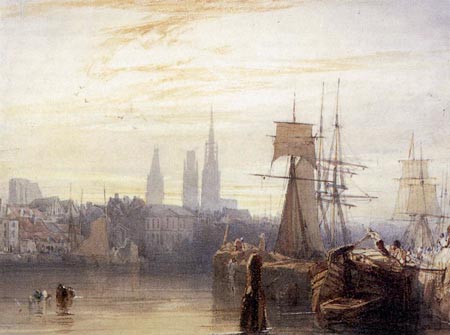
Richard Parkes Bonington was one of the great English landscape painters at the height of the grand era of landscape painting in the 1800’s, and a notable figure in the English watercolor movement.He is credited with carrying the influence of both of those artistic waves to Continental Europe and inspiring many European painters to take up the practice of painting with watercolor, including Delacroix.
In his tragically short life of twenty six years, and a career as a painter that lasted only ten, he produced a notable body of work; with fresh, atmospheric paintings that bent the rules of what was acceptable in painting at the time, and helped lay the groundwork on which later sharp breaks with tradition (i.e. Impressionism) would be based.
He preferred to work outdoors, and took his compositions from modern life rather than composing “history paintings” in which the landscape was subservient to some concept of classical antiquity or religious significance.
His paintings are notable for their sweeping skies, atmospheric haze and quick suggestions of texture in place of labored rendering.
Categories:
-
Mark Bischel
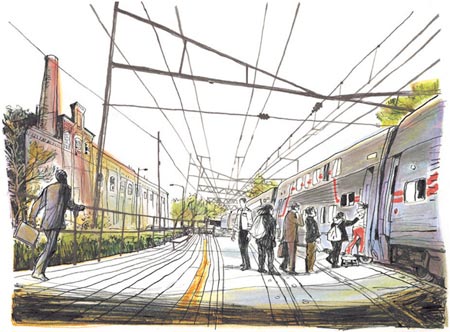
Mark Bischel is another of those illustrators whose work I’ve encountered, but about whom I know little. His web presence is minimalist to a fault, consisting of a series of (unfortunately horizontally) scrolling thumbnails and the larger images they link to; which can also be navigated (fortunately) by forward and back arrows.His images range from dark and thickly textured monochrome charcoal drawings to brusquely textured oil paintings to graphic and somewhat monochromatic silkscreen, and what appear to be ink and watercolor paintings.
As fascinating as the slikscreens are, it’s the ink and watercolor pieces I find most appealing. They have a a loose, fresh feeling, and carry the best qualities of an on-location sketch, with free line work and lightly applied areas of color.
A brief search for Bischel produced little additional information other than the fact that he is a graduate of the School of Visual Arts. He has also been in the Communication Arts Illustration Annuals, which is where I encountered his work.
Perhaps Bischel will update his site at some point with additional images and maybe even a little information.
Categories:
-
American Artist’s Self-Portrait Competition
I’ve always been fascinated by self-portraits (not that I’ve done that many myself). Here is not only the artist’s personality expressed through their work, but through their own inner or outer vision of themselves.Many of history’s great paintings have been self portraits, from Durer and Rembrandt to Sargent and Van Gogh, artists have made self-portraits into powerful statements with the full force of their personality and artistic skills.
One of the most intriguing things about self-portraits is the variety of approach, in terms of materials, the nature of the composition, attitude of the artist as sitter, and the background, setting and objects an artist can choose to surround themselves with.
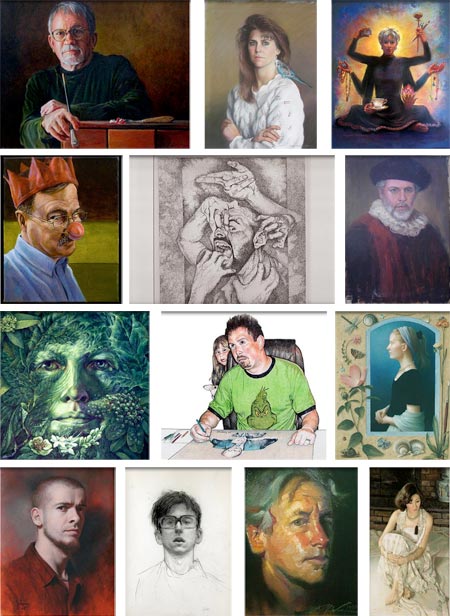
American Artist, the venerable artists’ magazine, has opened the entry process on this year’s Self-Portrait Competition, in which the selected winners will have their self-portraits published in the magazine. The magazine’s web site has a slide-show of recent entries, about 70 of them at this point, which already constitute a colorful (in more ways then one) assortment of approaches and interpretations of the idea of self portraiture.
In addition, they have provided an inspirational gallery of self-portraits from the history of art, including some greats like Durer’s Christ-like advertisement for his painting skills as a young artist, Chardin’s lifted-eyebrow self-appraisal of his scarfed head, three of Rembrandt’s always remarkable self-images, Sargent’s dignified banker-esque stare, Élisabeth-Louis Vigée-Lebrun’s beautiful 3/4 length portrait with palette, brushes and full-dress finery, Anders Zorn’s frank self-appraisal, several of Ergon Scheel’s stark, gaunt visages and van Gogh’s hauntingly electric, blue and green study of intensity and emotional chaos.
That said, you can submit your own portraits, haunting or otherwise, to the competition for their entry fee of $20, and $5 for additional entries. The info page has general information and the registration page has the terms and conditions. The deadline is May 1, 2008 and entry is limited to U.S. residents.
I don’t know how many pieces will be displayed in the magazine. At any rate, it should be worth checking the recent entries page occasionally just to see the the variety and range of the entries.
(Image above, left to right, Row 1: Ted Burn, Dianne Panarelli Miller, Virginia Blechman; Row 2: Daniel van Benthuysen, Peter Nuchims, David Frank; Row 3: Johanna Uribes, Jim Kilmartin, Koo Schadler; Row 4: Cesar Santos, Spencer Sharp, F. Michael Wood, Ying-He Liu. The unfortunate shadow at the top of each image is the product of the cheesy slide show application the magazine has, for reasons that are beyond me, chosen for this display.)
Categories:
-
Une Semaine de Bonté at the Albertina
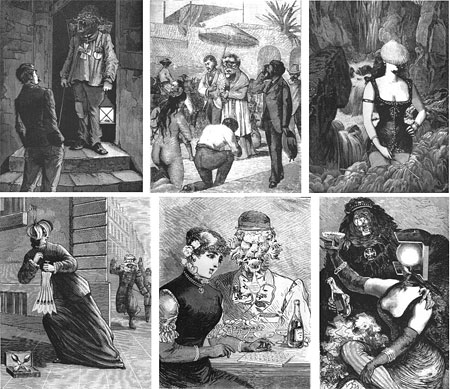
In 1934, Surrealist Max Ernst created an extraordinary collage novel (or, as I pointed out a few years ago, “graphic novel”), composed of collage images constructed of cut-outs from popular French periodicals and catalogs of the time.The result is a fascinating, spooky, wondrous and eye-opening excursion into the mind of a Surrealist master on the cusp of World War II. Here is my post about Une Semaine de Bonté, ou Les Sept Éléments Capitaux (A Week of Kindness, or the Seven Deadly Sins) from 2005.
This month, the Albertina museum in Vienna is displaying some of Ernst’s original collages for the book (how many is unclear). This is the first time the works have been exhibited since 1936. The show runs until the 9th of April, 2008. The museum’s site has a 6 thumbnails posted of images in the exhibition, though, inexplicably, no larger versions. I’ve found corresponding images in my files and posted them above.
Though I consider it legitimately a “graphic novel” (and long-time lines and colors readers will know I’m cranky about the inaccurate use of that term), it is not arranged in comic-strip form, as my composite above might suggest. Each of these images is a full page, but they are part of a narrative sequence (the images above are out of sequence from various parts of the book). The narrative is loose and dreamlike, or “stream of consciousness”, if you will. This is actually in keeping with the Surrealists’ prose and poetry, and could more correctly be called “stream of unconsciousness”, as one of their professed aims was to create art directly from their unconscious minds.
For those of us for whom a trip to Vienna is not practical, good old Dover Books is still keeping their delightfully inexpensive version, Une Semaine De Bonte: A Surrealistic Novel in Collage, in print after all these years (as well they should, it’s a classic, despite their slightly off title). I’ve had my dog-eared copy since I was a teenager, and the work still manages to surprise and delight me with repeated viewings.
When I wrote my previous post, there was an online version of the entire book available that has since disappeared. But, as the Internet giveth and the Internet taketh away, there is now a version on Google Books that looks reasonably complete.
You will also find some images, often with larger versions, on Giornale Nuovo and La Boîte à Images.
If you are at all intrigued, though, opt for the print version.
Categories:
-
Robin Chyo

We catch concept artist Robin Chyo at the very beginning of his career. A graduate of Academy of Art University with a BFA in Illustration, Chyo is working to build a career in the gaming and/or film industry as a concept designer and illustrator.He has begun by establishing a presence in publications like the Spectrum collections of fantastic art (Spectrum 13 and 14, which is where I encountered his work), Ballistic Publishing’s Painter digital art showcase and D’artiste: Concept Art collection, as well as ImagineFX and 2DArtist Magazine.
He has also created a reasonably extensive portfolio, showcasing his abilities in the major areas of concept design for gaming and special effects centric movies, such as characters, environments, props, creatures and mechanical devices.
He has also, wisely, created a web site to make his portfolio readily available. Though it isn’t fancy (probably also a wise decision), he’s done a good job of providing the essentials — bio, resume, contact information and galleries of work that can be viewed by either thumbnails or Previous and Next navigation. He has also added a subtle id mark of his web site address to his images without marring them with ugly watermarks (are you listening, all of you watermarking fanatics?). (I should point out, though, that the “http://” in URL on the image is unnecessary.)
The baseline, of course, is that all of this is in support of very nice work. Chyo’s concept designs show a youthful verve and freedom of imagination that is sometimes more subdued in older veterans in the field. His creatures, in particular, seem more truly alien and less clichéd than most. His mechanical devices, props and character accouterments often have an interestingly organic feeling.
There is a certain brusqueness to his rendering that I find appealing, with an emphasis on textures and a muted palette with highlights of more intense hues.
Chyo lists a number of 2-D and 3-D digital graphics applications in his resume, along with traditional media like pencil, oils and acrylics. It looks like the majority of work in his portfolio is relatively straightforward digital painting in Painter and Photoshop.
All in all, it looks like he’s doing a lot of things right, and it’s probably only a matter of time before we see credits for gaming or film projects on his resume. I just hope that working within industry standards doesn’t take away his imaginative wild streak.
Categories:
-
79 years of Best Picture Winners in Posters

Some of us are waiting with bated breath for the Academy Awards (and some of us are waiting for them to be over so we can get back to more important things, like new episodes of The Daily Show), but it’s a time of year when movies become a topic of discussion.Movie Poster Addict, a blog with the nice subtitle “Because we all like pretty pictures”, has posted 79 years of Best Picture Winners in Posters, featuring a series of the posters that accompanied the past Academy Award winners for Best Picture from 1927 up to last year.
These aren’t the best movie posters ever (by any means), simply the ones associated with the Best Picture winners, but some of them are pretty good, and it’s fascinating to see the mish-mash of quality between the posters and the movies; some of each are classic, and some of each are eminently forgettable.
If you click on most of the images in the blog post you’ll get an larger version. The links underneath lead to the source for the poster image which sometimes includes an even larger version and some information about the movie.
Unfortunately, many of them don’t include credits for the poster artist or designer, though some do. Some of them are the work of well known illustrators, like Bob Peak’s poster for My Fair Lady, John Van Hamersveld’s Amadeus poster and Richard Amsel doing his best to emulate J.C. Leyendecker in his poster for The Sting.
Credits for some of the older illustrations are apparently lost in the mists of time, or at least out of the reach of a quick Google.
For some more interesting posters, see Movie Poster Addict’s post on the 2007 Key Art Awards, which actually are awards for artwork associated with movie promotional materials.
[Link via Neatorama]
Categories:




Charley’s Picks
Bookshop.org
(Bookshop.org affilliate links; sales benefit independent bookshop owners; I get a small percentage to help support my work on Lines and Colors)

John Singer Sargent: Watercolors


Urban Sketching: Understanding Perspective


Charley’s Picks
Amazon
(Amazon.com affiliate links; sales go to a larger yacht for Jeff Bezos; but I get a small percentage to help support my work on Lines and Colors)
John Singer Sargent: Watercolors
Urban Sketching: Understanding Perspective