


Categories
- 3d CGI
- Amusements
- Animation
- Anime & Manga
- Art Materials
- Art Videos
- Blogroll
- Cartoons
- Color
- Comics
- Concept & Visual Dev.
- Creativity
- Digital Art
- Digital Painting
- Displaying Art on the Web
- Drawing
- Eye Candy for Today
- Gallery and Museum Art
- High-res Art Images
- Illustration
- Motion Graphics & Flash
- Museums
- Online Museums
- Outsider Art
- Painting
- Painting a Day
- Paleo Art
- Pastel, Conté & Chalk
- Pen & Ink
- Prints and Printmaking
- Reviews
- Sc-fi and Fantasy
- Sculpture & Dimensional
- Site Comments
- Sketching
- Storyboards
- Tools and Techniques
- Uncategorized
- Vector Art
- Videos & Podcasts
- Vision and Optics
- Watercolor and Gouache
- Webcomics
Archives
- April 2026
- March 2026
- February 2026
- January 2026
- December 2025
- November 2025
- October 2025
- September 2025
- August 2025
- July 2025
- June 2025
- May 2025
- January 2025
- December 2024
- November 2024
- October 2024
- September 2024
- August 2024
- June 2024
- April 2024
- March 2024
- February 2024
- January 2024
- December 2023
- November 2023
- October 2023
- September 2023
- August 2023
- July 2023
- May 2023
- April 2023
- March 2023
- February 2023
- January 2023
- December 2022
- November 2022
- September 2022
- August 2022
- July 2022
- June 2022
- May 2022
- April 2022
- March 2022
- February 2022
- January 2022
- December 2021
- November 2021
- October 2021
- September 2021
- August 2021
- July 2021
- June 2021
- May 2021
- April 2021
- March 2021
- February 2021
- January 2021
- December 2020
- November 2020
- October 2020
- September 2020
- August 2020
- July 2020
- June 2020
- May 2020
- April 2020
- March 2020
- February 2020
- January 2020
- December 2019
- November 2019
- October 2019
- September 2019
- August 2019
- July 2019
- June 2019
- May 2019
- April 2019
- March 2019
- February 2019
- January 2019
- December 2018
- November 2018
- October 2018
- September 2018
- August 2018
- July 2018
- June 2018
- May 2018
- April 2018
- March 2018
- February 2018
- January 2018
- December 2017
- November 2017
- October 2017
- September 2017
- August 2017
- July 2017
- June 2017
- May 2017
- April 2017
- March 2017
- February 2017
- January 2017
- December 2016
- November 2016
- October 2016
- September 2016
- August 2016
- July 2016
- June 2016
- May 2016
- April 2016
- March 2016
- February 2016
- January 2016
- December 2015
- November 2015
- October 2015
- September 2015
- August 2015
- July 2015
- June 2015
- May 2015
- April 2015
- March 2015
- February 2015
- January 2015
- December 2014
- November 2014
- October 2014
- September 2014
- August 2014
- July 2014
- June 2014
- May 2014
- April 2014
- March 2014
- February 2014
- January 2014
- December 2013
- November 2013
- October 2013
- September 2013
- August 2013
- July 2013
- June 2013
- May 2013
- April 2013
- March 2013
- February 2013
- January 2013
- December 2012
- November 2012
- October 2012
- September 2012
- August 2012
- July 2012
- June 2012
- May 2012
- April 2012
- March 2012
- February 2012
- January 2012
- December 2011
- November 2011
- October 2011
- September 2011
- August 2011
- July 2011
- June 2011
- May 2011
- April 2011
- March 2011
- February 2011
- January 2011
- December 2010
- November 2010
- October 2010
- September 2010
- August 2010
- July 2010
- June 2010
- May 2010
- April 2010
- March 2010
- February 2010
- January 2010
- December 2009
- November 2009
- October 2009
- September 2009
- August 2009
- July 2009
- June 2009
- May 2009
- April 2009
- March 2009
- February 2009
- January 2009
- December 2008
- November 2008
- October 2008
- September 2008
- August 2008
- July 2008
- June 2008
- May 2008
- April 2008
- March 2008
- February 2008
- January 2008
- December 2007
- November 2007
- October 2007
- September 2007
- August 2007
- July 2007
- June 2007
- May 2007
- April 2007
- March 2007
- February 2007
- January 2007
- December 2006
- November 2006
- October 2006
- September 2006
- August 2006
- July 2006
- June 2006
- May 2006
- April 2006
- March 2006
- February 2006
- January 2006
- December 2005
- November 2005
- October 2005
- September 2005
- August 2005
Relevant Blogs
Art, Painting & Sketch
- Gurney Journey
- Underpaintings
- Art and Influence
- Painting Perceptions
- Oil Painters of America
- Vasari Paint POV
- Flying Fox
- Urban Sketchers
- Bento (Smithsonian)
- Art Inconnu
- The Hidden Place
- Still Life
- Making a Mark
- The Art of the Landscape
- Exploring Color & Creativity
- Art Contrarian
- Artist A Day
- beinArt Surreal Art Collective
- Eye Level
- David Dunlop
- p.i.g.m.e.n.t.i.u.m
- CultureGrrl
- Joaquín Sorolla blog
- Artists in Pastel
“Painting a Day”
- A Painting a Day (Keiser)
- On Painting (Keiser)
- Julian Merrow-Smith
- Karen Jurick
- Jeffrey Hayes
- Carol Marine
- Abbey Ryan
- Daily Paintworks
Other Painting Blogs
- Virtual Gouache Land
- Neil Hollingsworth
- Marc Hanson
- Kevin Menck
- Marc Dalessio
- Larry Seiler
- Stapleton Kearns
- Colin Page
- Roos Schuring
- Hans Versfelt
- Titus Meeuws
- Régis Pettinari
- René Plein Air
- Belinda Del Pesco
- Robin Weiss
- Nathan Fowkes (Land Sketch)
- William Wray
- Frank Serrano
- Stephen Magsig
- Michael Chesley Johnson
- Twice a Week
- Sarah Wimperis
- Rob Adams
- Michael Cole Manley
- The Dirty Palette Club
- Mike Manley’s Draw!
Gallery Art & Illustration mix
Illustration
- Howard Pyle
- 100 Years of Illustration
- BibliOdyssey
- Illustration Art
- Today’s Inspiration
- Illustration Mundo
- Little Chimp Society
- Danny Gregory
- R D (John Martz
- Illustration Friday blog
- Monster Brains
- Illustrators & Illustrations (RU)
- Elwood H. Smith
- DaniDraws.com
- Designers Who Blog
- iSpot Blog
Sci-Fi & Fantasy
Illustration & Comics
Comics & Cartoons
- Comics Beat
- Robot 6
- Newsarama Blog
- Comic Vine
- Comics Alliance
- Forbidden Planet Int.
- Paolo Rivera
- Bolt City
- Flight
- Scott McCloud
- The Comics Journal
- Comixpedia
- Funnybook Babylon
- James Baker
- Middleton’s Sketchbook
- Boneville
- The Hotel Fred
- Paul Rivoche
- Daily Cartoonist
- Mad About Cartoons (William Wray)
- Digital Strips
Illustration & Concept
Animation & Concept
- Cartoon Brew
- Animation Blog
- Cold Hard Flash
- Concept Art World
- The CAB
- FY Concept Art
- Concept Ships
- Concept Robots
- John Nevarez
- Armand Serrano
- Marcos Mateu-Mestre
- all kinds of stuff (Kricfalusi)
- Yacin the faun (Man Arenas)
- Kelsey Mann
- Cre8tivemarks Blog
- Ice-Cream Monster Toon Cafe
- AAU Character & Creature Design
- AAU Animation Notes
- Articles and Texticles
Paleo & Scientific
Tools & Techniques
Other
Lists of Art Blogs
Art Image Resource Links
Historic Art Images
- Wikimedia Commons: Paintings
- Wikimedia Commons: Drawings
- The Athenaeum
- WikiArt (WikiPaintings)
- Google Art Project: Artists
- Google Art Project: Collections (Museums)
- ArtCyclopedia
- Web Gallery of Art
- Art Renewal Center
- Web Gallery of Impressionism
Auction Consolidation sites
Auction sites
- Sotheby’s
- Bonham’s
- Christies
- Heritage Auctions: Fine Art
- Heritage Auctions: Illustration
- Freeman’s Auctions
- Bukowskis
- Shannon’s
Image Search
Reverse Image Search (search by image)
- Tin Eye
- RevImg
- Google Image Search (camera icon)
- Bing Image Search (camera icon)
Promoting some friends and some clients of my website design business
- Twin Willows T’ai Chi studio in Wilmington DE. Taiji classes with Bryan Davis.
- Ray Hayward, Inspired Teacher of T’ai Chi ( Taiji ) in Minneapolis, Founder of Mindful Motion Tai Chi Academy
- OldHead Tattoo studio and Art Gallery in Wilmington DE. Tattoos and paintings by Bruce Gulick
- Sharon Domenico Art, pet portrait oil paintings
- Platinum Paperhanging, wallpaper hanging, Main Line and Philadelphia, PA
- Lisa Stone Design, interior designer, Main Line and Philadelphia, PA
- Studio12KPT, original art, prints, calendars and other custom printed items by Van Sickle & Rolleri
-
Patrick Arrasmith
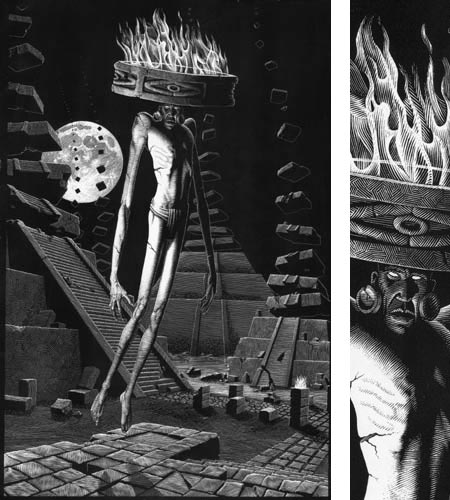
There is something particularly appealing about images created by an artist who is strongly skilled in the medium of scratchboard. This slightly arcane and quite demanding medium is the through-the-looking-glass version of pen and ink; in which black ink is taken away from the coating on a clay-surfaced board, and the image is built from lights rather than from darks.It may be the texture, the balance of dark to light, or the characteristic line work, but I often find scratchboard images particularly compelling.
Patrick Arrasmith is an accomplished illustrator who works primarily in scratchboard, and his work is an excellent case in point.
Arrasmith’s clients include The New York Times, The Wall Street Journal, The Village Voice, Entertainment Weekly, Reader’s Digest, Outside, The Weekly Standard and numerous other periodicals and book publishers.
As you look through the work on his site, you are likely to see stylistic similarities to other practitioners of the art of scratchboard that I’ve featured in the past, like Mark Summers, Scott McKowen and Elizabeth Traynor; but on further inspection you’ll see farther reaching comparisons like the amazing scratchboard/pen and ink master Virgil Finlay, and even the lithographs of M.C. Escher.
Even though you might often wish for larger images of Arrasmith’s work, the images on his site are large enough to get some idea of the total piece, and there are often detail crops that show a bit of the texture of the scratchboard technique (image above, with slice of detail image, right).
Arrasmith seems to be restlessly exploring some of the possibilities of the medium, and his portfolio includes a series of figure studies, portraits of dogs and various experiments and personal pieces. At first I assumed that, like Finlay, he was combining “pure scratchboard” with pen and ink, but my impression is the most, if not all, of the pieces are completely brought out of the blackness of the ink coating with the finely scratched white lines.
There are some color pieces, in which the scratchboard drawing has had color applied over it, presumably digitally in Photoshop. A number of these have a nice balance of black and white to color in that the color has only been applied to selected areas of the image, leaving an appealing blend between the two approaches.
In all of them, though, there is that ineffable visual magic inherent in the scratching of white lines out of the dark mysteries of a flat black page.
Categories:
-
1,000 True Fans

For those who are drawn to the siren call of “creative” endeavors, whether it be in any form of “the arts”, the process of making a living is often one of struggle, compromise and at times even desperation. Artists of all stripes are notoriously not a group associated with business acumen and across-the board financial success. Though some do extremely well, and are good at those aspects of managing their lives and careers. many are not.If your work isn’t well known to millions, or in demand in circles where it can command the highest rates, it may be difficult to work out a creative living from the traditional pathways.
But what if there were an unorthodox business model for artists, musicians, writers and other creative individuals in the modern world, that didn’t depend on the kind of large-scale acceptance often associated with success in those fields?
What if artists could make a good, ongoing living from a smaller number of people who happen to love their work? Instead of having to appeal to millions, what if they could make their living on the devoted following of just 1,000 individuals, 1,000 “True Fans”?
Some background:
Kevin Kelley helped launch Wired magazine in 1993, and served as its Executive Editor until 1999. He co-founded the WELL, one of the first online services, started in 1985, and was also the publisher and Editor of the Whole Earth Review, a “journal of unorthodox technical news”. The latter is where I first encountered him, and came to hold his knack for reviewing cool stuff in high regard; as I recommended to you in my post on Blurb and Lulu, which referenced his review of same on his high-profile Cool Tools web site.
One of Kelley’s former Wired alumni, Chris Anderson, coined the phrase The Long Tail in a 2004 Wired article, to put a name to the phenomenon of business like Amazon.com or Netflix succeeding in profiting from selling low volume items, but lots and lots of different ones, as opposed to the usual retail goal of only selling a lower selection of highly popular items. (See the article on Wikipedia.)
Kelley, no slouch when it comes to ideas and thinking through the ramifications of things, posted an article, 1,000 True Fans, yesterday on his blog/column The Technium (from which the graphic above is taken), that takes off from this premise with an unusual suggestion.
In it he has put forth the notion that the same technology that allows this kind of approach, which, by its nature seems to leave out the small seller, can in fact empower individual artists (visual, musical, literary or other), if they can culture the devotion of a certain number of True Fans.
Kelley defines a True Fan as “…someone who will purchase anything and everything you produce. They will drive 200 miles to see you sing. They will buy the super deluxe re-issued hi-res box set of your stuff even though they have the low-res version. They have a Google Alert set for your name. They bookmark the eBay page where your out-of-print editions show up. They come to your openings. They have you sign their copies. They buy the t-shirt, and the mug, and the hat. They can’t wait till you issue your next work.”
He posits that if a True Fan spends an average of one days wages per year in support of your endeavors, stating that this is probably conservative, as your Truest Fan will spend more than that, there is a certain number at which they can support the artist. If the average spending figure is $100 per year, 1,000 True Fans works out to $100,000 a year, a decent living for most people.
Kelly goes on to say: “..the actual number may vary depending on the media. Maybe it is 500 True Fans for a painter and 5,000 True Fans for a videomaker.” […] “But in fact the actual number is not critical, because it cannot be determined except by attempting it.”
The point isn’t the number: the point is that there is a number of True Fans, at which individual artists of various kinds can make a living.
He continues: “I am suggesting there is a home for creatives in between poverty and stardom. Somewhere lower than stratospheric bestsellerdom, but higher than the obscurity of the long tail.”
But he also cautions that dealing with True Fans is time and attention intensive, and that not everyone has the temperament to culture a base of True Fans. They may need someone to run interference, like an agent, a rep, an aggressively devoted gallery or other intermediary, who is willing to share the load, but must also share in the profit, hence making the “magic number” higher to support the duo.
But, if your goal is to make a living from your art, as opposed to a choice between striving for stardom or accepting poverty, perhaps it’s a viable model.
Kelley ends his article (which goes into much more depth than my skimmed description here) with a call for those who have chosen such a path to let him know. Presumably, some interesting personal stories will be added as word gets out.
[Link via BoingBoing and Waxy]
Categories:
-
James Martin

Like his friend and fellow contributor to the Paintopolis group blog, Kevin Turcotte, (who has continued to add nice small paintings to that blog since my post last week), James Martin works in the animation industry.Martin works for Dreamworks, but aside from that I can find little information about him or his professional work.
What I did find on his blog, James Martin Studio, is lots of fresh, bright, quickly realized small oils of subject matter in Souther California, presumably near where he lives or works.
Like Turcotte, he describes several of his small (often 8×6) oils as “lunchtime sketches”; which, if you think about it, is a great way to mark off a little time to paint every day.
His blog posts also include some more fully realized works, figure paintings and interior studies. All of them though, are direct, painterly and nicely unfussed-with.
Categories:
-
Daniel López Muñoz

Daniel López Muñoz is a Spanish born concept and visual development artist for the film industry now living in California. He worked for some time for Blue Sky Studios and now works for Pixar. His credits include Ice Age: The Meltdown and Robots, as well as a series of 3-2-1 Penguins titles.Muñoz has been blogging since July of 2006, but his schedule has evidently kept him from posting often. The blog’s contents, while not extensive, do hold enough treats to make it worthwhile; including concept art from various professional projects, as well as some personal pieces.
The blog includes a number of concept designs from the movie Robots, which show that the best thing about that movie was, in fact, the concept art. These make me marvel, as I often do, at the way studios so often take terrific work on the part of their teams and squander it on tired clichés instead of good stories, evidently afraid to do something that doesn’t follow an existing formula.
Of particular interest on Muñoz’ blog are his wonderfully expressive drawings for his contributions to the Out of Picture anthologies (image above). These are collections, originally published in France, of comics stories by artists associated at one time or another with Blue Sky Studios. Out of Picture Volume 1: Art from the Outside Looking In was published in the U.S. last year. Out of Picture Volume 2 is due out this June.
The list of participating artists includes a number of artists I’ve featured previously on lines and colors: Daisuke Tsutsumi, Jake Parker, Sang Jun Lee and Peter de Séve. For the complete list and more information, see the Out of Picture blog, which includes a few tastes of work from Out of Picture 2.
Muñoz is also a participant in the SketchTravel project. (See my post from last year about SketchTravel.)
Categories:
-
Jean Frédéric Bazille

I think of Frédéric Bazille as the “lost” Impressionist, both in the sense that he is often overlooked in discussions of the principle figures in the Impressionist movement; and in the sense that he was lost to the Impressionists, and the world, when he foolishly joined Napoleon’s army at the outbreak of the Franco-Prussian War, and lost his life in a “minor skirmish” at the age of 29.In 1862 the young Bazille, son of a well-off family from Montpelier, whose friends included art patrons who owned paintings by Delacroix that inspired him to study painting, moved to Paris and enrolled in the atelier of Charles Gleyre, where he met some other young art students, notably Claude Monet, Pierre Auguste Renoir and Alfred Sisley.
Gleyre, though traditional in his emphasis on paintings having “meaning” and idealized beauty, as was the norm at the time, was also an advocate of plein air painting, and those four young painters spent many hours painting on location in the Forest of Fontainebleau. (Side notes: Gleyre’s previous students included the American painter James McNeil Whistler. Gleyre himself added watercolor painting to his skills under the tutelage of Richard Parkes Bonington.)
Bazille shared his friends’ enthusiasm for painting from life, and was also very influenced by Edouard Manet, who was a friend to the Impressionists but not one of them, and Gustav Courbet. He developed a loose, bold brushstroke, and in many ways shared the experimental temperament of the early Impressionist circle, but he did not reject the academic subject matter of portraits and figure painting in favor of landscape as they did. His paintings also were regularly accepted at the Salon (as were Manet’s), when the other young Impressionists were turned away; though some of his most modern and ambitious works, like La Toilette were rejected..
Bazille’s large, outdoor scenes of figures in landscapes were notable as the nexus of these influences, and the most famous of them, Family Reunion is interesting to compare to Monet’s abandoned attempt at a similar large-scale tableau, Déjeuner sur l’Herbe (also here and alternate version here).
Though he didn’t consider landscape his forté, Bazille’s landscapes can be wonderful, like his beautiful but unfinished The Terrace at Méric (Oleander), in which you can see the ghostly drawing of a figure that was being blocked into the composition, perhaps after he had considered it finished at one point.
My favorites of Bazille’s paintings, though, are his images of his own studios, Bazzille’s Studio; 9 rue de la Condamine, and in particular, Studio in the rue de Furstenberg (above, with detail). I always enjoy painters’ images of their own (or their fellow artists’), studios. In their direct, painterly realism, Bazille’s studio images remind me of the later studio portrayals of William Merritt Chase and other American painters influenced by the Impressionists.
Bazille was very much a part of the initial development of French Impressionism, but he died before the full flowering of what would come to be known as the Impressionist style.
Most people have the impression (sorry, couldn’t resist), that the revolutionary French painting style bloomed amid tranquil times similar to those in La Belle Epoch, but Napoleon’s war with Prussia, and its aftermath, including the bloody turmoil of the Paris Commune, interrupted its development with a time of terror and strife. Among the tragic losses in that period was the potential remaining lifetime of brilliant painting from Frédéric Bazille.
Categories:
-
The Vadeboncoeur Collection of ImageS
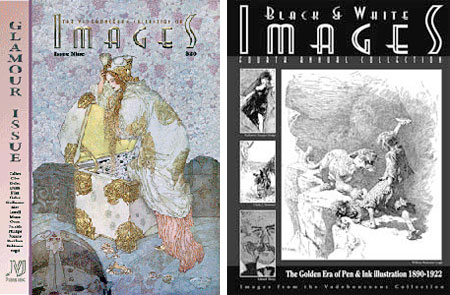
I’ll let you in on a little secret.Some of you may be under the impression from my posts on the subject that I’m an expert on the field and history of illustration, but that’s not the case. I simply know a little bit about some terrific illustrators that I’ve come across over the years. Compared to a real expert, like Jim Vadeboncoeur Jr., my knowledge is like a creek compared to a river (it might be the Brandywine Creek, but a creek nonetheless).
But that’s not the secret I wanted to let you in on. The secret is The Vadeboncoeur Collection of ImageS, at least it’s more of a secret than it should be (and no, the capital “S” is not a typo, that’s the way it’s written).
Since 2001, Vadeboncoeur has been publishing a periodical, I hesitate to call it a magazine because it defies the conventions of most magazines, featuring beautiful images from some of history’s greatest illustrators, both well known and obscure; as well as work from artists from the same time period as the Golden Age of illustration.
It’s a secret because, unless you frequent BPIB (formerly Bud Plant Illustrated Books), a web resource to which I have occasionally sent you in reference to the history of great illustrators, chances are you haven’t seen the modest link to the ImageS pages.
The web site itself is a little, um… stuck in the 90’s, (when entering the site through the home page, choose “No Frames“, because frames suck), but the heart of the site is a wonderful collection short but of terrific, and often definitive, articles on great illustrators, from Edwin Austin Abbey to Newell Convers Wyeth.
You could spend hours here lost among the articles and (unfortunately somewhat small) images from these greats, but why settle for that when you can get Vadeboncoeur’s beautifully printed collections full of stunning, high-resolution images of works that you just won’t find anywhere else.
These collections, (again, I hesitate to call them magazines, and they’re not quite books) are printed larger than most magazines (9″x12″), are up to 44 pages each; and, in recent issues, feature amazing reproductions by way of Stochastic printing (a process that eliminates the traditional limitation of process dots and looks amazingly like a photograph).
The early issues are starting to disappear, but a number of back issues are still available, including the special Black & White ImageS Annual Collections, which showcase some of the most amazing pen and ink illustration ever produced. These are thicker than the color collections, up to 112 pages, and the fourth one was just released. Like the color collections, these are printed on 100 lb paper and the reproductions are superb.
Unfortunately, the web site doesn’t do a very good job of presenting the collections, with a small, too-quick, GIF animations of a few pages, that you can’t even focus on for more than a second, as the only preview.
Vadeboncoeur should take a page from Dan Zimmer’s Illustration Magazine previews, which give a thumbnail of every page in the magazine (see my posts on Illustration Magazine); or, better yet, feature two or three large images to give some idea of how beautiful these pieces really are.
In the meanwhile, lacking better previews, take my word for it. These collections are head-spinningly beautiful and a must-have for any serious fan of Golden Age illustration.
But don’t let too many people in on our little secret, at least not until we get a chance to snap up those back issues.
Categories:




Charley’s Picks
Bookshop.org
(Bookshop.org affilliate links; sales benefit independent bookshop owners; I get a small percentage to help support my work on Lines and Colors)

John Singer Sargent: Watercolors


Urban Sketching: Understanding Perspective


Charley’s Picks
Amazon
(Amazon.com affiliate links; sales go to a larger yacht for Jeff Bezos; but I get a small percentage to help support my work on Lines and Colors)
John Singer Sargent: Watercolors
Urban Sketching: Understanding Perspective