


Categories
- 3d CGI
- Amusements
- Animation
- Anime & Manga
- Art Materials
- Art Videos
- Blogroll
- Cartoons
- Color
- Comics
- Concept & Visual Dev.
- Creativity
- Digital Art
- Digital Painting
- Displaying Art on the Web
- Drawing
- Eye Candy for Today
- Gallery and Museum Art
- High-res Art Images
- Illustration
- Motion Graphics & Flash
- Museums
- Online Museums
- Outsider Art
- Painting
- Painting a Day
- Paleo Art
- Pastel, Conté & Chalk
- Pen & Ink
- Prints and Printmaking
- Reviews
- Sc-fi and Fantasy
- Sculpture & Dimensional
- Site Comments
- Sketching
- Storyboards
- Tools and Techniques
- Uncategorized
- Vector Art
- Videos & Podcasts
- Vision and Optics
- Watercolor and Gouache
- Webcomics
Archives
- April 2026
- March 2026
- February 2026
- January 2026
- December 2025
- November 2025
- October 2025
- September 2025
- August 2025
- July 2025
- June 2025
- May 2025
- January 2025
- December 2024
- November 2024
- October 2024
- September 2024
- August 2024
- June 2024
- April 2024
- March 2024
- February 2024
- January 2024
- December 2023
- November 2023
- October 2023
- September 2023
- August 2023
- July 2023
- May 2023
- April 2023
- March 2023
- February 2023
- January 2023
- December 2022
- November 2022
- September 2022
- August 2022
- July 2022
- June 2022
- May 2022
- April 2022
- March 2022
- February 2022
- January 2022
- December 2021
- November 2021
- October 2021
- September 2021
- August 2021
- July 2021
- June 2021
- May 2021
- April 2021
- March 2021
- February 2021
- January 2021
- December 2020
- November 2020
- October 2020
- September 2020
- August 2020
- July 2020
- June 2020
- May 2020
- April 2020
- March 2020
- February 2020
- January 2020
- December 2019
- November 2019
- October 2019
- September 2019
- August 2019
- July 2019
- June 2019
- May 2019
- April 2019
- March 2019
- February 2019
- January 2019
- December 2018
- November 2018
- October 2018
- September 2018
- August 2018
- July 2018
- June 2018
- May 2018
- April 2018
- March 2018
- February 2018
- January 2018
- December 2017
- November 2017
- October 2017
- September 2017
- August 2017
- July 2017
- June 2017
- May 2017
- April 2017
- March 2017
- February 2017
- January 2017
- December 2016
- November 2016
- October 2016
- September 2016
- August 2016
- July 2016
- June 2016
- May 2016
- April 2016
- March 2016
- February 2016
- January 2016
- December 2015
- November 2015
- October 2015
- September 2015
- August 2015
- July 2015
- June 2015
- May 2015
- April 2015
- March 2015
- February 2015
- January 2015
- December 2014
- November 2014
- October 2014
- September 2014
- August 2014
- July 2014
- June 2014
- May 2014
- April 2014
- March 2014
- February 2014
- January 2014
- December 2013
- November 2013
- October 2013
- September 2013
- August 2013
- July 2013
- June 2013
- May 2013
- April 2013
- March 2013
- February 2013
- January 2013
- December 2012
- November 2012
- October 2012
- September 2012
- August 2012
- July 2012
- June 2012
- May 2012
- April 2012
- March 2012
- February 2012
- January 2012
- December 2011
- November 2011
- October 2011
- September 2011
- August 2011
- July 2011
- June 2011
- May 2011
- April 2011
- March 2011
- February 2011
- January 2011
- December 2010
- November 2010
- October 2010
- September 2010
- August 2010
- July 2010
- June 2010
- May 2010
- April 2010
- March 2010
- February 2010
- January 2010
- December 2009
- November 2009
- October 2009
- September 2009
- August 2009
- July 2009
- June 2009
- May 2009
- April 2009
- March 2009
- February 2009
- January 2009
- December 2008
- November 2008
- October 2008
- September 2008
- August 2008
- July 2008
- June 2008
- May 2008
- April 2008
- March 2008
- February 2008
- January 2008
- December 2007
- November 2007
- October 2007
- September 2007
- August 2007
- July 2007
- June 2007
- May 2007
- April 2007
- March 2007
- February 2007
- January 2007
- December 2006
- November 2006
- October 2006
- September 2006
- August 2006
- July 2006
- June 2006
- May 2006
- April 2006
- March 2006
- February 2006
- January 2006
- December 2005
- November 2005
- October 2005
- September 2005
- August 2005
Relevant Blogs
Art, Painting & Sketch
- Gurney Journey
- Underpaintings
- Art and Influence
- Painting Perceptions
- Oil Painters of America
- Vasari Paint POV
- Flying Fox
- Urban Sketchers
- Bento (Smithsonian)
- Art Inconnu
- The Hidden Place
- Still Life
- Making a Mark
- The Art of the Landscape
- Exploring Color & Creativity
- Art Contrarian
- Artist A Day
- beinArt Surreal Art Collective
- Eye Level
- David Dunlop
- p.i.g.m.e.n.t.i.u.m
- CultureGrrl
- Joaquín Sorolla blog
- Artists in Pastel
“Painting a Day”
- A Painting a Day (Keiser)
- On Painting (Keiser)
- Julian Merrow-Smith
- Karen Jurick
- Jeffrey Hayes
- Carol Marine
- Abbey Ryan
- Daily Paintworks
Other Painting Blogs
- Virtual Gouache Land
- Neil Hollingsworth
- Marc Hanson
- Kevin Menck
- Marc Dalessio
- Larry Seiler
- Stapleton Kearns
- Colin Page
- Roos Schuring
- Hans Versfelt
- Titus Meeuws
- Régis Pettinari
- René Plein Air
- Belinda Del Pesco
- Robin Weiss
- Nathan Fowkes (Land Sketch)
- William Wray
- Frank Serrano
- Stephen Magsig
- Michael Chesley Johnson
- Twice a Week
- Sarah Wimperis
- Rob Adams
- Michael Cole Manley
- The Dirty Palette Club
- Mike Manley’s Draw!
Gallery Art & Illustration mix
Illustration
- Howard Pyle
- 100 Years of Illustration
- BibliOdyssey
- Illustration Art
- Today’s Inspiration
- Illustration Mundo
- Little Chimp Society
- Danny Gregory
- R D (John Martz
- Illustration Friday blog
- Monster Brains
- Illustrators & Illustrations (RU)
- Elwood H. Smith
- DaniDraws.com
- Designers Who Blog
- iSpot Blog
Sci-Fi & Fantasy
Illustration & Comics
Comics & Cartoons
- Comics Beat
- Robot 6
- Newsarama Blog
- Comic Vine
- Comics Alliance
- Forbidden Planet Int.
- Paolo Rivera
- Bolt City
- Flight
- Scott McCloud
- The Comics Journal
- Comixpedia
- Funnybook Babylon
- James Baker
- Middleton’s Sketchbook
- Boneville
- The Hotel Fred
- Paul Rivoche
- Daily Cartoonist
- Mad About Cartoons (William Wray)
- Digital Strips
Illustration & Concept
Animation & Concept
- Cartoon Brew
- Animation Blog
- Cold Hard Flash
- Concept Art World
- The CAB
- FY Concept Art
- Concept Ships
- Concept Robots
- John Nevarez
- Armand Serrano
- Marcos Mateu-Mestre
- all kinds of stuff (Kricfalusi)
- Yacin the faun (Man Arenas)
- Kelsey Mann
- Cre8tivemarks Blog
- Ice-Cream Monster Toon Cafe
- AAU Character & Creature Design
- AAU Animation Notes
- Articles and Texticles
Paleo & Scientific
Tools & Techniques
Other
Lists of Art Blogs
Art Image Resource Links
Historic Art Images
- Wikimedia Commons: Paintings
- Wikimedia Commons: Drawings
- The Athenaeum
- WikiArt (WikiPaintings)
- Google Art Project: Artists
- Google Art Project: Collections (Museums)
- ArtCyclopedia
- Web Gallery of Art
- Art Renewal Center
- Web Gallery of Impressionism
Auction Consolidation sites
Auction sites
- Sotheby’s
- Bonham’s
- Christies
- Heritage Auctions: Fine Art
- Heritage Auctions: Illustration
- Freeman’s Auctions
- Bukowskis
- Shannon’s
Image Search
Reverse Image Search (search by image)
- Tin Eye
- RevImg
- Google Image Search (camera icon)
- Bing Image Search (camera icon)
Promoting some friends and some clients of my website design business
- Twin Willows T’ai Chi studio in Wilmington DE. Taiji classes with Bryan Davis.
- Ray Hayward, Inspired Teacher of T’ai Chi ( Taiji ) in Minneapolis, Founder of Mindful Motion Tai Chi Academy
- OldHead Tattoo studio and Art Gallery in Wilmington DE. Tattoos and paintings by Bruce Gulick
- Sharon Domenico Art, pet portrait oil paintings
- Platinum Paperhanging, wallpaper hanging, Main Line and Philadelphia, PA
- Lisa Stone Design, interior designer, Main Line and Philadelphia, PA
- Studio12KPT, original art, prints, calendars and other custom printed items by Van Sickle & Rolleri
-
ArtDemonstrations.com

ArtDemonstrations.com is a blog in which the author has collected and shares links to various art demonstrations and tutorials he has come across on the web.Some of them are more useful than others and they take several forms, from a few steps in a painting process shown as photos, to longer step-by step breakdowns, to time-lapse videos of the creation of drawings or paintings (like the portrait drawing by Barrett Bailey shown above), to full half hour or more videos of painting demonstrations.
At first I thought that the blog might be from someone associated with SmartFlix, an instructional video rental service that features a number of art instruction DVDs, because of the ubiquitous banner. There is also a list of text links under his Google ads that look like a blogroll, but are actually links (presumably paid links) to items in the SmartFlix store. These are videos that might be of interest, but the listings feature no actual online demos or articles.
Apparently, though, SmartFlix is just a sponsor the author encountered after doing a short post on them. (They’ve contacted me as well, but I haven’t had a chance to check into the service yet. I’ll try to rent a video or two and give you a report in the near future.)
Some of the ArtDemonstrations.com posts are links to short promos for artists’ commercial video releases, including short excerpts from a new instructional painting video, The Portrait Sketch, by Jeremy Lipking, as well as other video clips of him.
In addition to Jeremy Lipking, the blog points to demos by other artists that I’ve mentioned on lines and colors, including Tony Ryder, Duane Keiser, and a couple by William Whitaker (from the blog’s listings for November, 2005)
Other posts mention books and web archives of books, as well as tidbits like old film of Picasso at work and a PDF of an article on Sargent’s painting methods (PDF link 28k) posted by Craig Mullins.
In addition to Mullins there are a few mentions of concept artists, though that’s one of the largest areas of available tutorials on the web, particularly in the portals like CG Society and ConceptArt.org. Still, most people with a particular interest in concept art are aware of those sources and I think ArtDemonstrations.com is better aimed at the broader art community.
Unfortunately, the author, who I can find referenced only as “Jeff” (and is apparently an artist himself and has contributed one or two of his own demos), doesn’t seem to post often; and has not yet included a number of readily available painting demos I’ve come across on YouTube and other places.
The idea of trying to collect a central reference for available art tutorials on the web is a terrific one, and I would love to see it pursued more aggressively; but instead of complaining, I should be thanking Jeff for sharing what he has.
Categories:
-
John Beder

Had I come across John Beder’s children’s book illustrations on their own, rather than finding them on his web site after seeing the realist still life paintings on his painting blog, I would not have thought them to be the work of the same artist.His illustrations for children’s books are loose, almost roughly realized, and at times cartoonlike. His still life paintings, on the other hand are precise, detailed and contemplative. Both sides of his work show a fondness for bright colors.
His still life paintings are most often of arrangements of fruit. Though his subject matter and blog format shares some similarity with the blogs of many “painting a day” artists, it’s obvious at first glance that these paintings are the work of much longer painting sessions.
They are often wonderful explorations of the way light cascades across and wraps itself around the forms of the fruit, sometimes lighting them as if with an inner glow. The forms of individual grapes or the surfaces of plums are revealed with dedicated attention to the appearance of their textural and light reflective qualities.
In a number of paintings, Beder challenges himself with the rendering of the play of shadow and light across the complex folds of striped cloth, arranged as a backdrop to the still life, in what must be an very painstaking process.
As you might expect, Beder doesn’t post new paintings often. My one real disappointment, though, is that he doesn’t post larger versions of them. The “detail versions”, such as they are, are hardly larger than the images on the blog page; leaving you to imagine as best you can what the paintings might look like in person, as they are reasonably large, in the range of 30″x 20″ (75x50cm).
You can also find some of his paintings on his (somewhat awkwardly arranged) web site, which is devoted largely to his illustrations and his “Feeling Faces” line of emotion flash cards.
Categories:
-
Kevin Turcotte

Kevin Turcotte is another of those artists who has a somewhat vague web presence. I don’t think he has a site of his own, but he posts his small paintings as a participant in the group blog, Paintopolis.He shares Paintopolis with James Martin, Jeremy Engleman and Marty Havran. There is little direct information about any of them on the blog, but I’m guessing that they all work for Disney animation in some capacity, as the one other bit of information I’ve been able to come up with on Turcotte is his IMDB listing; which credits him as background artist or background supervisor on films like Sinbad: Legend of the Seven seas, Spirit: Stallion of the Cimarron, The Road to Eldorado, The Prince of Egypt, Pocahontas, The Lion King and Aladdin.
You’re left with the impression that the blog exists basically for the benefit of the artists themselves and/or their friends, because, except for the artist’s names and a few short notes about the posted images, no background information is provided.
Turcotte seems to be the most prolific contributor, frequently posting small landscapes that he describes as “lunchtime paintings”, quickly realized and fresh with the painterly immediacy that the limited timeframe implies. These are done primarily in oil and occasionally in watercolor. Likewise he often posts both oil and watercolor figure paintings, from appearances done in a classroom or workshop setting. These are also wonderfully painterly and quickly but surely rendered.
There are also quick studies of flowers and still life subjects as well as a few more fully realized paintings.
In browsing through the blog, which unfortunately is one of those Blogger affairs that doesn’t have an “earlier posts” link and requires you to fidget through the archives links to see past the first page, you’ll also encounter the work of his fellow Paintoplois bloggers, whose “off-hours” work is also worth attention, even if they don’t think it’s worth any explanation, bios, or other background information.
Categories:
-
Brad Holland

Brad Holland has been a major figure in contemporary American illustration for as long as I can remember, and I’ve wanted to do a post about him for some time, but I’ve been put off by his web site, in which the images are few and inexplicably small.I just discovered, however, that Holland now has a space on illoz that is many times better than his own web site and finally gives an adequate view of his work.
Holland has a long list of prestigious clients including The New York Times, The Wall Street Journal, Vanity Fair and many others.
I remember being impressed early on with his pen and ink drawings, in which he somehow made ink textures that felt like charcoal and pulled light out of darkness.
His ink drawings can be at times sophisticated and complex and at other times have a rough cartoony feeling reminiscent of the drawings of B. Kliban.
His color pieces have a remarkable feeling in which color and texture seem to be inseparable, as though he worked in color/texture as a sensibility rather then one or the other at any given moment.
His editorial illustrations can be brain-tinglingly clever in their concept and execution, often making a complete statement in themselves in addition to illustrating the written piece.
New York Art World hosts a page of quotes from Holland on art and related subjects that, agree or disagree, are worth a listen.
I particularly like his quote on “That’s Not Art, That’s Illustration”:
Almost everybody is an artist these days. Rock and Roll singers are artists. So are movie directors, performance artists, make-up artists, tattoo artists, con artists and rap artists. Movie stars are artists. Madonna is an artist, because she explores her own sexuality. Snoop Doggy Dogg is an artist because he explores other people’s sexuality. Victims who express their pain are artists. So are guys in prison who express themselves on shirt cardboard. Even consumers are artists when they express themselves in their selection of commodities. The only people left in America who seem not to be artists are illustrators.
Categories:
-
LitGraphic: The World of the Graphic Novel

If you tell a story of a certain length with words, it is called a novel; and, bad or good, is considered representative of an art form. Drawings are likewise considered representative of an art form, whether they are good examples or not. Put words and drawings together, however, and they somehow sink through the clouds, disappear from the art form firmament and descend ignominiously to earth (or below) with a resounding thud.Getting the art establishment in the U.S. to accept comics as the unique art form that they represent has been a little like getting Israelis and Palestinians (or worse, Republicans and Democrats) to admit that the other may occasionally have a valid point of view.
This stonewall of cultural bias seems to be largely localized to the United States, perhaps out of insecurity in our ability to lay claim to having culture in any form. Museums large and small in Europe will mount major shows of comics artists and cartoonists, recognizing them as a valued part of the cultural whole.
This cultural divide is finally starting to show signs of cracks in the U.S., however, and the cultural elite here are starting to show a dim awareness of what the rest of the world has known for years.
I’m always heartened when museum exhibits of comics and cartoons are mounted, as it represents progress, however small, in the direction of improving that awareness.
The Norman Rockwell Museum, which should be very aware of cultural bias in the visual arts in the form of the “illustration is not art” bias that accompanies the “comics are trash” bias, has taken a good step toward promoting awareness of the place of comics in our cultural treasure chest with their current exhibit, LitGraphic: The World of the Graphic Novel.
The show features a scattering of examples from the burgeoning field of long-form comics stories, both by current practitioners and past trailblazers. It showcases work by Will Eisner, Robert Crumb, Frans Masareel, Frank Miller, Art Spigelman, Steve Ditko, Harvey Kurtzman, Dave Sim, Terry Moore, Lynd Ward, Peter Kuper and several others.
The Rockwell museum has a somewhat skimpy preview on their site that I don’t think highlights the major figures in the exhibition well enough.
The exhibition is currently on view and extends to May 26, 2008.
I haven’t seen it, and I’m not certain if my schedule will let me get there, so I’ll refer you to a first person account from James Gurney, who also lists additional links and resources relevant to the exhibition, including links to some mini-documentaries producer Jeremy Clowe has posted on YouTube.
In addition, TFAOI has an article and a list of labels from the exhibition.
(Image above, left to right: Will Eisner, Niko Henrichon, Peter Kuper, Harvey Kurtzman, Lynd Ward, Terry Moore.)
Categories:
-
William Stout’s murals for the San Diego Natural History Museum
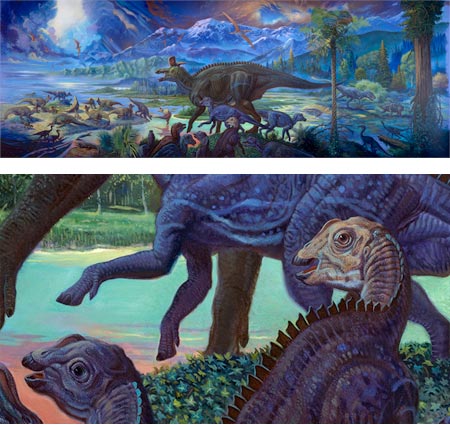
Prior to the influence of pioneering paleontological artist Charles R. Knight, the display of dinosaurs and other prehistoric animals in natural history museums consisted mostly of isolated fossilized bones in glass cases, fascinating to scientists to be sure, but perhaps as exciting to the general public as mounted butterfly specimens.After Knight’s work with paleontologists at the American Museum of Natural History to display the animals in realistic settings, and, later, Rudolf Zallenger’s astonishing murals for the Yale Peabody Museum, the display of prehistoric life by museums would never be the same.
These days, when natural history museums are competing with multimedia, games and popular entertainment to capture the attention of the public, the skeletons of prehistoric animals are mounted in the most dramatic and theatrical manner possible within the framework of scientific knowledge.
As museums renovate their dinosaur halls, which are often the focal point of a natural history museum’s public relations strategy, emphasis is placed on creating an immersive experience, a significant part of which is created by the presence of large murals depicting life in prehistoric settings (see my recent post on the spectacular new murals at the Carnegie Museum of Natural History by Robert Walters and his studio).
A new exhibit at the San Diego Museum Natural History Museum called Fossil Mysteries that opened in the Fall features several dramatic new murals of prehistoric life by William Stout.
Stout is a multi-talented painter, paleo artist, concept designer, illustrator and comics artist who I profiled in 2006. The exhibit also includes work by Doug Henderson, Raúl Martin and others (artist bios here), but Stout’s paintings are the headliner.
His murals for the exhibit depict prehistoric life from several eras. From the age of giant mammals we see huge ground sloths, fierce sabertooth cats and giant mastodons. Reaching back into the dark mysteries of the Cretaceous Period and the Paleocene Epoch, Stout takes us into the depths of seas teeming with life. And, of course, there are dinosaurs; in this case a tableau of costal dinosaurs awash with brilliant color, dramatic skies and ingeniously theatrical lighting effects. All of them are vibrantly painted with Stout’s trademark emphasis on color, texture and fluidity of line.
Characteristic of the substandard quality of many natural history museum web sites, the SDNHM information on the murals is skimpy and not very informative. However, the museum has posted a wonderful set of high-resolution images of the murals, presumably for use by the press and schools (and, of course, lines and colors readers).
These are nice large files that are (finally!) big enough that you can really appreciate the way Stout has worked with his colors, values and contrasts to sharply define individual elements when viewed up close, but kept all of them working as part of a unified whole when seen from a farther vantage point. It’s also surprising how painterly the images can be when seen in detail.
Stout’s new murals will be featured in the March 2008 issue of Natural History magazine. You can also see some (unfortunately much smaller) images of Stout’s previous paleo life murals and other paintings of prehistoric life on his web site. His terrific book, The New Dinosaurs is still available and is full of his wonderfully expressive paintings and drawings of dinosaurs, often done in a playful nod to the styles of other artists (Art Nouveau dinosaurs anyone?).
Stout fans will also be delighted to know that Flesk Publications (which I mentioned most recently in my post about Steve Rude: Artist in Motion) is planning a volume of his work.
[Link via Paleoblog]
Categories:




Charley’s Picks
Bookshop.org
(Bookshop.org affilliate links; sales benefit independent bookshop owners; I get a small percentage to help support my work on Lines and Colors)

John Singer Sargent: Watercolors


Urban Sketching: Understanding Perspective


Charley’s Picks
Amazon
(Amazon.com affiliate links; sales go to a larger yacht for Jeff Bezos; but I get a small percentage to help support my work on Lines and Colors)
John Singer Sargent: Watercolors
Urban Sketching: Understanding Perspective