


Categories
- 3d CGI
- Amusements
- Animation
- Anime & Manga
- Art Materials
- Art Videos
- Blogroll
- Cartoons
- Color
- Comics
- Concept & Visual Dev.
- Creativity
- Digital Art
- Digital Painting
- Displaying Art on the Web
- Drawing
- Eye Candy for Today
- Gallery and Museum Art
- High-res Art Images
- Illustration
- Motion Graphics & Flash
- Museums
- Online Museums
- Outsider Art
- Painting
- Painting a Day
- Paleo Art
- Pastel, Conté & Chalk
- Pen & Ink
- Prints and Printmaking
- Reviews
- Sc-fi and Fantasy
- Sculpture & Dimensional
- Site Comments
- Sketching
- Storyboards
- Tools and Techniques
- Uncategorized
- Vector Art
- Videos & Podcasts
- Vision and Optics
- Watercolor and Gouache
- Webcomics
Archives
- August 2026
- July 2026
- June 2026
- May 2026
- April 2026
- March 2026
- February 2026
- January 2026
- December 2025
- November 2025
- October 2025
- September 2025
- August 2025
- July 2025
- June 2025
- May 2025
- January 2025
- December 2024
- November 2024
- October 2024
- September 2024
- August 2024
- June 2024
- April 2024
- March 2024
- February 2024
- January 2024
- December 2023
- November 2023
- October 2023
- September 2023
- August 2023
- July 2023
- May 2023
- April 2023
- March 2023
- February 2023
- January 2023
- December 2022
- November 2022
- September 2022
- August 2022
- July 2022
- June 2022
- May 2022
- April 2022
- March 2022
- February 2022
- January 2022
- December 2021
- November 2021
- October 2021
- September 2021
- August 2021
- July 2021
- June 2021
- May 2021
- April 2021
- March 2021
- February 2021
- January 2021
- December 2020
- November 2020
- October 2020
- September 2020
- August 2020
- July 2020
- June 2020
- May 2020
- April 2020
- March 2020
- February 2020
- January 2020
- December 2019
- November 2019
- October 2019
- September 2019
- August 2019
- July 2019
- June 2019
- May 2019
- April 2019
- March 2019
- February 2019
- January 2019
- December 2018
- November 2018
- October 2018
- September 2018
- August 2018
- July 2018
- June 2018
- May 2018
- April 2018
- March 2018
- February 2018
- January 2018
- December 2017
- November 2017
- October 2017
- September 2017
- August 2017
- July 2017
- June 2017
- May 2017
- April 2017
- March 2017
- February 2017
- January 2017
- December 2016
- November 2016
- October 2016
- September 2016
- August 2016
- July 2016
- June 2016
- May 2016
- April 2016
- March 2016
- February 2016
- January 2016
- December 2015
- November 2015
- October 2015
- September 2015
- August 2015
- July 2015
- June 2015
- May 2015
- April 2015
- March 2015
- February 2015
- January 2015
- December 2014
- November 2014
- October 2014
- September 2014
- August 2014
- July 2014
- June 2014
- May 2014
- April 2014
- March 2014
- February 2014
- January 2014
- December 2013
- November 2013
- October 2013
- September 2013
- August 2013
- July 2013
- June 2013
- May 2013
- April 2013
- March 2013
- February 2013
- January 2013
- December 2012
- November 2012
- October 2012
- September 2012
- August 2012
- July 2012
- June 2012
- May 2012
- April 2012
- March 2012
- February 2012
- January 2012
- December 2011
- November 2011
- October 2011
- September 2011
- August 2011
- July 2011
- June 2011
- May 2011
- April 2011
- March 2011
- February 2011
- January 2011
- December 2010
- November 2010
- October 2010
- September 2010
- August 2010
- July 2010
- June 2010
- May 2010
- April 2010
- March 2010
- February 2010
- January 2010
- December 2009
- November 2009
- October 2009
- September 2009
- August 2009
- July 2009
- June 2009
- May 2009
- April 2009
- March 2009
- February 2009
- January 2009
- December 2008
- November 2008
- October 2008
- September 2008
- August 2008
- July 2008
- June 2008
- May 2008
- April 2008
- March 2008
- February 2008
- January 2008
- December 2007
- November 2007
- October 2007
- September 2007
- August 2007
- July 2007
- June 2007
- May 2007
- April 2007
- March 2007
- February 2007
- January 2007
- December 2006
- November 2006
- October 2006
- September 2006
- August 2006
- July 2006
- June 2006
- May 2006
- April 2006
- March 2006
- February 2006
- January 2006
- December 2005
- November 2005
- October 2005
- September 2005
- August 2005
Relevant Blogs
Art, Painting & Sketch
- Gurney Journey
- Underpaintings
- Art and Influence
- Painting Perceptions
- Oil Painters of America
- Vasari Paint POV
- Flying Fox
- Urban Sketchers
- Bento (Smithsonian)
- Art Inconnu
- The Hidden Place
- Still Life
- Making a Mark
- The Art of the Landscape
- Exploring Color & Creativity
- Art Contrarian
- Artist A Day
- beinArt Surreal Art Collective
- Eye Level
- David Dunlop
- p.i.g.m.e.n.t.i.u.m
- CultureGrrl
- Joaquín Sorolla blog
- Artists in Pastel
“Painting a Day”
- A Painting a Day (Keiser)
- On Painting (Keiser)
- Julian Merrow-Smith
- Karen Jurick
- Jeffrey Hayes
- Carol Marine
- Abbey Ryan
- Daily Paintworks
Other Painting Blogs
- Virtual Gouache Land
- Neil Hollingsworth
- Marc Hanson
- Kevin Menck
- Marc Dalessio
- Larry Seiler
- Stapleton Kearns
- Colin Page
- Roos Schuring
- Hans Versfelt
- Titus Meeuws
- Régis Pettinari
- René Plein Air
- Belinda Del Pesco
- Robin Weiss
- Nathan Fowkes (Land Sketch)
- William Wray
- Frank Serrano
- Stephen Magsig
- Michael Chesley Johnson
- Twice a Week
- Sarah Wimperis
- Rob Adams
- Michael Cole Manley
- The Dirty Palette Club
- Mike Manley’s Draw!
Gallery Art & Illustration mix
Illustration
- Howard Pyle
- 100 Years of Illustration
- BibliOdyssey
- Illustration Art
- Today’s Inspiration
- Illustration Mundo
- Little Chimp Society
- Danny Gregory
- R D (John Martz
- Illustration Friday blog
- Monster Brains
- Illustrators & Illustrations (RU)
- Elwood H. Smith
- DaniDraws.com
- Designers Who Blog
- iSpot Blog
Sci-Fi & Fantasy
Illustration & Comics
Comics & Cartoons
- Comics Beat
- Robot 6
- Newsarama Blog
- Comic Vine
- Comics Alliance
- Forbidden Planet Int.
- Paolo Rivera
- Bolt City
- Flight
- Scott McCloud
- The Comics Journal
- Comixpedia
- Funnybook Babylon
- James Baker
- Middleton’s Sketchbook
- Boneville
- The Hotel Fred
- Paul Rivoche
- Daily Cartoonist
- Mad About Cartoons (William Wray)
- Digital Strips
Illustration & Concept
Animation & Concept
- Cartoon Brew
- Animation Blog
- Cold Hard Flash
- Concept Art World
- The CAB
- FY Concept Art
- Concept Ships
- Concept Robots
- John Nevarez
- Armand Serrano
- Marcos Mateu-Mestre
- all kinds of stuff (Kricfalusi)
- Yacin the faun (Man Arenas)
- Kelsey Mann
- Cre8tivemarks Blog
- Ice-Cream Monster Toon Cafe
- AAU Character & Creature Design
- AAU Animation Notes
- Articles and Texticles
Paleo & Scientific
Tools & Techniques
Other
Lists of Art Blogs
Art Image Resource Links
Historic Art Images
- Wikimedia Commons: Paintings
- Wikimedia Commons: Drawings
- The Athenaeum
- WikiArt (WikiPaintings)
- Google Art Project: Artists
- Google Art Project: Collections (Museums)
- ArtCyclopedia
- Web Gallery of Art
- Art Renewal Center
- Web Gallery of Impressionism
Auction Consolidation sites
Auction sites
- Sotheby’s
- Bonham’s
- Christies
- Heritage Auctions: Fine Art
- Heritage Auctions: Illustration
- Freeman’s Auctions
- Bukowskis
- Shannon’s
Image Search
Reverse Image Search (search by image)
- Tin Eye
- RevImg
- Google Image Search (camera icon)
- Bing Image Search (camera icon)
Promoting some friends and some clients of my website design business
- Twin Willows T’ai Chi studio in Wilmington DE. Taiji classes with Bryan Davis.
- Ray Hayward, Inspired Teacher of T’ai Chi ( Taiji ) in Minneapolis, Founder of Mindful Motion Tai Chi Academy
- OldHead Tattoo studio and Art Gallery in Wilmington DE. Tattoos and paintings by Bruce Gulick
- Sharon Domenico Art, pet portrait oil paintings
- Platinum Paperhanging, wallpaper hanging, Main Line and Philadelphia, PA
- Lisa Stone Design, interior designer, Main Line and Philadelphia, PA
- Studio12KPT, original art, prints, calendars and other custom printed items by Van Sickle & Rolleri
-
The Unreal Rockwell
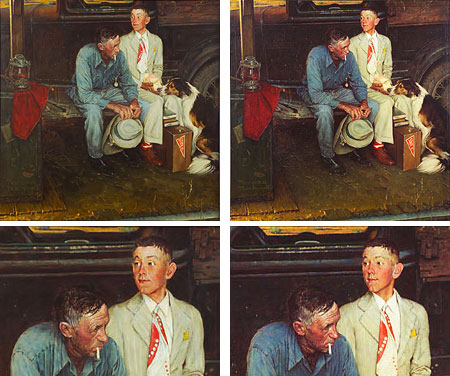
In art, as in philosophy and politics, we’re often presented with the question “What is real?”.For years experts have been mystified by inconsistencies in one of Norman Rockwell’s most widely recognized illustrations for The Saturday Evening Post, a painting known as Breaking Home Ties (above, left… or is it right?).
The painting originally appeared on the cover of the Post in September of 1954. The original was purchased in 1960 by Donald Trachte Sr, Rockwell’s friend and neighbor, who was himself an illustrator, painter, amateur architect, astronomer and inventor. Trachte was also a cartoonist and drew the Henry Sunday newspaper strips after Carl Anderson’s death in 1948. (John Liney took over the dailies.) It is Trachte’s version of the Henry Sundays that are reprinted in papers today.
Trachte had loaned the Rockwell out for exhibit for years, but over time there was more and more concern that the painting had been damaged in some way, perhaps by an overzealous restorer or cleaner trying to cover unintentional damage at a museum, or even that the painting had been stolen or replaced with a forgery. Those who knew Rockwell’s work well could see that this was just not up to his normal standards, particularly in terms of color and the appearance of the paint in many areas. The painting’s original provenance was unquestionable; it was widely known that Rockwell had sold the painting to Trachte, but the questions remained about how it had come to its current state.
Trachte Sr. died in 2005 and it turns out that the Rockwell on display was indeed a forgery (above, right,… or is it left?), painted by Trachte himself. This was revealed when Trachte’s sons discovered the original (above, left… no, right) in a secret compartment behind a bookcase in the family home.
Donald Trachte Jr., in an interview on NPR yesterday, said that their father had given them no indication that the painting on display was a forgery (or even that he was capable of painting at that level), or that the original was hidden in their house. There is some speculation that the existence of the forgery was related to the divorce of Trachte Sr. and his wife, but no one really knows.
You can see the two paintings in larger reproduction on NPR’s site. There is a nice detailed account on the Berkshire Eagle, and the originals of both paintings are currently on view at The Norman Rockwell Museum.
As for the little guessing game I’ve been playing with you, go to this post’s comment page for the answer.
Categories:
-
Frazer Irving
 Frazer Irving is a British comics artist who has done work for UK titles like 2000 AD and Judge Death as well as working for American companies like DC Comics, Dark Horse Comics and Wizards of the Coast. He cites his influences as mostly comics and British TV (“…a never ending assault of sci-fi, horror, and the generally weird…” in his words); but somewhere he picked up a wonderful tendency to use great, fat brush strokes in a way that sometimes make his comics panels look like bizarre woodcuts.
His work tends toward horror and the macabre. One of his projects for Dark Horse Comics was a four issue mini-series (and trade paperback) called Fort: Prophet of the Unexplained (written by Peter M. Lenkov), ostensibly non-fiction about an actual 19th century paranormal investigator named Charles Fort.
I first encountered Frazer Irving as the artist of a DC Comics series penned by Grant Morrison (one of my favorite comics writers) called Klarion the Witchboy, which Morrison has folded into a story arc with other titles he writes (with different artists) to produce a larger story called Seven Soldiers of Victory. The relevant issues of the individual titles have been collected in sequence and released as a series of trade paperbacks under the Seven Soldiers title. I picked up the story because I like Morrison’s writing and was immediately struck by Irving’s unique drawing and coloring style.
His drawings are nicely stylized but still have a foundation of solid draughtsmanship. When coloring his own work (something that mainstream comics artists seldom do) Irving often meets the edges of discreet areas of color with broad “feathering” brushstrokes of color, a technique usually reserved for the application of black ink in comics, but nicely applied to color in his approach. That and his sharp use of blacks and large flat areas of color give Irving’s color work a unique graphic sensibility.
But it’s hard to focus on his color work, as nice as it is, when his black and white style is so captivating. Irving really has a good command of the language of black and white comics, even if the end result has color added. His pages are rich with blacks, nicely balanced between black and white areas, and punctuated with enough texture and rendering to give them a real snap. His style is particularly appropriate for the disturbing, horror-themed stories he often takes on, and has a great ability to deliver the shock of the story with real graphic punch.
In addition to his personal site linked below, there is a Frazer Irving page on the official 200AD site with articles and interviews and a gallery of Frazer Irving prints available on the unofficial 2000AD.org site.
Categories:
-
Bev Byrnes
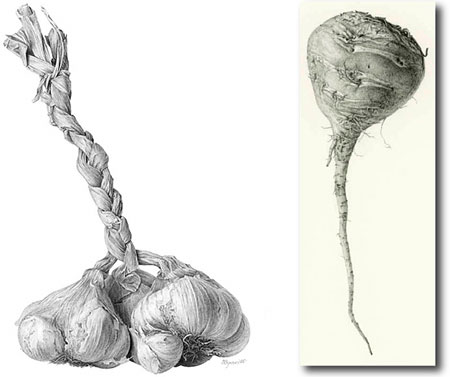
Looking through a number of wonderful paintings of small objects for my post on “painting a day” sites put me in mind of another type of art, one that, like architectural rendering and medical illustration, seldom gets notice from artists and observers outside the genre: botanical illustration.Like architectural rendering, which I mentioned in my post about T.W. Schaller, much botanical illustration can seem similar and formulaic. To a large extent, this is because of the restrictions imposed by the very specific requirements for this type of art. There are always those who manage stand out, however, and when I came across Bev Byrne’s wonderful graphite renderings of gourds, plants and mushrooms, I was struck by the visual appeal of her style and approach.
I’m certain she is fulfilling the technical requirements of the projects for which her images are created, but she has managed to step beyond that with the attention she pays to the creation of form, the rendering of texture and the careful arrangement of tonal values.
Her drawings of cloves of garlic (above, left), a gourd and an artichoke are rendered with the kind of attention to tone and surface detail that many artists might devote to a landscape. Her careful and faithful rendering of a simple beet (above, right) is done with the kind of artistic sensibility usually reserved for objects of more obvious beauty, flowers or trees for example, and in the process makes it obvious that this humble root vegetable is, in fact, just as beautiful as a flower or a tree.
In particular her drawing of the beet reminded me of something I used to enjoy very much but haven’t indulged in for years – root drawing. I had a drawing teacher once who suggested, and rightly so, that thick, gnarled roots made wonderful subjects for drawing. At the time, I was astonished at how involved and fascinated I would get in drawing these root forms. The practice was not only enjoyable, it pushed my skills at observing and drawing ahead significantly.
Byrnes has studied several kinds of drawing and has taught workshops in botanical rendering. She has also participated in a number of exhibitions in both fine art and botanical art venues. In the course of developing her personal style she has managed to see and capture the beauty in the botanical forms she is rendering and create works that not only fulfill their role as scientific illustration, but also as wonderful drawings.
Link (indirectly) via Making a Mark.
Categories:
-
Ryan Church (update)

If you are interested in learning to paint and render digitally, particularly within the area of concept art and fantasy and science fiction art, there are some great sources available. One of them is Ryan Church, who is widely acknowledged to be one of the foremost concept artists working today. As I reported in my previous post about him from last August, Church is a Senior Art Director at ILM and was a Concept Design Supervisor for Star Wars Episode II and III.Church works digitally in Corel Painter and Adobe Photoshop and he talks briefly about his methods in the “how I work” and Q&A sections of his site. In the latter, his lists his choice Painter and Photoshop brushes (which is instructive in itself if you know something about digital painting), and in the former he offers some of his custom Painter brushes for download.
While he was working on SW III, he was teaching “Advanced Entertainment Design” at the Art Center College of Design. He eventually found that too demanding on his schedule to continue, but later got together with the Gnomon Workshop to produce a series of instructional DVDs with specific topics on digital rendering like Rendering Shiny Vehicles and Rendering Hi-Tech Architecture, that are available through his site as well as the Workshop’s site.
There are also galleries on his site of his professional work, including concept art from the Star Wars films and personal work, including images used in the Gnomon Workshop tutorials.
Church’s work has also appeared in the EXPOSE 2 collection of digital art from Ballistic Publishing as well as The Art of Star Wars, Episode II – Attack of the Clones (Mark Vaz), The Art of Star Wars, Episode III – Revenge of the Sith (Jonathan Rinzler) and The Making of Star Wars, Episode III – Revenge of the Sith (Jonathan Rinzler).
There are interviews with him on CGChannel, VFX World, CG Networks and others listed on his links page. There is also an additional gallery of Church’s work on the Gnomon Workshop site.
One of the great advantages of living in the digital age is not only the availability of digital art tools, but the ability to learn to use them with help from some of the best in the field.
Categories:
-
“Painting a Day” blogs
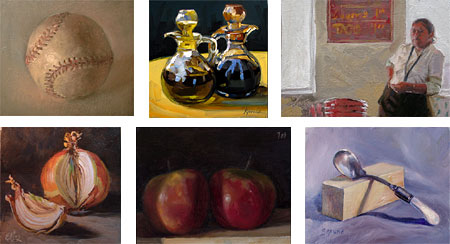
Back in December of 2004, Virginia artist and teacher Duane Keiser started the terrific practice of painting one small (usually postcard size) painting every day (as far as I know, starting with the painting of the baseball above). At the same time, he started a blog on which he would post an image of that day’s painting. See my original post about Keiser and his A Painting a Day blog from last October.Since then, a number of other artists have begun to keep this kind of routine as well (I regret to say I’m not among them). Not only is this an excellent discipline for any painter or visual artist, it may be financially beneficial as well. Keiser, and most of the other artists who have added this practice to their daily routine, usually offer their images for sale directly through their blogs. Most of Keiser’s “postcard paintings” (which he paints using a small easel made from an old cigar box) have been offered for sale (originally for $100, now for much more). Occasionally, he will do a larger scale or more complex painting within the context of the series and offer it for bid on eBay.
The other “painting a day” painters follow a similar model; small format paintings posted to a blog and offered for direct sale or bid on eBay. This not only allows the artists to leverage the fondness the web has for frequently changing content (which is one of the primary reasons for the popularity of blogs) to increase their potential audience, but also lets them connect directly with those interested in their paintings, effectively doing an end-run around galleries and their high commissions for at least some portion of their work. (A $100 postcard size painting would have to be at least 2-3 times that if sold in a gallery to accommodate the gallery’s commission as well as framing and preparation for hanging.)
The paintings all share some similarities as well. Of necessity they are small in scale and directly done, which usually translates into a fresh, painterly approach, and they are most often of individual small household objects: salt shakers, fruit, painting tubes and other studio paraphernalia, flowers, dishes, etc. Many of the sites, including Keiser’s, offer a “gallery view” of thumbnails of the paintings in addition to the chronological blog listings.
After keeping up this amazing discipline for over two years, Keiser announced on Saturday that he will be slowing down for the time being, posting a little less frequently for a bit while he focuses his energy on larger projects. My hat is off to him for making this admirable practice worthy of note and worthy of emulation.
I’ve included here a sampling (certainly not comprehensive) of some of the “painting a day” style blogs of artists I’ve come across or who have contacted me. All of them are worthy of a full post and I’ll try to revisit them in detail in the future. Clockwise from top-left: Duane Keiser, Karin Jurick, David R. Darrow, Shelly Grund, Julian Merrow-Smith, Elin Pendleton.
Categories:
-
Mort Drucker

Mort Drucker is one of the finest caricaturists and cartoonists of our age. He is often overlooked for a couple of reasons. One reason is that he is overshadowed by the attention paid to people like Al Hirschfeld and David Levine (both of whom I admire, but not as much as Drucker), along with editorial cartoonists and other caricaturists who work in more literary and cultural venues. The other is that Drucker’s main venue, aside from occasional Time and TV Guide covers, has been Mad magazine, and you don’t get much more culturally disrespected than that.Drucker has been creating splendiferous move and TV parodies in the pages of Mad since the late 50’s, for a time appearing while the great Wally Wood was still plying his visual magic at the magazine. For my money, Drucker is the only one of the post-EC Mad artists who is in the same class with Wood, Will Elder and Jack Davis (and that class is within the all time top echelon of comics artists).
Drucker is the absolute best ever at combining consistently brilliant caricatures with comics, i.e. sequential storytelling; in this he even surpasses Wood and Elder. Unlike Herschfeld and Levine, he doesn’t just create a likeness in a single image, he draws multi-page comics stories in which the caricatures are consistent, recognizable and hilariously dead-on through the course of a story, requiring a wide range of position, action and expression!
On top of all of that, Mort Drucker has one of the most wonderfully realized humorous comic drawing styles I’ve ever encountered. Every line, every figure, expression and background element is a visual treat. His lively, springy lines are full of energy and a loose, comfortable feeling that makes Drucker’s drawings just vibrate with visual fun. You get the impression that his pen just dances across the paper, leaving its marvelous marks almost as a residual effect of the joy of drawing. David Apatoff’s Illustration Art blog has a wonderful post dedicated just to the way Drucker draws hands (from which I borrowed the image above).
Angelo Torres and other Mad caricature artists have tried to do a fair job of walking in Drucker’s footsteps, basically by imitating his style, but none have ever matched him.
I link to Drucker’s official site below. You can also find his work on his rep’s sites: here and here.
There was a book published in ’98 devoted to his work, Familiar Faces: The Art of Mort Drucker by David Douglas Duncan. Unfortunately, it’s out of print and demanding high prices as a collectable. For an easier (and perhaps better) way to get a look at Drucker’s genius, pick up some of the Mad collections that feature his work. Some good ones would be Mad About the Sixties : The Best of the Decade, or Mad About the Movies: Special Warner Bros Edition and Mad About TV. Another would be Mad About the Fifties, which doesn’t contain as much Drucker, but has the bonus of including brilliant work by Wood, Elder, Davis and Harvey Kurtzman.
Categories:




Charley’s Picks
Bookshop.org
(Bookshop.org affilliate links; sales benefit independent bookshop owners; I get a small percentage to help support my work on Lines and Colors)
Carlson’s Guide to Landscape Painting

Drawing and Sketching in Pencil

Bridgman’s Complete Guide to Drawing from Life
Charley’s Picks
Amazon
(Amazon.com affiliate links; sales go to a larger yacht for Jeff Bezos; but I get a small percentage to help support my work on Lines and Colors)
Carlson’s Guide to Landscape Painting
Drawing and Sketching in Pencil
Bridgman’s Complete Guide to Drawing from Life