


Categories
- 3d CGI
- Amusements
- Animation
- Anime & Manga
- Art Materials
- Art Videos
- Blogroll
- Cartoons
- Color
- Comics
- Concept & Visual Dev.
- Creativity
- Digital Art
- Digital Painting
- Displaying Art on the Web
- Drawing
- Eye Candy for Today
- Gallery and Museum Art
- High-res Art Images
- Illustration
- Motion Graphics & Flash
- Museums
- Online Museums
- Outsider Art
- Painting
- Painting a Day
- Paleo Art
- Pastel, Conté & Chalk
- Pen & Ink
- Prints and Printmaking
- Reviews
- Sc-fi and Fantasy
- Sculpture & Dimensional
- Site Comments
- Sketching
- Storyboards
- Tools and Techniques
- Uncategorized
- Vector Art
- Videos & Podcasts
- Vision and Optics
- Watercolor and Gouache
- Webcomics
Archives
- May 2026
- April 2026
- March 2026
- February 2026
- January 2026
- December 2025
- November 2025
- October 2025
- September 2025
- August 2025
- July 2025
- June 2025
- May 2025
- January 2025
- December 2024
- November 2024
- October 2024
- September 2024
- August 2024
- June 2024
- April 2024
- March 2024
- February 2024
- January 2024
- December 2023
- November 2023
- October 2023
- September 2023
- August 2023
- July 2023
- May 2023
- April 2023
- March 2023
- February 2023
- January 2023
- December 2022
- November 2022
- September 2022
- August 2022
- July 2022
- June 2022
- May 2022
- April 2022
- March 2022
- February 2022
- January 2022
- December 2021
- November 2021
- October 2021
- September 2021
- August 2021
- July 2021
- June 2021
- May 2021
- April 2021
- March 2021
- February 2021
- January 2021
- December 2020
- November 2020
- October 2020
- September 2020
- August 2020
- July 2020
- June 2020
- May 2020
- April 2020
- March 2020
- February 2020
- January 2020
- December 2019
- November 2019
- October 2019
- September 2019
- August 2019
- July 2019
- June 2019
- May 2019
- April 2019
- March 2019
- February 2019
- January 2019
- December 2018
- November 2018
- October 2018
- September 2018
- August 2018
- July 2018
- June 2018
- May 2018
- April 2018
- March 2018
- February 2018
- January 2018
- December 2017
- November 2017
- October 2017
- September 2017
- August 2017
- July 2017
- June 2017
- May 2017
- April 2017
- March 2017
- February 2017
- January 2017
- December 2016
- November 2016
- October 2016
- September 2016
- August 2016
- July 2016
- June 2016
- May 2016
- April 2016
- March 2016
- February 2016
- January 2016
- December 2015
- November 2015
- October 2015
- September 2015
- August 2015
- July 2015
- June 2015
- May 2015
- April 2015
- March 2015
- February 2015
- January 2015
- December 2014
- November 2014
- October 2014
- September 2014
- August 2014
- July 2014
- June 2014
- May 2014
- April 2014
- March 2014
- February 2014
- January 2014
- December 2013
- November 2013
- October 2013
- September 2013
- August 2013
- July 2013
- June 2013
- May 2013
- April 2013
- March 2013
- February 2013
- January 2013
- December 2012
- November 2012
- October 2012
- September 2012
- August 2012
- July 2012
- June 2012
- May 2012
- April 2012
- March 2012
- February 2012
- January 2012
- December 2011
- November 2011
- October 2011
- September 2011
- August 2011
- July 2011
- June 2011
- May 2011
- April 2011
- March 2011
- February 2011
- January 2011
- December 2010
- November 2010
- October 2010
- September 2010
- August 2010
- July 2010
- June 2010
- May 2010
- April 2010
- March 2010
- February 2010
- January 2010
- December 2009
- November 2009
- October 2009
- September 2009
- August 2009
- July 2009
- June 2009
- May 2009
- April 2009
- March 2009
- February 2009
- January 2009
- December 2008
- November 2008
- October 2008
- September 2008
- August 2008
- July 2008
- June 2008
- May 2008
- April 2008
- March 2008
- February 2008
- January 2008
- December 2007
- November 2007
- October 2007
- September 2007
- August 2007
- July 2007
- June 2007
- May 2007
- April 2007
- March 2007
- February 2007
- January 2007
- December 2006
- November 2006
- October 2006
- September 2006
- August 2006
- July 2006
- June 2006
- May 2006
- April 2006
- March 2006
- February 2006
- January 2006
- December 2005
- November 2005
- October 2005
- September 2005
- August 2005
Relevant Blogs
Art, Painting & Sketch
- Gurney Journey
- Underpaintings
- Art and Influence
- Painting Perceptions
- Oil Painters of America
- Vasari Paint POV
- Flying Fox
- Urban Sketchers
- Bento (Smithsonian)
- Art Inconnu
- The Hidden Place
- Still Life
- Making a Mark
- The Art of the Landscape
- Exploring Color & Creativity
- Art Contrarian
- Artist A Day
- beinArt Surreal Art Collective
- Eye Level
- David Dunlop
- p.i.g.m.e.n.t.i.u.m
- CultureGrrl
- Joaquín Sorolla blog
- Artists in Pastel
“Painting a Day”
- A Painting a Day (Keiser)
- On Painting (Keiser)
- Julian Merrow-Smith
- Karen Jurick
- Jeffrey Hayes
- Carol Marine
- Abbey Ryan
- Daily Paintworks
Other Painting Blogs
- Virtual Gouache Land
- Neil Hollingsworth
- Marc Hanson
- Kevin Menck
- Marc Dalessio
- Larry Seiler
- Stapleton Kearns
- Colin Page
- Roos Schuring
- Hans Versfelt
- Titus Meeuws
- Régis Pettinari
- René Plein Air
- Belinda Del Pesco
- Robin Weiss
- Nathan Fowkes (Land Sketch)
- William Wray
- Frank Serrano
- Stephen Magsig
- Michael Chesley Johnson
- Twice a Week
- Sarah Wimperis
- Rob Adams
- Michael Cole Manley
- The Dirty Palette Club
- Mike Manley’s Draw!
Gallery Art & Illustration mix
Illustration
- Howard Pyle
- 100 Years of Illustration
- BibliOdyssey
- Illustration Art
- Today’s Inspiration
- Illustration Mundo
- Little Chimp Society
- Danny Gregory
- R D (John Martz
- Illustration Friday blog
- Monster Brains
- Illustrators & Illustrations (RU)
- Elwood H. Smith
- DaniDraws.com
- Designers Who Blog
- iSpot Blog
Sci-Fi & Fantasy
Illustration & Comics
Comics & Cartoons
- Comics Beat
- Robot 6
- Newsarama Blog
- Comic Vine
- Comics Alliance
- Forbidden Planet Int.
- Paolo Rivera
- Bolt City
- Flight
- Scott McCloud
- The Comics Journal
- Comixpedia
- Funnybook Babylon
- James Baker
- Middleton’s Sketchbook
- Boneville
- The Hotel Fred
- Paul Rivoche
- Daily Cartoonist
- Mad About Cartoons (William Wray)
- Digital Strips
Illustration & Concept
Animation & Concept
- Cartoon Brew
- Animation Blog
- Cold Hard Flash
- Concept Art World
- The CAB
- FY Concept Art
- Concept Ships
- Concept Robots
- John Nevarez
- Armand Serrano
- Marcos Mateu-Mestre
- all kinds of stuff (Kricfalusi)
- Yacin the faun (Man Arenas)
- Kelsey Mann
- Cre8tivemarks Blog
- Ice-Cream Monster Toon Cafe
- AAU Character & Creature Design
- AAU Animation Notes
- Articles and Texticles
Paleo & Scientific
Tools & Techniques
Other
Lists of Art Blogs
Art Image Resource Links
Historic Art Images
- Wikimedia Commons: Paintings
- Wikimedia Commons: Drawings
- The Athenaeum
- WikiArt (WikiPaintings)
- Google Art Project: Artists
- Google Art Project: Collections (Museums)
- ArtCyclopedia
- Web Gallery of Art
- Art Renewal Center
- Web Gallery of Impressionism
Auction Consolidation sites
Auction sites
- Sotheby’s
- Bonham’s
- Christies
- Heritage Auctions: Fine Art
- Heritage Auctions: Illustration
- Freeman’s Auctions
- Bukowskis
- Shannon’s
Image Search
Reverse Image Search (search by image)
- Tin Eye
- RevImg
- Google Image Search (camera icon)
- Bing Image Search (camera icon)
Promoting some friends and some clients of my website design business
- Twin Willows T’ai Chi studio in Wilmington DE. Taiji classes with Bryan Davis.
- Ray Hayward, Inspired Teacher of T’ai Chi ( Taiji ) in Minneapolis, Founder of Mindful Motion Tai Chi Academy
- OldHead Tattoo studio and Art Gallery in Wilmington DE. Tattoos and paintings by Bruce Gulick
- Sharon Domenico Art, pet portrait oil paintings
- Platinum Paperhanging, wallpaper hanging, Main Line and Philadelphia, PA
- Lisa Stone Design, interior designer, Main Line and Philadelphia, PA
- Studio12KPT, original art, prints, calendars and other custom printed items by Van Sickle & Rolleri
-
Martina Hoffmann

Visionary artist Martina Hoffmann was born in Germany, grew up in Cameroon in West Africa, and now lives in Spain with her husband, artist Robert Venosa, who I profiled last week.She paints intricate, detailed works inspired by dreams and the unconscious, which makes it appropriate to call her work surreal, in spite of how picky I can be about the indiscriminate use of that term. Her pieces often involve themes of fertility, pregnancy, birth and other invocations of the universal feminine, as well as suggestions of altered stares of consciousness or spiritual awakening.
She shares with Venosa a kinship to the liquid-reality visions of Surrealists Yves Tanguy, Max Ernst and Dali, and a fascination with the combination of imagined forms with traditional landscape elements. In her case there is also often an incorporation of intricate patterns, suggestive of radiant spiritual or biological energy, surrounding, or emanating from, living things, that brings to mind the work of Alex Grey.
Hofffmann also has a fascinating series of portraits, in which there is a suggestion of other-worldliness or spitiruality to the backgrounds and settings.
There is a gallery of her work on the beinArt Surreal Art Collective; and along with Venosa, she is one of the artists featured in their new collection Metamorphosis, which I wrote about in this post.
There is also a gallery of her work on the Society for the Art of Imagination, along with a bio and interview.
Addendum: I received a notice that Martina Hoffmann and Robert Venosa are conducting a series of workshops on Visionary Painting, the latest of which will be held this November 24th to 30th in Boulder, Colorado.
Categories:
-
Simon Bartram

Though he does other advertising and editorial illustration, U.K. illustrator Simon Bartram is noted for a series of children’s books that he both wrote and illustrated: Watch out for Sprouts, Dougal’s Deep Sea Diary (image above, right) and Man on the Moon (a day in the life of Bob) (above, left).He has also illustrated children’s books for other authors, including Pumpkin Moon by Tim Preston, A Christmas Wish by Marcus Sedgwick and Night and the Candlemaker by Wolfgang Somary.
Bartram’s children’s book illustrations often have characters with smallish heads and overlarge hands, and are painted with a kind of textured solidity that gives the exaggerated images a sort of nice, cheery goofiness. That, combined with backgrounds and scenes loaded with lots of objects and colorful details, provides a rich smorgasbord of shapes, colors and textures to satisfy the visual appetites of kids and adults alike.
It’s easy to overlook the fact that illustrations for children’s books aimed at younger kids must appeal to both the kids and the adults, who need to remain amused themselves through repeated readings.
Though Bartram doesn’t appear to have a web site, he has a portfolio on the site of his rep, ArenaWorks and another on the SAA Illustration Hub.
Categories:
-
How to Paint a Portrait
(David R. Darrow)
Here’s an interesting take on the process of painting a portrait – from the subjects point of view. Geoff Bouvier had his portrait painted by artist David R. Darrow, who I profiled previously in the context of one of my earliest reports on the practice of creating a “painting a day” and a later related post on the Daily Painters Guild.Darrow worked for many years as an illustrator, but has since moved into gallery painting and commissioned portraits. He received his formal training in illustration at the Art Center College of Design and later had the opportunity to study figure drawing with Fred Fixler.
Darrow has an immediate, painterly style and seems to revel in the physicality of the paint, with lots of luxurious brushstrokes in his subjects and broad swipes of textured color in his backgrounds.
Darrow has galleries on his site of figure paintings, charcoal sketches, his “Everyday Paintings” and a selection of recent works. He also has a page of information on how he approaches commissions, a subject that is explored in much more detail by subject Geoff Bouvier in a five page article he wrote for the San Diego Reader in June.
Darrow has since posted the article on his web site, filled out with larger images and some annotations and comments on the process.
The intention to write the article was there from the start, and the result is a talkative process in which Geoff asks Darrow about his methods in addition to observing them.
Although he takes some photographs for reference, Darrow is working from life in a traditional process that starts with a color sketch, then works from a charcoal drawing through the finished painting.
It’s enlightening to get the impressions of both the sitter and the artist on what is generally a non-verbal process. In the course of the article both reveal their thoughts about expectations, the likeness, the artist’s intention and the sequence of events in the course of painting a portrait.
Categories:
-
Glen Angus
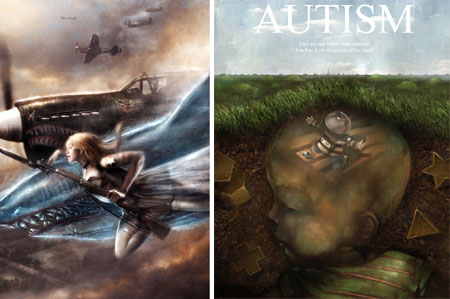
It’s always particularly sad when my first post about an artist is to mark their untimely passing.Glen Angus was talented illustrator, concept artist, designer and storyboard artist. He died suddenly last Thursday night.
Angus was a Senior Artist and major contributor to game developer Raven Software and there is a tribute page posted on their site, which includes an address for a memorial fund for his family.
His clients also included Wizards of the Coast, for which he created imaginative and fun illustrations for their popular Magic: The Gathering collectable card game.
His site includes galleries of paintings, pencil sketches, concept designs, storyboards and illustrations. The “For the Young at Heart” section includes children’s book illustrations.
His portfolio on CGSociety includes his delightful illustrations for a proposed children’s book Filling Valhalla as well as numerous drawings and illustrations.
There is page of his “Victory Gals” project on ConceptArt.org, in which he works in modern digital painting techniques in Photoshop and Painter in a series of themed images that harkens back to WWII aviation posters (image above, left).
The last part of Angus’s life was consumed with his efforts to secure treatment for his two year old son, Teddy, who was diagnosed with autism in December of 2006.
Children with autism respond to early intervention, but in many states, like Angus’ home state of Wisconsin, there is an unfortunately long waiting list for aid in acquiring the expensive therapy; and therapy is often critically delayed through periods when it could be of the most benefit to the child.
As part of his effort to change this and the unhelpful current policies of most medical insurance companies, both for his own son and other children, Angus created poster with his illustration of his son as he pictured him, as child trapped inside the barriers of his own mind, without voice (image above, right).
All of the interior pages on Angus’s site are now prefaced with his explanation of the situation, a large version of the poster image and some information on contacting the governor’s office in his state.
I don’t know much about autism, but I’ve tried to provide a couple of jumping off points for information in the links below, as well as a list of links to pages and galleries with Angus’ artwork. It’s now up to others to carry on his fight.
Addendum: The CGSociety has posted an extensive tribute page for Glen Angus.
[Information and links courtesy of Charles Morrow and “Dominus Elf“]
Categories:
-
J.M.W. Turner

Joseph Mallord William Turner is often mentioned in the same breath as John Constable, as they were the two preeminent English landscape painters of the Romantic era, and two of the most important landscape painters period.In the canons of modern art criticism, Turner is considered more important. His search for atmospheric effects and the emotional drama of color, which led to dramatic canvasses roiling with waves and clouds, are seen as a precursor to Impressionism and Modernism, and we all know that post WWII Modernism is the pinnacle of artistic achievement to which the previous 2000 years were a mere warm-up (he said, while rolling his eyes and making a rude gesture).
I like Turner; his work can be striking, dramatic, and dazzling; but I have to say that I find Constable just as interesting, more in fact; and I find more powerful antecedents to Impressionism in Courbet and, in particular, Corot (though Turner certainly set the stage for Whistler’s nocturnes). I just don’t see Turner as quite the turning point (if you’ll excuse the phrase) in the history of art that he gets credit for in the standard texts.
It will be interesting to see what Simon Schama has to say in tonight’s Power of Art (10pm on many PBS stations here in the U.S.), though somehow I think he will take the Modernist view of assigning Turner pivotal importance in the path to Modernism.
It might be helpful to look at Turner’s sources and influences. Constable apparently wasn’t one of them; reportedly Constable was interested in Turner’s work, but not the other way around (though there’s very little influence passed in either direction between them). You can see precedent for Turner’s great washes of sky and color in Claude Lorrain’s volumetric spaces bathed in light. Both Turner and Constable were probably influenced by Gainsborough, and perhaps even Caspar David Friederich.
Turner’s early work was richly detailed, his later paintings washed in color. In the middle the two blended, as in the history painting above, Dido Building Carthage, which I’ll offer in contrast to Slave Traders Throwing the Dead and Dying into the Sea – The Typhoon Approaches, the painting Schama will be focusing on.
Turner considered Dido Building Carthage his greatest work, and reportedly indicated in the first draft of his will that he wanted to be wrapped in the canvas when he was buried. He eventually thought better of that and donated the work to the National Gallery in London, apparently with the stipulation that it be displayed next to a seascape by Claude Lorrain that he found particularly inspiring.
Categories:
-
Colin Stimpson
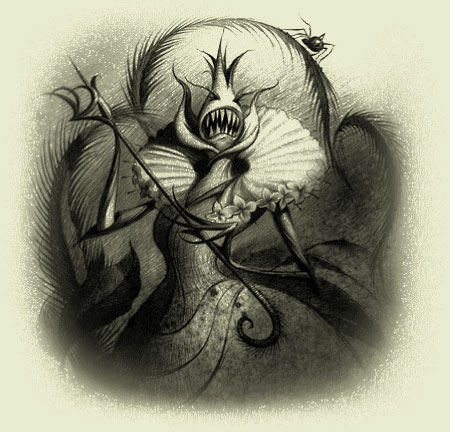
U.K illustrator and concept artist Colin Stimpson lists early influences that include great Edwardian illustrators like Edmund Dulac and Arthur Rackham. He carries those influences into his snappy, nicely textured illustrations and a richly imaginative rendering style for his concept art and color guides for animated films.Stimpson has worked on a number of Disney films like Hercules, Tinkerbell, The Hunchback of Notre Dame and The Emperor’s New Groove, for which he served as art director.
His web site has a gallery of his animation work that includes color guides and concept paintings for several of those projects. Unfortunately, the color guides in particular are reproduced way too small to get a good look at them. The most interesting work in his animation galleries is a series of beautiful monochromatic images for Kronk’s New Groove. These are imaginative and beautifully realized and have a wonderful sense of scale. The tone renderings have a dark to light drama that would be difficult to achieve in color.
In 2004 Stimpson returned to illustration when asked to illustrate a children’s book called The Poison Diaries for the Duchess of Northumberland. The resulting illustrations (image above) are the other highlight of Stimpson’s online portfolio. Again, his works in monochrome are outstanding in their subtle use of value and texture. There are also color illustrations associated with the book, but the tone images are just a treat.
[Link courtesy of Keith Holt]
Categories:




Charley’s Picks
Bookshop.org
(Bookshop.org affilliate links; sales benefit independent bookshop owners; I get a small percentage to help support my work on Lines and Colors)

John Singer Sargent: Watercolors


Urban Sketching: Understanding Perspective


Charley’s Picks
Amazon
(Amazon.com affiliate links; sales go to a larger yacht for Jeff Bezos; but I get a small percentage to help support my work on Lines and Colors)
John Singer Sargent: Watercolors
Urban Sketching: Understanding Perspective