


Categories
- 3d CGI
- Amusements
- Animation
- Anime & Manga
- Art Materials
- Art Videos
- Blogroll
- Cartoons
- Color
- Comics
- Concept & Visual Dev.
- Creativity
- Digital Art
- Digital Painting
- Displaying Art on the Web
- Drawing
- Eye Candy for Today
- Gallery and Museum Art
- High-res Art Images
- Illustration
- Motion Graphics & Flash
- Museums
- Online Museums
- Outsider Art
- Painting
- Painting a Day
- Paleo Art
- Pastel, Conté & Chalk
- Pen & Ink
- Prints and Printmaking
- Reviews
- Sc-fi and Fantasy
- Sculpture & Dimensional
- Site Comments
- Sketching
- Storyboards
- Tools and Techniques
- Uncategorized
- Vector Art
- Videos & Podcasts
- Vision and Optics
- Watercolor and Gouache
- Webcomics
Archives
- May 2026
- April 2026
- March 2026
- February 2026
- January 2026
- December 2025
- November 2025
- October 2025
- September 2025
- August 2025
- July 2025
- June 2025
- May 2025
- January 2025
- December 2024
- November 2024
- October 2024
- September 2024
- August 2024
- June 2024
- April 2024
- March 2024
- February 2024
- January 2024
- December 2023
- November 2023
- October 2023
- September 2023
- August 2023
- July 2023
- May 2023
- April 2023
- March 2023
- February 2023
- January 2023
- December 2022
- November 2022
- September 2022
- August 2022
- July 2022
- June 2022
- May 2022
- April 2022
- March 2022
- February 2022
- January 2022
- December 2021
- November 2021
- October 2021
- September 2021
- August 2021
- July 2021
- June 2021
- May 2021
- April 2021
- March 2021
- February 2021
- January 2021
- December 2020
- November 2020
- October 2020
- September 2020
- August 2020
- July 2020
- June 2020
- May 2020
- April 2020
- March 2020
- February 2020
- January 2020
- December 2019
- November 2019
- October 2019
- September 2019
- August 2019
- July 2019
- June 2019
- May 2019
- April 2019
- March 2019
- February 2019
- January 2019
- December 2018
- November 2018
- October 2018
- September 2018
- August 2018
- July 2018
- June 2018
- May 2018
- April 2018
- March 2018
- February 2018
- January 2018
- December 2017
- November 2017
- October 2017
- September 2017
- August 2017
- July 2017
- June 2017
- May 2017
- April 2017
- March 2017
- February 2017
- January 2017
- December 2016
- November 2016
- October 2016
- September 2016
- August 2016
- July 2016
- June 2016
- May 2016
- April 2016
- March 2016
- February 2016
- January 2016
- December 2015
- November 2015
- October 2015
- September 2015
- August 2015
- July 2015
- June 2015
- May 2015
- April 2015
- March 2015
- February 2015
- January 2015
- December 2014
- November 2014
- October 2014
- September 2014
- August 2014
- July 2014
- June 2014
- May 2014
- April 2014
- March 2014
- February 2014
- January 2014
- December 2013
- November 2013
- October 2013
- September 2013
- August 2013
- July 2013
- June 2013
- May 2013
- April 2013
- March 2013
- February 2013
- January 2013
- December 2012
- November 2012
- October 2012
- September 2012
- August 2012
- July 2012
- June 2012
- May 2012
- April 2012
- March 2012
- February 2012
- January 2012
- December 2011
- November 2011
- October 2011
- September 2011
- August 2011
- July 2011
- June 2011
- May 2011
- April 2011
- March 2011
- February 2011
- January 2011
- December 2010
- November 2010
- October 2010
- September 2010
- August 2010
- July 2010
- June 2010
- May 2010
- April 2010
- March 2010
- February 2010
- January 2010
- December 2009
- November 2009
- October 2009
- September 2009
- August 2009
- July 2009
- June 2009
- May 2009
- April 2009
- March 2009
- February 2009
- January 2009
- December 2008
- November 2008
- October 2008
- September 2008
- August 2008
- July 2008
- June 2008
- May 2008
- April 2008
- March 2008
- February 2008
- January 2008
- December 2007
- November 2007
- October 2007
- September 2007
- August 2007
- July 2007
- June 2007
- May 2007
- April 2007
- March 2007
- February 2007
- January 2007
- December 2006
- November 2006
- October 2006
- September 2006
- August 2006
- July 2006
- June 2006
- May 2006
- April 2006
- March 2006
- February 2006
- January 2006
- December 2005
- November 2005
- October 2005
- September 2005
- August 2005
Relevant Blogs
Art, Painting & Sketch
- Gurney Journey
- Underpaintings
- Art and Influence
- Painting Perceptions
- Oil Painters of America
- Vasari Paint POV
- Flying Fox
- Urban Sketchers
- Bento (Smithsonian)
- Art Inconnu
- The Hidden Place
- Still Life
- Making a Mark
- The Art of the Landscape
- Exploring Color & Creativity
- Art Contrarian
- Artist A Day
- beinArt Surreal Art Collective
- Eye Level
- David Dunlop
- p.i.g.m.e.n.t.i.u.m
- CultureGrrl
- Joaquín Sorolla blog
- Artists in Pastel
“Painting a Day”
- A Painting a Day (Keiser)
- On Painting (Keiser)
- Julian Merrow-Smith
- Karen Jurick
- Jeffrey Hayes
- Carol Marine
- Abbey Ryan
- Daily Paintworks
Other Painting Blogs
- Virtual Gouache Land
- Neil Hollingsworth
- Marc Hanson
- Kevin Menck
- Marc Dalessio
- Larry Seiler
- Stapleton Kearns
- Colin Page
- Roos Schuring
- Hans Versfelt
- Titus Meeuws
- Régis Pettinari
- René Plein Air
- Belinda Del Pesco
- Robin Weiss
- Nathan Fowkes (Land Sketch)
- William Wray
- Frank Serrano
- Stephen Magsig
- Michael Chesley Johnson
- Twice a Week
- Sarah Wimperis
- Rob Adams
- Michael Cole Manley
- The Dirty Palette Club
- Mike Manley’s Draw!
Gallery Art & Illustration mix
Illustration
- Howard Pyle
- 100 Years of Illustration
- BibliOdyssey
- Illustration Art
- Today’s Inspiration
- Illustration Mundo
- Little Chimp Society
- Danny Gregory
- R D (John Martz
- Illustration Friday blog
- Monster Brains
- Illustrators & Illustrations (RU)
- Elwood H. Smith
- DaniDraws.com
- Designers Who Blog
- iSpot Blog
Sci-Fi & Fantasy
Illustration & Comics
Comics & Cartoons
- Comics Beat
- Robot 6
- Newsarama Blog
- Comic Vine
- Comics Alliance
- Forbidden Planet Int.
- Paolo Rivera
- Bolt City
- Flight
- Scott McCloud
- The Comics Journal
- Comixpedia
- Funnybook Babylon
- James Baker
- Middleton’s Sketchbook
- Boneville
- The Hotel Fred
- Paul Rivoche
- Daily Cartoonist
- Mad About Cartoons (William Wray)
- Digital Strips
Illustration & Concept
Animation & Concept
- Cartoon Brew
- Animation Blog
- Cold Hard Flash
- Concept Art World
- The CAB
- FY Concept Art
- Concept Ships
- Concept Robots
- John Nevarez
- Armand Serrano
- Marcos Mateu-Mestre
- all kinds of stuff (Kricfalusi)
- Yacin the faun (Man Arenas)
- Kelsey Mann
- Cre8tivemarks Blog
- Ice-Cream Monster Toon Cafe
- AAU Character & Creature Design
- AAU Animation Notes
- Articles and Texticles
Paleo & Scientific
Tools & Techniques
Other
Lists of Art Blogs
Art Image Resource Links
Historic Art Images
- Wikimedia Commons: Paintings
- Wikimedia Commons: Drawings
- The Athenaeum
- WikiArt (WikiPaintings)
- Google Art Project: Artists
- Google Art Project: Collections (Museums)
- ArtCyclopedia
- Web Gallery of Art
- Art Renewal Center
- Web Gallery of Impressionism
Auction Consolidation sites
Auction sites
- Sotheby’s
- Bonham’s
- Christies
- Heritage Auctions: Fine Art
- Heritage Auctions: Illustration
- Freeman’s Auctions
- Bukowskis
- Shannon’s
Image Search
Reverse Image Search (search by image)
- Tin Eye
- RevImg
- Google Image Search (camera icon)
- Bing Image Search (camera icon)
Promoting some friends and some clients of my website design business
- Twin Willows T’ai Chi studio in Wilmington DE. Taiji classes with Bryan Davis.
- Ray Hayward, Inspired Teacher of T’ai Chi ( Taiji ) in Minneapolis, Founder of Mindful Motion Tai Chi Academy
- OldHead Tattoo studio and Art Gallery in Wilmington DE. Tattoos and paintings by Bruce Gulick
- Sharon Domenico Art, pet portrait oil paintings
- Platinum Paperhanging, wallpaper hanging, Main Line and Philadelphia, PA
- Lisa Stone Design, interior designer, Main Line and Philadelphia, PA
- Studio12KPT, original art, prints, calendars and other custom printed items by Van Sickle & Rolleri
-
Sterling Hundley
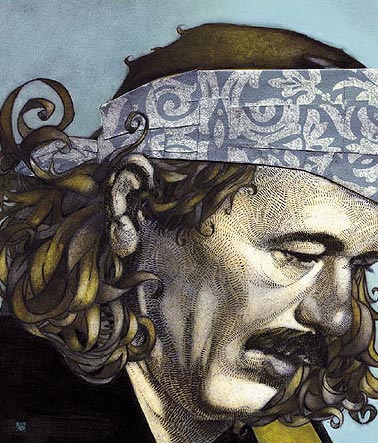
Sterling Hundley’s career as an illustrator got off to a quick start. While still a student at Virginia Commonwealth University, his work was chosen for the Society of Illustrators Student Scolarship Competition and the Society’s Illustrators Annual, and appeared in CMYK and Step by Step Magazine.He continues to garner awards and notice from the Society of Illustrators, The Illustrators Club, The LA Society of Illustrators, Communication Arts, Print Magazine and others.
His clients include The New Yorker, The Atlantic Monthly, Rolling Stone, GQ, The New York Times, Entertainment Weekly, Harper Collins and Putnam. He is represented by Richard Solomon (which says a fair bit in itself).
Hundley’s illustrations demonstrate a bold sense of design and are enlivened with imaginative variations of patterns and textures. His color palette tends to be muted, allowing the textures to assume part of the role normally assigned to color.
In his posters and book covers he often makes the title and other text an integral part of the illustration; and hand lettered text is used like a texture in some of his works (an interesting way to think of the word “texture”) .
His figures and faces are sometimes exaggerated, sometimes straightforwardly drawn and often a combination of both approaches. He also manages to combine abstracted shapes and pure design elements with more directly representational imagery. The result is a mixture of graphic elements, drawing and painting that gives the eye lots of variety within a coherent whole, like a nicely rounded meal.
Eschewing the usual categories into which artists separate their work when presenting it, Hundley interestingly divides his online portfolio into two sections titled “smart” and “pretty”.
His web site seems to be incomplete, as the “For Sale” and “Journal” sections still promise “Coming Soon”. Although, I’m not sure what “Journal” will be, as the “News” section is already in blog format. Unfortunately the blog as presented on the site is confined to scrolling within a limited-height frame, for reasons that are lost on me. You can view the blog without the frame here. You can also find Hundley posting, blog-style, to Drawger. You will find additional images on the blog and Drawger posts that are not in his online portfolio.
He apparently works in acrylic and oil, sometimes with digital additions.
I’m particularly fond of his intriguing portraits of musicians like Carlos Santana (above), Bob Dylan and Gerry Garcia.
Categories:
-
Janny Wurts

Most illustrators are called upon to interpret and represent the essence of a story. Occasionally, illustrators will venture into writing and, even less frequently, writers will have the skill to add illustrations to their own work. Outside of comics, a medium that seems to lend itself better to the role of author/illustrator, it’s rare to find someone as comfortable in both roles as fantasy author and illustrator Janny Wurts.Wurts is the author of fourteen novels, including the popular Wars of Light and Shadow series, as well as a collection of short stories; and has co-authored a trilogy with Raymond E. Feist. She is also an award-winning illustrator and her work has been featured in exhibitions like The Art of the Cosmos at the Hayden Planetarium, the exhibition for NASA’a 25th Anniversary, and exhibits of fantasy art at the Canton Art Museum and the Delaware Art Museum. She is also represented in the permanent collection of the Delaware Art Museum with her painting “Dragon’s Run” (which has the honor of sharing a gallery with works by N.C Wyeth, Frank Schoonover, Elizabeth Shippen Green and Jessie Wilcox Smith).
When illustrating the work of other authors, Wurts, like most illustrators, must make an interpretation of what she feels the writer intended. When illustrating her own stories, however, she has the unusual advantage of being in the writer’s mind and knowing exactly what the author envisioned.
Though she also works in science fiction, Wurts is most noted for her fantasy illustrations, and you will find her galleries filled with wizards, dragons, warriors and all manner of enchanted creatures as well as her visions other worlds and times. Her galleries also include sketches and works in progress.
She works directly from a transferred pencil sketch, and paints in oil, and sometimes in oil-alkyd and acrylic.
Wurts is married to illustrator Don Maitz, who I profiled in February. There is a gallery devoted to their collaborative works.
There are also special sections in both artists’ galleries devoted to Stolen Artwork, a disturbing reminder of one of the darker sides of putting work on display. In 1995, 23 works by Maitz and Wurts were stolen from a FedEx truck on the way to be displayed at the World Fantasy Con in Baltimore. The works have been registered with the International Fine Arts Registry, but one of the best hopes for recovery may lie in the continued vigilance of fans and other artists in the event there is an attempt to sell or display the stolen works.
Categories:
-
Albrecht Altdorfer

Easter celebrates the Christian ideal of resurrection and rebirth; its setting in early Springtime (and association with fertility symbols like rabbits and eggs) carries forward the idea of new beginnings and the power of nature. It’s also the time of year associated with Cecil B. DeMille’s Hollywood spectacles, with their attendant special effects and thunderously dramatic skies.Put together the resurrection of Jesus, the power of nature and spectacularly dramatic skies and you get Albrecht Altdorfer’s The Resurrection of Christ.
Altdorfer was a Germain painter and printmaker who was more or less contemporary with Albrecht Durer. Though not Durer’s equal (who was?), Altdorfer was one of the most accomplished and influential painters of the time. Even though he painted mostly religious works, he was intensely interested in landscape, and is credited as the first major artist to bring landscape to the fore as a subject for painting in and of itself.
His fascination for landscape and the power of nature carried over into his religious paintings, where great attention is given to the natural settings for many religious events. In particular, I have always been struck by his dramatic skies, which would have done well as examples for ILM in their special effects skies for Close Encounters of the Third Kind and Raiders of the Lost Ark.
In his Resurrection of Christ the skies around Christ’s golden halo boil with brilliant reds and yellows, while above, framed by the dark arch of rock, the parting darkness is more suggestive of a storm-tossed sea than mere darkened clouds.
For another great Altdorfer special effects sky, along with a sweeping landscape and a cast of thousands, see his remarkable Battle of Alexander.
Altdorfer was also renowned as an engraver and creator of woodcuts, and was particularly noted for his miniature engravings, many of which were only an inch or two on a side.
Categories:
-
The $100,000 Animation Drawing Course
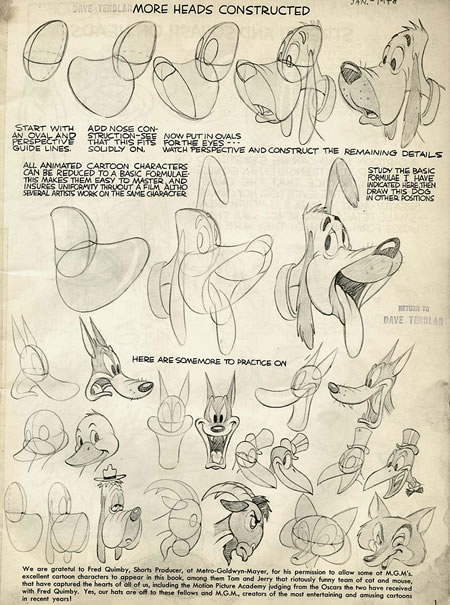
Wow! What an amazing treasure trove this is for anyone interested in animation or cartoon drawing.It should really be titled: “The $100,000 Animation Drawing Course for $8”. There is so much great stuff here that this should be a site of its own, but it’s actually part of the terrific ASIFA-Hollywood Animation Archive Project Blog. There are a multitude of resources here that will be the subjects of individual posts in the future, not the least of which are Preston Blair, Jon Kricfalusi and the Animation Archive itself, but I want to concentrate here on the “Drawing Course”, the premise of which is best summed up by Kricfalusi in his introduction:
“You can go to animation school, spend a $100,000 and not learn a damn thing about the basics of good animation drawing- OR you can buy a Preston Blair book for $8 and learn it all in a couple months. You pick.”
To back it up, Kricfalusi, the animator and instigator responsible for the brilliantly demented Ren and Stimpy cartoons, among other things, proceeds to take you through his course in 10 pages, with the assistance of supplied materials like pages from Preston Blair’s classic instruction book, his own model sheets for Ren and Stimpy, and model sheets from Disney, MGM and elsewhere. Remarkable.
Preston Blair was a brilliant animator for Disney (Fantasia, Pinocchio, Bambi) and MGM (on many Tex Avery classics) who wrote what is considered to be the definitive book on cartoon animation; originally released in its first edition as Advanced Animation; later revised and altered in content because of contractual disagreements and re-released as Preston Blair’s Animation; re-edited and changed in format with tall pages split in half and reorganized to make a horizontal format out of a vertical one (and unfortunately overexposed in repro, losing most of the halftones), and released as Cartoon Animation; and restored to vertical format (but still missing the original, contractually conflicted content) in two volumes as Cartooning: Animation 1 with Preston Blair and Cartooning: Animation 2 with Preston Blair. The second volume is unfortunately out of print and overpriced from many sellers, but you can pick up the horizontal format Cartoon Animation volume to make up the difference.
Despite any of my comments about the disparity between the original and revised volumes (which Mark Deckter makes clear on his blog here and here), this is still far and away the best book available on animation and drawing for cartoons, bar none. (Some younger artists starting on the path of cartoon animation may think of this as “old-fashioned-looking” and hence irrelevant. Oh how wrong you are. When you can draw as well as Preston Blair, come and tell me that.)
One of the great perks here is that the bulk of Preston Blair’s original book, the one with Disney and MGM characters in it, has been posted to the Archive in nice big scans with halftones intact (here and here, in addition to the links in the course – you’ll still want a printed copy to work from, though). This by itself is invaluable (this version of the book is long out of print and incredibly expensive as a rare book); combine it with Kricfalusi’s guidance and other resources and you have the makings of a real cartoon drawing and animation course.
You have to supply the impetus and determination to follow it, of course, but it really is amazing how much knowledge and expertise is here for the taking. (If you find it worthwhile, consider helping to support the Archive for making it available with a donation for a tiny fraction of its real value.)
Kricfalusi is carrying on with more drawing lessons on his own blog, all kinds of stuff, which is just that, all kinds of stuff about drawing, writing and animating cartoons.
You say you’re interested in animation and cartoon drawing? There’s enough here to keep you learning steadliy for a full school year or more. Or maybe you want to make your comic book drawing or cartoon illustration more solid, crisp and snappy? What are you waiting for? Pick up your pencil and draw!
Categories:
-
Sergei Bongart (update)

When I first wrote about Russian-American painter Sergei Bongart back in January of this year, I was disappointed with the small number of his works that could be seen online.Happily, Patricia Le Grand Bongart, Sergei Bongart’s wife and an accomplished artist herself, wrote at the time to tell us that there was both a web site and new book devoted to Sergei Bongart in progress.
She has just written again to tell us that the new web site is up, and the book on his painting method, Sergei Bongart …touched by the gods, is now available.
The interesting title of the book comes from a quote from Bongart: “There are two kinds of artists, the emotional painter and academician. The academician can paint into old age sitting on his stool licking his canvas until 98 years of age. The emotional artist burns himself up; he does not live long. The academician always creates something acceptable, boring, but acceptable. The emotional artist often misses, but when he hits it is breathtakingly beautiful,… touched by the gods!”
In addition to the new book, there is a video of Patricia Bongart demonstrating the Bongart Method and an audio CD of Sergei’s classroom lectures (apparently in a fairly heavy accent).
The new web site features a gallery with about 60 works, including some by Patricia Le Grand Bongart. Of the works by Sergei, there is a wonderful variety, including life drawings and travel sketches in addition to his brilliantly colored landscapes and still life paintings.
Categories:
-
Flight 4 preview

For those of you who think that “comics” = pointlessly endless stories of musclebound, spandex-clad goons, grimacing as if terminally constipated while bludgeoning one another senseless, I once again offer the antidote and alternative of the Flight anthologies of comics stories.I like to emphasize the release of these particular books, not only because they’re excellent, but because I think they offer those who have been put off by the harsh face presented by mainstream American comic books a potential path into the joys of an entire and often overlooked medium of expression.
I’ve mentioned previous Flight comics anthologies before, here and here, as well as in posts on some of the individual artists. The newest volume, Flight 4, is due to be released this summer.
Newsarama, the venerable online comics news source, has posted a 57-page preview of the upcoming volume. Click on the preview images and you’ll find images of pages from the book, reproduced large enough for you to get a nice idea of some of the wonderful variety of artistic styles and approaches to storytelling you can expect from this talented group of young artists.
From the look of the preview, Flight 4 promises to be the strongest volume yet.
(BTW, just for the record, I really like many of the pointlessly endless stories of musclebound, spandex-clad goons, grimacing as if terminally constipated while bludgeoning one another senseless in American mainstream comics. I just think it’s unfortunate that many people think that, and the watered down leftovers that pass for newspaper comics these days, are all that comics have to offer.)
Link via Comixpedia
Categories:




Charley’s Picks
Bookshop.org
(Bookshop.org affilliate links; sales benefit independent bookshop owners; I get a small percentage to help support my work on Lines and Colors)

John Singer Sargent: Watercolors


Urban Sketching: Understanding Perspective


Charley’s Picks
Amazon
(Amazon.com affiliate links; sales go to a larger yacht for Jeff Bezos; but I get a small percentage to help support my work on Lines and Colors)
John Singer Sargent: Watercolors
Urban Sketching: Understanding Perspective