


Categories
- 3d CGI
- Amusements
- Animation
- Anime & Manga
- Art Materials
- Art Videos
- Blogroll
- Cartoons
- Color
- Comics
- Concept & Visual Dev.
- Creativity
- Digital Art
- Digital Painting
- Displaying Art on the Web
- Drawing
- Eye Candy for Today
- Gallery and Museum Art
- High-res Art Images
- Illustration
- Motion Graphics & Flash
- Museums
- Online Museums
- Outsider Art
- Painting
- Painting a Day
- Paleo Art
- Pastel, Conté & Chalk
- Pen & Ink
- Prints and Printmaking
- Reviews
- Sc-fi and Fantasy
- Sculpture & Dimensional
- Site Comments
- Sketching
- Storyboards
- Tools and Techniques
- Uncategorized
- Vector Art
- Videos & Podcasts
- Vision and Optics
- Watercolor and Gouache
- Webcomics
Archives
- May 2026
- April 2026
- March 2026
- February 2026
- January 2026
- December 2025
- November 2025
- October 2025
- September 2025
- August 2025
- July 2025
- June 2025
- May 2025
- January 2025
- December 2024
- November 2024
- October 2024
- September 2024
- August 2024
- June 2024
- April 2024
- March 2024
- February 2024
- January 2024
- December 2023
- November 2023
- October 2023
- September 2023
- August 2023
- July 2023
- May 2023
- April 2023
- March 2023
- February 2023
- January 2023
- December 2022
- November 2022
- September 2022
- August 2022
- July 2022
- June 2022
- May 2022
- April 2022
- March 2022
- February 2022
- January 2022
- December 2021
- November 2021
- October 2021
- September 2021
- August 2021
- July 2021
- June 2021
- May 2021
- April 2021
- March 2021
- February 2021
- January 2021
- December 2020
- November 2020
- October 2020
- September 2020
- August 2020
- July 2020
- June 2020
- May 2020
- April 2020
- March 2020
- February 2020
- January 2020
- December 2019
- November 2019
- October 2019
- September 2019
- August 2019
- July 2019
- June 2019
- May 2019
- April 2019
- March 2019
- February 2019
- January 2019
- December 2018
- November 2018
- October 2018
- September 2018
- August 2018
- July 2018
- June 2018
- May 2018
- April 2018
- March 2018
- February 2018
- January 2018
- December 2017
- November 2017
- October 2017
- September 2017
- August 2017
- July 2017
- June 2017
- May 2017
- April 2017
- March 2017
- February 2017
- January 2017
- December 2016
- November 2016
- October 2016
- September 2016
- August 2016
- July 2016
- June 2016
- May 2016
- April 2016
- March 2016
- February 2016
- January 2016
- December 2015
- November 2015
- October 2015
- September 2015
- August 2015
- July 2015
- June 2015
- May 2015
- April 2015
- March 2015
- February 2015
- January 2015
- December 2014
- November 2014
- October 2014
- September 2014
- August 2014
- July 2014
- June 2014
- May 2014
- April 2014
- March 2014
- February 2014
- January 2014
- December 2013
- November 2013
- October 2013
- September 2013
- August 2013
- July 2013
- June 2013
- May 2013
- April 2013
- March 2013
- February 2013
- January 2013
- December 2012
- November 2012
- October 2012
- September 2012
- August 2012
- July 2012
- June 2012
- May 2012
- April 2012
- March 2012
- February 2012
- January 2012
- December 2011
- November 2011
- October 2011
- September 2011
- August 2011
- July 2011
- June 2011
- May 2011
- April 2011
- March 2011
- February 2011
- January 2011
- December 2010
- November 2010
- October 2010
- September 2010
- August 2010
- July 2010
- June 2010
- May 2010
- April 2010
- March 2010
- February 2010
- January 2010
- December 2009
- November 2009
- October 2009
- September 2009
- August 2009
- July 2009
- June 2009
- May 2009
- April 2009
- March 2009
- February 2009
- January 2009
- December 2008
- November 2008
- October 2008
- September 2008
- August 2008
- July 2008
- June 2008
- May 2008
- April 2008
- March 2008
- February 2008
- January 2008
- December 2007
- November 2007
- October 2007
- September 2007
- August 2007
- July 2007
- June 2007
- May 2007
- April 2007
- March 2007
- February 2007
- January 2007
- December 2006
- November 2006
- October 2006
- September 2006
- August 2006
- July 2006
- June 2006
- May 2006
- April 2006
- March 2006
- February 2006
- January 2006
- December 2005
- November 2005
- October 2005
- September 2005
- August 2005
Relevant Blogs
Art, Painting & Sketch
- Gurney Journey
- Underpaintings
- Art and Influence
- Painting Perceptions
- Oil Painters of America
- Vasari Paint POV
- Flying Fox
- Urban Sketchers
- Bento (Smithsonian)
- Art Inconnu
- The Hidden Place
- Still Life
- Making a Mark
- The Art of the Landscape
- Exploring Color & Creativity
- Art Contrarian
- Artist A Day
- beinArt Surreal Art Collective
- Eye Level
- David Dunlop
- p.i.g.m.e.n.t.i.u.m
- CultureGrrl
- Joaquín Sorolla blog
- Artists in Pastel
“Painting a Day”
- A Painting a Day (Keiser)
- On Painting (Keiser)
- Julian Merrow-Smith
- Karen Jurick
- Jeffrey Hayes
- Carol Marine
- Abbey Ryan
- Daily Paintworks
Other Painting Blogs
- Virtual Gouache Land
- Neil Hollingsworth
- Marc Hanson
- Kevin Menck
- Marc Dalessio
- Larry Seiler
- Stapleton Kearns
- Colin Page
- Roos Schuring
- Hans Versfelt
- Titus Meeuws
- Régis Pettinari
- René Plein Air
- Belinda Del Pesco
- Robin Weiss
- Nathan Fowkes (Land Sketch)
- William Wray
- Frank Serrano
- Stephen Magsig
- Michael Chesley Johnson
- Twice a Week
- Sarah Wimperis
- Rob Adams
- Michael Cole Manley
- The Dirty Palette Club
- Mike Manley’s Draw!
Gallery Art & Illustration mix
Illustration
- Howard Pyle
- 100 Years of Illustration
- BibliOdyssey
- Illustration Art
- Today’s Inspiration
- Illustration Mundo
- Little Chimp Society
- Danny Gregory
- R D (John Martz
- Illustration Friday blog
- Monster Brains
- Illustrators & Illustrations (RU)
- Elwood H. Smith
- DaniDraws.com
- Designers Who Blog
- iSpot Blog
Sci-Fi & Fantasy
Illustration & Comics
Comics & Cartoons
- Comics Beat
- Robot 6
- Newsarama Blog
- Comic Vine
- Comics Alliance
- Forbidden Planet Int.
- Paolo Rivera
- Bolt City
- Flight
- Scott McCloud
- The Comics Journal
- Comixpedia
- Funnybook Babylon
- James Baker
- Middleton’s Sketchbook
- Boneville
- The Hotel Fred
- Paul Rivoche
- Daily Cartoonist
- Mad About Cartoons (William Wray)
- Digital Strips
Illustration & Concept
Animation & Concept
- Cartoon Brew
- Animation Blog
- Cold Hard Flash
- Concept Art World
- The CAB
- FY Concept Art
- Concept Ships
- Concept Robots
- John Nevarez
- Armand Serrano
- Marcos Mateu-Mestre
- all kinds of stuff (Kricfalusi)
- Yacin the faun (Man Arenas)
- Kelsey Mann
- Cre8tivemarks Blog
- Ice-Cream Monster Toon Cafe
- AAU Character & Creature Design
- AAU Animation Notes
- Articles and Texticles
Paleo & Scientific
Tools & Techniques
Other
Lists of Art Blogs
Art Image Resource Links
Historic Art Images
- Wikimedia Commons: Paintings
- Wikimedia Commons: Drawings
- The Athenaeum
- WikiArt (WikiPaintings)
- Google Art Project: Artists
- Google Art Project: Collections (Museums)
- ArtCyclopedia
- Web Gallery of Art
- Art Renewal Center
- Web Gallery of Impressionism
Auction Consolidation sites
Auction sites
- Sotheby’s
- Bonham’s
- Christies
- Heritage Auctions: Fine Art
- Heritage Auctions: Illustration
- Freeman’s Auctions
- Bukowskis
- Shannon’s
Image Search
Reverse Image Search (search by image)
- Tin Eye
- RevImg
- Google Image Search (camera icon)
- Bing Image Search (camera icon)
Promoting some friends and some clients of my website design business
- Twin Willows T’ai Chi studio in Wilmington DE. Taiji classes with Bryan Davis.
- Ray Hayward, Inspired Teacher of T’ai Chi ( Taiji ) in Minneapolis, Founder of Mindful Motion Tai Chi Academy
- OldHead Tattoo studio and Art Gallery in Wilmington DE. Tattoos and paintings by Bruce Gulick
- Sharon Domenico Art, pet portrait oil paintings
- Platinum Paperhanging, wallpaper hanging, Main Line and Philadelphia, PA
- Lisa Stone Design, interior designer, Main Line and Philadelphia, PA
- Studio12KPT, original art, prints, calendars and other custom printed items by Van Sickle & Rolleri
-
Cherries from Chauvet’s Orchard

Ruth Phillips is an English cellist living Provence, France. She is married to Julian Merrow-Smith, an artist I have written about previously.After Duane Keiser, Merrow-Smith is one of the earliest pioneers of the “painting a day” painter/blogger model of creating small daily paintings and offering them for sale over the internet. He also happens to be one of my favorite contemporary painters. I’ve been following his daily paintings blog, Postcard from Provence, since 2006.
In one of my previous posts about Merrow-Smith, I pointed out that watching the images of his postcard paintings arrive by email day after day, as well as traveling back through time by looking through his extensive archive of previous work (over 1,600 at this point), was particularly appealing because I saw within the series of paintings a story, as the landscapes and the fruits and vegetables gathered from local markets for still life paintings changed with the seasons, and as Merrow-Smith worked, experimented and grew as a painter over time.
Here, then, is another side of that story, along with Phillips’ own, as she works to balance her life as a cellist, a wife, an artist’s assistant, an Englishwoman in Provence, a homeowner and an observer of the life, and lives, around her.
In her book Cherries from Chauvet’s Orchard: A Memoir of Provence, Phillips has given us a verbal parallel to her husband’s postcard sized paintings — small colorful glimpses of other places and other lives.
In succinct, three or four page chapters, she paints vivid short scenes of life in Provence, lives of the villages in which she and her husband have lived, lives of the individuals they have encountered and lives of some of the people who have purchased Merrow-Smith’s paintings.
The latter glimpses are often told in the individuals’ own words, included in italics as chapter beginning or chapter ending quotes. They were gathered in response to a request Phillips sent out for the purchasers to write with short accounts of their particular Merrow-Smith painting or paintings, where they were hung and what they meant in their lives. She received a much more extensive response than expected, from which she culled down selected accounts to season the book.
Each chapter of Cherries is titled as one of Merrow-Smith’s paintings, sometimes directly related to the subject of the chapter, sometimes just in a metaphorical relationship. The quotes, likewise, are sometimes directly and sometimes obliquely related to the subject of the chapter.
Within these short postcard-like glimpses, Phillips manages to tell the story of her relationship with Merrow-Smith, the beginnings of their marriage and their efforts to make an uninhabitable shell of a house in Southern France into a living home and studio against the tide of an arcane rural French bureaucracy, as well as the story of how “the painter who never painted” became an early practitioner of the “painting a day” discipline, and eventually one of the most successful of the painter/bloggers — artists who pioneered the use of the internet to bypass traditional gallery markets and take their work directly to their patrons around the world, even from a small village in rural France with spotty dial-up internet access.
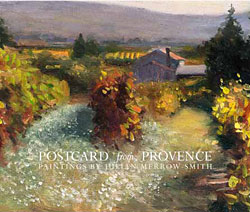 The book, save for its cover, is not illustrated, but the perfect companion volume exists in the form of Merrow-Smith’s beautiful collection Postcard from Provence: Paintings by Julian Merrow-Smith (my review here). Of course, if you already have Postcard from Provence, Cherries from Chauvet’s Orchard makes the perfect companion to that book.
I found it particularly enjoyable to have my copy of Postcard from Provence handy as I read Cherries, and leisurely turn between them, each providing “color” for the other.
Cherries from Chauvet’s Orchard can be ordered directly from Merrow-Smith’s website, as can the Postcard from Provence volume. Both are also available from Amazon, Barnes & Noble and other booksellers in the US and UK (links are provided on the site). You can read a sample of Cherries on fReado.
In addition to her website, Phillips writes two blogs, cello notes and meanwhile (here in France). In the latter, she chronicles her life in Southern France, in some ways providing a continuation and extension of Cherries from Chauvet’s Orchard.
The episodes in the book’s short chapters, some sweet, some sour, are like the eponymous cherries picked from their Provençal neighbor’s orchard. They can be read as a memoir, a love story, a series of character sketches, an account of an artist’s progress or the chronicle of the early stages of a shift in the paradigm of how art is created and sold in the 21st Century. Take your pick.
Categories:
-
Degas and the Ballet: Picturing Movement

Edgar Degas, the member of the French Impressionist group who maintained traditional academic values more than the others, spent much of his career fascinated with the ballet dancers of the Paris Opera.He drew and painted them again and again, in the process creating some of his most memorable works, including the strikingly innovative pieces in which, to the consternation of critics at the time, he shattered the traditional rules of artistic composition (two top images above). It’s difficult for us, in our jaded post-modernist position in time, to appreciate what a leap that was.
Degas used innovative divisions of the picture plane, in addition to the positions of the figure, to convey the motion of his dancers.
Degas and the Ballet: Picturing Movement is a new exhibition at the Royal Academy of Arts in London that traces the artist’s fascination with ballet dancers and movement over the course of his life and artistic development, along with the corresponding impact of the new visual technology of photography.
Aside from an introductory video, the Royal Academy’s site doesn’t do a very good job of picturing the exhibition. The Guardian comes through again with a review and slideshow that features works from the show.
Degas and the Ballet: Picturing Movement is on view until 11 December 2011. There is an exhibition catalogue and CD accompanying the exhibit.
Categories:
-
James Gurney on Gamut Masking

A gamut is a range of colors. More specifically it is a range of colors that can be created or reproduced on a particular device or with a certain set of beginning colors.Those working with print reproduction are very familiar with the concept of the CMYK gamut, or the range of colors that can be reproduced using traditional Cyan, Magenta, Yellow and Black printing inks, a smaller subset of the colors available, for example, on a computer monitor.
It’s not a term that painters use as often, but “gamut” also applies to a painter’s palette. When starting from a particular set of colors, the gamut is the range of colors that can be produced by mixing those colors (usually with the addition of white).
You will often hear me mention a “carefully controlled” or “limited” palette when talking about specific artists, particularly those working in film and gaming concept and visual development art, where limited gamuts are used to dramatic effect.
James Gurney, a highly experienced artist who works both with paintings for reproduction and for easel painting, has posted a series of articles on his blog, Gurney Journey, that delve into this often misunderstood aspect of color choices.
He started several years ago with a three part series on Color Wheel Masking, The Shapes of Color Schemes and From Mask to Palette.
His recent posts on the Gamut Masking Method, (Part 2 and Part 3) carry the principles into the creation of variations in color scheme for alternate versions of the same painting, making the process even clearer.
The most recent post, Part 3, Gamut Masking Method is particularly informative in that Gurney has included an excellent short video in which he explains the essential principles of gamut masking in a demonstration.
These principles are also covered in some detail in Gurney’s excellent recent book, Color and Light: A Guide for the Realist Painter (my review here).
Categories:
-
Pochade boxes (updated)

Even though the end of the summer is rapidly approaching for those of us who live in then northern hemisphere, the time for plein air painting is hardly over; and many, myself included, find this time of year ideal for painting outdoors.In 2008 I wrote a rather extensive article on pochade boxes, those combinations of palette and portable easel, often with provision for carrying panels and supplies, that mount on camera tripods and have become a staple tool in the modern plein air painting revival.
In attempting to find the right pochade box for my own use, I went through a fairly exhaustive search of all of the pochade box makers and models I could find at the time, as well as researching articles on making your own pochade box.
The result has been a popular Lines and Colors post in which I listed all of the resources I could find for the various kinds of pochade boxes.
I’ve just revisited the post, adding to it two more makers of pochade boxes, Sienna and Mabef, as well as expanding on the sections on tripods and painting panels.
I’ve also included an additional resources on building your own pochade box from Jim Serrett and Fazwan Barrage.
(Images above: Sienna, Mabef, Jim Serrett, Fazwan Barrage, Open Box M, Alla Prima Pochade)
Categories:
-
Robert Tracy (update)
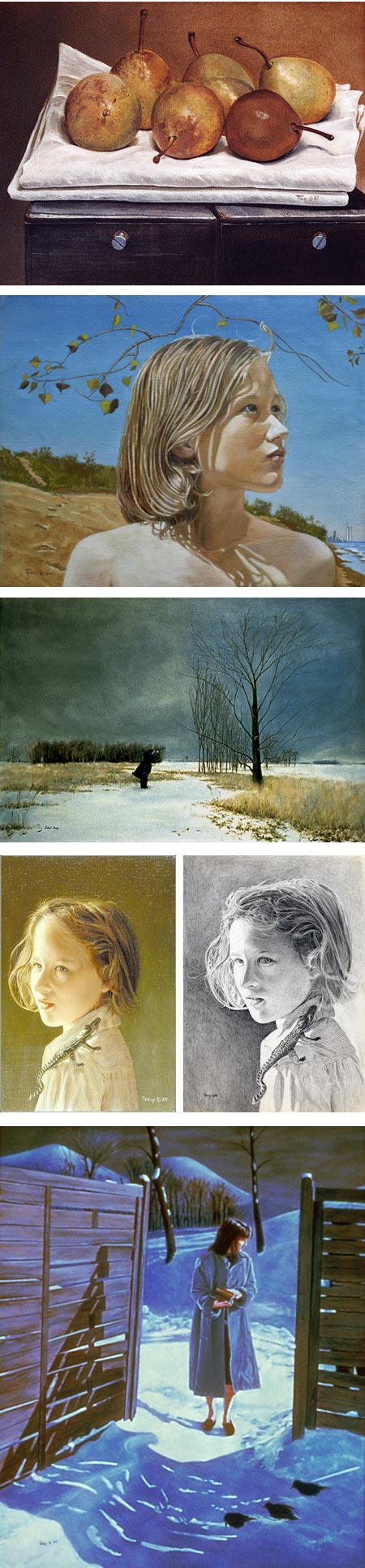
Robert Tracy is an artist I have written about previously. Tracy had not updated his website for some time, but recently added a number of older works he has made available for purchase.You can find even more of his work on his deviantART gallery, which contains an archive of pieces going back to 1965.
The deviantART galleries are more extensive (if you don’t mind the occasional intrusive ad, which is now deviantART’s policy if you are not logged in), but his website contains both older and more recent work that is available for sale. Navigation there is a bit disjointed, with links from various places on the homepage that are not accessible from the other pages.
Tracy is a self taught artist with an interest in traditional art, and his range of work chronicles his path in tackling a variety of subjects and media as he explores the possibilities of each.
You will find landscapes, portraits, still life, interiors, florals, animals, copies from the masters and narrative images in oil, watercolor, gouache, egg tempera, acrylic, colored pencil, pastel, graphite, charcoal and even silverpoint.
I find particular interest in seeing him tackle related subjects in different media; for example, painting similar still life arrangements in acrylic, watercolor and oil.
Categories:
-
L.D. Austin

Laurel D. Austin is a concept artist, illustrator and sculptor originally from Canada, based for several years in the UK where she was Senior Concept Artist for Splash Damage, and now living in California where she will be working with Blizzard Entertainment.Here website has galleries of illustration, concept art, sketches and 3D work. The latter showcases physical sculpture, though she also does some 3D computer modeling.
I particularly enjoy the way she utilizes suggestions of texture in her digital painting, while maintaining a loose, painterly feel in many pieces.
Her blog includes a video step through of her process on her illustration “The Egg Thief” (image above, top), as well as larger versions of some of the pieces in her portfolio.
The sketchbook section of her site contains some nicely handled life drawings done in conté and charcoal on toned paper.
There is also a gallery of her work on CGHub.
Categories:




Charley’s Picks
Bookshop.org
(Bookshop.org affilliate links; sales benefit independent bookshop owners; I get a small percentage to help support my work on Lines and Colors)

John Singer Sargent: Watercolors


Urban Sketching: Understanding Perspective


Charley’s Picks
Amazon
(Amazon.com affiliate links; sales go to a larger yacht for Jeff Bezos; but I get a small percentage to help support my work on Lines and Colors)
John Singer Sargent: Watercolors
Urban Sketching: Understanding Perspective