


Categories
- 3d CGI
- Amusements
- Animation
- Anime & Manga
- Art Materials
- Art Videos
- Blogroll
- Cartoons
- Color
- Comics
- Concept & Visual Dev.
- Creativity
- Digital Art
- Digital Painting
- Displaying Art on the Web
- Drawing
- Eye Candy for Today
- Gallery and Museum Art
- High-res Art Images
- Illustration
- Motion Graphics & Flash
- Museums
- Online Museums
- Outsider Art
- Painting
- Painting a Day
- Paleo Art
- Pastel, Conté & Chalk
- Pen & Ink
- Prints and Printmaking
- Reviews
- Sc-fi and Fantasy
- Sculpture & Dimensional
- Site Comments
- Sketching
- Storyboards
- Tools and Techniques
- Uncategorized
- Vector Art
- Videos & Podcasts
- Vision and Optics
- Watercolor and Gouache
- Webcomics
Archives
- April 2026
- March 2026
- February 2026
- January 2026
- December 2025
- November 2025
- October 2025
- September 2025
- August 2025
- July 2025
- June 2025
- May 2025
- January 2025
- December 2024
- November 2024
- October 2024
- September 2024
- August 2024
- June 2024
- April 2024
- March 2024
- February 2024
- January 2024
- December 2023
- November 2023
- October 2023
- September 2023
- August 2023
- July 2023
- May 2023
- April 2023
- March 2023
- February 2023
- January 2023
- December 2022
- November 2022
- September 2022
- August 2022
- July 2022
- June 2022
- May 2022
- April 2022
- March 2022
- February 2022
- January 2022
- December 2021
- November 2021
- October 2021
- September 2021
- August 2021
- July 2021
- June 2021
- May 2021
- April 2021
- March 2021
- February 2021
- January 2021
- December 2020
- November 2020
- October 2020
- September 2020
- August 2020
- July 2020
- June 2020
- May 2020
- April 2020
- March 2020
- February 2020
- January 2020
- December 2019
- November 2019
- October 2019
- September 2019
- August 2019
- July 2019
- June 2019
- May 2019
- April 2019
- March 2019
- February 2019
- January 2019
- December 2018
- November 2018
- October 2018
- September 2018
- August 2018
- July 2018
- June 2018
- May 2018
- April 2018
- March 2018
- February 2018
- January 2018
- December 2017
- November 2017
- October 2017
- September 2017
- August 2017
- July 2017
- June 2017
- May 2017
- April 2017
- March 2017
- February 2017
- January 2017
- December 2016
- November 2016
- October 2016
- September 2016
- August 2016
- July 2016
- June 2016
- May 2016
- April 2016
- March 2016
- February 2016
- January 2016
- December 2015
- November 2015
- October 2015
- September 2015
- August 2015
- July 2015
- June 2015
- May 2015
- April 2015
- March 2015
- February 2015
- January 2015
- December 2014
- November 2014
- October 2014
- September 2014
- August 2014
- July 2014
- June 2014
- May 2014
- April 2014
- March 2014
- February 2014
- January 2014
- December 2013
- November 2013
- October 2013
- September 2013
- August 2013
- July 2013
- June 2013
- May 2013
- April 2013
- March 2013
- February 2013
- January 2013
- December 2012
- November 2012
- October 2012
- September 2012
- August 2012
- July 2012
- June 2012
- May 2012
- April 2012
- March 2012
- February 2012
- January 2012
- December 2011
- November 2011
- October 2011
- September 2011
- August 2011
- July 2011
- June 2011
- May 2011
- April 2011
- March 2011
- February 2011
- January 2011
- December 2010
- November 2010
- October 2010
- September 2010
- August 2010
- July 2010
- June 2010
- May 2010
- April 2010
- March 2010
- February 2010
- January 2010
- December 2009
- November 2009
- October 2009
- September 2009
- August 2009
- July 2009
- June 2009
- May 2009
- April 2009
- March 2009
- February 2009
- January 2009
- December 2008
- November 2008
- October 2008
- September 2008
- August 2008
- July 2008
- June 2008
- May 2008
- April 2008
- March 2008
- February 2008
- January 2008
- December 2007
- November 2007
- October 2007
- September 2007
- August 2007
- July 2007
- June 2007
- May 2007
- April 2007
- March 2007
- February 2007
- January 2007
- December 2006
- November 2006
- October 2006
- September 2006
- August 2006
- July 2006
- June 2006
- May 2006
- April 2006
- March 2006
- February 2006
- January 2006
- December 2005
- November 2005
- October 2005
- September 2005
- August 2005
Relevant Blogs
Art, Painting & Sketch
- Gurney Journey
- Underpaintings
- Art and Influence
- Painting Perceptions
- Oil Painters of America
- Vasari Paint POV
- Flying Fox
- Urban Sketchers
- Bento (Smithsonian)
- Art Inconnu
- The Hidden Place
- Still Life
- Making a Mark
- The Art of the Landscape
- Exploring Color & Creativity
- Art Contrarian
- Artist A Day
- beinArt Surreal Art Collective
- Eye Level
- David Dunlop
- p.i.g.m.e.n.t.i.u.m
- CultureGrrl
- Joaquín Sorolla blog
- Artists in Pastel
“Painting a Day”
- A Painting a Day (Keiser)
- On Painting (Keiser)
- Julian Merrow-Smith
- Karen Jurick
- Jeffrey Hayes
- Carol Marine
- Abbey Ryan
- Daily Paintworks
Other Painting Blogs
- Virtual Gouache Land
- Neil Hollingsworth
- Marc Hanson
- Kevin Menck
- Marc Dalessio
- Larry Seiler
- Stapleton Kearns
- Colin Page
- Roos Schuring
- Hans Versfelt
- Titus Meeuws
- Régis Pettinari
- René Plein Air
- Belinda Del Pesco
- Robin Weiss
- Nathan Fowkes (Land Sketch)
- William Wray
- Frank Serrano
- Stephen Magsig
- Michael Chesley Johnson
- Twice a Week
- Sarah Wimperis
- Rob Adams
- Michael Cole Manley
- The Dirty Palette Club
- Mike Manley’s Draw!
Gallery Art & Illustration mix
Illustration
- Howard Pyle
- 100 Years of Illustration
- BibliOdyssey
- Illustration Art
- Today’s Inspiration
- Illustration Mundo
- Little Chimp Society
- Danny Gregory
- R D (John Martz
- Illustration Friday blog
- Monster Brains
- Illustrators & Illustrations (RU)
- Elwood H. Smith
- DaniDraws.com
- Designers Who Blog
- iSpot Blog
Sci-Fi & Fantasy
Illustration & Comics
Comics & Cartoons
- Comics Beat
- Robot 6
- Newsarama Blog
- Comic Vine
- Comics Alliance
- Forbidden Planet Int.
- Paolo Rivera
- Bolt City
- Flight
- Scott McCloud
- The Comics Journal
- Comixpedia
- Funnybook Babylon
- James Baker
- Middleton’s Sketchbook
- Boneville
- The Hotel Fred
- Paul Rivoche
- Daily Cartoonist
- Mad About Cartoons (William Wray)
- Digital Strips
Illustration & Concept
Animation & Concept
- Cartoon Brew
- Animation Blog
- Cold Hard Flash
- Concept Art World
- The CAB
- FY Concept Art
- Concept Ships
- Concept Robots
- John Nevarez
- Armand Serrano
- Marcos Mateu-Mestre
- all kinds of stuff (Kricfalusi)
- Yacin the faun (Man Arenas)
- Kelsey Mann
- Cre8tivemarks Blog
- Ice-Cream Monster Toon Cafe
- AAU Character & Creature Design
- AAU Animation Notes
- Articles and Texticles
Paleo & Scientific
Tools & Techniques
Other
Lists of Art Blogs
Art Image Resource Links
Historic Art Images
- Wikimedia Commons: Paintings
- Wikimedia Commons: Drawings
- The Athenaeum
- WikiArt (WikiPaintings)
- Google Art Project: Artists
- Google Art Project: Collections (Museums)
- ArtCyclopedia
- Web Gallery of Art
- Art Renewal Center
- Web Gallery of Impressionism
Auction Consolidation sites
Auction sites
- Sotheby’s
- Bonham’s
- Christies
- Heritage Auctions: Fine Art
- Heritage Auctions: Illustration
- Freeman’s Auctions
- Bukowskis
- Shannon’s
Image Search
Reverse Image Search (search by image)
- Tin Eye
- RevImg
- Google Image Search (camera icon)
- Bing Image Search (camera icon)
Promoting some friends and some clients of my website design business
- Twin Willows T’ai Chi studio in Wilmington DE. Taiji classes with Bryan Davis.
- Ray Hayward, Inspired Teacher of T’ai Chi ( Taiji ) in Minneapolis, Founder of Mindful Motion Tai Chi Academy
- OldHead Tattoo studio and Art Gallery in Wilmington DE. Tattoos and paintings by Bruce Gulick
- Sharon Domenico Art, pet portrait oil paintings
- Platinum Paperhanging, wallpaper hanging, Main Line and Philadelphia, PA
- Lisa Stone Design, interior designer, Main Line and Philadelphia, PA
- Studio12KPT, original art, prints, calendars and other custom printed items by Van Sickle & Rolleri
-
Ralph Oberg
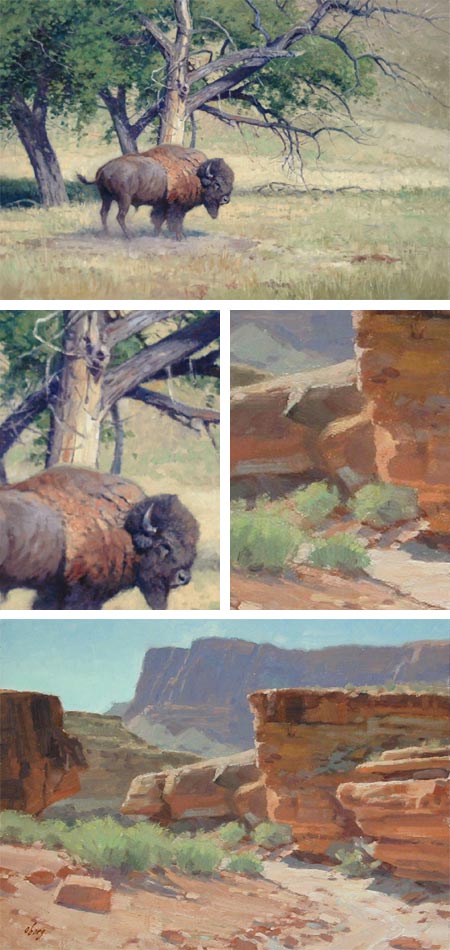
As much as I happen to enjoy paleontological reconstruction art, which is essentially paintings of no longer extant animals, I have to say that I usually don’t respond well to contemporary wildlife art.Too often it feels staged and artificial, and seems to lean on over-rendering and sentimentality in place of more solid artistic concerns. Of course there are plenty of exceptions to those (perhaps unfair) generalizations. Ralph Oberg is a case in point.
His paintings of landscapes in the western mountains of the the US and some of the larger wildlife of the area are fresh, painterly and immediate. The impression I had when I first encountered his work was that he was a landscape painter who happened to include animals, rather than a wildlife artist.
That impression was borne out when I read his biography. After attending Colorado State University on an art scholarship and studying at the Seibel School of Drafting in Denver, Oberg briefly worked in commercial illustration and then devoted himself to wildlife painting for ten years. He then became interested in plein air painting, and has dedicated himself to that practice for the past ten years, only recently reintroducing the study of animals into his work.
The result is a lively combination of plein air and alla prima techinque with a knowledge of animal anatomy and characteristics that come from long study.
Oberg uses an almost impressionistic application of paint that gives even his more finished studio canvases the feel of outdoor painting; and his wildlife subjects are rendered with the same painterly approach. Oberg’s years of plein air work have honed his sense of color and ability to suggest complex textures with an economy of brushwork.
His animals are represented naturalistically, incorporated into their settings rather than staged against a backdrop of landscape. Oberg avoids the overly dramatic poses of animals sometimes found in the genre, and incorporates them into his compositions as though they were as much a natural part of a landscape as rocks or trees; which, of course, they are.
Categories:
-
Wojtek Siudmak
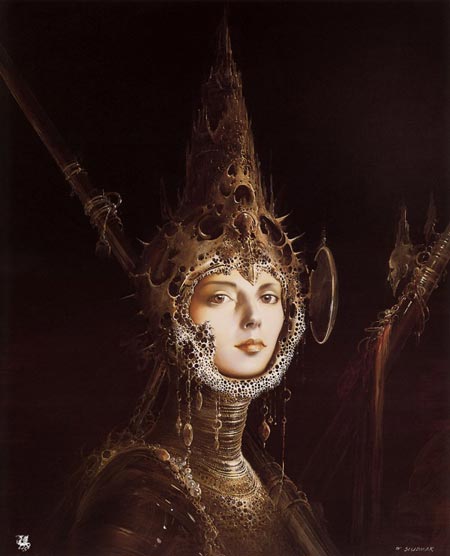
Wojtek Siudmak is contemporary Polish born artist who studied at the College of Plastic Arts and Adacemy of Fine Arts in Warsaw, and the École des Beaux-Arts in Paris. He now resides in France.Siudmak is a leading proponent of fantastic realism (sometimes called “magic realism”), a branch of fantastic art with one foot in classicism and the other in Surrealism. You can see both in his paintings, classical draftsmanship and technique in the service of free-wheelingly imaginative imagery. At times Daliesque, at others leaning toward Renaissance themes, Siudmak’s subjects swirl, morph, appear, disappear and fade from one image to another, occasionally revealing glimpses of hidden worlds.
Siudmak was associated with a group of artists, writers and filmmakers in Paris who resisted the currents of Modernism in the late 20th Century and became associated with the fantasy and science fiction illustration community. Siudmak’s paintings have been used for the covers of science fiction books, and he has actively illustrated others, including the Polish version of Frank Herbert’s Dune.
He has a web site with a gallery of both drawings and paintings, though I found the “pop up and close” routine a bit tiring. You may find it easier to browse his paintings on other sites like The Funny Web (2 pages) and Museum Syndicate (3 pages), but come back to Siudmak’s own site to go through his drawings, which are poorly represented elsewhere.
Note: sites should be considered mildly NSFW.
Categories:
-
Marie-Denise Villers (update)

A question from a reader prompted me to revisit my 2006 post on Marie-Denise Villers, a talented but little known French portrait painter whose “one-hit-wonder” claim to fame was that her painting, now called Young Woman Drawing (detail, above), was for some time attributed to Neo-classical master Jaques-Louis David (also here).The painting, which I believe is a self-portrait, shows a beautiful and intensely focused young woman staring directly at the viewer and drawing in a portfolio sheaf in her lap. Through an enigmatically cracked window pane behind her, what may be a pair of lovers confers on a railed walkway atop a wall. The painting is beautiful and striking when you see it in person, and it seemed unfortunate that there was little information on the artist or her other works at the time I was writing.
As the art resources on the Web are constantly being added to, I went looking to see if more information on Villers had cropped up in the three years since my post. The bad news is that there isn’t much more available on her. Apparently there just isn’t much information about her in general; though I did manage to find some links that I’ve added to the original post and listed below.
The good news is that the Metropolitan Museum of Art, which has the painting in its collection, has added a larger, more color-accurate image to their listing, as well as a zoomable version of the image, which makes is possible to see the painting in more detail if you can’t make it to the Met to see it in person. I’ve used it to show the detail image above; for a view of the entire painting, and more of my comments on it, see my previous post on Marie-Denise Villers.
The Met has also added the painting to their Heilbrunn Timeline of Art History and makes mention of Villers and her sister, Marie-Victoire Lemoine, who was also a painter, in their related article on Eighteenth-Century Women Painters in France.
I also found a few other tidbits, including a painting in a past auction from Sotheby’s, A Young Woman Seated by a Window, which also has a zoomable image; though this work seems less accomplished than the piece in the Met. (I don’t know how long this auction image will remain available.)
Categories:
-
Brian Despain (update)

Brian Despain’s world-weary and weather-beaten robots may be the “every robot” in all of us. At times active and engaged, at other times forlorn and seemingly lost, his dented and roughly textured copper-skinned automatons carry a darkly humorous portrayal of our own place amid the natural world.I first wrote about Brian Despain back in 2006, when I pointed out my admiration for his approach to texture and subtle use of a controlled palette, plus my basic fondness for his original take on most things robotic.
Despain’s work is currently on view in a show at the Roq La Rue Gallery in Seattle, Washington until December 5th, 2009. There is also a page devoted to Despain on the gallery’s site that includes a video interview with the artist.
Despain’s own web site has been redesigned and expanded since my last writing, and there are also new resources elsewhere, including a Facebook page.
You will find some larger images on this blog post about a 2008 show at Roq la Rue.
There is also an iPhone app featuring Despain’s art, that can be appreciated simply as a gallery or used as iPhone wallpaper images, AppShopper review here, and iTunes link here.
Categories:
-
Sotheby’s

If, like me, you find yourself frequently frustrated with the relatively low resolution images provided by many museums and fine art sites; and tire of the frustrating little zoom windows that they provide for a “close up”, I have a suggestion for a site that you may not have considered.This site has nice large images of museum quality art that happens to be changing hands. It is the Sotheby’s auction site.
Sotheby’s is a long established auction house through which some of the world’s most expensive (and notorious) art purchases have been transacted. Prior to their sales they post on their site previews of the items to be auctioned, in high enough resolution for potential buyers to take a look, and even bid online if inclined.
For those of us who can’t shell out a few million for the odd masterpiece here and there, the site is still a treasure trove of relatively high resolution images of terrific art.
You can’t pick and choose, of course; what’s up is what happens to be for sale, but I find it rare that I cannot check out an auction of art from the early 20th Century or earlier without encountering several pieces that make the visit worthwhile.
They currently list an auction of American Paintings, Drawings and Sculpture that is due to be auctioned in New York on December 3, 2009. It includes work by Everett Shinn, Jessie Wilcox Smith, Andrew Wyeth, Robert Henri, Childe Hassam, Thomas Hart Benton, Norman Rockwell, Mary Cassatt, Edward Redfield, Frederic Edwin Church, Thomas Moran, J.C. Leyendecker, Thomas Eakins, James Bama, Frederic Remington, and N.C. Wyeth, among others.
Click on “View E-Catalogue”, wait a few seconds for the pop-up window to populate with thumbnails, then maximize the window and scroll through the thumbnails to find what you like. Mouse over them to see the name of the piece and artist, and click to view the single piece. Then look for the “Zoom In” button below the image and use the plus sign to enlarge the image as large as it will go. The title block and zoom control can block part of the image, but you can get around that by moving your mouse to scroll.
Exit zoom and you can then use the next and previous buttons to move through the images, or use the navigation to return to the thumbnails.
The images are usually much larger than most encountered on the net, often large enough to see the brushstrokes quite nicely.
From the main pages you can choose “Explore Auctions” and find sales of old masters, 19th Century art, Russian painting, Impressionist and modern art and a variety of other auctions scheduled in locations across the world. There are several pages of auctions listed at any given time.
For any of them, click “Browse New E-Catalog” to get to the large images. There are also downloadable PDF catalogs for many of the auctions, but the images in them are not as large as those on the site.
Come back in a few weeks, and there will be another set of auctions to browse.
Do I see someone in the back raising their hand? Making a bid? No? A Question. “What about Christies?” you say.
Yes, Christie’s is the other high end art auction site, and you will find some wonderful pieces there as well, but their display is limited to the more common zoom in a box feature, albeit a larger one than usual. The Sotheby’s display is much nicer (though it’s certainly worthwhile browsing through the Christie’s lots).
So take a look through. You never know, you might find something you want to pick up for over the couch.
(Image above, with enlargement from full size image: The Courtship: J.C. Leyendecker; estimate: $30,000 – $50,000)
Categories:
-
Magic Highway, USA
 I’m fond of retro-futurism, the appreciation of past visions of the future; often the “future” in which we are currently living.
I’m particularly delighted with future visions rendered out in that wonderful ’50s & ’60s modern cartoon style that seems to be having a bit of a revival these days.
Disney’s Magic Highway, USA is a classic in the genre. Originally part of a TV program aired in 1958, it took off from visionary speculation about the U.S. Interstate Highway System, the construction of which had just been authorized two years prior.
The animation presaged some of the realistic aspects of that system, which had been championed by then-President Eisenhower as a national defense initiative. The animators then carried on into flights of imaginative fantasy about the future of automobile transportation.
It is at once naive, silly, fanciful, astute, ridiculous, clever and, at times, surprisingly predictive of things like rear-view cameras, digital dashboard read-outs (“onboard teletypes”) and the equivalent of GPS map displays.
Remember this is pre-Interstate Highway, pre-Jetsons, pre-space travel, pre-widespread commercial jet travel and produced at a time when computers as powerful as an iPhone took a up an entire room.
It is also remarkably insightful in the prediction of the de-centralization of urban areas into an idyllic version of contemporary suburban sprawl.
The animation and design work are a delight. Disney, both in animation and in their theme parks, often indulges in futurism, and this is one of the best examples from their animation studios.
Unfortunately, I don’t know of a source for the animation credits.
[Via Daring Fireball]
Categories:




Charley’s Picks
Bookshop.org
(Bookshop.org affilliate links; sales benefit independent bookshop owners; I get a small percentage to help support my work on Lines and Colors)

John Singer Sargent: Watercolors


Urban Sketching: Understanding Perspective


Charley’s Picks
Amazon
(Amazon.com affiliate links; sales go to a larger yacht for Jeff Bezos; but I get a small percentage to help support my work on Lines and Colors)
John Singer Sargent: Watercolors
Urban Sketching: Understanding Perspective