


Categories
- 3d CGI
- Amusements
- Animation
- Anime & Manga
- Art Materials
- Art Videos
- Blogroll
- Cartoons
- Color
- Comics
- Concept & Visual Dev.
- Creativity
- Digital Art
- Digital Painting
- Displaying Art on the Web
- Drawing
- Eye Candy for Today
- Gallery and Museum Art
- High-res Art Images
- Illustration
- Motion Graphics & Flash
- Museums
- Online Museums
- Outsider Art
- Painting
- Painting a Day
- Paleo Art
- Pastel, Conté & Chalk
- Pen & Ink
- Prints and Printmaking
- Reviews
- Sc-fi and Fantasy
- Sculpture & Dimensional
- Site Comments
- Sketching
- Storyboards
- Tools and Techniques
- Uncategorized
- Vector Art
- Videos & Podcasts
- Vision and Optics
- Watercolor and Gouache
- Webcomics
Archives
- June 2026
- May 2026
- April 2026
- March 2026
- February 2026
- January 2026
- December 2025
- November 2025
- October 2025
- September 2025
- August 2025
- July 2025
- June 2025
- May 2025
- January 2025
- December 2024
- November 2024
- October 2024
- September 2024
- August 2024
- June 2024
- April 2024
- March 2024
- February 2024
- January 2024
- December 2023
- November 2023
- October 2023
- September 2023
- August 2023
- July 2023
- May 2023
- April 2023
- March 2023
- February 2023
- January 2023
- December 2022
- November 2022
- September 2022
- August 2022
- July 2022
- June 2022
- May 2022
- April 2022
- March 2022
- February 2022
- January 2022
- December 2021
- November 2021
- October 2021
- September 2021
- August 2021
- July 2021
- June 2021
- May 2021
- April 2021
- March 2021
- February 2021
- January 2021
- December 2020
- November 2020
- October 2020
- September 2020
- August 2020
- July 2020
- June 2020
- May 2020
- April 2020
- March 2020
- February 2020
- January 2020
- December 2019
- November 2019
- October 2019
- September 2019
- August 2019
- July 2019
- June 2019
- May 2019
- April 2019
- March 2019
- February 2019
- January 2019
- December 2018
- November 2018
- October 2018
- September 2018
- August 2018
- July 2018
- June 2018
- May 2018
- April 2018
- March 2018
- February 2018
- January 2018
- December 2017
- November 2017
- October 2017
- September 2017
- August 2017
- July 2017
- June 2017
- May 2017
- April 2017
- March 2017
- February 2017
- January 2017
- December 2016
- November 2016
- October 2016
- September 2016
- August 2016
- July 2016
- June 2016
- May 2016
- April 2016
- March 2016
- February 2016
- January 2016
- December 2015
- November 2015
- October 2015
- September 2015
- August 2015
- July 2015
- June 2015
- May 2015
- April 2015
- March 2015
- February 2015
- January 2015
- December 2014
- November 2014
- October 2014
- September 2014
- August 2014
- July 2014
- June 2014
- May 2014
- April 2014
- March 2014
- February 2014
- January 2014
- December 2013
- November 2013
- October 2013
- September 2013
- August 2013
- July 2013
- June 2013
- May 2013
- April 2013
- March 2013
- February 2013
- January 2013
- December 2012
- November 2012
- October 2012
- September 2012
- August 2012
- July 2012
- June 2012
- May 2012
- April 2012
- March 2012
- February 2012
- January 2012
- December 2011
- November 2011
- October 2011
- September 2011
- August 2011
- July 2011
- June 2011
- May 2011
- April 2011
- March 2011
- February 2011
- January 2011
- December 2010
- November 2010
- October 2010
- September 2010
- August 2010
- July 2010
- June 2010
- May 2010
- April 2010
- March 2010
- February 2010
- January 2010
- December 2009
- November 2009
- October 2009
- September 2009
- August 2009
- July 2009
- June 2009
- May 2009
- April 2009
- March 2009
- February 2009
- January 2009
- December 2008
- November 2008
- October 2008
- September 2008
- August 2008
- July 2008
- June 2008
- May 2008
- April 2008
- March 2008
- February 2008
- January 2008
- December 2007
- November 2007
- October 2007
- September 2007
- August 2007
- July 2007
- June 2007
- May 2007
- April 2007
- March 2007
- February 2007
- January 2007
- December 2006
- November 2006
- October 2006
- September 2006
- August 2006
- July 2006
- June 2006
- May 2006
- April 2006
- March 2006
- February 2006
- January 2006
- December 2005
- November 2005
- October 2005
- September 2005
- August 2005
Relevant Blogs
Art, Painting & Sketch
- Gurney Journey
- Underpaintings
- Art and Influence
- Painting Perceptions
- Oil Painters of America
- Vasari Paint POV
- Flying Fox
- Urban Sketchers
- Bento (Smithsonian)
- Art Inconnu
- The Hidden Place
- Still Life
- Making a Mark
- The Art of the Landscape
- Exploring Color & Creativity
- Art Contrarian
- Artist A Day
- beinArt Surreal Art Collective
- Eye Level
- David Dunlop
- p.i.g.m.e.n.t.i.u.m
- CultureGrrl
- Joaquín Sorolla blog
- Artists in Pastel
“Painting a Day”
- A Painting a Day (Keiser)
- On Painting (Keiser)
- Julian Merrow-Smith
- Karen Jurick
- Jeffrey Hayes
- Carol Marine
- Abbey Ryan
- Daily Paintworks
Other Painting Blogs
- Virtual Gouache Land
- Neil Hollingsworth
- Marc Hanson
- Kevin Menck
- Marc Dalessio
- Larry Seiler
- Stapleton Kearns
- Colin Page
- Roos Schuring
- Hans Versfelt
- Titus Meeuws
- Régis Pettinari
- René Plein Air
- Belinda Del Pesco
- Robin Weiss
- Nathan Fowkes (Land Sketch)
- William Wray
- Frank Serrano
- Stephen Magsig
- Michael Chesley Johnson
- Twice a Week
- Sarah Wimperis
- Rob Adams
- Michael Cole Manley
- The Dirty Palette Club
- Mike Manley’s Draw!
Gallery Art & Illustration mix
Illustration
- Howard Pyle
- 100 Years of Illustration
- BibliOdyssey
- Illustration Art
- Today’s Inspiration
- Illustration Mundo
- Little Chimp Society
- Danny Gregory
- R D (John Martz
- Illustration Friday blog
- Monster Brains
- Illustrators & Illustrations (RU)
- Elwood H. Smith
- DaniDraws.com
- Designers Who Blog
- iSpot Blog
Sci-Fi & Fantasy
Illustration & Comics
Comics & Cartoons
- Comics Beat
- Robot 6
- Newsarama Blog
- Comic Vine
- Comics Alliance
- Forbidden Planet Int.
- Paolo Rivera
- Bolt City
- Flight
- Scott McCloud
- The Comics Journal
- Comixpedia
- Funnybook Babylon
- James Baker
- Middleton’s Sketchbook
- Boneville
- The Hotel Fred
- Paul Rivoche
- Daily Cartoonist
- Mad About Cartoons (William Wray)
- Digital Strips
Illustration & Concept
Animation & Concept
- Cartoon Brew
- Animation Blog
- Cold Hard Flash
- Concept Art World
- The CAB
- FY Concept Art
- Concept Ships
- Concept Robots
- John Nevarez
- Armand Serrano
- Marcos Mateu-Mestre
- all kinds of stuff (Kricfalusi)
- Yacin the faun (Man Arenas)
- Kelsey Mann
- Cre8tivemarks Blog
- Ice-Cream Monster Toon Cafe
- AAU Character & Creature Design
- AAU Animation Notes
- Articles and Texticles
Paleo & Scientific
Tools & Techniques
Other
Lists of Art Blogs
Art Image Resource Links
Historic Art Images
- Wikimedia Commons: Paintings
- Wikimedia Commons: Drawings
- The Athenaeum
- WikiArt (WikiPaintings)
- Google Art Project: Artists
- Google Art Project: Collections (Museums)
- ArtCyclopedia
- Web Gallery of Art
- Art Renewal Center
- Web Gallery of Impressionism
Auction Consolidation sites
Auction sites
- Sotheby’s
- Bonham’s
- Christies
- Heritage Auctions: Fine Art
- Heritage Auctions: Illustration
- Freeman’s Auctions
- Bukowskis
- Shannon’s
Image Search
Reverse Image Search (search by image)
- Tin Eye
- RevImg
- Google Image Search (camera icon)
- Bing Image Search (camera icon)
Promoting some friends and some clients of my website design business
- Twin Willows T’ai Chi studio in Wilmington DE. Taiji classes with Bryan Davis.
- Ray Hayward, Inspired Teacher of T’ai Chi ( Taiji ) in Minneapolis, Founder of Mindful Motion Tai Chi Academy
- OldHead Tattoo studio and Art Gallery in Wilmington DE. Tattoos and paintings by Bruce Gulick
- Sharon Domenico Art, pet portrait oil paintings
- Platinum Paperhanging, wallpaper hanging, Main Line and Philadelphia, PA
- Lisa Stone Design, interior designer, Main Line and Philadelphia, PA
- Studio12KPT, original art, prints, calendars and other custom printed items by Van Sickle & Rolleri
-
Howard Pyle

If we look at art over the course of time, we see an intricate web of the influences of one artist on another; influences that, in their crossings and re-crossings, eventually weave the tapestry of styles that we call art history.Howard Pyle, who is often rightly called “The Father of American Illustration”, is one of those remarkable points within that tapestry where the threads converge, the design is pulled together, reworked and renewed and influence radiates out in fresh patterns.
Pyle revolutionized illustration, both through his own work, which introduced a new level of drama, action and visual excitement to what was largely a staid and restrained art form at the time, and through his influence on his students, who included some of the finest illustrators ever to put lines or colors on a flat surface. Collectively, Pyle and his students helped usher in the “Golden Age of American Illustration”.
Pyle’s impact on the art form known as illustration is hard to overstate. His Durer-influenced pen and ink illustrations are among the finest ever done. He was one of the first illustrators to embrace and understand the new four-color printing process, and his paintings are remarkable for their ground-breaking color, dramatic compositions and emotional impact.
 Among Pyle’s most impressive accomplishments is the list of students that he nurtured, encouraged and influenced in his role a teacher, both at the Drexel Institute of Arts and Sciences in Philadelphia, (now Drexel University), and at his own school in Delaware and plein air sessions in nearby Chadds Ford, Pennsylvania. The list is resplendent with great illustrators like N.C. Wyeth, Maxfield Parrish, Frank Schoonover, Harvey Dunn, Phillip Goodwin, Stanley Arthurs and many others.
At a time when it was highly unusual for women to train in the commercial field of illustration, over forty of Pyle’s 100 or so students were women, and included such amazing illustrators as Elizabeth Shippen Green, Jessie Wilcox Smith and Violet Oakley. Green, Smith and Oakley collectively came to be known as “The Red Rose Girls”, and are sure to be the subjects of future posts as they are among my favorites.
Pyle’s influence extended through his students to their students, and well beyond. The great Dean Cornwell, for example, was a student of Pyle’s student Harvey Dunn. Even though the art establishment and upper class snobs were already starting their scurrilous campaign to denigrate illustration as somehow inferior to “fine art” (a bit of class warfare that continues to this day), Pyle’s influence was felt in other artist circles as well. Vincent van Gogh collected clippings of Pyle’s illustrations from Harper’s.
Rather than try to write an entire book here, I’ll provide some links below to Pyle information and resources on the web. There are also some wonderful print resources of Pyles work. A good place to start might be Visions of Adventure: N. C. Wyeth and the Brandywine Artists by Walt Reed. Although it is not about Pyle specifically and features his brilliant student, N.C. Wyeth, more prominently, it is a terrific book that serves as a good introduction to the Brandywine School, puts Pyle in context and includes wonderful images by Pyle, Wyeth, Dunn, Schoonover, Gooodwin and Cornwell.
In the context of my point about Pyle’s place in the history of illustration, I would recommend a couple of other excellent books that include good sections on Pyle as well as showcasing many of the other greats of Illustration: America’s Great Illustrators and A treasury of the great children’s book illustrators, both by Susan E Meyer.
Pyle was an accomplished writer as well as an illustrator. Look for the wonderfully inexpensive Dover Books editions of the books that Pyle both wrote and illustrated in his luxurious pen and ink style: The Story of the Champions of the Round Table, The Story of Sir Launcelot and His Companions, Otto of the Silver Hand, The Story of the Grail and the Passing of Arthur, and many others including The Wonder Clock, from which the pen and ink drawing above is taken.
Pyle was born and lived most of his life in Wilmington, Delaware, not far from where I grew up, so I’ve been exposed to his wonderful illustrations for almost as long as I remember. Overall, the beneficiaries of Pyle’s influence came to be known as “The Brandywine School”, after the Brandywine Valley and its creek, which runs through Chadds Ford and into Wilmington. (See my post on N.C. Wyeth’s son, Andrew Wyeth.)
I’ve been visiting his paintings and drawings in the Delaware Art Museum, which houses the largest single collection of Pyle’s work, and, to a lesser extent, in the Brandywine River Museum, for so long that I’m sometimes tempted to take him for granted.
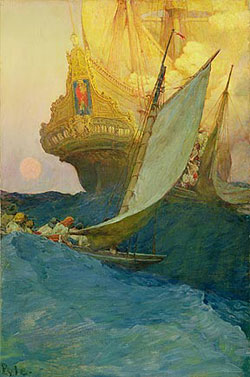
But every time I walk into the Delaware Art Museum and stand in front of Marooned, or Attack on a Galleon (above, left), I can feel those invisible strands of Pyle’s influence reaching out through generations of artists, and I’m reminded that you simply can’t take Howard Pyle for granted.
Categories:
-
On the Couch: Cartoons from The New Yorker

Yesterday, May 6, 2006, marked the 150th anniversary of the birth of Sigmund Freud.For at least 80 of those years, since 1927, cartoonists at The New Yorker have been making fun of psychoanalysis with the familiar image of the analyst’s couch, therapist and diploma that has become more of a cartoon cliché anything except the desert island.
In honor of the occasion, and in celebration of the 80 years of wonderful mockery, the Museum of the City of New York, a city linked with the image of psychoanalysis if there ever was one, has mounted an exhibition of 75 of those cartoons entitled On the Couch; Cartoons from The New Yorker, which runs to July 23, 2006.
The Cartoon Bank has published a book of psychoanalysis cartoons, with the same title, that also acts as a catalog of the exhibition. The book is only available at the museum or through the Cartoon bank site.
There isn’t an online version or excerpts from the exhibit, but you can create your own virtual exhibit by going to the Cartoon Bank, the New Yorker’s online cartoon division (and subject of one of my first posts), and doing a search in Cartoon Prints for psychiatrist and Freud.
Some of them are as clichéd as the image and subject, but some, like the cartoon by the great Gahan Wilson, above, are “heads above” the rest.
Categories:
-
Illustration Friday
 OK artists, illustrators cartoonists and painters, here’s where you stand: you have 6 more days to do “fat”.
“Huh?” you say, staring at me in wide-eyed perplexity, “Say what?”. “Fat”, I say, “6 more days to do ‘fat’, or at least your interpretation of fat”. You stare at me again like I had spoken in an obscure dialect of Siberian Eskimo, and I casually add: “Illustration Friday, it’s this week’s topic on Illustration Friday.”
“Don’t know about Illustration Friday?”, I say, limbering my typing knuckles in anticipatory blogger position, “Well, let me tell you.”
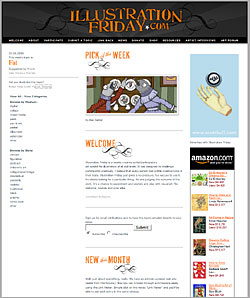
Illustration Friday is an idea, a word, more specifically a topic, served up once a week on the Illustration Friday website as an excuse or focal point for the creation of illustrations by hundreds of participants across the web. There is no client, no art director, no restrictive format demands or requirements for medium, size or proportions. It’s just the illustrator and the topic, dancing the dance of inspiration.
As artists, and particularly illustrators working with clients, we can easily find our joy in that dance dampened by the requirements, restrictions and editorial/art director conflicts that hang on it like a sour-mouthed, puritan chaperone. Deadlines, revisions, space restrictions, intrusive type and the stress of doing business can deflate our little balloon of joy in the act of creation in short order, and the idea of sitting down and doing an illustration simply for our own benefit, for the fun of it, seems remote.
Illustration Friday provides an excuse, a time and a topic for exercising our creative muscles in a little jaunt free of the usual restrictions. The site consists mainly of a topic, like “Fat”, Insect”, “Escape”, “Summer”, “Broken”, “Ancient” or “Lost”, and the artists who choose to participate create an illustration of their interpretation of that topic, in any size, proportion or medium, and post it to their own web site or blog. They then submit the location of that illustration to the Illustration Friday site through a simple form, and the links to the illustrations are listed on the Illustration Friday site, to be browsed through by other artists and interested art fans ’round the web.
There is a simple set of instructions on how to participate.
Everything is designed to encourage creativity, rather than suppress it. The topics themselves are usually submitted by participants, and the ones selected tend to be adjectives more often than nouns in an attempt to suggest possibilities other than the literal. “Fat”, for example doesn’t have to be obese individuals, it can be a steak dinner, a thick pencil, a large tree trunk, a thick to thin line or a caricature of Oliver Hardy, with or without his partner. Freeing your imagination is the whole point.
Illustration Friday is the inspiration of illustrator Penelope Dullaghan. Aided on the tech side by Brianna Privett, Penelope maintains the site and has just given it a major workover and expansion.
It now allows you to view the submitted illustrations by medium or by style rather than the previous simple list by number. Artists can now submit a thumbnail image, although most just use the same thumbnail to identify themselves, rather than providing a thumbnail of each work. It’s still useful for those browsing the list to pick out illustrations they’d like to check out.
The style, approach and level of artistic accomplishment can vary widely, but that’s a nice result of the process. This is a great place for fledgling artists to stretch their artistic wings, and put their work out for others to see.
The site also includes a list of artist resources, artist interviews and a discussion forum.
When browsing, clicking on the “Link Viewer” (just under this week’s topic) allows you to see the entries in a frame next to the list of links so you don’t have to keep opening and closing windows. Very nice feature.
Illustration Friday is one of the most widely linked sites I’ve seen on art related sites and blogs. Rarely do I encounter a site with a link to lines and colors that doesn’t also have one to Illustration Friday. So maybe I’m not telling you anything new, but consider it another reminder.
Yes, I know I’m telling you about “Illustration Friday” on a Saturday. I wanted you to see the process of the topic building in its early stages but with enough entries for the new topic up for you to get a good idea of how it works. The list of links will build throughout the week.
Readers and art appreciators can check it out as new illustrations are added daily. Artists, get out your pencils, pens, chaulks, brushes, and Wacoms and see what you can do with “Fat”. You have 6 days until the next Illustration Friday topic is posted.
Enjoy!
Categories:
-
Free Comic Book Day!

Update: This year’s Free Comic Book Day! is past, but you may still find this post worth reading, both for my suggestions for why comic books may be more interesting that you suspect, and my introduction to comic book specialty shops.Here are some photos from the event at Captain Blue Hen in Delaware from the Draw! blog by Mike Manley, veteran comics and storyboard artist, who was one of the participating comics professionals.
—
Tomorrow is Free Comic Book Day! Hooray!
If you don’t know much about comic books, and are even slightly curious but perhaps put off by the thought of being conspicuous in a small comic shop filled with geeky adolescents discussing the nuances of how batman’s cowl should fit his jaw, Saturday is your day to check out this whole comics phenomenon without feeling uncomfortable or out of place.
With the cooperation of comic book publishers, distributors, artists, writers, and comic book specialty shops across the country, Saturday, May 6th, 2006 is the 5th annual event offering free comics to all visitors at participating stores. The smarter, more involved shops will be doing their best to turn the occasion into a local media worthy event.
Publishers large and small are publishing special titles just for the event and many shops will be giving away additional titles as well. Everyone gets at least one free comic, sometimes more, depending on the shop and the number of people attending the event.
If you don’t know where a local comic book specialty shop is, the Free Comic Book Day web site features a Zip code locator for participating shops. Or check the weekend events listing of your local paper and see if there are Free Comic Book Day events listed anywhere.
This is a great opportunity to visit a comic shop and see why so many people find this medium so fascinating. You can just wander around and look through the colorful titles and be dazzled at the array of drawings and colors, some of it horrible, much of it mediocre, but some of it absolutely wonderful (much like books, movies, music or any other medium of expression).
Why you should check out comic books
I can suggest many reasons to check out comic books. You should check out comic books because they are different from newspaper comics. They have a much longer format for telling more involved and fully developed stories. You should check out comics because they are a unique American art form and the singular combination of words and pictures telling a story. You should check out comics because comics are the only medium involving stories told with images in which you, the reader, set your own pace.
Movies and TV come at you at the speed the director sets; but in comics, like novels, you can read at your own pace, stop and contemplate, pick them up or put them down at will. Comics give you more visuals to work with than books, but leave more to your own imagination than movies. Best of all, the medium of comics is a synthesis of words and drawings that has its own language and method of expression, and can tell stories in ways no other medium can.
If you don’t know what to look at, ask the proprietor. Most comic shop owners are friendly and knowledgeable about comics and will understand if you say “I don’t like superheroes.” and will be able to recommend other options. Most shops will have many items beyond the usual superhero fare that most people associate with comic books in America. Look for wonderful reprints of classic newspaper comics and “graphic novels”, which are stories or collections in trade paperback format (which I feel is the best way to buy and read comics).
Ask about “independent” publishers or “small publishers”. The small publishers are where the most varied and interesting work is being done. The best shops will also have European comic albums and Japanese Manga (just a fancy word for Japanese comics) that will have very different stories and art than American comics.
An introduction to comic book specialty shops
Most specialty comics shops have a few common characteristics. Almost all of them will have rack of new comics, released during the current week, and most will have several racks of recent back issues from the previous few months, and then bins or boxes of older comics, often in plastic bags with cardboard backings, for the benefit of collectors. The back issues in bags are often marked up in price as collectables.
Browsing through anything not in plastic bags is usually fine. If it’s not, you’re in the wrong comic book shop. If you walk in and all of the comics are in plastic bags, including the new comics released this week, choose another shop. These shops treat comics more like collectable dolls than books to be read and enjoyed. However, they’re not as likely to participate in this event.
In the larger shops, there can be so many titles and genres that it can seem overwhelming. Don’t be reluctant to tell the proprietor that you don’t know anything about comics and are just curious. They will be delighted with your interest and more than happy to make helpful suggestions. Like good bookstore owners, they will also be happy to leave you to browse if that is your preference.
If you tell them what kind of books you like (drama, humor, mystery, romance, science fiction, historical novels), chances are they can recommend a comic book or trade paperback in a genre you like. If the shop has only superhero comics, try another before judging the medium by one experience. (Some smaller shops have such a limited budget, and/or imagination, that they only stock the best selling superhero titles and not much else; look for a larger shop.) Despite my recent rant about the dominance of superhero comics in the market, there are many alternatives out there (the Flight anthologies I mentioned in that same post are a prime example).
You’ll find a range of Free Comic Book Day participation at various shops. Captain Blue Hen Comics in Newark, Delaware is a shop in my area that goes all out for Free Comic Book Day, with signings by comics artists and writers, door prizes and events, costumed characters, charitable contributions, reciprocal promotion with the local library (present your library card an get an additional free comic, contribute 50 cents to the library restoration fund and get another), and more. It’s practically a town fair in itself.
Checking out comics is also sometimes a way to stumble across very unique stores. I buy my comics at a store in Delaware called Between Books, that features a remarkable combination of comics, graphic novels, science fiction, fantasy, horror and mystery books, adventure gaming, animated videos, manga, anime and a range of art books and children’s books hand picked by the owner. I would never have even known such a unique place existed had I not been curious about comics.
You won’t know what you’re missing until you check it out, and what better time to do that than Free Comic Book Day? At the very least, drop by and pick your your free comic book. Why not?
Categories:
-
Roger Dean

Technology giveth and technology taketh away.A few years before our wonderful digital art tools came into use, illustration lost one of its more prominent vehicles as LP records were replaced by digital audio CDs, and the golden age of album cover art drew to a close.
Yes, there is still nice work being done in CD cover design, but the glorious 12×12″ canvas of the LP record jacket was one of the most expansive areas an illustrator could have to work with, larger than most magazine covers, and its replacement was less than a fifth that size.
At the height of that wonderful period of album cover art, UK artist Roger Dean come to prominence as one of the most imaginative and popular artists working in the field. He did album covers for a number of bands, but is most closely linked with the progressive-rock band Yes. In fact, with the possible exception of the Pink Floyd covers designed by the Hipgnosis design studio, I can’t think of a more prominent association between a visual artist and a musician or group.
Dean’s work is often referred to as being surreal, but I’ve always thought of his imagined landscapes, with their muted colors, graceful curvilinear forms, wonderfully textured rocks and floating islands, as flights of fancy. I see little evidence of the psychological drama of true Surrealism. Dean, in fact, has said that he thinks of himself as a landscape painter.
Dean works primarily in watercolor and gouache and sometimes adds ink, crayon and even collage to achieve his effects of color and texture. There were two compilations of his work, now out of print but possibly available through eBay, Amazon or used book sites: Views, and Magnetic Storm. Dean has also released a number of calendars featuring his work over the years, the latest editions of which should still be available.
There are also several books on great album cover art including a series co-cuthored by Roger Dean; the first volume is Album Cover Album One (Album Cover Series) co-authored by Hipgnosis and Roger Dean.
Dean’s site has a store with prints and other items, including English Bone China mugs, (not your typical art reproduction mugs).
I’ve supplemented the link to Dean’s site below with an unofficial site that has larger reproductions of his work that give you a much better appreciation for his style, and in particular, his use of texture.
Like many artists, the gallery images on his official site are too small to give a real feeling for his work (meant to be reproduced nice and big on 12″ album covers, remember), perhaps with the thought that larger ones could be used for unauthorized reproduction.
However, as I often point out to artists who get overly concerned with image size and watermarks and other issues about preventing their images from being “stolen” off the web, if you have any images in print (you remember print, that other information technology), anyone with a $60 scanner can make higher resolution copies of your work than you’ll ever post to the web.
Technology giveth and technology taketh away.
Categories:
-
Edmund Tarbell

Regular readers of this blog will know that I have a particular fondness for painters who combine the light and color, painterly approach and immediacy of the Impressionists with the solid foundation and draughtsmanship of realism.Examples would include John Singer Sargent, Gustav Calliebotte, Joaquin Sorolla and Anders Zorn. To that partial list, I would add many of the “American Impressionists”, and in particular Edmund Charles Tarbell.
In addition to painting landscapes and interiors, Tarbell was an illustrator and a portrait painter. He was also an influential teacher at the Boston Museum School, but the impact of his approach to painting extended to many of his contemporary artists and subsequent generations of American painters working in the Impressionist style. His influence on painting in Boston was so dramatic at one point that many of those who followed his teaching and methods were called “Tarbellites”, and the style he exemplified and led came to be known as “The Boston School”.
Tarbell’s plein air paintings of garden scenes and women in fine dresses with parasols strolling paths or relaxing in boats on sun-dappled waters are as rich with splashes of pure pigment and the dazzling play of light and shadow as many of the French Impressionist canvasses. However, Tarbell usually kept shy of actually exploding his image into the flurry of separate brushstrokes that Monet would use at the extremes of his style.
As much as I like his bright exterior scenes, it is Tarbell’s darker, more subtle paintings of room interiors that contain the real magic for me. At times they are an obvious exploration the compositions of Vermeer, showing women seated at tables, surrounded by objects like vases and paintings, immediately in front of a window that bathes them in light, like Girl Reading, Girl Mending or Girl Crotcheting.
My favorites, though, are interiors in which there is a longer view of a room, with light spilling in from windows and washing over polished wood furniture and floors, as in Mother and Mary (above).
His painting Across the Room looks as though it belongs in a series with similar “more floor than room” compositions by Degas and Caillebotte.
It’s difficult to tell how rich and extraordinary these paintings are from small reproductions on the web. I had the opportunity to see a wonderful traveling exhibit of Tarbell’s work titled Impressionism Transformed – The Paintings of Edmund C. Tarbell, organized by the Currier Museum of Art, that visited the Delaware Art Museum, and then the Terra Museum of American Art, in 2002.
There is a catalog from the exhibition that is very nicely done, relatively inexpensive and serves as a good introduction to his work. There is also a nice volume titled Edmund C. Tarbell: Poet of Domesticity by Laurene Buckley.
The painters referred to as American Impressionists are often thought of as “second string”, merely followers of the “real” Impressionists. In fact, they were simply painters who were influenced by the French movement, and adopted some characteristics of the style they admired into their own unique explorations. No one exemplifies this more than Edmund Tarbell.
Categories:




Charley’s Picks
Bookshop.org
(Bookshop.org affilliate links; sales benefit independent bookshop owners; I get a small percentage to help support my work on Lines and Colors)

John Singer Sargent: Watercolors


Urban Sketching: Understanding Perspective


Charley’s Picks
Amazon
(Amazon.com affiliate links; sales go to a larger yacht for Jeff Bezos; but I get a small percentage to help support my work on Lines and Colors)
John Singer Sargent: Watercolors
Urban Sketching: Understanding Perspective