


Categories
- 3d CGI
- Amusements
- Animation
- Anime & Manga
- Art Materials
- Art Videos
- Blogroll
- Cartoons
- Color
- Comics
- Concept & Visual Dev.
- Creativity
- Digital Art
- Digital Painting
- Displaying Art on the Web
- Drawing
- Eye Candy for Today
- Gallery and Museum Art
- High-res Art Images
- Illustration
- Motion Graphics & Flash
- Museums
- Online Museums
- Outsider Art
- Painting
- Painting a Day
- Paleo Art
- Pastel, Conté & Chalk
- Pen & Ink
- Prints and Printmaking
- Reviews
- Sc-fi and Fantasy
- Sculpture & Dimensional
- Site Comments
- Sketching
- Storyboards
- Tools and Techniques
- Uncategorized
- Vector Art
- Videos & Podcasts
- Vision and Optics
- Watercolor and Gouache
- Webcomics
Archives
- September 2026
- August 2026
- July 2026
- June 2026
- May 2026
- April 2026
- March 2026
- February 2026
- January 2026
- December 2025
- November 2025
- October 2025
- September 2025
- August 2025
- July 2025
- June 2025
- May 2025
- January 2025
- December 2024
- November 2024
- October 2024
- September 2024
- August 2024
- June 2024
- April 2024
- March 2024
- February 2024
- January 2024
- December 2023
- November 2023
- October 2023
- September 2023
- August 2023
- July 2023
- May 2023
- April 2023
- March 2023
- February 2023
- January 2023
- December 2022
- November 2022
- September 2022
- August 2022
- July 2022
- June 2022
- May 2022
- April 2022
- March 2022
- February 2022
- January 2022
- December 2021
- November 2021
- October 2021
- September 2021
- August 2021
- July 2021
- June 2021
- May 2021
- April 2021
- March 2021
- February 2021
- January 2021
- December 2020
- November 2020
- October 2020
- September 2020
- August 2020
- July 2020
- June 2020
- May 2020
- April 2020
- March 2020
- February 2020
- January 2020
- December 2019
- November 2019
- October 2019
- September 2019
- August 2019
- July 2019
- June 2019
- May 2019
- April 2019
- March 2019
- February 2019
- January 2019
- December 2018
- November 2018
- October 2018
- September 2018
- August 2018
- July 2018
- June 2018
- May 2018
- April 2018
- March 2018
- February 2018
- January 2018
- December 2017
- November 2017
- October 2017
- September 2017
- August 2017
- July 2017
- June 2017
- May 2017
- April 2017
- March 2017
- February 2017
- January 2017
- December 2016
- November 2016
- October 2016
- September 2016
- August 2016
- July 2016
- June 2016
- May 2016
- April 2016
- March 2016
- February 2016
- January 2016
- December 2015
- November 2015
- October 2015
- September 2015
- August 2015
- July 2015
- June 2015
- May 2015
- April 2015
- March 2015
- February 2015
- January 2015
- December 2014
- November 2014
- October 2014
- September 2014
- August 2014
- July 2014
- June 2014
- May 2014
- April 2014
- March 2014
- February 2014
- January 2014
- December 2013
- November 2013
- October 2013
- September 2013
- August 2013
- July 2013
- June 2013
- May 2013
- April 2013
- March 2013
- February 2013
- January 2013
- December 2012
- November 2012
- October 2012
- September 2012
- August 2012
- July 2012
- June 2012
- May 2012
- April 2012
- March 2012
- February 2012
- January 2012
- December 2011
- November 2011
- October 2011
- September 2011
- August 2011
- July 2011
- June 2011
- May 2011
- April 2011
- March 2011
- February 2011
- January 2011
- December 2010
- November 2010
- October 2010
- September 2010
- August 2010
- July 2010
- June 2010
- May 2010
- April 2010
- March 2010
- February 2010
- January 2010
- December 2009
- November 2009
- October 2009
- September 2009
- August 2009
- July 2009
- June 2009
- May 2009
- April 2009
- March 2009
- February 2009
- January 2009
- December 2008
- November 2008
- October 2008
- September 2008
- August 2008
- July 2008
- June 2008
- May 2008
- April 2008
- March 2008
- February 2008
- January 2008
- December 2007
- November 2007
- October 2007
- September 2007
- August 2007
- July 2007
- June 2007
- May 2007
- April 2007
- March 2007
- February 2007
- January 2007
- December 2006
- November 2006
- October 2006
- September 2006
- August 2006
- July 2006
- June 2006
- May 2006
- April 2006
- March 2006
- February 2006
- January 2006
- December 2005
- November 2005
- October 2005
- September 2005
- August 2005
Relevant Blogs
Art, Painting & Sketch
- Gurney Journey
- Underpaintings
- Art and Influence
- Painting Perceptions
- Oil Painters of America
- Vasari Paint POV
- Flying Fox
- Urban Sketchers
- Bento (Smithsonian)
- Art Inconnu
- The Hidden Place
- Still Life
- Making a Mark
- The Art of the Landscape
- Exploring Color & Creativity
- Art Contrarian
- Artist A Day
- beinArt Surreal Art Collective
- Eye Level
- David Dunlop
- p.i.g.m.e.n.t.i.u.m
- CultureGrrl
- Joaquín Sorolla blog
- Artists in Pastel
“Painting a Day”
- A Painting a Day (Keiser)
- On Painting (Keiser)
- Julian Merrow-Smith
- Karen Jurick
- Jeffrey Hayes
- Carol Marine
- Abbey Ryan
- Daily Paintworks
Other Painting Blogs
- Virtual Gouache Land
- Neil Hollingsworth
- Marc Hanson
- Kevin Menck
- Marc Dalessio
- Larry Seiler
- Stapleton Kearns
- Colin Page
- Roos Schuring
- Hans Versfelt
- Titus Meeuws
- Régis Pettinari
- René Plein Air
- Belinda Del Pesco
- Robin Weiss
- Nathan Fowkes (Land Sketch)
- William Wray
- Frank Serrano
- Stephen Magsig
- Michael Chesley Johnson
- Twice a Week
- Sarah Wimperis
- Rob Adams
- Michael Cole Manley
- The Dirty Palette Club
- Mike Manley’s Draw!
Gallery Art & Illustration mix
Illustration
- Howard Pyle
- 100 Years of Illustration
- BibliOdyssey
- Illustration Art
- Today’s Inspiration
- Illustration Mundo
- Little Chimp Society
- Danny Gregory
- R D (John Martz
- Illustration Friday blog
- Monster Brains
- Illustrators & Illustrations (RU)
- Elwood H. Smith
- DaniDraws.com
- Designers Who Blog
- iSpot Blog
Sci-Fi & Fantasy
Illustration & Comics
Comics & Cartoons
- Comics Beat
- Robot 6
- Newsarama Blog
- Comic Vine
- Comics Alliance
- Forbidden Planet Int.
- Paolo Rivera
- Bolt City
- Flight
- Scott McCloud
- The Comics Journal
- Comixpedia
- Funnybook Babylon
- James Baker
- Middleton’s Sketchbook
- Boneville
- The Hotel Fred
- Paul Rivoche
- Daily Cartoonist
- Mad About Cartoons (William Wray)
- Digital Strips
Illustration & Concept
Animation & Concept
- Cartoon Brew
- Animation Blog
- Cold Hard Flash
- Concept Art World
- The CAB
- FY Concept Art
- Concept Ships
- Concept Robots
- John Nevarez
- Armand Serrano
- Marcos Mateu-Mestre
- all kinds of stuff (Kricfalusi)
- Yacin the faun (Man Arenas)
- Kelsey Mann
- Cre8tivemarks Blog
- Ice-Cream Monster Toon Cafe
- AAU Character & Creature Design
- AAU Animation Notes
- Articles and Texticles
Paleo & Scientific
Tools & Techniques
Other
Lists of Art Blogs
Art Image Resource Links
Historic Art Images
- Wikimedia Commons: Paintings
- Wikimedia Commons: Drawings
- The Athenaeum
- WikiArt (WikiPaintings)
- Google Art Project: Artists
- Google Art Project: Collections (Museums)
- ArtCyclopedia
- Web Gallery of Art
- Art Renewal Center
- Web Gallery of Impressionism
Auction Consolidation sites
Auction sites
- Sotheby’s
- Bonham’s
- Christies
- Heritage Auctions: Fine Art
- Heritage Auctions: Illustration
- Freeman’s Auctions
- Bukowskis
- Shannon’s
Image Search
Reverse Image Search (search by image)
- Tin Eye
- RevImg
- Google Image Search (camera icon)
- Bing Image Search (camera icon)
Promoting some friends and some clients of my website design business
- Twin Willows T’ai Chi studio in Wilmington DE. Taiji classes with Bryan Davis.
- Ray Hayward, Inspired Teacher of T’ai Chi ( Taiji ) in Minneapolis, Founder of Mindful Motion Tai Chi Academy
- OldHead Tattoo studio and Art Gallery in Wilmington DE. Tattoos and paintings by Bruce Gulick
- Sharon Domenico Art, pet portrait oil paintings
- Platinum Paperhanging, wallpaper hanging, Main Line and Philadelphia, PA
- Lisa Stone Design, interior designer, Main Line and Philadelphia, PA
- Studio12KPT, original art, prints, calendars and other custom printed items by Van Sickle & Rolleri
-
Shaun Tan on InFrame.tv

InFrame.tv, a video podcast out of Melbourne, Australia with a focus on arts, design and culture, has a nicely done segment on multi-talented illustrator and author Shaun Tan, who I wrote about previously here and here.In it, Tan talks about the adaptation of one of his books, The Lost Thing (images at top) into a CGI animated short feature.
The animated short is being produced by Passion Pictures Australia, and is set for release late next year. There is a page about the project on Tan’s site.
Incidentally, since my last post about Shaun tan, I picked up a copy of another of his books, The Arrival, and it is absolutely wonderful, even more beautiful than the preview images would lead you to believe. This wordless narrative is a story that combines down to earth emotional images with brilliantly imaginative flights of visual fancy. Drawn entirely in pencil and printed in various sepia tones, it’s one of the most delightful “graphic novels” I’ve seen in recent years.
I now have The Lost Thing on my list, and I’m looking forward to seeing the animated adaptation, particularly because of Tan’s intimate involvement with the production.
[Via Drawn!]
Categories:
-
Genetic Programming: Evolution of Mona Lisa

Trial and error.What artist has not at some point resorted to “I’ll just try this and see if it looks better.“?
You might say that, in light of Darwin’s model of natural selection, nature itself does the same: make a genetic mutation or two, or a billion, and see what works.
Swedish programmer Roger Alsing has created a playful experiment in “genetic programming” applied to image making, in which he wrote a small program for rendering 50 translucent polygons into an image area.
He set it to mutate slightly with each iteration, so that each pass of the program produces a different distribution of the polygons (the “genetic mutation”).
The fact that the polygons are translucent allows for many smaller subtle shapes within the composition, produced by overlapping areas of color, like laying an area of yellow glaze over both blue and green shapes in an oil painting.
At the end of each rendering sequence, the program uses a “fitness function”, basically a small routine to compare the resultant image pixel by pixel with a target image, in this case an image of the Mona Lisa.
Based on the “fitness” of the image, the program keeps either the new “dna” or the existing “dna”, whichever is more like the target, as the basis of the next mutation and iteration.
Trial and error. Survival of the fittest.
There is a selection of images on Alsing’s blog showing various renders, from which I’ve pulled a few representative samples, above. (For those who are programmatically inclined, there is also a faq with some of the basics.)
Under each of the sample images is a filename that shows the number of times the program had to run to reach that particular image.
The one at bottom-right shows 904,314 incidences of “I’ll just try this and see if it looks better“.
[Via Kottke]
Categories:
-
Albert Edelfelt
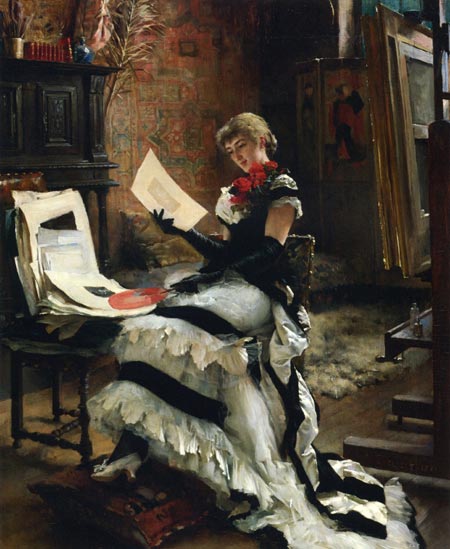
Albert Edelfelt was born to a Swedish family living in Finland in the mid 19th Century.He found art training resources limited at the Imperial University in Helsinki, and went to the Antwerp Academy of Art to study historical painting for six months and then moved to Paris, where he found his artistic horizons broadened.
He was one of the first Finnish artists to receive international recognition; he associated with famous artists and hung out with the Russian Czars and their families when they ruled Finland.
He painted historical, romantic and religious works but was most known for his portraits, in particular his portrait of Louis Pasteur is well-known.
He was also an advocate of plein air landscape painting. Though he encountered Jules Bastien-Lepage, an influential advocate of plein air painting, while studying in Paris, he only painted one major outdoor work during his stay there.
Edelfelt was undoubtedly influenced by the avant garde painters he encountered in the Paris galleries and cafes, but remained strongly influence from older masters like Valazquez and Goya.
His later work reminds me in a many ways of the American Impressionists, combining the bright color and free brushwork of the French Impressionists with a solid framework of Academic fundamentals.
I came across Edelfelt through a pair of excellent articles (here and here) on Michael Hirsh’s Articles & Texticles, as part of his wonderful series Parading My Ignorance, or Painters I should Have Known About.
After searching for Edelfelt resources on the web, Hirsh’s articles remain the best source on this exceptional artist and his work, including many preliminary studies, along with the finished paintings to which they apply. I’ve listed some additional resources below.
Edelfelt’s work is featured in an exhibit currently running at the National Gallery of Ireland called Northern Stars and Southern Lights: The Golden Age of Finnish Art 1870-1920 until February 1, 2009 (exhibit link via Art Knowledge News).
Categories:
-
Leong Wan Kok

Leong Wan Kok is a Malaysian comics artist and illustrator currently living in Kuala Lumpur.His wonderfully eccentric and at times intricately detailed images combine stylized, cartoon-like figures with intense rendering.
His darkly bizarre subject matter is accentuated by his choice of a dark palette and lots of textural variation, and highlighted with accents of higher chroma colors.
His website, 1000tentacles.com, is shared with illustrator pH Khor, though credits are not given for individual pieces.
The gallery suffers from one of those interfaces in which you must click on each individual thumbnail and wait for a JavaScript to open a new window, load the image, resize and reposition the window, then close and repeat the process for each image. You may find it easier at first to browse his gallery on CGSociety, though the web site has many more pieces, organized in categories for Comic, Illustration and Sketch.
There is a short interview with Leong Wan Kok on Jazma Online. There is also a preview on Liquid Citizen of his contribution to the Liquid City comics anthology (more info here).
Categories:
-
Shawn McKelvey

Shawn McKelvey is a California illustrator and landscape painter.Unfortunately, his three blog-based sites include little background information, other than to say he has been a freelance illustrator since 1988, with clients in the advertising, entertainment and toy industries.
His commercial work includes children’s book illustrations, backgrounds and illustrations for licensed properties and board game backgrounds (bottom, center). The latter is a design/illustration area that I’ve always found fascinating, but is largely overlooked in illustration annuals and books.
Of most interest to me, though, were Mckelvey’s direct, confidently handled landscape paintings. Primarily painted en plein air as far as I can tell, they depict Southern California subjects both intimate and scenic. Most are medium-small, 11″x14″ or 8″x10″ (27x35cm or 20x25cm), and rather than selling them through eBay auctions, like many painter/bloggers, Mckelvey’s site simply lists a set price for most, with a direct contact email.
In addition to his Landscape painting blog and his illustration blog, Mckelvey has a blog for Daily Painting and Other Vices, in which he posts small still life subjects, primarily ashtrays, cigars, billiard balls and drinks. These are painted in a smaller format, I’m guessing 5″x7″ (12x17cm), and he states that he’s doing them to “…explore composition, color and edges… and to keep my brushes wet between paintings.”
Categories:
-
Saul Steinberg: Illuminations
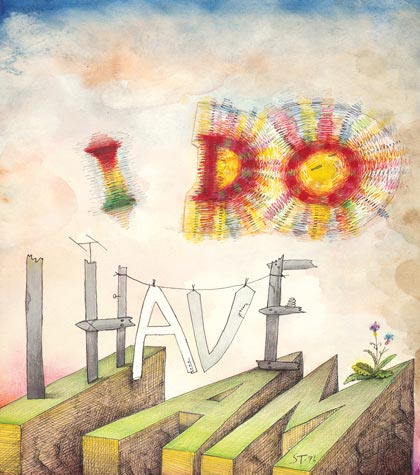
Saul Steinberg’s brilliant expressions in the medium of cartoon art have brightened eyes and tickled brains for the better part of a century. (See my previous article on Saul Steinberg.)Romanian born, trained in Milan and other cultural centers of Europe, Steinberg emigrated to the U.S. and became familiar to many Americans through his long time association with The New Yorker; where his humorous, thought provoking, and uncannily clever drawings delighted readers for over 60 years.
Residents of the U.K. now have an opportunity to view some of his original drawings in an exhibition that runs until February 15, 2009 at the Dulwich Picture Gallery in London.
Those of us in other parts of the world can pick up the exhibition catalog or Joel Smith’s Steinberg at the New Yorker, or simply search through the New Yorker’s extensive archives of cartoon art at The Cartoon Bank.
[Via Art Knowledge News]
Categories:



Charley’s Picks
Bookshop.org
(Bookshop.org affilliate links; sales benefit independent bookshop owners; I get a small percentage to help support my work on Lines and Colors)
Carlson’s Guide to Landscape Painting
Drawing and Sketching in Pencil
Bridgman’s Complete Guide to Drawing from Life


Charley’s Picks
Amazon
(Amazon.com affiliate links; sales go to a larger yacht for Jeff Bezos; but I get a small percentage to help support my work on Lines and Colors)
Carlson’s Guide to Landscape Painting
Drawing and Sketching in Pencil
Bridgman’s Complete Guide to Drawing from Life