


Categories
- 3d CGI
- Amusements
- Animation
- Anime & Manga
- Art Materials
- Art Videos
- Blogroll
- Cartoons
- Color
- Comics
- Concept & Visual Dev.
- Creativity
- Digital Art
- Digital Painting
- Displaying Art on the Web
- Drawing
- Eye Candy for Today
- Gallery and Museum Art
- High-res Art Images
- Illustration
- Motion Graphics & Flash
- Museums
- Online Museums
- Outsider Art
- Painting
- Painting a Day
- Paleo Art
- Pastel, Conté & Chalk
- Pen & Ink
- Prints and Printmaking
- Reviews
- Sc-fi and Fantasy
- Sculpture & Dimensional
- Site Comments
- Sketching
- Storyboards
- Tools and Techniques
- Uncategorized
- Vector Art
- Videos & Podcasts
- Vision and Optics
- Watercolor and Gouache
- Webcomics
Archives
- May 2026
- April 2026
- March 2026
- February 2026
- January 2026
- December 2025
- November 2025
- October 2025
- September 2025
- August 2025
- July 2025
- June 2025
- May 2025
- January 2025
- December 2024
- November 2024
- October 2024
- September 2024
- August 2024
- June 2024
- April 2024
- March 2024
- February 2024
- January 2024
- December 2023
- November 2023
- October 2023
- September 2023
- August 2023
- July 2023
- May 2023
- April 2023
- March 2023
- February 2023
- January 2023
- December 2022
- November 2022
- September 2022
- August 2022
- July 2022
- June 2022
- May 2022
- April 2022
- March 2022
- February 2022
- January 2022
- December 2021
- November 2021
- October 2021
- September 2021
- August 2021
- July 2021
- June 2021
- May 2021
- April 2021
- March 2021
- February 2021
- January 2021
- December 2020
- November 2020
- October 2020
- September 2020
- August 2020
- July 2020
- June 2020
- May 2020
- April 2020
- March 2020
- February 2020
- January 2020
- December 2019
- November 2019
- October 2019
- September 2019
- August 2019
- July 2019
- June 2019
- May 2019
- April 2019
- March 2019
- February 2019
- January 2019
- December 2018
- November 2018
- October 2018
- September 2018
- August 2018
- July 2018
- June 2018
- May 2018
- April 2018
- March 2018
- February 2018
- January 2018
- December 2017
- November 2017
- October 2017
- September 2017
- August 2017
- July 2017
- June 2017
- May 2017
- April 2017
- March 2017
- February 2017
- January 2017
- December 2016
- November 2016
- October 2016
- September 2016
- August 2016
- July 2016
- June 2016
- May 2016
- April 2016
- March 2016
- February 2016
- January 2016
- December 2015
- November 2015
- October 2015
- September 2015
- August 2015
- July 2015
- June 2015
- May 2015
- April 2015
- March 2015
- February 2015
- January 2015
- December 2014
- November 2014
- October 2014
- September 2014
- August 2014
- July 2014
- June 2014
- May 2014
- April 2014
- March 2014
- February 2014
- January 2014
- December 2013
- November 2013
- October 2013
- September 2013
- August 2013
- July 2013
- June 2013
- May 2013
- April 2013
- March 2013
- February 2013
- January 2013
- December 2012
- November 2012
- October 2012
- September 2012
- August 2012
- July 2012
- June 2012
- May 2012
- April 2012
- March 2012
- February 2012
- January 2012
- December 2011
- November 2011
- October 2011
- September 2011
- August 2011
- July 2011
- June 2011
- May 2011
- April 2011
- March 2011
- February 2011
- January 2011
- December 2010
- November 2010
- October 2010
- September 2010
- August 2010
- July 2010
- June 2010
- May 2010
- April 2010
- March 2010
- February 2010
- January 2010
- December 2009
- November 2009
- October 2009
- September 2009
- August 2009
- July 2009
- June 2009
- May 2009
- April 2009
- March 2009
- February 2009
- January 2009
- December 2008
- November 2008
- October 2008
- September 2008
- August 2008
- July 2008
- June 2008
- May 2008
- April 2008
- March 2008
- February 2008
- January 2008
- December 2007
- November 2007
- October 2007
- September 2007
- August 2007
- July 2007
- June 2007
- May 2007
- April 2007
- March 2007
- February 2007
- January 2007
- December 2006
- November 2006
- October 2006
- September 2006
- August 2006
- July 2006
- June 2006
- May 2006
- April 2006
- March 2006
- February 2006
- January 2006
- December 2005
- November 2005
- October 2005
- September 2005
- August 2005
Relevant Blogs
Art, Painting & Sketch
- Gurney Journey
- Underpaintings
- Art and Influence
- Painting Perceptions
- Oil Painters of America
- Vasari Paint POV
- Flying Fox
- Urban Sketchers
- Bento (Smithsonian)
- Art Inconnu
- The Hidden Place
- Still Life
- Making a Mark
- The Art of the Landscape
- Exploring Color & Creativity
- Art Contrarian
- Artist A Day
- beinArt Surreal Art Collective
- Eye Level
- David Dunlop
- p.i.g.m.e.n.t.i.u.m
- CultureGrrl
- Joaquín Sorolla blog
- Artists in Pastel
“Painting a Day”
- A Painting a Day (Keiser)
- On Painting (Keiser)
- Julian Merrow-Smith
- Karen Jurick
- Jeffrey Hayes
- Carol Marine
- Abbey Ryan
- Daily Paintworks
Other Painting Blogs
- Virtual Gouache Land
- Neil Hollingsworth
- Marc Hanson
- Kevin Menck
- Marc Dalessio
- Larry Seiler
- Stapleton Kearns
- Colin Page
- Roos Schuring
- Hans Versfelt
- Titus Meeuws
- Régis Pettinari
- René Plein Air
- Belinda Del Pesco
- Robin Weiss
- Nathan Fowkes (Land Sketch)
- William Wray
- Frank Serrano
- Stephen Magsig
- Michael Chesley Johnson
- Twice a Week
- Sarah Wimperis
- Rob Adams
- Michael Cole Manley
- The Dirty Palette Club
- Mike Manley’s Draw!
Gallery Art & Illustration mix
Illustration
- Howard Pyle
- 100 Years of Illustration
- BibliOdyssey
- Illustration Art
- Today’s Inspiration
- Illustration Mundo
- Little Chimp Society
- Danny Gregory
- R D (John Martz
- Illustration Friday blog
- Monster Brains
- Illustrators & Illustrations (RU)
- Elwood H. Smith
- DaniDraws.com
- Designers Who Blog
- iSpot Blog
Sci-Fi & Fantasy
Illustration & Comics
Comics & Cartoons
- Comics Beat
- Robot 6
- Newsarama Blog
- Comic Vine
- Comics Alliance
- Forbidden Planet Int.
- Paolo Rivera
- Bolt City
- Flight
- Scott McCloud
- The Comics Journal
- Comixpedia
- Funnybook Babylon
- James Baker
- Middleton’s Sketchbook
- Boneville
- The Hotel Fred
- Paul Rivoche
- Daily Cartoonist
- Mad About Cartoons (William Wray)
- Digital Strips
Illustration & Concept
Animation & Concept
- Cartoon Brew
- Animation Blog
- Cold Hard Flash
- Concept Art World
- The CAB
- FY Concept Art
- Concept Ships
- Concept Robots
- John Nevarez
- Armand Serrano
- Marcos Mateu-Mestre
- all kinds of stuff (Kricfalusi)
- Yacin the faun (Man Arenas)
- Kelsey Mann
- Cre8tivemarks Blog
- Ice-Cream Monster Toon Cafe
- AAU Character & Creature Design
- AAU Animation Notes
- Articles and Texticles
Paleo & Scientific
Tools & Techniques
Other
Lists of Art Blogs
Art Image Resource Links
Historic Art Images
- Wikimedia Commons: Paintings
- Wikimedia Commons: Drawings
- The Athenaeum
- WikiArt (WikiPaintings)
- Google Art Project: Artists
- Google Art Project: Collections (Museums)
- ArtCyclopedia
- Web Gallery of Art
- Art Renewal Center
- Web Gallery of Impressionism
Auction Consolidation sites
Auction sites
- Sotheby’s
- Bonham’s
- Christies
- Heritage Auctions: Fine Art
- Heritage Auctions: Illustration
- Freeman’s Auctions
- Bukowskis
- Shannon’s
Image Search
Reverse Image Search (search by image)
- Tin Eye
- RevImg
- Google Image Search (camera icon)
- Bing Image Search (camera icon)
Promoting some friends and some clients of my website design business
- Twin Willows T’ai Chi studio in Wilmington DE. Taiji classes with Bryan Davis.
- Ray Hayward, Inspired Teacher of T’ai Chi ( Taiji ) in Minneapolis, Founder of Mindful Motion Tai Chi Academy
- OldHead Tattoo studio and Art Gallery in Wilmington DE. Tattoos and paintings by Bruce Gulick
- Sharon Domenico Art, pet portrait oil paintings
- Platinum Paperhanging, wallpaper hanging, Main Line and Philadelphia, PA
- Lisa Stone Design, interior designer, Main Line and Philadelphia, PA
- Studio12KPT, original art, prints, calendars and other custom printed items by Van Sickle & Rolleri
-
Dyana Hesson
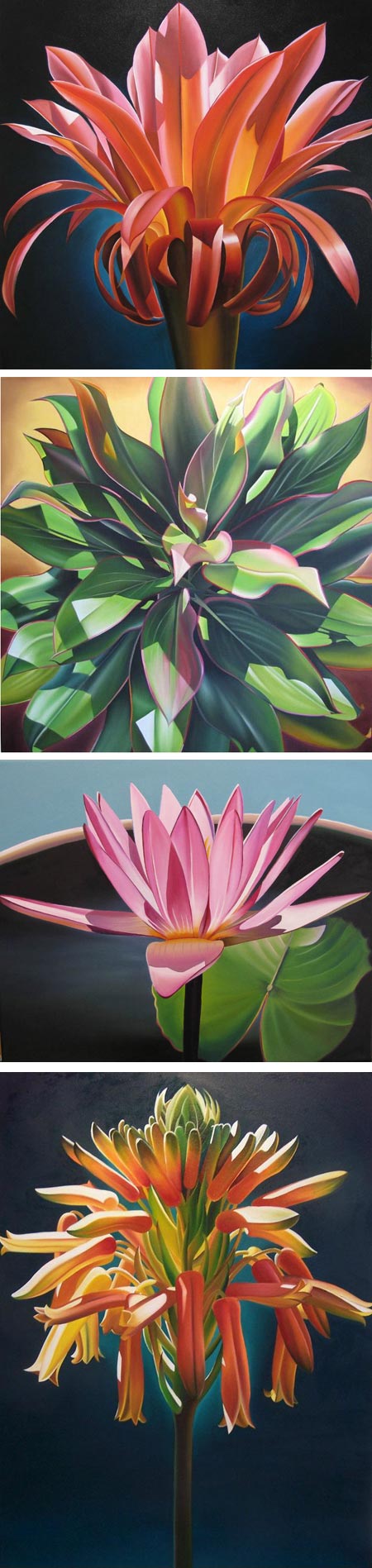
I’m not always appreciative of floral subjects in paintings, too often they focus on the pretty at the expense of the beautiful.Dyana E. Hesson is an artist who was born in California and is now living in Arizona, where she earned her degree in art from Arizona State University. She paints floral and botanical subjects with a difference, seeming to focus on each individual petal as if it was a sculptural object, wrapped in light and shadow.
Many of her luminous oils are painted at a relatively large scale, 40 x 40″ (100 x 100cm) or larger, though some are considerably smaller. She finds intricate landscapes of form within flowers, and renders them as crisply delineated shapes with rich colors, often accentuated by dark, softly gradated backgrounds.
Her subjects include plant forms other than flowers, and all of them have sense of botanical accuracy, though I’m certainly no expert in judging that.
Her website has a section of Original Oils, which is divided into sub-sections, as well as a section of limited edition prints. You can find additional galleries of her work on the websites for David Bonner Galleries (also here, here and here) and Manitou Galleries.
Hesson is featured in the current (January, 2011) issue of American Art Collector.
Categories:
-
Scott Anderson

Scott Anderson is an illustrator based in Santa Barbara, California. He is also a faculty member of the art department at Westmont College.Anderson’s refined, carefully crafted illustrations are done in oil on gessoed illustration board. In addition to the portfolios on his website for illustrations and sketches, you will find additional images on his blog, along with preliminary studies, figure drawings and still life paintings.
Of particular interest are a series of postings showing his working process, as in this post about the illustration of an angel contemplating a rose shown above, top.
Anderson also occasionally posts about artists that he admires, including his recent post about J.C. Leyendecker, which I mentioned here.
Also of interest are his posts about the “Dialog sketchbook” (also here), chronicling progress on a Moleskine sketchbook that he and illustrator Peter Cusak have been passing back and forth, each artist in turn painting a two-page spread before returning it to the other.
Categories:
-
Kekai Kotaki

Hawaii born Kekai Kotaki is an illustrator and concept artist for the gaming industry now living and working in Seattle.He is currently working as Lead Concept Artist on Guild Wars 2 for Arena.net. He has previously done work for Wizards of the Coast, Tor Books, Blur DC Comics, Fantasy Flight Games and Ballistic Publishing, among others.
His work has been included in the last two editions of the Spectrum collections of contemporary fantastic art, several of the Expose collections of digital art and was featured in issue #41 of ImagineFX.
Kataki works largely in digital media, creating his fantastic characters and environments with stylus and graphics software like Photoshop.
He often employs limited, almost monochromatic palettes, combined with an excellent command of atmospheric perspective, to give his compositions drama and layers of depth.
His website has galleries of work from his most recent projects (accessed from a drop-down menu under the “Gallery” navigation element at the top of the page).
As is frequently the case with concept artists, I find the work in his “Personal” section, done without the constraints of a professional job, to be some of the most interesting.
Kotaki also maintains a blog, where you can find other art and news of current projects, as well as a few step-through demos of his working process.
Categories:
-
Harvey Dunn

The great American illustrator Howard Pyle was influential both in his own work and as a teacher whose ranks of students contained a generation of America’s finest illustrators. Artists like N.C. Wyeth, Frank Schoonover, William James Aylward, Elizabeth Shippen Green, Jessie Wilcox Smith, Violet Oakley, Maxfield Parrish, Ellen Thompson Pyle, Olive Rush, Phillip Goodwin, Stanley Arthurs, Allen Tupper True and many others passed through his classes at the Drexel Institute in Philadelphia and his own school in Wilmington, Delaware.Of them, Harvey Dunn stood out not only for his masterful paintings, but for his own contributions as a teacher, carrying forward Pyle’s teachings, along with his own learning and strongly held convictions, to a new generation of illustrators, a list that also includes many notable names. After only two years as Pyle’s student, Dunn opened his own studio in Wilmington and began to take on illustration students.
Dunn created vibrant, energetic canvases that sing with drama, emotion, adventure and excitement. Even though many of his paintings were printed as black and white illustrations, he painted them in strikingly rich color, perhaps partly to please himself and partly to honor the extremely high standards of his mentor.
His illustrations appeared in The Saturday Evening Post, Collier’s Weekly, Harper’s Magazine and Scribner’s as well as in numerous books. He emphasized the emotion and feeling of the image, taking Pyle’s advice to project oneself into the scene being painted, and he became a master of dramatic composition.
Dunn is particularly renowned for his portrayals of the pioneer west and of the prairie, as exemplified by the area in South Dakota where he was born. His ouevre, however, was much broader than that. In World War I Dunn volunteered as one of the first to be an official war artist (see my posts on Art of War and They Drew Fire), traveling with a fighting unit and sending his pictures of the battlefield back to the U.S., bringing the war home in personal and emotionally powerful manner.
On his return from the war, Dunn found himself unenthused about returning to editorial illustration, but his plans to continue expanding his wartime sketches into fully realized canvasses were dashed by a lack of interest from the war office, and a public apparently eager to put the war behind them.
He began a series of more personal works, some of them among his best known, of the prairie and prairie life, including The Prairie is My Garden (above, top) and a series of beautiful nudes.
Dunn continued his commercial work, but eventually moved to New Jersey, just outside of New York, where he opened a school of illustration with Charles Chapman and also began teaching in Manhattan at the Grand Central School of Art.
Like N.C. Wyeth, Dunn was a restless experimenter, always working with the application of paint and color, observing and absorbing influences from many quarters, including, to my eye, French Impressionism, German Expressionism and even Fauvism. His work can be a dramatic amalgam of the traditional and the modern.
Dunn’s work and contribution to American painting are greatly undervalued, and even in these days of increasing appreciation for classic illustration he doesn’t get the recognition he deserves.
 Fortunately, a new book may help remedy that, Flesk Publications has just released a wonderful new book of Dunn’s work, Harvey Dunn: Illustrator and Painter of the Pioneer West, compiled, researched and written by Walt Reed.
Reed, for those unfamiliar with the name, is a well known author of several books on artists and illustration, the founder of Illustration House, the foremost art gallery devoted to illustration in America, and a lifelong devotee of the work and methods of Harvey Dunn. Though he couldn’t study with Dunn directly, Reed, an artist himself and faculty member of the Famous Artist Schools, studied with Dunn’s student Harold Von Schmidt.
I had known this book was in production, but I have to say that when I received a review copy from Flesk I was stunned. First of all, the book is absolutely beautiful. Flesk may have even raised the bar on their own high standards of art book production.
What really took me by surprise, however, was the depth and extent of the book. With almost 300 color plates and more than 70 additional black white illustrations, the book is a sweeping account of Dunn’s career and prolific output. The pages just pop with his intense color, dramatically three dimensional application of textural paint and striking compositions.
It displays a deep appreciation of Dunn’s approach and artistic concerns, follows his development and displays his range with exceptional reproductions, wonderfully selected and arranged.
Though the majority of the book is a monograph on Dunn and his work, there is a second aspect of the title that I didn’t expect, a look at Dunn as a teacher, including a section on his working methods, and an overview of some of his notable students, which included Harold Von Schmidt, Arthur D. Fuller, Charles Andres, Saul Tepper, James Edward Allen and the incredibly accomplished Dean Cornwell and Mead Schaeffer.
There is also a remarkable treasure in the form of an almost-facsimile reproduction of An Evening in the Classroom, a compendium of notes from Dunn’s students (who revered him) of his comments, criticisms and advice given in the course of his classes.
Reed says in his introduction that, though he was unable to study with Dunn directly, he has become a student of Dunn after the fact in assembling this book. In doing so, he has allowed us to share in that privilege.
The volume goes on to include a bibliography, a listing of Dunn’s work in museum collections, and a record of Dunn’s published work.
The book is available from Flesk Publications as both a trade hardcover for $50 and a deluxe slipcased limited edition with additional features for $125. There is a preview of some of the pages on the page for the book, but it just doesn’t do the book, or Dunn’s striking work, justice. This is unfortunate, because the book isn’t being distributed to mass market stores, so you can’t pick it up and look at it, and those not already familiar with Dunn may miss out.
The price, however, is the other thing that amazed me. An art book this extensive, authoritative and strikingly beautiful (even as a coffee table art book) in the hands of most other art book publishers would be priced over $75 or $100. I don’t know how Flesk has kept it to $50, perhaps a labor of love on their part as well, but I’m glad they did. Anyone with an appreciation for the Brandywine School, or American illustration, or for that matter, painting in general, will find it a treasure, and Dunn’s work deserves to be much more broadly known.
This is obviously more than a book on Harvey Dunn, this is a labor of love by Walt Reed, a beautiful tribute to a great American artist and a stunning volume that, if not a catalogue raisonné, is without question the definitive book on the artist and his work.
Categories:
-
Adrie Hello

Adrie Hello ia a watercolorist based in Dordrecht, Netherlends. He paints townscapes of his city with atmospheric transparent watercolor and occasional touches of gouache.Hello often finds interesting subjects in streets and canals seen through mist or light rain, using soft washes of muted color contrasted with accented edges on the objects he wants to bring forward.
He has a knack for suggestion, providing just enough detail and suggestion of textures that your mind fills in the rest.
His website has a section for Recent works and another for Paintings that is divided into sub-galleries.
Also of interest are his extensive lists of links to other artists and art resources, and his page on his favorite watercolor painters.
[Suggestion courtesy of Lyl and Aelle Ayres]
Categories:
-
The Wormworld Saga, Daniel Lieske
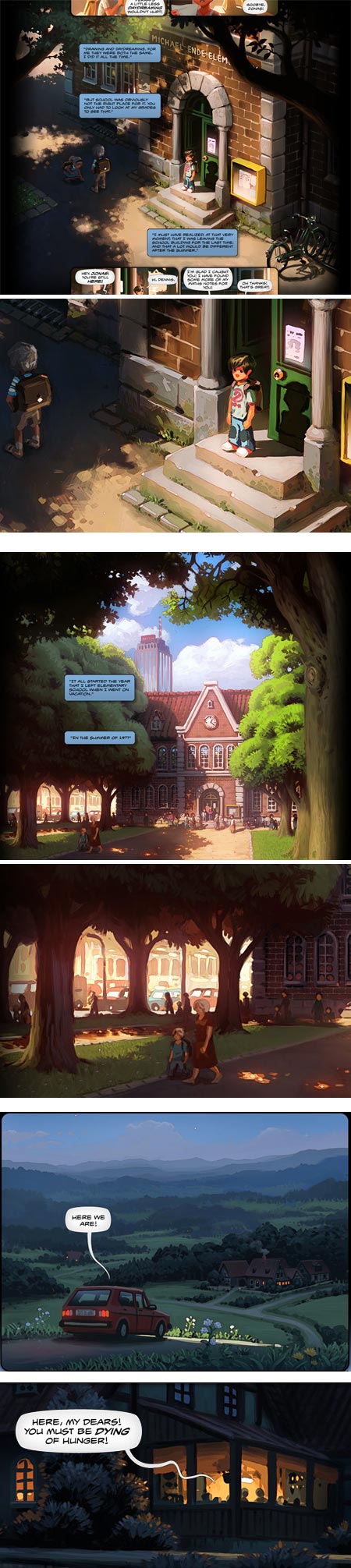
The Wormworld Saga is a new online graphic novel by German illustrator, comics artist and gaming concept artist Daniel Lieske.It is an adventure story centering on the memories of a young boy recalling a time in his life when the world of the everyday intersected with the extraordinary.
The format is a bit different from most online graphic stories, which are posted a page or a few panels at a time; the first chapter of The Wormworld Saga was just posted complete; a necessity in this case because the entire chapter, in a variation of Scott McCloud’s “infinite canvas” concept, is essentially one long scrolling page, with the panels interconnected by larger passages and shared backgrounds.
The comic is read by scrolling down (something seemingly particularly appropriate for reading on the iPad), and though there are sections that might be considered “pages” in that their content and panel format is related, they defy the boundaries of conventional page layout.
Unlike some artists who have experimented with the online comics format and the conventions of how comics stories are read, Lieske hasn’t indulged in experimentation at the expense of graphic storytelling fundamentals, and his story reads well, flows nicely and is easy to follow.
The story, though only one chapter long so far, also stands out for its pace, more like an actual novel than the pace of most comics, which tend to proceed like a movie or television show, in which the narrative is compressed. Lieske seems comfortable with a pace that allow him to build up background and narrative texture; though the story is told well enough that there is no feeling of lag or delay.
The most outstanding characteristic of The Wormworld Saga, however, is Lieske’s artwork, which is highly accomplished, quite original and wonderfully realized.
Lieske is a digital painter by profession, both in his illustration and his game related concept art (you can see his professional portfolio here). He has applied his skills with digital painting tools to the images for the story in way that is delightfully painterly; and no, I don’t think applying the description “painterly” to a digital medium is a misuse of the term, it refers to the application of color in patches that look and feel like physical brush strokes.
Combined with a cinematic feeling for drama, his painterly textures and judiciously applied details give the story an emotional resonance and sense of place and time.
Lieske created a page called The Wormworld Saga Exhibitions, in which he talks about the project and its origins. he also maintains a blog which likewise features background on the story and art, as well as a personal website with sections for his other projects, including galleries of digital painting and sketches, and a page about the artist. There is also a page for ordering prints that should go live sometime this month.
If Lieske continues his practice of creating an entire chapter before posting, the next installment of The Wormworld Saga may take a while to arrive; but the current chapter ends in a way that will allow us to wait, and the next chapter should be worth waiting for.
[Via MetaFilter]
Categories:




Charley’s Picks
Bookshop.org
(Bookshop.org affilliate links; sales benefit independent bookshop owners; I get a small percentage to help support my work on Lines and Colors)

John Singer Sargent: Watercolors


Urban Sketching: Understanding Perspective


Charley’s Picks
Amazon
(Amazon.com affiliate links; sales go to a larger yacht for Jeff Bezos; but I get a small percentage to help support my work on Lines and Colors)
John Singer Sargent: Watercolors
Urban Sketching: Understanding Perspective