


Categories
- 3d CGI
- Amusements
- Animation
- Anime & Manga
- Art Materials
- Art Videos
- Blogroll
- Cartoons
- Color
- Comics
- Concept & Visual Dev.
- Creativity
- Digital Art
- Digital Painting
- Displaying Art on the Web
- Drawing
- Eye Candy for Today
- Gallery and Museum Art
- High-res Art Images
- Illustration
- Motion Graphics & Flash
- Museums
- Online Museums
- Outsider Art
- Painting
- Painting a Day
- Paleo Art
- Pastel, Conté & Chalk
- Pen & Ink
- Prints and Printmaking
- Reviews
- Sc-fi and Fantasy
- Sculpture & Dimensional
- Site Comments
- Sketching
- Storyboards
- Tools and Techniques
- Uncategorized
- Vector Art
- Videos & Podcasts
- Vision and Optics
- Watercolor and Gouache
- Webcomics
Archives
- April 2026
- March 2026
- February 2026
- January 2026
- December 2025
- November 2025
- October 2025
- September 2025
- August 2025
- July 2025
- June 2025
- May 2025
- January 2025
- December 2024
- November 2024
- October 2024
- September 2024
- August 2024
- June 2024
- April 2024
- March 2024
- February 2024
- January 2024
- December 2023
- November 2023
- October 2023
- September 2023
- August 2023
- July 2023
- May 2023
- April 2023
- March 2023
- February 2023
- January 2023
- December 2022
- November 2022
- September 2022
- August 2022
- July 2022
- June 2022
- May 2022
- April 2022
- March 2022
- February 2022
- January 2022
- December 2021
- November 2021
- October 2021
- September 2021
- August 2021
- July 2021
- June 2021
- May 2021
- April 2021
- March 2021
- February 2021
- January 2021
- December 2020
- November 2020
- October 2020
- September 2020
- August 2020
- July 2020
- June 2020
- May 2020
- April 2020
- March 2020
- February 2020
- January 2020
- December 2019
- November 2019
- October 2019
- September 2019
- August 2019
- July 2019
- June 2019
- May 2019
- April 2019
- March 2019
- February 2019
- January 2019
- December 2018
- November 2018
- October 2018
- September 2018
- August 2018
- July 2018
- June 2018
- May 2018
- April 2018
- March 2018
- February 2018
- January 2018
- December 2017
- November 2017
- October 2017
- September 2017
- August 2017
- July 2017
- June 2017
- May 2017
- April 2017
- March 2017
- February 2017
- January 2017
- December 2016
- November 2016
- October 2016
- September 2016
- August 2016
- July 2016
- June 2016
- May 2016
- April 2016
- March 2016
- February 2016
- January 2016
- December 2015
- November 2015
- October 2015
- September 2015
- August 2015
- July 2015
- June 2015
- May 2015
- April 2015
- March 2015
- February 2015
- January 2015
- December 2014
- November 2014
- October 2014
- September 2014
- August 2014
- July 2014
- June 2014
- May 2014
- April 2014
- March 2014
- February 2014
- January 2014
- December 2013
- November 2013
- October 2013
- September 2013
- August 2013
- July 2013
- June 2013
- May 2013
- April 2013
- March 2013
- February 2013
- January 2013
- December 2012
- November 2012
- October 2012
- September 2012
- August 2012
- July 2012
- June 2012
- May 2012
- April 2012
- March 2012
- February 2012
- January 2012
- December 2011
- November 2011
- October 2011
- September 2011
- August 2011
- July 2011
- June 2011
- May 2011
- April 2011
- March 2011
- February 2011
- January 2011
- December 2010
- November 2010
- October 2010
- September 2010
- August 2010
- July 2010
- June 2010
- May 2010
- April 2010
- March 2010
- February 2010
- January 2010
- December 2009
- November 2009
- October 2009
- September 2009
- August 2009
- July 2009
- June 2009
- May 2009
- April 2009
- March 2009
- February 2009
- January 2009
- December 2008
- November 2008
- October 2008
- September 2008
- August 2008
- July 2008
- June 2008
- May 2008
- April 2008
- March 2008
- February 2008
- January 2008
- December 2007
- November 2007
- October 2007
- September 2007
- August 2007
- July 2007
- June 2007
- May 2007
- April 2007
- March 2007
- February 2007
- January 2007
- December 2006
- November 2006
- October 2006
- September 2006
- August 2006
- July 2006
- June 2006
- May 2006
- April 2006
- March 2006
- February 2006
- January 2006
- December 2005
- November 2005
- October 2005
- September 2005
- August 2005
Relevant Blogs
Art, Painting & Sketch
- Gurney Journey
- Underpaintings
- Art and Influence
- Painting Perceptions
- Oil Painters of America
- Vasari Paint POV
- Flying Fox
- Urban Sketchers
- Bento (Smithsonian)
- Art Inconnu
- The Hidden Place
- Still Life
- Making a Mark
- The Art of the Landscape
- Exploring Color & Creativity
- Art Contrarian
- Artist A Day
- beinArt Surreal Art Collective
- Eye Level
- David Dunlop
- p.i.g.m.e.n.t.i.u.m
- CultureGrrl
- Joaquín Sorolla blog
- Artists in Pastel
“Painting a Day”
- A Painting a Day (Keiser)
- On Painting (Keiser)
- Julian Merrow-Smith
- Karen Jurick
- Jeffrey Hayes
- Carol Marine
- Abbey Ryan
- Daily Paintworks
Other Painting Blogs
- Virtual Gouache Land
- Neil Hollingsworth
- Marc Hanson
- Kevin Menck
- Marc Dalessio
- Larry Seiler
- Stapleton Kearns
- Colin Page
- Roos Schuring
- Hans Versfelt
- Titus Meeuws
- Régis Pettinari
- René Plein Air
- Belinda Del Pesco
- Robin Weiss
- Nathan Fowkes (Land Sketch)
- William Wray
- Frank Serrano
- Stephen Magsig
- Michael Chesley Johnson
- Twice a Week
- Sarah Wimperis
- Rob Adams
- Michael Cole Manley
- The Dirty Palette Club
- Mike Manley’s Draw!
Gallery Art & Illustration mix
Illustration
- Howard Pyle
- 100 Years of Illustration
- BibliOdyssey
- Illustration Art
- Today’s Inspiration
- Illustration Mundo
- Little Chimp Society
- Danny Gregory
- R D (John Martz
- Illustration Friday blog
- Monster Brains
- Illustrators & Illustrations (RU)
- Elwood H. Smith
- DaniDraws.com
- Designers Who Blog
- iSpot Blog
Sci-Fi & Fantasy
Illustration & Comics
Comics & Cartoons
- Comics Beat
- Robot 6
- Newsarama Blog
- Comic Vine
- Comics Alliance
- Forbidden Planet Int.
- Paolo Rivera
- Bolt City
- Flight
- Scott McCloud
- The Comics Journal
- Comixpedia
- Funnybook Babylon
- James Baker
- Middleton’s Sketchbook
- Boneville
- The Hotel Fred
- Paul Rivoche
- Daily Cartoonist
- Mad About Cartoons (William Wray)
- Digital Strips
Illustration & Concept
Animation & Concept
- Cartoon Brew
- Animation Blog
- Cold Hard Flash
- Concept Art World
- The CAB
- FY Concept Art
- Concept Ships
- Concept Robots
- John Nevarez
- Armand Serrano
- Marcos Mateu-Mestre
- all kinds of stuff (Kricfalusi)
- Yacin the faun (Man Arenas)
- Kelsey Mann
- Cre8tivemarks Blog
- Ice-Cream Monster Toon Cafe
- AAU Character & Creature Design
- AAU Animation Notes
- Articles and Texticles
Paleo & Scientific
Tools & Techniques
Other
Lists of Art Blogs
Art Image Resource Links
Historic Art Images
- Wikimedia Commons: Paintings
- Wikimedia Commons: Drawings
- The Athenaeum
- WikiArt (WikiPaintings)
- Google Art Project: Artists
- Google Art Project: Collections (Museums)
- ArtCyclopedia
- Web Gallery of Art
- Art Renewal Center
- Web Gallery of Impressionism
Auction Consolidation sites
Auction sites
- Sotheby’s
- Bonham’s
- Christies
- Heritage Auctions: Fine Art
- Heritage Auctions: Illustration
- Freeman’s Auctions
- Bukowskis
- Shannon’s
Image Search
Reverse Image Search (search by image)
- Tin Eye
- RevImg
- Google Image Search (camera icon)
- Bing Image Search (camera icon)
Promoting some friends and some clients of my website design business
- Twin Willows T’ai Chi studio in Wilmington DE. Taiji classes with Bryan Davis.
- Ray Hayward, Inspired Teacher of T’ai Chi ( Taiji ) in Minneapolis, Founder of Mindful Motion Tai Chi Academy
- OldHead Tattoo studio and Art Gallery in Wilmington DE. Tattoos and paintings by Bruce Gulick
- Sharon Domenico Art, pet portrait oil paintings
- Platinum Paperhanging, wallpaper hanging, Main Line and Philadelphia, PA
- Lisa Stone Design, interior designer, Main Line and Philadelphia, PA
- Studio12KPT, original art, prints, calendars and other custom printed items by Van Sickle & Rolleri
-
Erwin Madrid
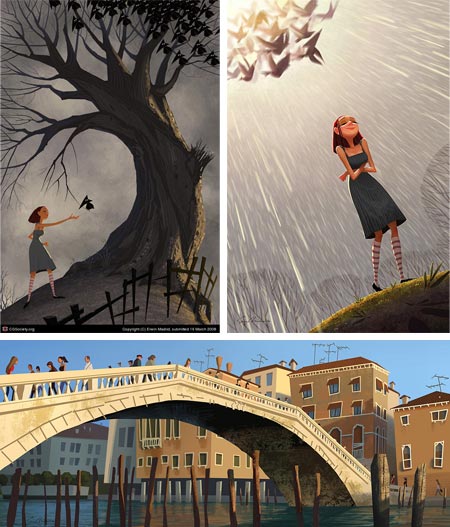
Erwin Madrid is a concept artist for the entertainment industry, currently based in San Francisco, where he earned his BFA at the Academy of Art College.He has worked for PDI/Dreamworks Animation on films like Shrek 2, Shrek the Third and the Madagascar sequel. He has also done concept art for the gaming industry for titles like Drake’s Fortune.
Artwork on his web site is divided between sections for Shrek and other concept art, personal projects (images above) and a section of landscape paintings from California and Europe.
His work has the snappy, angular energy and fresh color that often gives concept art much of its appeal. His personal projects are lively and imaginative , with a playful use of perspective and unusual viewpoints.
His landscape paintings, done in what I assume is gouache, have a breezy, sketch-like quality that gives them a nice feeling of immediacy.
Madrid also has a blog on which he posts largely about his personal projects, including his contribution to the recent Tokyo Forest Project.
There are also portfolios of his work on the CG Society and Tor.com and a selection of prints for sale on the deviantART shop.
Categories:
-
Langridge Re-imagines Spongebob

Roger Langridge, the brilliantly off-kilter UK cartoonist that I wrote about back in 2006, recently posted to his blog some comics that were done for Nickelodeon Magazine, in which he draws on his fondness for the great classics of newspaper comics to re-cast Sponegbob Squarepants in the mold of Winsor McCay’s and Little Nemo in Slumberland (image above, bottom), George Herriman’s The Family Upstairs (above, top) and Krazy Kat, Milton Caniff’s Terry and the Pirates; and others like Peanuts and Buck Rogers.Don’t miss the chance to lose your day being delighted and diverted by the rest of Langridge’s blog, The Hotel Fred, as well as his website and the assortment of comics therein.
[Link via io9]
Categories:
-
Thomas Cole
Though often thought of as a quintessentially American painter, the founder of the Hudson River School of painting and even the father of American landscape painting in general, it is perhaps fitting that Thomas Cole was an immigrant. Born in Lancashire England he moved to the U.S. with his family in 1818, when he was 18.Cole spent a year on his own in Philadelphia before going on to join his family in Stubenville, Ohio, where he worked as a wallpaper designer for his father’s wallpaper factory. He later returned to Philadelphia for two years, and at the Pennsylvania Academy of the Fine Arts was inspired by the works of Thomas Birch and Thomas Doughty. He then moved to New York and devoted himself to the study of landscape painting.
He did a series of paintings after a sketching trip up the Hudson River that proved to be very successful and he began to accept commissions for works that displayed the grandeur and drama of the still largely unspoiled American wilderness.
Cole took several trips to Europe, refining his distinctly American art with the study of the European masters. He eventually settled in Catskill, New York. There is a Thomas Cole National Historic Site at Cedar Grove.
Cole had a distinct influence on other painters of the time, notably Asher B. Durand, whose famous painting Kindred Spirits was a tribute to Cole and his friend poet William Cullen Bryant; and the renowned painter Frederic Edwin Church, who was Cole’s only formal student.
Cole divided his attention between landscape commissions and large scale allegorical paintings of imaginary views that embodied philosophical ideals, such as a series showing The Voyage of Life, in four stages from childhood to old age.
The most famous of these is his grand sequence of five large canvasses depicting The Course of Empire, from the wilderness of an undiscovered continent to the pastoral beginnings of a young country to the heights of imperial glory and on to the inevitable destruction and collapse of an empire under its own weight.
Cole apparently preferred his ambitious allegorical works, but he is most often admired for his dramatic landscapes, with sweeping views of the wild and open country that still beckoned the American spirit of adventure and discovery.
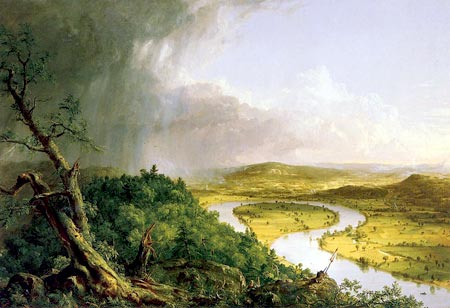
The image above is alternately titled The Oxbow or The Connecticut River Near Northampton (larger version here and here).
It shows a long view of the American landscape, renewed and glowing in the sun as the darkness of a storm subsides.
Categories:
-
Wake Up, America!

No sleeping in, no blog reading, no excuses; get to the polls and vote.Image above is by James Montgomery Flagg. For more on Flagg, (after you’ve voted), see my post urging you to get out and vote in 2006.
Good luck, America.
Categories:
-
Double Lives: American Painters as Illustrators

Long time readers of Lines and Colors know that I take great pleasure in many types of visual art, and that I like to blur and cross the lines between genres. In particular, I like to point out the artificiality of the distinction between illustration and “fine art”.Not that I don’t find it a useful distinction, the intention and approach are often different, but I object to the snobbery often found in “fine art” circles that says that illustration is “not art”. The insistence on this distinction can often be vehement, even to the point of lawsuits to declare a piece of illustration “not art”.
My favorite response to this is a quote from illustrator Brad Holland:
Almost everybody is an artist these days. Rock and Roll singers are artists. So are movie directors, performance artists, make-up artists, tattoo artists, con artists and rap artists. Movie stars are artists. Madonna is an artist, because she explores her own sexuality. Snoop Doggy Dogg is an artist because he explores other people’s sexuality. Victims who express their pain are artists. So are guys in prison who express themselves on shirt cardboard. Even consumers are artists when they express themselves in their selection of commodities. The only people left in America who seem not to be artists are illustrators.
This snobbery is essentially a form of class warfare; illustration is, after all, mass-reproduced art for the masses, and “fine art” is the domain of the wealthy (the ability to buy it not to create it, artists are supposed to live in noble poverty, while collectors, auction houses and speculators make the money).
Those of us who appreciate visual art in its many forms can revel in the “you don’t know what you’re missing” feeling of traversing the line between illustration and “fine art” at will, enjoying the best of what both worlds have to offer.
There is an exhibit currently on view at the Brandywine River Museum, always a bastion of great illustration art, that explores this often strained relationship. Double Lives: American Painters as Illustrators features both illustration by artists known mostly as “fine artists” and gallery paintings by illustrators, as well as paintings and drawings by these artists in their own genres.
The artists represented include American Impressionist Childe Hassam, who started his career illustrating children’s books, Winslow Homer, whose Civil War drawings appeared in Harper’s Weekly; and numerous other artists like Frederick Remington, John Sloan, Grant Wood, Rockwell Kent, William Glackens (image above, bottom left) and, of course, a number of striking pieces form the museum’s own collection of works by the great illustrator (and gallery artist) N.C. Wyeth (above, bottom right).
For those who are within visiting range, the exhibit is worth it just for a few outstanding pieces that are on loan, including Childe Hassam’s beautiful Jour du Grand Prix (image above, top, zoomable view here), from the New Britain Museum of American Art, which co-organized the exhibit; as well as a striking large piece by Edwin Austin Abbey, and other gems.
There is a catalog accompanying the exhibition, but I didn’t see it while I was at the museum, and I’m not certain if it’s been released yet.
Double Lives: American Painters as Illustrators runs at the Brandywine River Museum in Chadds Ford, PA until November 23, 2008.
Categories:
-
Tristan Elwell
Tritan Elwell is an illustrator who graduated from the High School of Music and Art in New York and went on to attend the School of Visual Arts there on a full scholarship. In addition he worked as an assistant to photorealist painter Charles Bell. He returned to the School of Visual Arts as an instructor, teaching classes in painting and illustration.He has maintained a client list that includes HarperCollins, Penguin, Avon, Pocket Books, Bantam and Tor Books. Tor books has a gallery of his work.
He has also been featured in Print, Communication Arts and the Spectrum collections of contemporary fantastic art.
Elwell utilizes contrasts, not only of value and color, but of degree of detail, to control how he directs your eye and snaps attention to the focal point of the image. He also maintains a designerly eye to the graphic elements of his images, giving them a balance of positive elements and negative spaces.
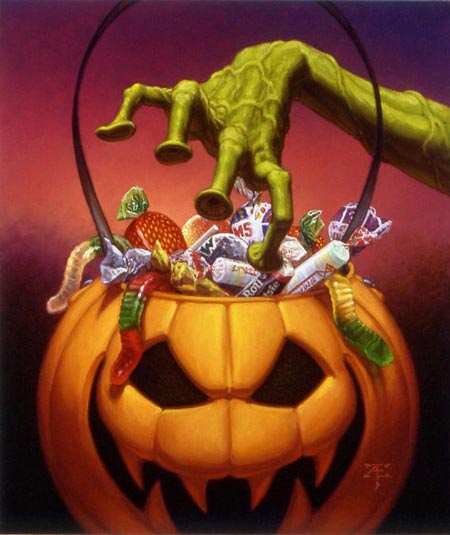
The image shown here is perhaps not as representative of his work as some others might be, but seemed delightfully appropriate for Halloween.
I was unable to find a dedicated web site for Elwell, but I’ve gather a list of links to galleries of his work.
Categories:




Charley’s Picks
Bookshop.org
(Bookshop.org affilliate links; sales benefit independent bookshop owners; I get a small percentage to help support my work on Lines and Colors)

John Singer Sargent: Watercolors


Urban Sketching: Understanding Perspective


Charley’s Picks
Amazon
(Amazon.com affiliate links; sales go to a larger yacht for Jeff Bezos; but I get a small percentage to help support my work on Lines and Colors)
John Singer Sargent: Watercolors
Urban Sketching: Understanding Perspective