


Categories
- 3d CGI
- Amusements
- Animation
- Anime & Manga
- Art Materials
- Art Videos
- Blogroll
- Cartoons
- Color
- Comics
- Concept & Visual Dev.
- Creativity
- Digital Art
- Digital Painting
- Displaying Art on the Web
- Drawing
- Eye Candy for Today
- Gallery and Museum Art
- High-res Art Images
- Illustration
- Motion Graphics & Flash
- Museums
- Online Museums
- Outsider Art
- Painting
- Painting a Day
- Paleo Art
- Pastel, Conté & Chalk
- Pen & Ink
- Prints and Printmaking
- Reviews
- Sc-fi and Fantasy
- Sculpture & Dimensional
- Site Comments
- Sketching
- Storyboards
- Tools and Techniques
- Uncategorized
- Vector Art
- Videos & Podcasts
- Vision and Optics
- Watercolor and Gouache
- Webcomics
Archives
- April 2026
- March 2026
- February 2026
- January 2026
- December 2025
- November 2025
- October 2025
- September 2025
- August 2025
- July 2025
- June 2025
- May 2025
- January 2025
- December 2024
- November 2024
- October 2024
- September 2024
- August 2024
- June 2024
- April 2024
- March 2024
- February 2024
- January 2024
- December 2023
- November 2023
- October 2023
- September 2023
- August 2023
- July 2023
- May 2023
- April 2023
- March 2023
- February 2023
- January 2023
- December 2022
- November 2022
- September 2022
- August 2022
- July 2022
- June 2022
- May 2022
- April 2022
- March 2022
- February 2022
- January 2022
- December 2021
- November 2021
- October 2021
- September 2021
- August 2021
- July 2021
- June 2021
- May 2021
- April 2021
- March 2021
- February 2021
- January 2021
- December 2020
- November 2020
- October 2020
- September 2020
- August 2020
- July 2020
- June 2020
- May 2020
- April 2020
- March 2020
- February 2020
- January 2020
- December 2019
- November 2019
- October 2019
- September 2019
- August 2019
- July 2019
- June 2019
- May 2019
- April 2019
- March 2019
- February 2019
- January 2019
- December 2018
- November 2018
- October 2018
- September 2018
- August 2018
- July 2018
- June 2018
- May 2018
- April 2018
- March 2018
- February 2018
- January 2018
- December 2017
- November 2017
- October 2017
- September 2017
- August 2017
- July 2017
- June 2017
- May 2017
- April 2017
- March 2017
- February 2017
- January 2017
- December 2016
- November 2016
- October 2016
- September 2016
- August 2016
- July 2016
- June 2016
- May 2016
- April 2016
- March 2016
- February 2016
- January 2016
- December 2015
- November 2015
- October 2015
- September 2015
- August 2015
- July 2015
- June 2015
- May 2015
- April 2015
- March 2015
- February 2015
- January 2015
- December 2014
- November 2014
- October 2014
- September 2014
- August 2014
- July 2014
- June 2014
- May 2014
- April 2014
- March 2014
- February 2014
- January 2014
- December 2013
- November 2013
- October 2013
- September 2013
- August 2013
- July 2013
- June 2013
- May 2013
- April 2013
- March 2013
- February 2013
- January 2013
- December 2012
- November 2012
- October 2012
- September 2012
- August 2012
- July 2012
- June 2012
- May 2012
- April 2012
- March 2012
- February 2012
- January 2012
- December 2011
- November 2011
- October 2011
- September 2011
- August 2011
- July 2011
- June 2011
- May 2011
- April 2011
- March 2011
- February 2011
- January 2011
- December 2010
- November 2010
- October 2010
- September 2010
- August 2010
- July 2010
- June 2010
- May 2010
- April 2010
- March 2010
- February 2010
- January 2010
- December 2009
- November 2009
- October 2009
- September 2009
- August 2009
- July 2009
- June 2009
- May 2009
- April 2009
- March 2009
- February 2009
- January 2009
- December 2008
- November 2008
- October 2008
- September 2008
- August 2008
- July 2008
- June 2008
- May 2008
- April 2008
- March 2008
- February 2008
- January 2008
- December 2007
- November 2007
- October 2007
- September 2007
- August 2007
- July 2007
- June 2007
- May 2007
- April 2007
- March 2007
- February 2007
- January 2007
- December 2006
- November 2006
- October 2006
- September 2006
- August 2006
- July 2006
- June 2006
- May 2006
- April 2006
- March 2006
- February 2006
- January 2006
- December 2005
- November 2005
- October 2005
- September 2005
- August 2005
Relevant Blogs
Art, Painting & Sketch
- Gurney Journey
- Underpaintings
- Art and Influence
- Painting Perceptions
- Oil Painters of America
- Vasari Paint POV
- Flying Fox
- Urban Sketchers
- Bento (Smithsonian)
- Art Inconnu
- The Hidden Place
- Still Life
- Making a Mark
- The Art of the Landscape
- Exploring Color & Creativity
- Art Contrarian
- Artist A Day
- beinArt Surreal Art Collective
- Eye Level
- David Dunlop
- p.i.g.m.e.n.t.i.u.m
- CultureGrrl
- Joaquín Sorolla blog
- Artists in Pastel
“Painting a Day”
- A Painting a Day (Keiser)
- On Painting (Keiser)
- Julian Merrow-Smith
- Karen Jurick
- Jeffrey Hayes
- Carol Marine
- Abbey Ryan
- Daily Paintworks
Other Painting Blogs
- Virtual Gouache Land
- Neil Hollingsworth
- Marc Hanson
- Kevin Menck
- Marc Dalessio
- Larry Seiler
- Stapleton Kearns
- Colin Page
- Roos Schuring
- Hans Versfelt
- Titus Meeuws
- Régis Pettinari
- René Plein Air
- Belinda Del Pesco
- Robin Weiss
- Nathan Fowkes (Land Sketch)
- William Wray
- Frank Serrano
- Stephen Magsig
- Michael Chesley Johnson
- Twice a Week
- Sarah Wimperis
- Rob Adams
- Michael Cole Manley
- The Dirty Palette Club
- Mike Manley’s Draw!
Gallery Art & Illustration mix
Illustration
- Howard Pyle
- 100 Years of Illustration
- BibliOdyssey
- Illustration Art
- Today’s Inspiration
- Illustration Mundo
- Little Chimp Society
- Danny Gregory
- R D (John Martz
- Illustration Friday blog
- Monster Brains
- Illustrators & Illustrations (RU)
- Elwood H. Smith
- DaniDraws.com
- Designers Who Blog
- iSpot Blog
Sci-Fi & Fantasy
Illustration & Comics
Comics & Cartoons
- Comics Beat
- Robot 6
- Newsarama Blog
- Comic Vine
- Comics Alliance
- Forbidden Planet Int.
- Paolo Rivera
- Bolt City
- Flight
- Scott McCloud
- The Comics Journal
- Comixpedia
- Funnybook Babylon
- James Baker
- Middleton’s Sketchbook
- Boneville
- The Hotel Fred
- Paul Rivoche
- Daily Cartoonist
- Mad About Cartoons (William Wray)
- Digital Strips
Illustration & Concept
Animation & Concept
- Cartoon Brew
- Animation Blog
- Cold Hard Flash
- Concept Art World
- The CAB
- FY Concept Art
- Concept Ships
- Concept Robots
- John Nevarez
- Armand Serrano
- Marcos Mateu-Mestre
- all kinds of stuff (Kricfalusi)
- Yacin the faun (Man Arenas)
- Kelsey Mann
- Cre8tivemarks Blog
- Ice-Cream Monster Toon Cafe
- AAU Character & Creature Design
- AAU Animation Notes
- Articles and Texticles
Paleo & Scientific
Tools & Techniques
Other
Lists of Art Blogs
Art Image Resource Links
Historic Art Images
- Wikimedia Commons: Paintings
- Wikimedia Commons: Drawings
- The Athenaeum
- WikiArt (WikiPaintings)
- Google Art Project: Artists
- Google Art Project: Collections (Museums)
- ArtCyclopedia
- Web Gallery of Art
- Art Renewal Center
- Web Gallery of Impressionism
Auction Consolidation sites
Auction sites
- Sotheby’s
- Bonham’s
- Christies
- Heritage Auctions: Fine Art
- Heritage Auctions: Illustration
- Freeman’s Auctions
- Bukowskis
- Shannon’s
Image Search
Reverse Image Search (search by image)
- Tin Eye
- RevImg
- Google Image Search (camera icon)
- Bing Image Search (camera icon)
Promoting some friends and some clients of my website design business
- Twin Willows T’ai Chi studio in Wilmington DE. Taiji classes with Bryan Davis.
- Ray Hayward, Inspired Teacher of T’ai Chi ( Taiji ) in Minneapolis, Founder of Mindful Motion Tai Chi Academy
- OldHead Tattoo studio and Art Gallery in Wilmington DE. Tattoos and paintings by Bruce Gulick
- Sharon Domenico Art, pet portrait oil paintings
- Platinum Paperhanging, wallpaper hanging, Main Line and Philadelphia, PA
- Lisa Stone Design, interior designer, Main Line and Philadelphia, PA
- Studio12KPT, original art, prints, calendars and other custom printed items by Van Sickle & Rolleri
-
Ed “Big Daddy” Roth

At some point in my impressionable youth, I was exposed to certain “corrupting influences” that twisted my little brain into a fevered pop culture pretzel and made me not only want draw comics and cartoons, but draw outrageous and weird comics and cartoons.One was my discovery of paperback reprints of E.C. Mad comics from the 1950’s with the hilariously subversive art of Wally Wood, Will Elder and Jack Davis, and another was the outlandishly exaggerated, lurid and over the top monster and hot rod car art of Ed “Big Daddy” Roth.
Roth was one of the seminal figures in the “Kalifornia Kustom Kar Kulture” of the early 1960’s. Roth was into the creation of hot rods and customized show cars, particularly using the amazing new wonder material of fiberglass, that enabled him to design free form bodies for his cars instead of just cutting into existing metal bodies.
To support the investment necessary for his obsession, Roth would use an airbrush to draw outrageous cartoon monsters and grotesquely exaggerated cars on T-shirts at car shows and drag races. These were the drawings that turned my tender little 12 year old brain into glowing orange gook when I saw them.
Wonderfully grotesque monsters, extended tongues dripping saliva as they trailed in the wind, bloodshot eyes bulging from their distended craniums, usually with one ungainly arm extended to crank on an improbably long and weirdly curved gear shift lever, drove nitro-burning hot rods with gleaming chrome plated engines extending through their hoods, exhaust pipes spewing white hot flames and smoke pouring off of enormous tortured racing slicks as the cars lifted themselves in eternal wheelies, feverishly screaming down Hell’s drag strip to some kind of dramatic reward or explosive oblivion. Wow.
It’s hard to overstate how bizarre and anti-establishment this kind of stuff was at the time Roth was working, because all of this lowbrow art, outragrously grotesque creatures and characters in films and concept art, underground comics, 60’s psychedelic art and album covers, MTV-style in-your-face TV rock, grunge and punk culture, and general acceptance of wild, anti-authoritarian behavior as acceptably rembunctious, that we take for granted as part of modern pop culture, didn’t exist yet, with the exception of certain bastions of outrageous art like the aforementioned 1950’s Mad comics and E.C. horror comics, which were certainly an influence on Roth’s cartoons. Most of the country was still wrapped in the warm but rigidly controlled Leave it to Beaver and Ozzie and Harriet delusions of the 1950’s up until 1964 or so, when “the 60’s” started to shake things apart.
Roth’s images became tremendously popular and one of his characters, the Rat Fink (image above, lower right), became a cultural icon. Roth was able to parlay his images into licensing deals for T-shirts and decals, along with merchandise like the Revell model kit versions of his show cars. He became successful enough to employ other artists, like Ed Newton and Robert Williams, to produce art for him.
For a fascinating glimpse into this Kustom Kar Kulture of the early 1960’s see Tom Wolfe’s wonderful essay The Kandy Kolored Tangerine Flake Streamline Baby. Though it features George Barris a bit more prominently than Roth, in it, Wolfe makes the insightful observation, with which I agree, that these custom cars were so radical and free form in their curvulinear molded fiberglass bodies and half inch thick hand-rubbed layers of translucent lacquer, that they transcended mere automotive customizing and ascended into the realm of modern sculpture.
Roth’s cars went well beyond the “normal” (if such a word can apply to the custom car culture at all) customs that had been hot rodded, painted and perhaps chopped and channeled (had their roof lines lowered and bodies set lower on their chassis). “Beatnik Bandit”, for example, didn’t mess around with a chopped top or cut-out roof panels, but sported instead a bubble top, a transparent hemispherical dome that looked like it had been plucked off of a cartoon flying saucer, and featured a joy stick steering control. The bubble top was carried on to some of Roth’s other Kustom Kreations, like the Mysterion, which looked like it might have been jointly designed by Syd Mead and Richard Powers (image of the Revell model kit box cover, illustrated by another artist, above, lower left).
These fantastic sculptured cars by Roth, George Barris, Bill Cushenberry and Darryl Starbird, along with the the pinstriping and car body airbrush art of Von Dutch, and Roth’s outrageous monster car T-shirt and decal art, were the beginnings of the modern lowbrow/outsider art phenomenon known as “pop surrealism”.
Roth is now talked of as the Andy Warhol of lowbrow art/pop surrealism (though I prefer Wolfe’s comparison to Dali), a banner held high by Robert Williams, who, after working for Roth for some time, went on to be one of the more influential underground comix artists of the mid-sixties (and one of my favorites), eventually founded Juxtapoz magazine and became a central figure in lowbrow art circles.
Along the way Roth’s influence helped establish a demand for car culture comics, notably CARtoons and Drag Cartoons from Peterson Publishing, in which Roth was occasionally a character, and which featured artists like Mark Millar, Gilbert Shelton, William Stout and Alex Toth (some of Toth’s car culture work is available in a book called One for the Road from Auad Publishing). You can add these to the list of comics that helped distort the part of my brain that takes demented glee in outrageous comic art.
Ed Roth is currently in the spotlight in the form of an exhibit of 17 of his original pen and ink drawings (some of which look like they have Williams’ touch) for T-shirts and decals at the La Luz de Jusus Gallery in Los Angeles, which runs from now to July 1, 2007. Juxtapoz has an article and photo essay on the show’s opening.
Unfortunately the “official” Big Daddy Roth site is less than cherry, but there are other resources available.
There is a collection of his art, Rat Fink: The Art of Ed “Big Daddy” Roth by Douglas Nason, Greg Escalante, Doug Harvey, and he is featured prominently in Kustom Kulture: Von Dutch, Ed “Big Daddy” Roth, Robert Williams and Others.
You may also be able to find some older titles, Ed “Big Daddy” Roth: His Life, Times, Cars, and Art by Pat Ganahl, Confessions of a Rat Fink: The Life and Times of Ed “Big Daddy” Roth and “Hot Rods by Ed “Big Daddy” Roth by Ed Roth and Tony Thacker. I’ve tried to pull together some online resources below.
There is a documentary film about Roth, Tales of the Rat Fink (official site here), by Ron Mann (who also made Comic Book Confidential).
You can see my own little tribute to “Big Daddy” Roth in this page and this page from Argon Zark!, my webcomic; which carries more than than a little of his influence.
Link to gallery exhibit via BoingBoing
Categories:
-
William Blake

William Blake was in turn ignored, considered mad, and called a genius and one of the greatest British artists. A visionary painter, printmaker and poet active during the late 18th and early 19th Centuries, Blake pulled elements from classicism and romanticism, stirred them in the fires of his own wild imaginings and produced art that stood outside his time and the normal chronology of art history.His classical influences came from dramatic painters like Raphael and Michelangelo, and particularly printmakers like Durer. Blake worked in a fascinating process of “relief etching” in which the traditional method of scratching lines out of wax resist and biting those lines with acid was reversed by drawing the lines with acid resistant material and biting away the rest of the plate, leaving the raised surface to print, like a woodblock.
Blake had a history of visions, even from childhood, reportedly seeing God, Angels, and his dead brother Robert. Out of his visions he created his own mythology, populated with fantastical images that would give modern concept artists a few lessons in character creation. Blake continued through his life to find more inspiration in his imagination than in the immediate world around him.
Though he had little love for the established church, he was fascinated with the Bible and did several series of biblical illustrations, most notably for the book of Revelation. He also produced illustrations for Milton’s Paradise Lost, as well as taking on a commission to illustrate Dante’s Inferno, which was started, but incomplete a the time of his death.
Blake associated with other artists of his time who were involved with what they saw as a spiritual and artistic revival and considered a “New Age”, as embodied in the philosophy of Christian mystic Emanuel Swedenborg. These included John Linnell and Samuel Palmer; but most of them, like Blake, did not see commercial success in their lifetimes.
Though he admired the works of the Renaissance masters and the traditions of Gothic art, Blake’s watercolors and etchings often have an element of primitivism that may account for the lack of respect during his lifetime, but from a later vantage point have a remarkable power and presence. The image above is “The Great Red Dragon and the Woman Clothed with the Sun”.
Blake’s art and writing have inspired generations of artists, poets and, in the 1960’s, found particular resonance with a counter-culture that found him a champion of free-thinking, sexual liberty and the triumph of imagination, as exemplified by the opening lines of his lyrical poem Auguries of Innocence:
To see a World in a Grain of Sand
And a Heaven in a Wild Flower,
Hold Infinity in the palm of your hand
And Eternity in an hour.Yep, sounds like a tripped-out, hippified, counter culture freakazoid to me. Right on.
Categories:
-
Ann Marshall

When I was a teenager, I used to amuse myself by making pseudo-Surrealist collages, painstakingly cutting images out of magazines and pasting them together in whatever jarring juxtapositions my fevered little brain could cook up. This was pre-Photoshop, and the ease of digital image manipulation has rendered that kind of collage a bit moot.I’m still fascinated, though, with the artful and effective use of collage as an artistic technique, something I find rare (not the use of collage, the effective use of collage). I’m also always interested in traditional draftsmanship, so I was impressed with the combination of techniques employed by New York artist Ann Marshall.
Marshall draws/paints pastel portraits and incorporates them into composition in which they are surrounded by, and intertwined with, elements of collage, apparently taken from magazines and other sources. Her portraits are usually of women or girls, sometime formal, sometimes very casual, and feature large areas which are, in essence, rendered in collage. By that I mean that the collage elements are used as textures, patterns or areas of color and detail to suggest a dress, a bedspread, or part of a background, the way a painter might employ stipple or scumbling as a technique to accomplish similar ends.
Her portraits, though occasionally given the name of the sitter, often have interesting names like “Connecticut Could Never Quite Contain Her” and “Weddings Bored Her, Even Her Own” (image above).
I get the impression that, as fascinating as they are in photographs on the web, Marshall’s works probably suffer more than most from the limits of photographic reproduction due to the physical nature of collage, and would dramatically benefit from being viewed in person.
Those in New York can see her work as part of a two-person show, along with Matthew Wood, at The Gallery at Lincoln Center in the Concourse Level of the Metropolitan Opera House in Manhattan from now until June 30, 2007.
Categories:
-
Neil Hollingsworth (update)

As I pointed out in my post on Chardin, still life is a branch of painting that doesn’t get the respect that it deserves, even though it has remained a staple of gallery art for centuries, and continues to be a popular area for contemporary artists.Still life may, in fact, be gaining ground in certain circles, particularly among those engaged the the practice of “painting-a-day” that I’ve been reporting on over the last year and a half. The immediacy and availability of subject matter lends itself well to the practical realities of that discipline.
For all of that, in the eyes of many, still life remains the chartered accountant, librarian and legal secretary of painting subjects — useful, but dull. Perhaps cast drawing is thought of as slightly less exciting.
However, in the same sense that “Beauty is in the eye of the beholder.”, excitement in a painting subject is in the eye and mind of the artist. I’m reminded of this whenever I look at the still life paintings of James Neil Hollingsworth, who I profiled in May of last year. Hollingsworth is an Atlanta based painter who has an uncanny knack for finding and portraying visual drama in the most humble of subjects.
Look at this wonderful painting of a single ripe tomato. Even within the limits of a square format (in itself a challenge), Hollingsworth has placed his subject dead center, which usually deadens a composition, and managed to build a swirling yin-yang of dark and light around it, roiling the shadows of the tablecloth’s folds like waves or a mountainous landscape, and using the dark background and backlit modeling of the tomato to push it into high relief.
The tomato itself is an instruction manual in the dramatic use of light and shadow to define a spheroidal form, and a textbook for the use of ambient, local and reflected color. Just look at the stem, simultaneously revealed and hidden as if it were the edge of a dark forest, bits of cast shadow reinforcing the roundness of the tomato’s form, and defined with magically lost and found edges, as in the body of the tomato, where dark touches dark and light touches light, areas where a less confident painter might feel compelled to always force sharp contrasts of light against dark to define an edge.
In addition to placing the subject in the very center of the composition, the horizon created by the tablecloth and background is almost vertically centered, the dark and light areas are almost 50-50, and the viewing angle is straight on. Hollingsworth manages to take all of these Composition 101 no-no’s and spin them into a little wonder of theatrical lighting and brilliantly focused color.
I doubt very much that the artist was thinking that way when composing the piece, he was probably just thinking “I’ll paint a tomato.” and let his eye, trained over years of finding the drama in simple subjects, do the rest.
Since I last wrote about Hollingsworth, he has added to his online galleries, with considerable new work in the Still Life gallery, and a new series of “Six by Six” paintings of which the image above is one. You will also find his older series of transparent and reflective objects, of which I am particularly fond, as well as several other categories of subject matter.
Hollingsworth now has a blog, Paintings in Oil, on which he displays his most recent work and discusses his process. Neil Hollingsworth is married to Karen Hollingsworth, who I profiled here, another strong painter with a terrific grasp of visual drama within subjects normally seen as subdued (check out her “Windowscapes” and “Roomsapes”).
As much as I like many of Neil’s various categories of subject matter, I keep coming back to his simple, intimate still life paintings, their subjects dramatically unveiled as light pours over them like honey.
So to the age-old question, “Where do I find a dramatic painting subject?”, the answer, if you’re Neil Hollingsworth, is “almost anywhere”.
Categories:
-
Keith Parkinson
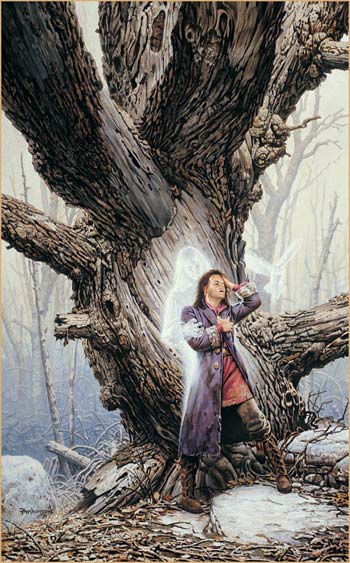
Yesterday’s post, with its image of Gustaf Tenngren’s magically dark forest, put me in mind of another fantasy artist who painted wonderful forests and amazing trees, but with a distinctly diferent style.Keith Parkinson was an outstanding illustrator and fantasy artist whose life and career were sadly cut short in 2005 at the age of 47 by Acute Myelogenous Leukemia (AML).
He started his career creating posters and then moved into creating artwork for early arcade games. He then went to work for TSR and from that point on created a range of memorable covers, for TSR’s books magazines and game packaging, later for book publishers like Random House, Bantam Books and Penguin Books, and eventually for several companies in the gaming industry.
Parkinson was a superb painter, with a solid grounding in classical painting techniques, one of the few fantasy or science fictions artists I would put in the same class with Donato Giancola in that respect. Giancola, in fact was a good friend of Parkinson’s and it was Parkinson’s wish that Giancola be the artist to finish his last major project, the cover painting for the role playing game Vanguard: Saga of Heroes, from Sigil Games Online, a company for which Parkinson was art director and co-founder.
Parkinson’s images are wonderfully tactile, with a strong sense of place and atmosphere. You can just about reach out and touch the scales on his marvelous dragons and creatures, feel the rough stone of his castle walls, and in particular, place yourself easily in his landscapes.
As you look through his galleries, tear yourself away from the warriors, monsters, dragons and elementals long enough to notice his trees, rocks, mountains and clouds. His terrific sense of texture, feeling for natural forms and command of atmospheric perspective make me think that, had he wished, he could have been tremendously successful as a straightforward landscape painter.
Of course, if it’s fantasy and adventure that you want, Parkinson’s paintings really deliver.
Keith Parkinson’s web site is being continued and maintained by his family, much to the delight of fantasy art fans everywhere, who appreciate the ability to continue to view his work online.
There have been collections of Parkinson’s work, Knightsbridge: The Art of Keith Parkinson, Spellbound: The Keith Parkinson Sketchbook, and Kingsgate: The Art of Keith Parkinson. He is also featured in group collections like The Art of Dragon Magazine and several of the Dungeons and Dragons annuals.
Categories:
-
Gustaf Tenggren

Swedish illustrator Gustaf Adolf Tenggren had his roots (and judging from his illustrations, wonderfully gnarled and knotted roots they were) deeply into the rich soil of Scandinavian myth, and the fertile influence of other great illustrators, most notably the terrific and underappreciated John Bauer, who Teggren succeeded as the primary illustrator for Bland Tomtar och Troll (Among Elves and Trolls), a famous fairy tale themed children’s annual in Sweden.Tenggren also inherited stylistic elements from other great illustrators who influenced, and were influenced by, Bauer, in particular Kay Neilsen, Edmund Dulac and the amazing Arthur Rackham. Teggren moved to America (though he continued to illustrate Bland Tomtar och Troll from here for six years) and worked illustrating books in a lush, Rackhamish style full of dark, art-nouveau forests, marvelously grotesque trolls, stunning princesses, and wonderfully stylized characters of all kinds.
After a stint at Milton Bradley, the game company, he went to work for The Walt Disney Company and was one of the main concept artists on Disney’s groundbreaking Snow White and the Seven Dwarfs, and contributed significantly to Pinocchio and Bambi.
The amazing Animation Archive has come through again and has posted high-res images from Tenggren’s beautiful Grimms Fairy Tales. Here are part one and part two. They also have a post of his illustrations for Small Fry and the Winged Horse. Click on the images for larger versions. The American Art Archives has also posted some of his commercial illustrations, some of which show Howard Pyle’s influence.
Teggren was an amazing illustrator, but for reasons I haven’t been able to divine, abandoned his beautiful Bauer/Rackham/Neilsen style after leaving Disney and adopted a more prosaic style (to put it politely) for illustrating children’s books. His new style, though dull and lifeless to me in comparison to his former work, was quite successful commercially and he published a series of books with his name in the title, in addition to working on such famous Little Golden Books at The Poky Little Puppy.
He never returned to his previous style after leaving Disney and reportedly destroyed much of his older work (AKKK!). Perhaps he ran into some real trolls at Disney?
Categories:




Charley’s Picks
Bookshop.org
(Bookshop.org affilliate links; sales benefit independent bookshop owners; I get a small percentage to help support my work on Lines and Colors)

John Singer Sargent: Watercolors


Urban Sketching: Understanding Perspective


Charley’s Picks
Amazon
(Amazon.com affiliate links; sales go to a larger yacht for Jeff Bezos; but I get a small percentage to help support my work on Lines and Colors)
John Singer Sargent: Watercolors
Urban Sketching: Understanding Perspective