


Categories
- 3d CGI
- Amusements
- Animation
- Anime & Manga
- Art Materials
- Art Videos
- Blogroll
- Cartoons
- Color
- Comics
- Concept & Visual Dev.
- Creativity
- Digital Art
- Digital Painting
- Displaying Art on the Web
- Drawing
- Eye Candy for Today
- Gallery and Museum Art
- High-res Art Images
- Illustration
- Motion Graphics & Flash
- Museums
- Online Museums
- Outsider Art
- Painting
- Painting a Day
- Paleo Art
- Pastel, Conté & Chalk
- Pen & Ink
- Prints and Printmaking
- Reviews
- Sc-fi and Fantasy
- Sculpture & Dimensional
- Site Comments
- Sketching
- Storyboards
- Tools and Techniques
- Uncategorized
- Vector Art
- Videos & Podcasts
- Vision and Optics
- Watercolor and Gouache
- Webcomics
Archives
- September 2026
- August 2026
- July 2026
- June 2026
- May 2026
- April 2026
- March 2026
- February 2026
- January 2026
- December 2025
- November 2025
- October 2025
- September 2025
- August 2025
- July 2025
- June 2025
- May 2025
- January 2025
- December 2024
- November 2024
- October 2024
- September 2024
- August 2024
- June 2024
- April 2024
- March 2024
- February 2024
- January 2024
- December 2023
- November 2023
- October 2023
- September 2023
- August 2023
- July 2023
- May 2023
- April 2023
- March 2023
- February 2023
- January 2023
- December 2022
- November 2022
- September 2022
- August 2022
- July 2022
- June 2022
- May 2022
- April 2022
- March 2022
- February 2022
- January 2022
- December 2021
- November 2021
- October 2021
- September 2021
- August 2021
- July 2021
- June 2021
- May 2021
- April 2021
- March 2021
- February 2021
- January 2021
- December 2020
- November 2020
- October 2020
- September 2020
- August 2020
- July 2020
- June 2020
- May 2020
- April 2020
- March 2020
- February 2020
- January 2020
- December 2019
- November 2019
- October 2019
- September 2019
- August 2019
- July 2019
- June 2019
- May 2019
- April 2019
- March 2019
- February 2019
- January 2019
- December 2018
- November 2018
- October 2018
- September 2018
- August 2018
- July 2018
- June 2018
- May 2018
- April 2018
- March 2018
- February 2018
- January 2018
- December 2017
- November 2017
- October 2017
- September 2017
- August 2017
- July 2017
- June 2017
- May 2017
- April 2017
- March 2017
- February 2017
- January 2017
- December 2016
- November 2016
- October 2016
- September 2016
- August 2016
- July 2016
- June 2016
- May 2016
- April 2016
- March 2016
- February 2016
- January 2016
- December 2015
- November 2015
- October 2015
- September 2015
- August 2015
- July 2015
- June 2015
- May 2015
- April 2015
- March 2015
- February 2015
- January 2015
- December 2014
- November 2014
- October 2014
- September 2014
- August 2014
- July 2014
- June 2014
- May 2014
- April 2014
- March 2014
- February 2014
- January 2014
- December 2013
- November 2013
- October 2013
- September 2013
- August 2013
- July 2013
- June 2013
- May 2013
- April 2013
- March 2013
- February 2013
- January 2013
- December 2012
- November 2012
- October 2012
- September 2012
- August 2012
- July 2012
- June 2012
- May 2012
- April 2012
- March 2012
- February 2012
- January 2012
- December 2011
- November 2011
- October 2011
- September 2011
- August 2011
- July 2011
- June 2011
- May 2011
- April 2011
- March 2011
- February 2011
- January 2011
- December 2010
- November 2010
- October 2010
- September 2010
- August 2010
- July 2010
- June 2010
- May 2010
- April 2010
- March 2010
- February 2010
- January 2010
- December 2009
- November 2009
- October 2009
- September 2009
- August 2009
- July 2009
- June 2009
- May 2009
- April 2009
- March 2009
- February 2009
- January 2009
- December 2008
- November 2008
- October 2008
- September 2008
- August 2008
- July 2008
- June 2008
- May 2008
- April 2008
- March 2008
- February 2008
- January 2008
- December 2007
- November 2007
- October 2007
- September 2007
- August 2007
- July 2007
- June 2007
- May 2007
- April 2007
- March 2007
- February 2007
- January 2007
- December 2006
- November 2006
- October 2006
- September 2006
- August 2006
- July 2006
- June 2006
- May 2006
- April 2006
- March 2006
- February 2006
- January 2006
- December 2005
- November 2005
- October 2005
- September 2005
- August 2005
Relevant Blogs
Art, Painting & Sketch
- Gurney Journey
- Underpaintings
- Art and Influence
- Painting Perceptions
- Oil Painters of America
- Vasari Paint POV
- Flying Fox
- Urban Sketchers
- Bento (Smithsonian)
- Art Inconnu
- The Hidden Place
- Still Life
- Making a Mark
- The Art of the Landscape
- Exploring Color & Creativity
- Art Contrarian
- Artist A Day
- beinArt Surreal Art Collective
- Eye Level
- David Dunlop
- p.i.g.m.e.n.t.i.u.m
- CultureGrrl
- Joaquín Sorolla blog
- Artists in Pastel
“Painting a Day”
- A Painting a Day (Keiser)
- On Painting (Keiser)
- Julian Merrow-Smith
- Karen Jurick
- Jeffrey Hayes
- Carol Marine
- Abbey Ryan
- Daily Paintworks
Other Painting Blogs
- Virtual Gouache Land
- Neil Hollingsworth
- Marc Hanson
- Kevin Menck
- Marc Dalessio
- Larry Seiler
- Stapleton Kearns
- Colin Page
- Roos Schuring
- Hans Versfelt
- Titus Meeuws
- Régis Pettinari
- René Plein Air
- Belinda Del Pesco
- Robin Weiss
- Nathan Fowkes (Land Sketch)
- William Wray
- Frank Serrano
- Stephen Magsig
- Michael Chesley Johnson
- Twice a Week
- Sarah Wimperis
- Rob Adams
- Michael Cole Manley
- The Dirty Palette Club
- Mike Manley’s Draw!
Gallery Art & Illustration mix
Illustration
- Howard Pyle
- 100 Years of Illustration
- BibliOdyssey
- Illustration Art
- Today’s Inspiration
- Illustration Mundo
- Little Chimp Society
- Danny Gregory
- R D (John Martz
- Illustration Friday blog
- Monster Brains
- Illustrators & Illustrations (RU)
- Elwood H. Smith
- DaniDraws.com
- Designers Who Blog
- iSpot Blog
Sci-Fi & Fantasy
Illustration & Comics
Comics & Cartoons
- Comics Beat
- Robot 6
- Newsarama Blog
- Comic Vine
- Comics Alliance
- Forbidden Planet Int.
- Paolo Rivera
- Bolt City
- Flight
- Scott McCloud
- The Comics Journal
- Comixpedia
- Funnybook Babylon
- James Baker
- Middleton’s Sketchbook
- Boneville
- The Hotel Fred
- Paul Rivoche
- Daily Cartoonist
- Mad About Cartoons (William Wray)
- Digital Strips
Illustration & Concept
Animation & Concept
- Cartoon Brew
- Animation Blog
- Cold Hard Flash
- Concept Art World
- The CAB
- FY Concept Art
- Concept Ships
- Concept Robots
- John Nevarez
- Armand Serrano
- Marcos Mateu-Mestre
- all kinds of stuff (Kricfalusi)
- Yacin the faun (Man Arenas)
- Kelsey Mann
- Cre8tivemarks Blog
- Ice-Cream Monster Toon Cafe
- AAU Character & Creature Design
- AAU Animation Notes
- Articles and Texticles
Paleo & Scientific
Tools & Techniques
Other
Lists of Art Blogs
Art Image Resource Links
Historic Art Images
- Wikimedia Commons: Paintings
- Wikimedia Commons: Drawings
- The Athenaeum
- WikiArt (WikiPaintings)
- Google Art Project: Artists
- Google Art Project: Collections (Museums)
- ArtCyclopedia
- Web Gallery of Art
- Art Renewal Center
- Web Gallery of Impressionism
Auction Consolidation sites
Auction sites
- Sotheby’s
- Bonham’s
- Christies
- Heritage Auctions: Fine Art
- Heritage Auctions: Illustration
- Freeman’s Auctions
- Bukowskis
- Shannon’s
Image Search
Reverse Image Search (search by image)
- Tin Eye
- RevImg
- Google Image Search (camera icon)
- Bing Image Search (camera icon)
Promoting some friends and some clients of my website design business
- Twin Willows T’ai Chi studio in Wilmington DE. Taiji classes with Bryan Davis.
- Ray Hayward, Inspired Teacher of T’ai Chi ( Taiji ) in Minneapolis, Founder of Mindful Motion Tai Chi Academy
- OldHead Tattoo studio and Art Gallery in Wilmington DE. Tattoos and paintings by Bruce Gulick
- Sharon Domenico Art, pet portrait oil paintings
- Platinum Paperhanging, wallpaper hanging, Main Line and Philadelphia, PA
- Lisa Stone Design, interior designer, Main Line and Philadelphia, PA
- Studio12KPT, original art, prints, calendars and other custom printed items by Van Sickle & Rolleri
-
Urban Sketchers

I just discovered the Urban Sketchers blog a couple of weeks ago, and it immediately became one of my favorites.I enjoy location sketches done in an urban environment, particularly travel sketches, and the blog has much of that feeling, even though the contributors are often sketching in their home city.
I came across Urban Sketchers by way of Katherine Tyrrell, who is one of the correspondents, and contributes from London (see my post on Katherine Tyrrell).
In addition to Tyrell, contributing artists that I have featured previously on Lines and Colors include Lok Jansen and Laura Frankstone.
Other contributors are from various cities in France, Spain, Italy, Denmark, Norway, Germany, Russia and other locations in Europe; a number of cities in the US, including New York, San Francisco, and Seattle, as well as cities in Canada and other parts of the globe, like Tokyo, Bangkok, Tal-Aviv and Sao Paulo. You can see the contributors listed by location in the side bar.
There is also a Meet the Correspondents page, on which some of the contributors give short profiles of themselves, their subject cities and their sketching practices.
There is a variety of approaches in medium, drawing style and subject matter, though some common themes, like the frequent use of the ubiquitous and oh-so-convenient Moleskine sketchbooks, and a consistently high level of quality.
The blog is an extension of the Urban Sketchers Flickr group started in 2007 by Seattle illustrator/journalist Gabi Campanario.
The subtitle of the blog is “See the world one drawing at a time”, and though the blog has only been up since October, with an “official” launch on November 1st, there is already a world of images posted from the multiple contributors.
Next to traveling and sketching yourself, what better way to see the world than through the eyes and pens of artists?
(Images above, left to right, top to bottom: Alessandro Andreuccetti, Rob Carey, Gabi Campanario, Lok Janssen, Laura Genz, Matthew Cenich)
Categories:
-
Petar Meseldžija
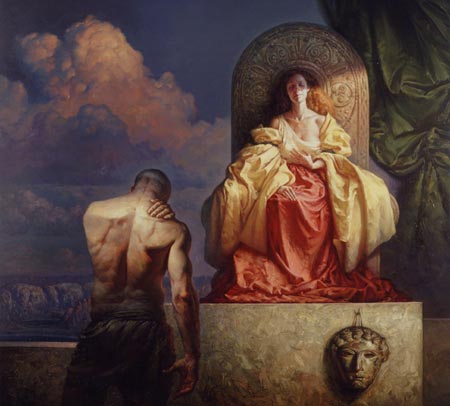
Petar Meseldžija is a Serbian artist who started in comics, publishing a comic called Krampi in the comic magazine Stripoteka and working on a short licensed Tarzan series.He then went on to study painting at the Art Academy in Novi Sad and began to take on illustration work, eventually abandoning comics for illustration and gallery painting.
Meseldžija works in a fantasy vein; his atmospheric and highly textured visions of other worlds have tactile presence and lively energy.
He frequently seems to control space with areas of the canvas, both objects and negative space, blocked out by dominant areas of color, within which there are more subtle variations.
His online galleries showcase both his illustration and gallery art.
His gallery paintings also often take on a fantasy motif, with touches of beautifully handled classical drapery and dramatic lighting. You will also find more traditional portraits and still life subjects as well as some nicely immediate and painterly landscapes.
Categories:
-
Tilt-Shift Photography

We have a tendency to think of photography as “realistic” because it often seems to reproduce what we see with reasonable accuracy, but photography and human perception often diverge significantly.You may have noticed when looking at photographs of small objects, models, dioramas or model train layouts, that there is a limited range of the scene that is in focus. This is due to the limited focal length of camera lenses when focused at short distances.
A fascinating practice that has become popular in the last couple of years is “tilt-shift photography”, the use of techniques involving tilting the lens relative to the plane of the scene, often from a high vantage point, mimicking the way small objects are often photographed from above, and using a large aperture (lens opening), creating a shallow depth of field, to produce photographs of real scenes and objects that look like miniatures.
There is a good selection of this kind of photography in a recent article on Smashing Magazine that serves as a nice introduction to the phenomenon if you haven’t encountered it before; and a resource for further investigation if you have. The article also includes some tilt-shift videos and some links to related resources.
It’s uncanny how strong the effect can be. Even when you know the scenes or objects are real, it’s difficult to shift out of the perception that you’re looking at objects in miniature.
Something to think about the next time you’re tempted to refer to a realist painting as “photographic”.
[Images above: Tiltshiftphotography.net and Tilt-Shift Photography: It’s A Small World After All]
Categories:
-
Phillip K. Dick Book Cover Art Gallery

Though I’ve come across it before, the Phillip K. Dick Book Cover Art Gallery is one of the unusual galleries featured in the Museum of Online Museums I mentioned in yesterday’s post.Phillip K. Dick was a science fiction writer active in the mid Twentieth Century, noted for his eccentric and um… original viewpoint. Though perhaps not the best writer in the sense of well-structured prose, his unique ideas and flights of bizarre imaginings set him apart and made him a favorite of many (myself included).
There have been attempts to translate a number of his books into films, most of them about as successful as returns from the hilarious game he suggested back in 1969 in his novel Galactic Pot-Healer, of translating famous phrases from one language to another and back, say from English to Japanese to English, and letting others try to guess the phrase from its mangled translation.
(The actual ability to do this eventually became practical with the advent of online translation services like Babel Fish and Google Translate, and we used to have fun with it a few years ago, but it’s actually become more difficult lately as the translation programs have gotten much better.)
Blade Runner, adapted from Dick’s Do Androids Dream of Electric Sheep?, is the best of the movies made from his novels, but is more Ridley Scott’s vision than Phillp Dick’s. I’ve long thought that the best cinematic adaptation of the ideas of Phillip K. Dick (and William Gibson), though not a direct adaptation of a work by either author, was the original Matrix movie (you know, the good one).
As more movie adaptations have been made and interest in Dick has been revived, a number of his books have been reissued (again), and there is now a long list of various versions, editions and translations from the last half century or more.
A large number of these (though certainly not all, yet) have been gathered in a cover gallery on the phillipkdick.com site. Though the list of links is text rather than thumbnails, it’s easy to look through them if you’re using a modern tabbed browser, by Command-clicking (Mac) or Control-clicking (Windows) to open multiple links in additional tabs.
Some of the cover illustrations (particularly on one recent series of reissues) are very good, others are varying degrees of good, mediocre, terrible, worse than bad and just plain bizarre.
It’s fun to look through multiple versions of the same title, both to see the different approaches to science fiction illustration over a 50 year or so span, and also to see the variety in interpretations of the same story by different artists.
Many have nothing whatsoever to do with the story, but look great anyway, like the cover at top, left for The Three Stigmata of Palmer Eldritch (one of my favorite Dick novels, a psychedelic black hole of recursive paranoia that leaves you wondering “How did anybody even think of this?). (Side note to fans of David Cronenberg’s films, look for the nod to the influence of Three Stigmata in the form of fast food from Perky Pat’s in one scene of eXistenZ.)
Unfortunately, the Phillip K. Dick Book Cover Art Gallery does not include artist credits for the covers (and I’m not confident enough in my guesses to give credits for the covers I’ve shown here).
I won’t go into Dick’s personal life, which is in some ways even stranger than his novels, but there is a wonderfully bizarre graphic story (i.e. comics) account of The Religious Experience of Philip K. Dick by Robert Crumb from Weirdo, readable online.
If you’re new to Phillip K. Dick and curious to read something of his, I recommend Ubik (currently being adapted for film) or Man in the High Castle as places to start.
There is a compendium of four of his better known novels, Philip K. Dick: Four Novels of the 1960s: UBIK, The Man in the High Castle, The Three Stigmata of Palmer Eldritch, Do Androids Dream of Electric Sheep?.
You can very often find Phillip K. Dick novels, frequently with interesting covers, by digging around in second hand book stores; a wonderful way to come across odd treasures.
Categories:
-
The Museum of Online Museums
 I’ll start out by giving the Major Time Sink Warning.
The Museum of Online Museums is site maintained by Coudal Partners, a design firm based in Chicago.
Basically it’s a list of links to an eclectic collection of online sites, either virtual museums, or online extensions of brick and mortar museums.
It ranges from the National Gallery of Art and the Metropolitan Museum of Art’s Timeline of Art History, to obscure and wonderfully bizarre collections like The Galleries of Thrift Store Art and the Museum of Vintage Octopus Pulp Covers.
Though there are plenty of art related links, the MoOM is not entirely art oriented, and you’ll find such gems as Very Small Objects, The Museum of Useful Things, The Virtual Typewriter Museum and the Squished Penny Museum.
The majority of the selections are art or design oriented, however; bearing in mind that’s a broad definition that includes things like The Museum of Bad Album Covers, The Museum of Forgotten Art Supplies, The Magazine Cover Archive, A Few Thousand Science Fiction Magazines, The Comic Book Cover Browser (which I’ve mentioned before), and the Museum of Imagined Contemporary Art.
There are also big items like the National Portrait Gallery (my post here), the Rijkemuseum, The Van Gogh Gallery, Art Treasures from Kyoto and the Russian Museums List.
There is a small, blog-like column on the left called “Now Showing”, in which half a dozen items are featured and described in more detail.
The MoOM is updated quarterly and you can sign up for a mailing list notification.
Remember, I did give you the Major Time Sink Warning.
Categories:
-
A Vermeer in Rome

In a situation similar to the one I described in my recent article on A Vermeer Comes to California, Jonathan Janson, the director of the amazing Essential Vermeer web resource, let us know in a comment on that post that there is currently a Vermeer on view in Rome.Normally the southernmost location to see a Vermeer in Europe is in Vienna (see the Essential Vermeer map of Vermeer locations in Europe).
From now until February 15, 2009, Vermeer’s Woman With a Pearl Necklace (larger version here), a painting that also bears fascinating similarities with the previously mentioned A Lady Writing, will be on loan from the Staatliche Museen Preußischer Kulturbesitz, Gemäldegalerie in Berllin and on view at the Museo del Corso, along with masterpieces by Rembrandt and other Dutch greats.
Jonathan Janson has articles on the show here and here on his new Vermeer oriented blog Flying Fox. He also has a list of other Vermeers that are traveling this year.
Hi resolution images from the show are available for download here.
It’s remarkable how similar this painting is to A Lady Writing in terms of the composition, the use of the same fur lined jacket, string of pearls and, of course, those famous pearl earrings; and yet how different it is in emotional tone, the far away gaze of the woman, turned away from us here, directly into that airy flood of light, and the seemingly blank wall that frames her.
The wall, where Vermeer so often displays works of art within his own paintings, here serves to display the light itself — flowing in through the delicate latticework of the window like a shimmering ghost, past the hinted sliver of a framed painting and the golden drapery, across the broad tableau of that seemingly empty space, where it reveals the rainbow spectrum within its overall hue, to find and embrace the figure of the woman, warm her robe, sparkle off her pearls like miniature suns and caress and reveal her face and hands with the soft highlights and delicate shadow that Vermeer coaxes out of his brush with uncanny skill.
Categories:



Charley’s Picks
Bookshop.org
(Bookshop.org affilliate links; sales benefit independent bookshop owners; I get a small percentage to help support my work on Lines and Colors)
Carlson’s Guide to Landscape Painting
Drawing and Sketching in Pencil

Bridgman’s Complete Guide to Drawing from Life

Charley’s Picks
Amazon
(Amazon.com affiliate links; sales go to a larger yacht for Jeff Bezos; but I get a small percentage to help support my work on Lines and Colors)
Carlson’s Guide to Landscape Painting
Drawing and Sketching in Pencil
Bridgman’s Complete Guide to Drawing from Life